

Class 9 Maths Chapter 1 Orienting Yourself: The Use of Coordinates Notes with PDF Download
Class 9 Maths Chapter 1 Orienting Yourself: The Use of Coordinates Notes Free PDF Download is prepared based on the latest CBSE and NCERT syllabus. These notes will help in school exams, board exams, and quick revision. They help students understand the chapter clearly, revise faster, and prepare for exams with confidence.
Table of Contents
- What Are Coordinates?
- Key Terms to Remember
- Important Concepts from the Chapter
- Coordinate Plane Revision Notes
- How Coordinates Help in Finding Locations
- Important Rules to Remember
- Coordinate Representation Examples
- Formula and Concept Summary
- Frequently Asked Questions on Class 9 Maths Chapter 1 Orienting Yourself: The Use of Coordinates

What Are Coordinates?
Coordinates are a pair of numbers used to describe the exact position of a point on a flat surface. Instead of saying "the point is somewhere to the right and a bit above the centre," coordinates let you say precisely: the point is at position (3, 5). The first number tells you how far to move horizontally, and the second number tells you how far to move vertically.
Importance of Coordinates in Daily Life
You already use coordinates without realising it. When you look up a location on Google Maps, the app uses latitude and longitude a coordinate system. A chess board uses letters and numbers to name each square (like E4). A cinema ticket says Row C, Seat 7. All of these are real life examples of the coordinate system in action. Chapter 1 takes this everyday idea and formalises it in mathematics.
Know more about related topics:
Key Terms to Remember
Coordinate System
A coordinate system is a method of assigning a unique pair of numbers to every point on a plane. The most common one used in Class 9 is the Cartesian coordinate system, where two straight lines one horizontal and one vertical cross at a central point, and all positions are measured from that crossing.
Ordered Pair
An ordered pair is a set of two numbers written inside brackets with a comma between them, like (x, y). The word "ordered" is important the pair (3, 5) is completely different from (5, 3). The order always follows the rule: x-coordinate first, y-coordinate second.
Origin
The origin is the fixed starting point of the coordinate system. It is the point where the horizontal and vertical axes cross each other. The coordinates of the origin are always (0, 0). Every other point on the plane is measured relative to this central point.
X-Axis
The x-axis is the horizontal line that runs left and right through the origin. Positive values of x are to the right of the origin, and negative values are to the left. When you read a coordinate (x, y), the x-coordinate tells you how far along the x-axis the point sits.
Y-Axis
The y-axis is the vertical line that runs up and down through the origin. Positive values of y are above the origin, and negative values are below. The y-coordinate in the pair (x, y) tells you how far up or down from the origin the point is located.
Important Concepts from the Chapter
Locating a Point Using Coordinates
To locate any point using its coordinates, always follow two steps in order. First, start at the origin (0, 0). Second, move horizontally by the x-coordinate (right for positive, left for negative). Then move vertically by the y-coordinate (up for positive, down for negative). The spot where you land is your point.
For example, to locate (4, 3): start at the origin, move 4 units to the right, then 3 units up. That is your point.
Reading Coordinates on a Grid
When you are given a grid with a point already marked, read the coordinates by reversing the process. Drop a vertical line from the point down to the x-axis the value where it touches is the x-coordinate. Drop a horizontal line from the point across to the y-axis the value where it touches is the y-coordinate. Write the pair as (x, y).
Understanding Ordered Pairs
The most important rule about ordered pairs is that the order cannot be swapped. (3, 5) and (5, 3) are two different points in completely different locations on the plane. The x-coordinate always comes first, and the y-coordinate always comes second. This rule applies every single time no exceptions.
Coordinate Plane Revision Notes
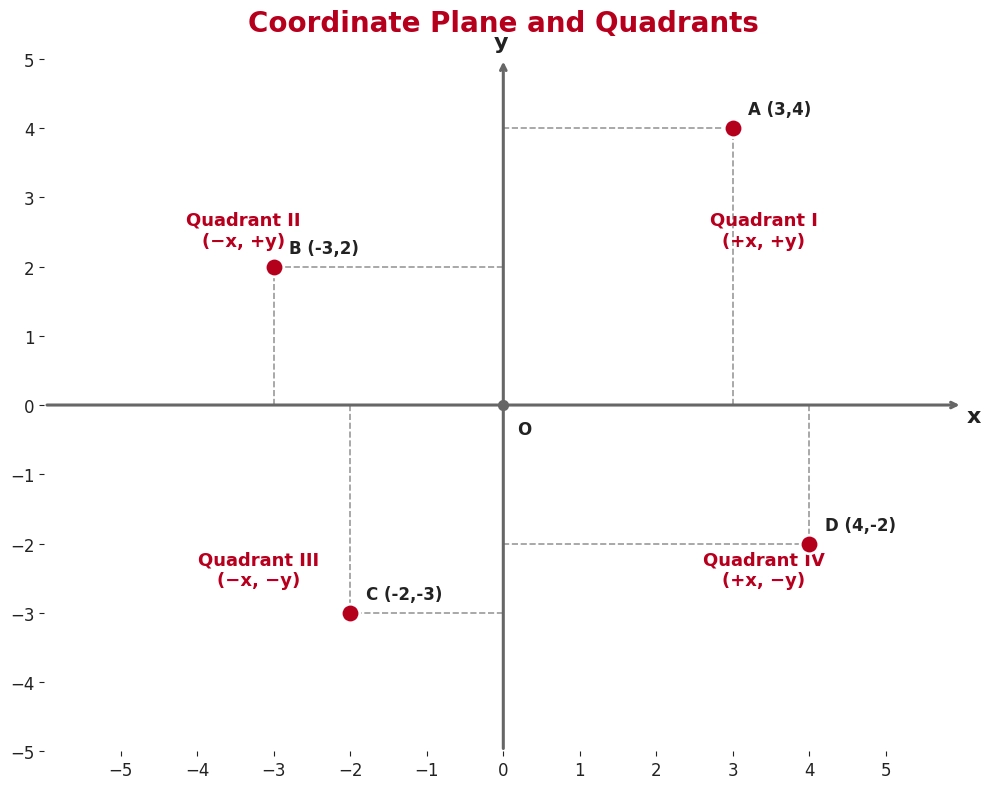
The diagram below shows the complete coordinate plane with both axes, the origin, all four quadrants, and example points labelled with their coordinates.
Horizontal and Vertical Axes
The coordinate plane is formed by two number lines that cross at right angles. The horizontal one is the x-axis. The vertical one is the y-axis. They divide the entire plane into four regions called quadrants. In Quadrant I, both x and y are positive. In Quadrant II, x is negative and y is positive. In Quadrant III, both are negative. In Quadrant IV, x is positive and y is negative.
Position of Points on the Plane
Every point on the plane has exactly one ordered pair. The dashed lines in the diagram above show how to read a point: drop a line to the x-axis to read the x-coordinate, and draw a line across to the y-axis to read the y-coordinate. Notice how point A (3, 4) sits in Quadrant I, point B (−3, 2) sits in Quadrant II, point C (−2, −3) sits in Quadrant III, and point D (4, −2) sits in Quadrant IV.
How Coordinates Help in Finding Locations
Maps and Navigation
A city map uses a grid where columns are labelled with letters (A, B, C…) and rows with numbers (1, 2, 3…). To find a hospital on the map, the index might say it is at D-5. You go to column D and row 5, and the hospital is in that square. This is exactly how the coordinate system works the column letter acts like the x-coordinate and the row number acts like the y-coordinate.
GPS systems work on the same principle but use latitude (horizontal measurement) and longitude (vertical measurement) a global coordinate system for the entire Earth.
Real-Life Applications of Coordinates
Coordinates appear in many everyday situations. In a cinema or theatre, your seat is described by the row and the seat number an ordered pair. In a spreadsheet like Excel, each cell has a column letter and a row number (like B7) that is a coordinate. In a video game, every character's position on screen is tracked as (x, y) coordinates that update in real time. Engineers use coordinates to draw precise maps of buildings. Pilots and sailors use coordinate grids to navigate safely. The ability to locate any position using just two numbers is one of the most powerful tools in all of mathematics.
Important Rules to Remember
Writing Coordinates Correctly
Always write coordinates inside regular brackets (parentheses) with a comma between the two numbers: (x, y). Do not use square brackets. Do not reverse the numbers. Do not leave out the brackets. The format is strict and consistent: x first, y second, always.
Identifying the X-Coordinate
The x-coordinate is the first number in the pair. It tells you the horizontal distance from the origin. If the point is to the right of the origin, x is positive. If the point is to the left, x is negative. If the point lies exactly on the y-axis, x = 0.
Identifying the Y-Coordinate
The y-coordinate is the second number in the pair. It tells you the vertical distance from the origin. If the point is above the origin, y is positive. If the point is below, y is negative. If the point lies exactly on the x-axis, y = 0.
Coordinate Representation Examples
Example 1: Reading a Point
A point P is plotted on a grid. A vertical line from P meets the x-axis at 4. A horizontal line from P meets the y-axis at 3. What are the coordinates of P?
Answer: The coordinates of P are (4, 3). The x-coordinate is 4 (horizontal distance), and the y-coordinate is 3 (vertical distance).
Example 2: Plotting a Point
Plot the point Q (−2, 5) on the coordinate plane.
Steps: Start at the origin (0, 0). Move 2 units to the left (because x = −2). Then move 5 units upward (because y = +5). Mark the point and label it Q (−2, 5). It will sit in Quadrant II.
Example 3: Finding a Location
A school is located at position (3, −4) on a coordinate map of a town. In which quadrant does the school sit, and what does the position tell you?
Answer: x = 3 (positive) and y = −4 (negative), so the school is in Quadrant IV. On the map, it is 3 units to the right of the centre and 4 units below the centre.
Formula and Concept Summary
Ordered Pair Format
Every point on a coordinate plane is written as (x, y) where x = horizontal distance from origin and y = vertical distance from origin.
Key rules in one place:
-
Origin = (0, 0)
-
Any point on the x-axis: y = 0, so it looks like (x, 0)
-
Any point on the y-axis: x = 0, so it looks like (0, y)
-
Quadrant I: (+, +)
-
Quadrant II: (−, +)
-
Quadrant III: (−, −)
-
Quadrant IV: (+, −)
Coordinate Plane Quick Revision
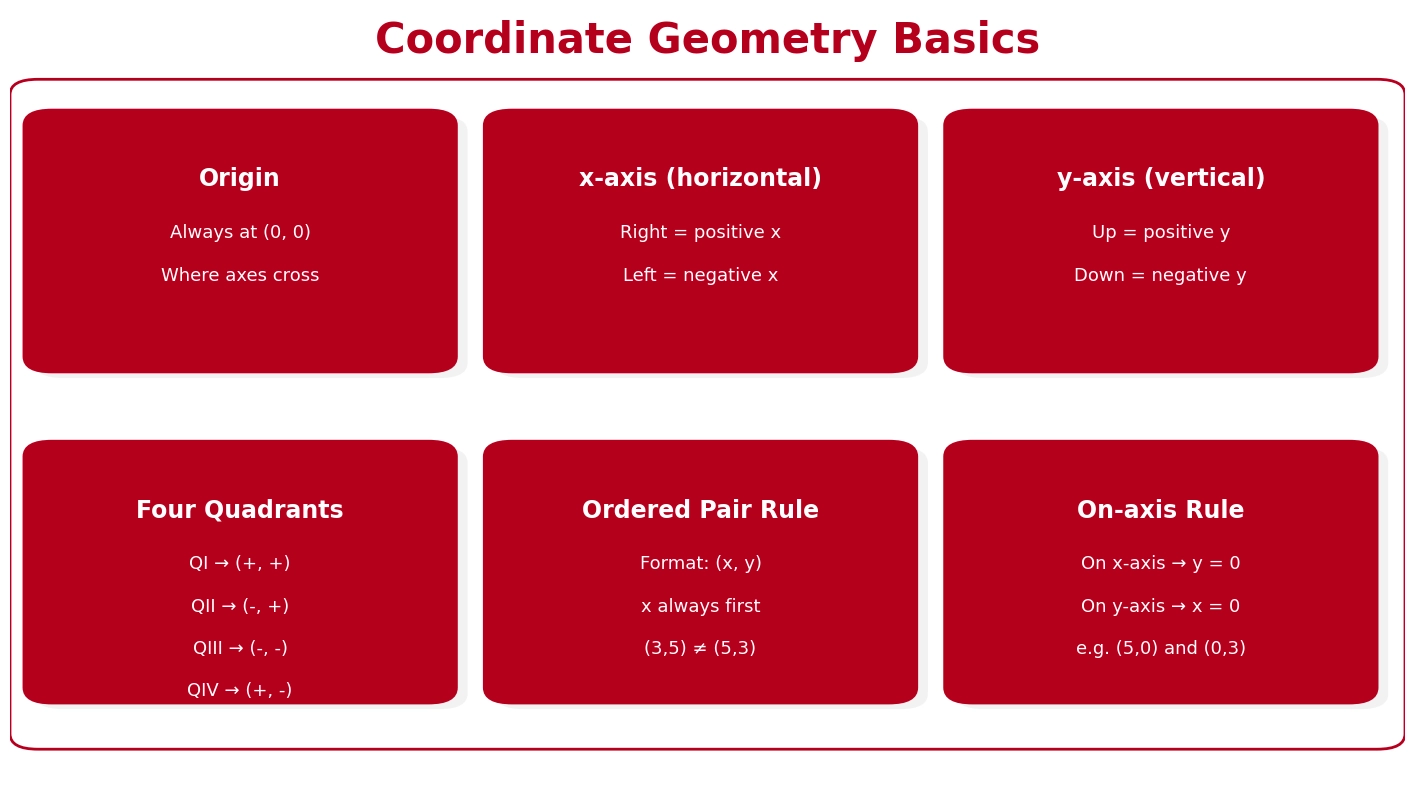
Orienting Yourself: The Use of Coordinates Notes PDF
Download PDF - Class 9 Maths Chapter 1 Orienting Yourself: The Use of Coordinates Notes
Frequently Asked Questions on Class 9 Maths Chapter 1 Orienting Yourself: The Use of Coordinates
1. What is the coordinate system in Class 9 Maths?
A coordinate system is a method of locating points on a plane using two perpendicular number lines called the x-axis and y-axis.
2. What are coordinates?
Coordinates are ordered pairs of numbers used to represent the position of a point on a coordinate plane.
3. What is the Cartesian plane?
The Cartesian plane is a two-dimensional plane formed by the intersection of the x-axis and y-axis.
4. What are the x-axis and y-axis?
The x-axis is the horizontal number line, while the y-axis is the vertical number line used in the coordinate system.
5. What is the origin in coordinate geometry?
The origin is the point where the x-axis and y-axis intersect. Its coordinates are: (0,0).
6. What are quadrants in a coordinate plane?
The x-axis and y-axis divide the coordinate plane into four regions called quadrants.
7. How are quadrants numbered?
Quadrants are numbered in an anticlockwise direction starting from the upper-right region:
- First Quadrant (I)
- Second Quadrant (II)
- Third Quadrant (III)
- Fourth Quadrant (IV)
8. Why is coordinate geometry important?
Coordinate geometry helps represent geometric figures, locate positions, and solve problems involving graphs and distances.
9. What are the common mistakes students make in coordinate geometry?
Common mistakes include:
- Reversing x and y coordinates
- Identifying the wrong quadrant
- Plotting points inaccurately
Numbers make sense when they're taught right. To see how Orchids The International School turns Maths from intimidating to intuitive, reach out to our admissions team.


Admissions Open for 2026-27
What type of concept pages would you prefer?
CBSE Schools In Popular Cities
- CBSE Schools in Bangalore
- CBSE Schools in Mumbai
- CBSE Schools in Pune
- CBSE Schools in Hyderabad
- CBSE Schools in Chennai
- CBSE Schools in Gurgaon
- CBSE Schools in Kolkata
- CBSE Schools in Indore
- CBSE Schools in Sonipat
- CBSE Schools in Delhi
- CBSE Schools in Rohtak
- CBSE Schools in Bhopal
- CBSE Schools in Aurangabad
- CBSE Schools in Jabalpur
- CBSE Schools in Jaipur
- CBSE Schools in Jodhpur
- CBSE Schools in Nagpur
- CBSE Schools in Ahmednagar
- CBSE School In Tumkur











Orchids The International School is one of India's leading chains of CBSE and ICSE schools, with 130+ schools across the country.