

Class 9 Maths Chapter 8 ‘Predicting What Comes Next - Exploring Sequences and Progressions’ Notes
Class 9 Maths Chapter 8 What Come Next Exploring Sequences and Progressions Notes Free PDF Download is made according to the latest CBSE and NCERT syllabus. These notes will be helpful in school exams, board exams and quick revisions. They help students to understand the chapter clearly, revise faster, and prepare for exams with confidence.
What Is a Sequence?
A sequence is an ordered list of numbers arranged according to a specific rule. Each number in the list is called a term. The position of every term is fixed the first term, the second term, the third term, and so on. Change the rule and you get an entirely different sequence.
For example: 2, 5, 8, 11, 14… is a sequence where each term is 3 more than the one before it.

Key Terms to Remember
- Sequence: An ordered list of numbers following a fixed rule. Example: 3, 6, 9, 12…
- Pattern: A regular and predictable arrangement the underlying rule that keeps the sequence consistent.
- Arithmetic Progression (AP): A sequence where the difference between any two consecutive terms is always the same fixed number.
- Common Difference (d): The fixed value added (or subtracted) to get from one term to the next in an arithmetic progression. d = second term − first term.
- Term of a Sequence: Each individual number in the sequence. The nth term is the term at position n. Written as aₙ or Tₙ.
Know more about related topics:
- Class 9 Maths Case Study Chapter 8 Predicting What Comes Next Exploring Sequences And Progressions
- Important Questions Class 9 Maths Predicting What Comes Next Exploring Sequences And Progressions
- Assertion Reason Questions For Class 9 Maths Chapter 8 Predicting What Comes Next Exploring Sequences And Progressions
- Arithmetic Progression
- Sequence And Series
Understanding Sequences
Number Sequences
A number sequence is simply a list of numbers in a specific order. Each number follows the previous one according to a clear rule. The rule might be "add 4 each time," "multiply by 2 each time," or "subtract 3 each time."
Examples:
-
1, 4, 7, 10, 13… (add 3 each time)
-
2, 4, 8, 16, 32… (multiply by 2 each time)
-
50, 45, 40, 35, 30… (subtract 5 each time)
Visual and Shape Based Sequences
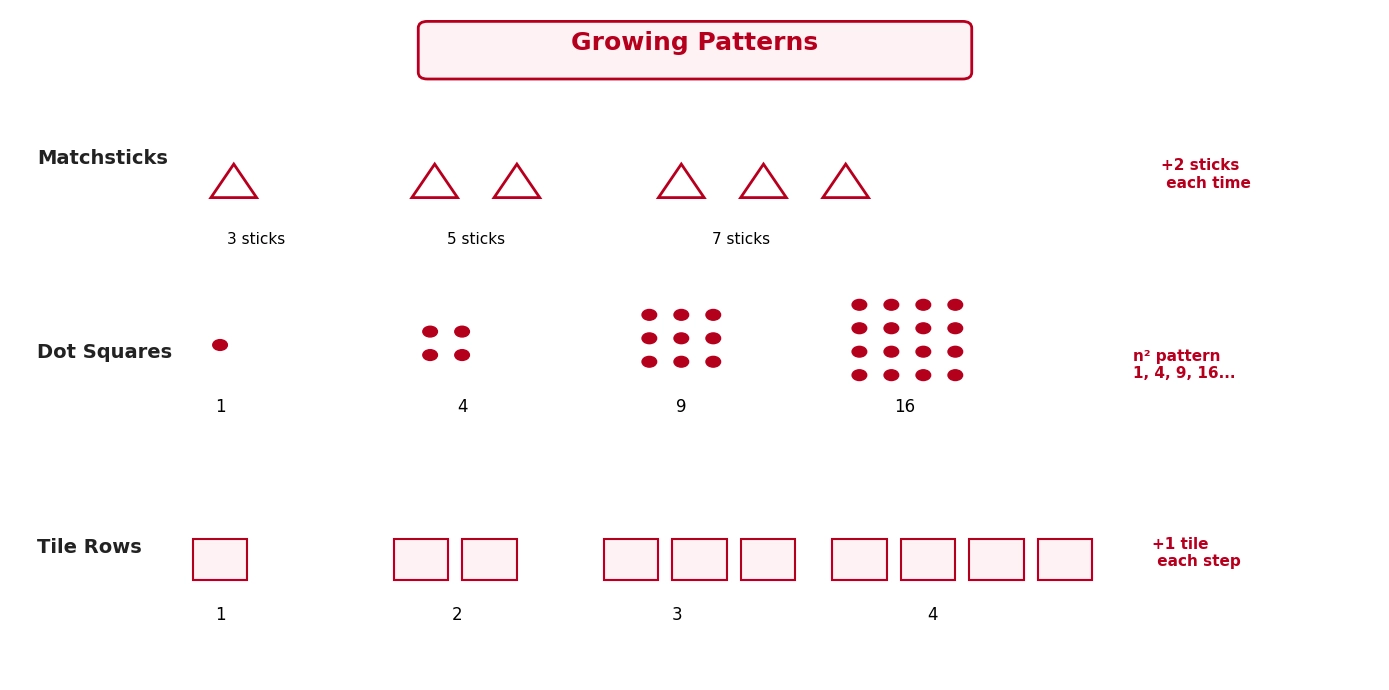
Not all sequences are made of numbers alone. Some sequences are made of shapes or dots arranged in growing patterns. For example, a sequence of triangles made from matchsticks where each new triangle adds two more sticks is a visual sequence. The number of sticks forms a number sequence: 3, 5, 7, 9…
Identifying Patterns in a Sequence
To identify the pattern in any sequence, look at the differences between consecutive terms. If the difference is constant, it is an arithmetic progression. If the ratio between terms is constant, it is a geometric sequence. If neither is constant, look for a different relationship such as squares or cubes of natural numbers.
Types of Sequences
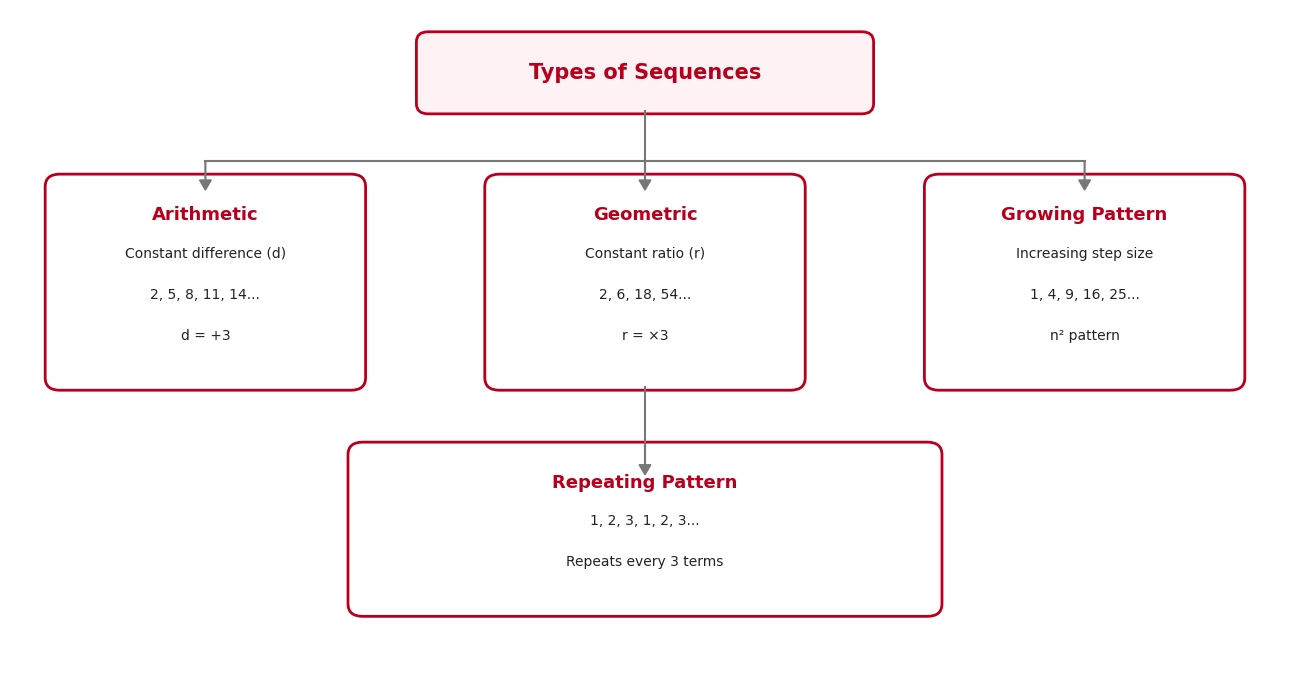
Arithmetic Sequence
An arithmetic sequence has a constant difference between consecutive terms. This difference can be positive (increasing sequence) or negative (decreasing sequence). Example: 10, 7, 4, 1, −2… has a common difference of −3.
Geometric Sequence
A geometric sequence has a constant ratio between consecutive terms. Each term is obtained by multiplying the previous term by a fixed number. Example: 3, 6, 12, 24, 48… has a common ratio of 2. Note: the Class 9 Chapter 8 curriculum focuses primarily on arithmetic progressions.
Growing Patterns
A growing pattern increases with each step but the difference between consecutive terms may not be constant. The sequence 1, 3, 6, 10, 15… (triangular numbers) grows but the differences increase: 2, 3, 4, 5…
Repeating Patterns
A repeating pattern cycles through the same set of values over and over. Example: Red, Blue, Green, Red, Blue, Green… The rule is a repeating block of three.
Arithmetic Progression (AP)
Definition of Arithmetic Progression
An Arithmetic Progression is a sequence of numbers in which the difference between every two successive terms is the same fixed value. This fixed value is called the common difference (d). If the terms of an AP are a₁, a₂, a₃…, then a₂ − a₁ = a₃ − a₂ = d for all terms.
Components of an Arithmetic Progression
An AP has three essential components: the first term (a or a₁), the common difference (d), and the number of terms (n). Once you know these three things, you can find any term in the progression.
Finding the Common Difference
d = any term − the term just before it
For the AP 7, 11, 15, 19, 23: d = 11 − 7 = 4.
Check: 15 − 11 = 4, 19 − 15 = 4
For a decreasing AP like 20, 15, 10, 5: d = 15 − 20 = −5.
Examples of Arithmetic Progressions
Formula for the nth Term of an Arithmetic Progression
Understanding the nth Term Formula
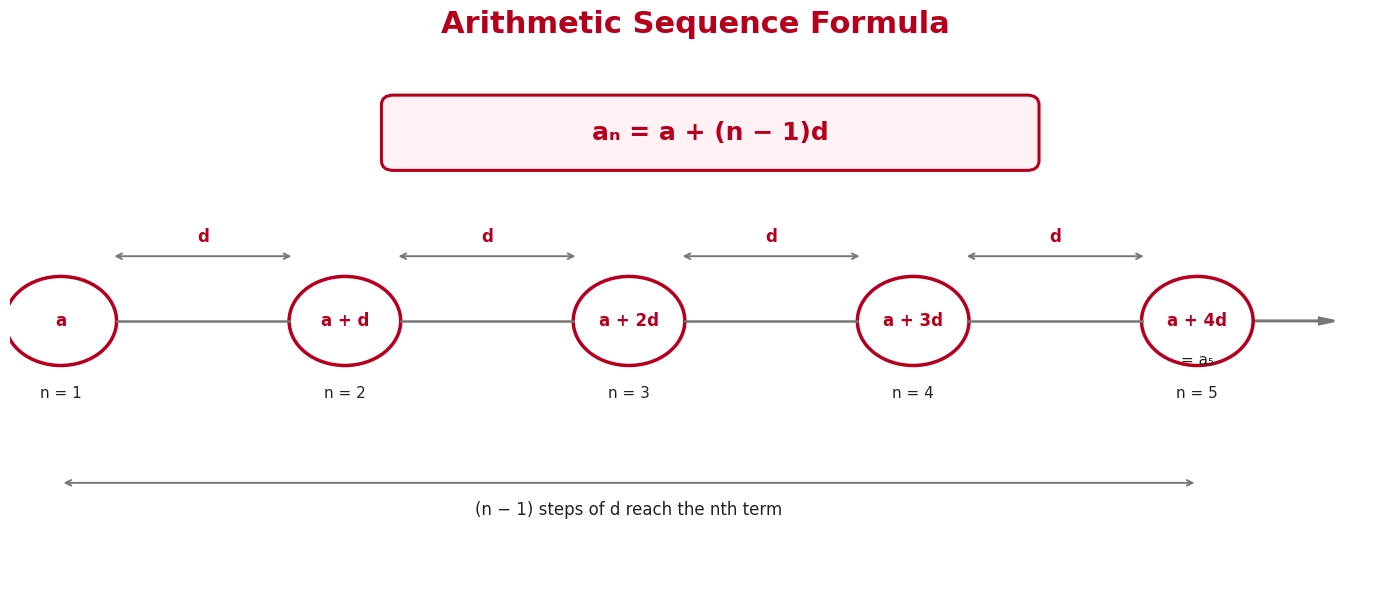
The nth term formula lets you find any term directly without listing all the terms before it. The formula is: aₙ = a + (n − 1)d
Where: a = first term, n = position of the term you want, d = common difference, aₙ = the value of the nth term.
The logic: to reach the nth term, you start at a and take (n − 1) steps of size d.
How to Apply the Formula
Step 1: Identify a (first term) and d (common difference).
Step 2: Identify n (the position of the term you want).
Step 3: Substitute into aₙ = a + (n − 1)d.
Step 4: Simplify.
Solved Example Using the nth Term Formula
Question: Find the 15th term of the AP: 4, 7, 10, 13…
First term a = 4, common difference d = 7 − 4 = 3, n = 15.
a₁₅ = 4 + (15 − 1) × 3 = 4 + 14 × 3 = 4 + 42 = 46
How to Predict the Next Term in a Sequence
Finding a Common Difference
To find the next term in an arithmetic sequence, calculate the common difference d by subtracting any term from the one that follows it. Then add d to the last known term.
Example: 11, 16, 21, 26, ?
d = 16 − 11 = 5
next term = 26 + 5 = 31
Finding a Common Ratio
For a geometric sequence, divide any term by the one before it to find the common ratio r. Multiply the last known term by r to get the next.
Example: 3, 6, 12, 24, ?
r = 6 ÷ 3 = 2
next term = 24 × 2 = 48
Recognising Number Patterns
Not every sequence fits the arithmetic or geometric pattern. Look at the differences between terms, or the differences of the differences. If those second differences are constant, the sequence follows a quadratic rule (like n²). If you see a pattern of squares, cubes, or alternating signs, identify that rule directly.
Visual Patterns and Their Extensions
Matchstick Patterns
In matchstick patterns, shapes are built from sticks and each new shape in the sequence adds a fixed number of sticks. For equilateral triangles arranged in a row, the first triangle uses 3 sticks and each new triangle added shares one side with the previous one, adding 2 sticks. The number of sticks follows the AP: 3, 5, 7, 9… with d = 2.
Dot Patterns
Dot patterns arrange dots in shapes. Square dot patterns grow as 1, 4, 9, 16… (perfect squares). Triangular dot patterns grow as 1, 3, 6, 10… These sequences are not arithmetic progressions but recognising their visual structure helps identify the rule.
Tile Patterns
Tile patterns grow by adding one or more tiles at each step. A single row of tiles growing by one tile at each step gives the natural number sequence 1, 2, 3, 4… itself the simplest arithmetic progression with a = 1 and d = 1.
Predicting Future Shapes in a Pattern
To predict the 10th shape in a matchstick pattern where d = 2 and a = 3: a₁₀ = 3 + (10 − 1) × 2 = 3 + 18 = 21 sticks. The nth term formula works for visual patterns exactly the same way it works for number sequences.
Important Concepts from the Chapter
Extending a Sequence
To extend any sequence, identify the rule (add d, multiply by r, or follow another pattern) and apply it to the last known term to generate the next terms.
Finding Missing Terms
If a term in the middle of a sequence is missing, use the fact that consecutive terms must maintain a constant difference. Example: 5, ?, 17, 23 — the difference should be constant. From 17 to 23 is +6, so from 5 to the missing term is also +6. Missing term = 5 + 6 = 11.
Generalising a Pattern
Generalising means writing the nth term as a formula. For the tile pattern 2, 5, 8, 11…: a = 2, d = 3, so the nth term = 2 + (n − 1) × 3 = 3n − 1. This single expression generates every term.
Writing Rules for Sequences
A rule for a sequence is a mathematical expression that gives the value of any term from its position number. For the sequence 4, 7, 10, 13…, the rule is aₙ = 3n + 1. Plug in n = 1: a₁ = 4 ✓. Plug in n = 5: a₅ = 16 ✓.
Solved Examples for Quick Revision
Example on Arithmetic Sequence
Question: Check whether 5, 11, 17, 23, 29 is an AP. If yes, find the common difference.
Solution: Differences: 11 − 5 = 6
17 − 11 = 6,
23 − 17 = 6,
29 − 23 = 6.
The difference is constant. Yes, it is an AP with d = 6.
Example on Finding the Next Term
Question: Find the next two terms of the AP: 13, 9, 5, 1…
Solution: d = 9 − 13 = −4.
Next term = 1 + (−4) = −3.
Term after that = −3 + (−4) = −7.
The sequence continues: 13, 9, 5, 1, −3, −7…
Example on Finding the nth Term
Question: Find the 20th term of the AP: 3, 8, 13, 18…
Solution: a = 3, d = 8 − 3 = 5, n = 20.
a₂₀ = 3 + (20 − 1) × 5 = 3 + 19 × 5 = 3 + 95 = 98
Formula Sheet for Class 9 Maths Chapter 8
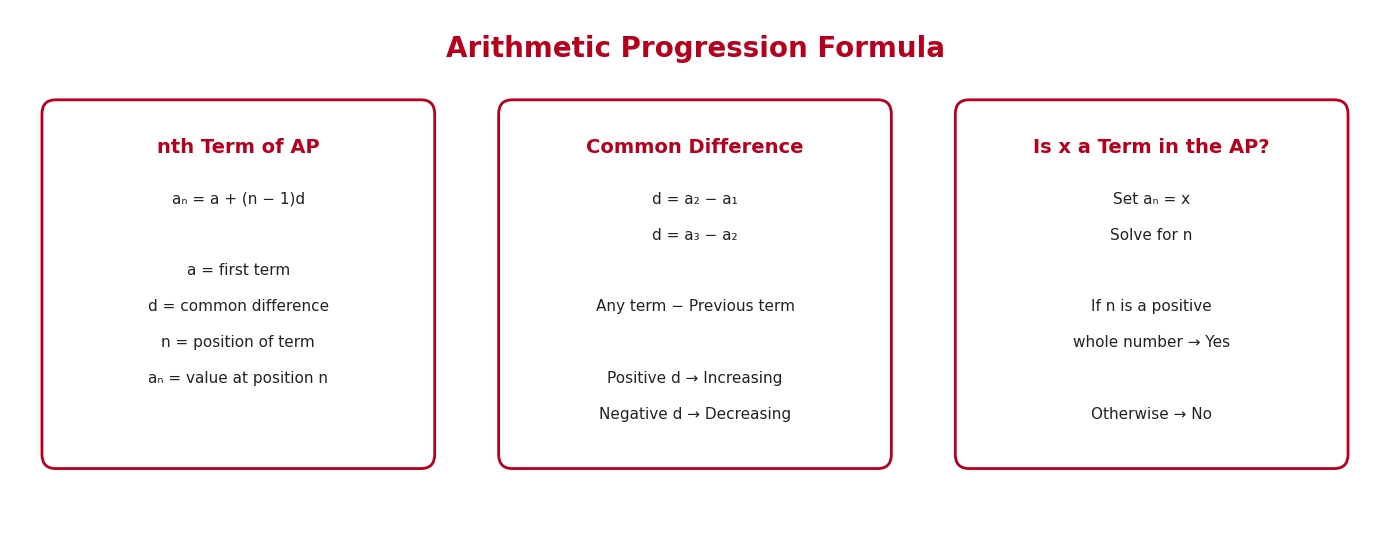
Predicting What Comes Next - Exploring Sequences and Progressions’ Notes PDF
Download PDF - Predicting What Comes Next Exploring Sequences and Progressions Notes
Numbers make sense when they're taught right. To see how Orchids The International School turns Maths from intimidating to intuitive, reach out to our admissions team.
Frequently Asked Questions on Class 9 Maths Chapter 8 Predicting What Comes Next Exploring Sequences and Progressions
1. What is a sequence in mathematics?
A sequence is an ordered list of numbers that follows a specific pattern or rule. Each number in the sequence is called a term.
2. What is an arithmetic progression?
An arithmetic progression (AP) is a sequence in which the difference between consecutive terms is always the same. This fixed difference is called the common difference.
3. How do you find the common difference?
The common difference is found by subtracting a term from the next term.
Formula: Common Difference = Next Term − Previous Term
For example, in the sequence 2, 5, 8, 11, ... the common difference is:
5 − 2 = 3
4. How can we predict the next term in a sequence?
To predict the next term, identify the pattern in the sequence and apply the same rule to the last term.
For example, in 4, 8, 12, 16, ... add 4 to each term, so the next term is 20.
5. Why are sequences and progressions important?
Sequences and progressions help us recognize patterns, solve mathematical problems, and make predictions. They are widely used in mathematics, science, finance, and computer programming.
Related Links


Admissions Open for 2026-27
What type of concept pages would you prefer?
CBSE Schools In Popular Cities
- CBSE Schools in Bangalore
- CBSE Schools in Mumbai
- CBSE Schools in Pune
- CBSE Schools in Hyderabad
- CBSE Schools in Chennai
- CBSE Schools in Gurgaon
- CBSE Schools in Kolkata
- CBSE Schools in Indore
- CBSE Schools in Sonipat
- CBSE Schools in Delhi
- CBSE Schools in Rohtak
- CBSE Schools in Bhopal
- CBSE Schools in Aurangabad
- CBSE Schools in Jabalpur
- CBSE Schools in Jaipur
- CBSE Schools in Jodhpur
- CBSE Schools in Nagpur
- CBSE Schools in Ahmednagar
- CBSE School In Tumkur











Orchids The International School is one of India's leading chains of CBSE and ICSE schools, with 130+ schools across the country.