

Case Study on Class 9 Maths Chapter 8 ‘Predicting What Comes Next - Exploring Sequences and Progressions’
The Case Study Questions for Class 9 Maths Chapter 8 "Predicting What Comes Next - Exploring Sequences and Progressions" include short, real life problem situations that have clear answers and step by step solutions to help students gain confidence for exams. It covers important topics including identifying patterns in sequences, understanding arithmetic progressions (AP) with common difference, exploring geometric progressions (GP) with common ratio, finding the nth term of a sequence, calculating the sum of terms in AP and GP, distinguishing between finite and infinite sequences, applying recursive and explicit rules, recognizing the Virahanka-Fibonacci sequence, and solving word problems involving sequences in daily life situations like savings plans, population growth, and depreciation. These practice questions help the students in better understanding of the concepts, handling sequence problems smoothly and to be faster and accurate for their board exams. A free PDF is included for offline practice.
Introduction to Case Study Questions on Sequences and Progressions
Understanding Sequences
A sequence is an ordered list of numbers in which each term follows a rule. The terms are written as a₁, a₂, a₃… where the subscript shows the position. To understand a sequence, always find the rule connecting consecutive terms.
Understanding Progressions
An Arithmetic Progression (AP) is a sequence where the difference between any two consecutive terms is always the same. This fixed difference is the common difference d. If d is positive, the sequence increases. If d is negative, it decreases.
Key formula: aₙ = a + (n − 1)d
Where a = first term, d = common difference, n = position, aₙ = nth term.
Arithmetic Patterns and Rules
Before applying the formula, always verify the sequence is arithmetic by checking two or three differences. If a₂ − a₁ = a₃ − a₂ = a₄ − a₃, the sequence is an AP and the formula applies.
Finding Missing Terms
If a term in the middle of a sequence is unknown, use the fact that consecutive differences must be equal. Set up a simple equation and solve. For example, if the sequence is 5, ?, 17, the missing term x must satisfy x − 5 = 17 − x, giving 2x = 22, so x = 11.

Case Study 1: Growing Number Patterns
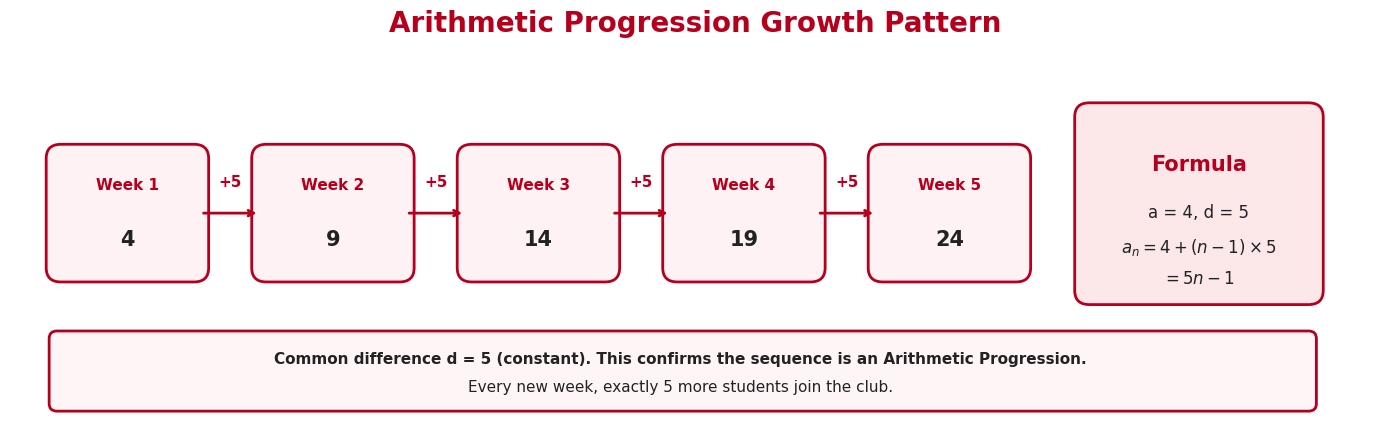
A mathematics teacher writes the following sequence on the board for her Class 9 students: 4, 9, 14, 19, 24… She tells them this pattern represents the number of students who have joined a school club over consecutive weeks, starting from Week 1. She asks the class to study the pattern and answer questions based on it.
Questions:
(i) What is the first term and common difference of this sequence?
(ii) Is this sequence an arithmetic progression? Justify.
(iii) Write the nth term formula for this sequence.
(iv) How many students will have joined by Week 10?
(v) In which week will the total reach 54?
Solution:
(i) First term a = 4. Common difference d = 9 − 4 = 5.
(ii) Yes. Check: 9 − 4 = 5, 14 − 9 = 5, 19 − 14 = 5, 24 − 19 = 5. The difference is constant throughout. This confirms it is an AP with d = 5.
(iii) aₙ = a + (n − 1)d = 4 + (n − 1) × 5 = 4 + 5n − 5 = 5n − 1.
(iv) a₁₀ = 5(10) − 1 = 50 − 1 = 49 students will join in Week 10.
(v) Set aₙ = 54: 5n − 1 = 54 → 5n = 55 → n = 11. The total reaches 54 in Week 11.
Know more about related topics:
- Class 9 Maths Notes Chapter 8 Predicting What Comes Next Exploring Sequences And Progression
- Important Questions Class 9 Maths Predicting What Comes Next Exploring Sequences And Progressions
- Assertion Reason Questions For Class 9 Maths Chapter 8 Predicting What Comes Next Exploring Sequences And Progressions
- Class 9 Maths Case Study Chapter 7 The Mathematics Of Maybe Introduction To Probability
- Arithmetic Progression
Case Study 2: Seating Arrangement in a School Auditorium
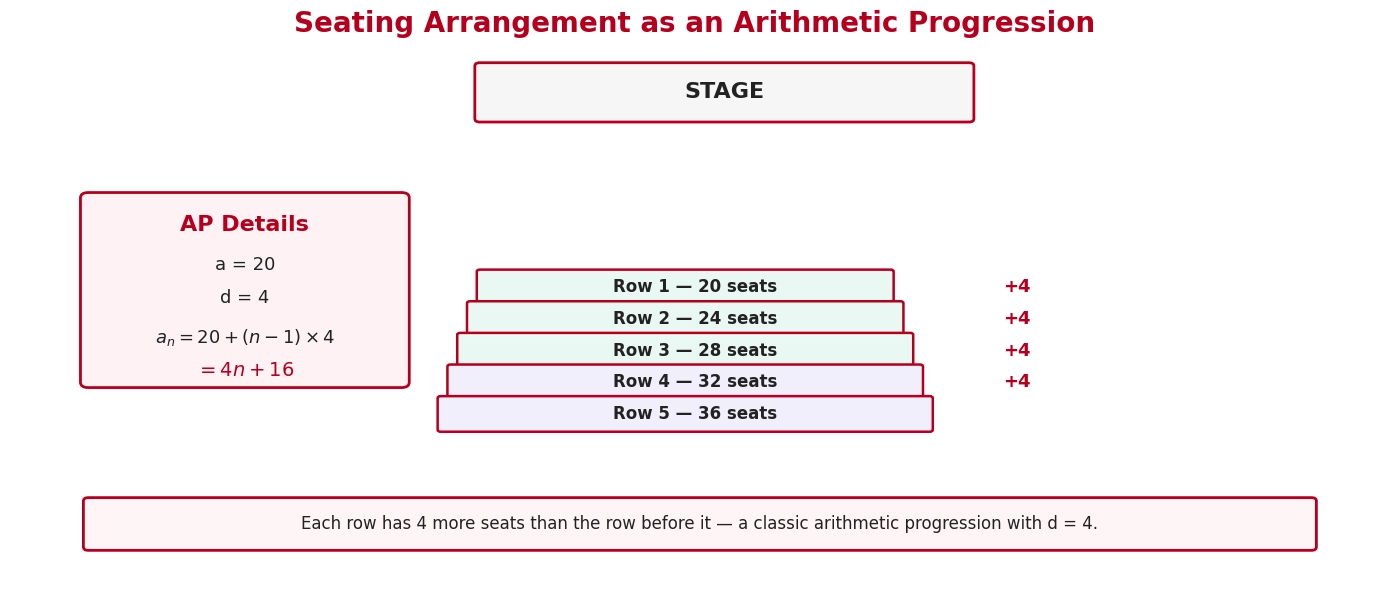
The principal of a school is arranging seats for the annual function. The first row has 20 seats, the second row has 24 seats, the third row has 28 seats, and this pattern continues throughout the auditorium. There are a total of 15 rows in the auditorium.
Questions:
(i) Identify the first term and common difference of this AP.
(ii) Write the general term (nth term) for the number of seats in the nth row.
(iii) How many seats are in the 15th row?
(iv) Which row has exactly 48 seats?
(v) The school wants to add a 16th row. How many seats should it have to continue the pattern?
Solution:
(i) First term a = 20 (Row 1). Common difference d = 24 − 20 = 4.
(ii) aₙ = 20 + (n − 1) × 4 = 20 + 4n − 4 = 4n + 16.
(iii) a₁₅ = 4(15) + 16 = 60 + 16 = 76 seats in the 15th row.
(iv) Set aₙ = 48: 4n + 16 = 48 → 4n = 32 → n = 8. Row 8 has exactly 48 seats.
(v) a₁₆ = 4(16) + 16 = 64 + 16 = 80 seats. The 16th row should have 80 seats.
Case Study 3: Matchstick Pattern Formation
During a craft class, students are asked to make a row of pentagons using matchsticks. The first pentagon uses 5 matchsticks. Each additional pentagon added to the row shares one side with the previous one and uses 4 more matchsticks. The pattern continues as more pentagons are added.
Questions:
(i) Write the number of matchsticks used for 1, 2, 3, and 4 pentagons.
(ii) Is the number of matchsticks an arithmetic progression? What is d?
(iii) Write the nth term formula for the number of matchsticks needed for n pentagons.
(iv) How many matchsticks are needed to make a row of 12 pentagons?
(v). A student has 45 matchsticks. What is the maximum number of pentagons she can make?
Solution:
(i) Pentagon 1: 5 sticks. Pentagon 2: 5 + 4 = 9 sticks. Pentagon 3: 9 + 4 = 13 sticks. Pentagon 4: 13 + 4 = 17 sticks. Sequence: 5, 9, 13, 17…
(ii) Yes. Check: 9 − 5 = 4, 13 − 9 = 4, 17 − 13 = 4. Constant difference. AP with d = 4.
(iii) a = 5, d = 4. aₙ = 5 + (n − 1) × 4 = 5 + 4n − 4 = 4n + 1.
(iv) a₁₂ = 4(12) + 1 = 48 + 1 = 49 matchsticks.
(v) Set aₙ ≤ 45: 4n + 1 ≤ 45, 4n ≤ 44, n ≤ 11. She can make a maximum of 11 pentagons (which needs 4(11) + 1 = 45 matchsticks exactly).
Case Study 4: Saving Money Every Month
Kavya decides to start saving money from January. In January, she saves ₹200. Each month after that, she saves ₹50 more than the previous month. So in February she saves ₹250, in March ₹300, and so on. She follows this plan for a full year (12 months).
Questions:
(i) List Kavya's savings for the first four months. Is it an AP?
(ii) What is the first term and common difference of this AP?
(iii) Write the nth term formula for her monthly savings.
(iv) How much does Kavya save in the 12th month (December)?
(v) In which month does her monthly saving first exceed ₹600?
Solution:
(i) January: ₹200, February: ₹250, March: ₹300, April: ₹350. Differences: 250 − 200 = 50, 300 − 250 = 50. Yes, it is an AP with constant difference ₹50.
(ii). First term a = ₹200. Common difference d = ₹50.
(iii) aₙ = 200 + (n − 1) × 50 = 200 + 50n − 50 = 50n + 150.
(iv) a₁₂ = 50(12) + 150 = 600 + 150 = ₹750 saved in December.
(v) Set aₙ > 600: 50n + 150 > 600, 50n > 450, n > 9. So in the 10th month (October), her saving first exceeds ₹600 (a₁₀ = 50(10) + 150 = ₹650).
Download Free PDF - Case Study: Class 9 Chapter 8 - Predicting What Comes Next - Exploring Sequence and Progressions
Frequently Asked Questions on Case Study Class 9 Maths Chapter 8 Predicting What Comes Next Exploring Sequences and Progressions
1. What are case study questions in Sequences and Progressions?
Case study questions are application-based questions that present a real-life scenario and require students to apply concepts of sequences and progressions to solve problems.
2. What is a sequence in mathematics?
A sequence is an ordered list of numbers arranged according to a specific rule or pattern. Each number in the sequence is called a term.
3. What is an arithmetic progression (AP)?
An arithmetic progression is a sequence in which the difference between consecutive terms remains constant. This fixed value is called the common difference.
4. How do you identify the pattern in a sequence?
Observe the relationship between consecutive terms and determine whether numbers are being added, subtracted, multiplied, or divided by a fixed value.
5. How can you find the next term in a sequence?
Find the pattern or rule followed by the sequence and apply it to the last given term to determine the next term.
6. What topics are important for sequence and progression case study questions?
Important topics include:
- Number patterns
- Arithmetic progressions
- Common difference
- Finding missing terms
- Predicting future terms
- Real-life applications of sequences
7. Are sequence and progression case study questions based on real-life situations?
Yes, they often involve real-life examples such as savings plans, seating arrangements, staircase patterns, population growth, and recurring events.
Numbers make sense when they're taught right. To see how Orchids The International School turns Maths from intimidating to intuitive, reach out to our admissions team.


Admissions Open for 2026-27
What type of concept pages would you prefer?
CBSE Schools In Popular Cities
- CBSE Schools in Bangalore
- CBSE Schools in Mumbai
- CBSE Schools in Pune
- CBSE Schools in Hyderabad
- CBSE Schools in Chennai
- CBSE Schools in Gurgaon
- CBSE Schools in Kolkata
- CBSE Schools in Indore
- CBSE Schools in Sonipat
- CBSE Schools in Delhi
- CBSE Schools in Rohtak
- CBSE Schools in Bhopal
- CBSE Schools in Aurangabad
- CBSE Schools in Jabalpur
- CBSE Schools in Jaipur
- CBSE Schools in Jodhpur
- CBSE Schools in Nagpur
- CBSE Schools in Ahmednagar
- CBSE School In Tumkur











Orchids The International School is one of India's leading chains of CBSE and ICSE schools, with 110+ schools across the country.