

Case Study on Class 9 Maths Chapter 7 ‘The Mathematics of Maybe - Introduction to Probability’
The Case Study Questions for Class 9 Maths Chapter 7 'The Mathematics of Maybe - Introduction to Probability' include short, real life problem situations that have clear answers and step by step solutions to help students gain confidence for exams. It covers important topics including understanding what probability means, identifying possible outcomes in everyday events, calculating probability of simple events, distinguishing between certain, impossible, and probable events, working with experimental and theoretical probability, solving problems involving coins, dice, and cards, and understanding the range of probability values from 0 to 1. These practice questions help the students in better understanding of the concepts, handling probability problems smoothly and to be faster and accurate for their board exams. A free PDF is included for offline timed practice.
Introduction to Case Study on The Mathematics of Maybe: Introduction to Probability
The probability formula, which states that the probability of an event equals the number of favourable outcomes divided by the total number of possible outcomes. The idea of a sample space, which is the complete list of all possible outcomes of an experiment. The meaning of certain events (probability = 1), impossible events (probability = 0), and likely events (probability between 0 and 1). The difference between experimental probability and theoretical probability. The rule that the sum of all probabilities in a sample space always equals 1.

Understanding Probability Before Solving Case Studies
Meaning of Probability
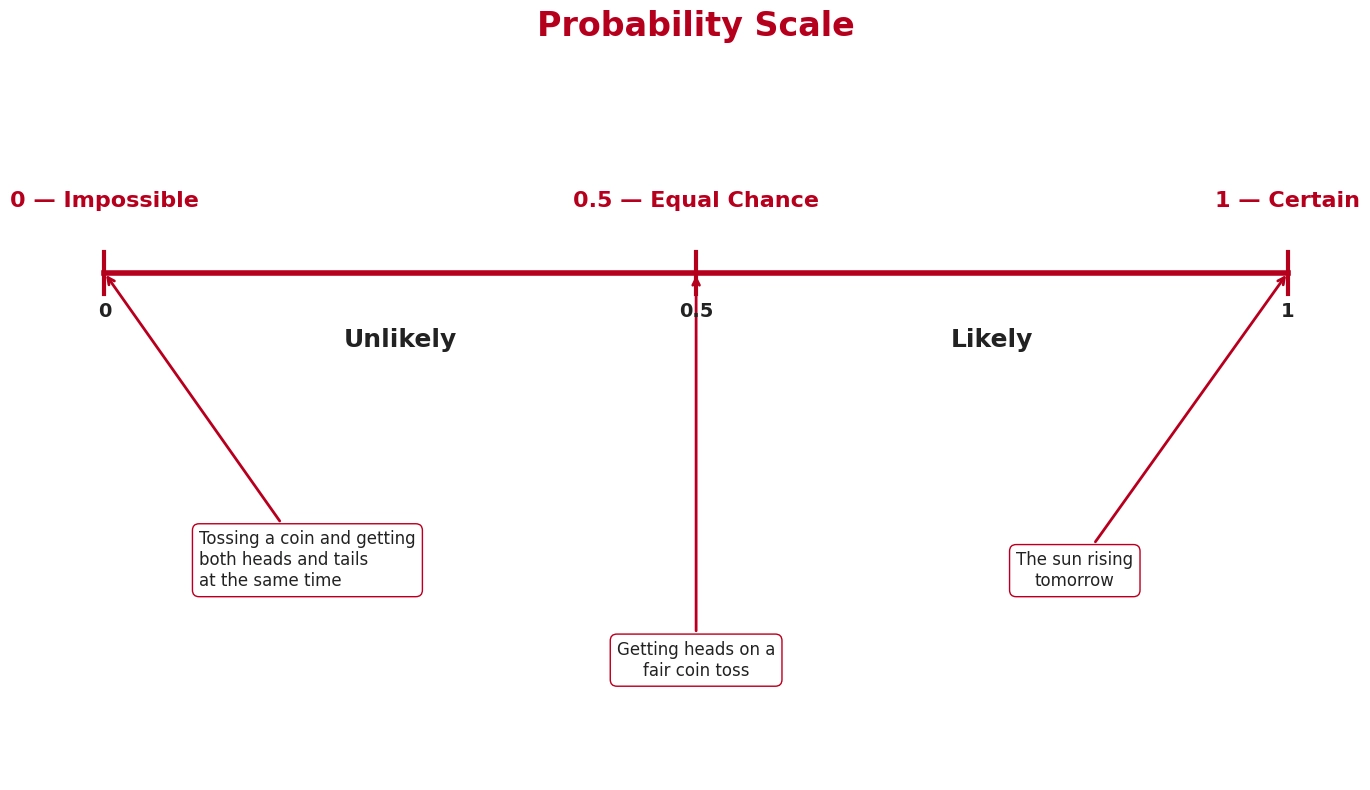
Probability is a measure of how likely an event is to happen. It is expressed as a number between 0 and 1, where 0 means the event will definitely not happen and 1 means the event will definitely happen. Any value in between represents varying degrees of likelihood.
The basic probability formula is: Probability of an event = Number of favourable outcomes ÷ Total number of possible outcomes
P(E) = n(E) ÷ n(S)
Where P(E) is the probability of event E, n(E) is the number of outcomes that satisfy the event, and n(S) is the total number of outcomes in the sample space.
Outcomes and Events
- An outcome is a single possible result of an experiment. For example, when you toss a coin, the two possible outcomes are heads and tails.
- An event is a specific outcome or a group of outcomes that you are interested in. For example, "getting heads" is an event when tossing a coin. "Getting an even number" is an event when rolling a dice.
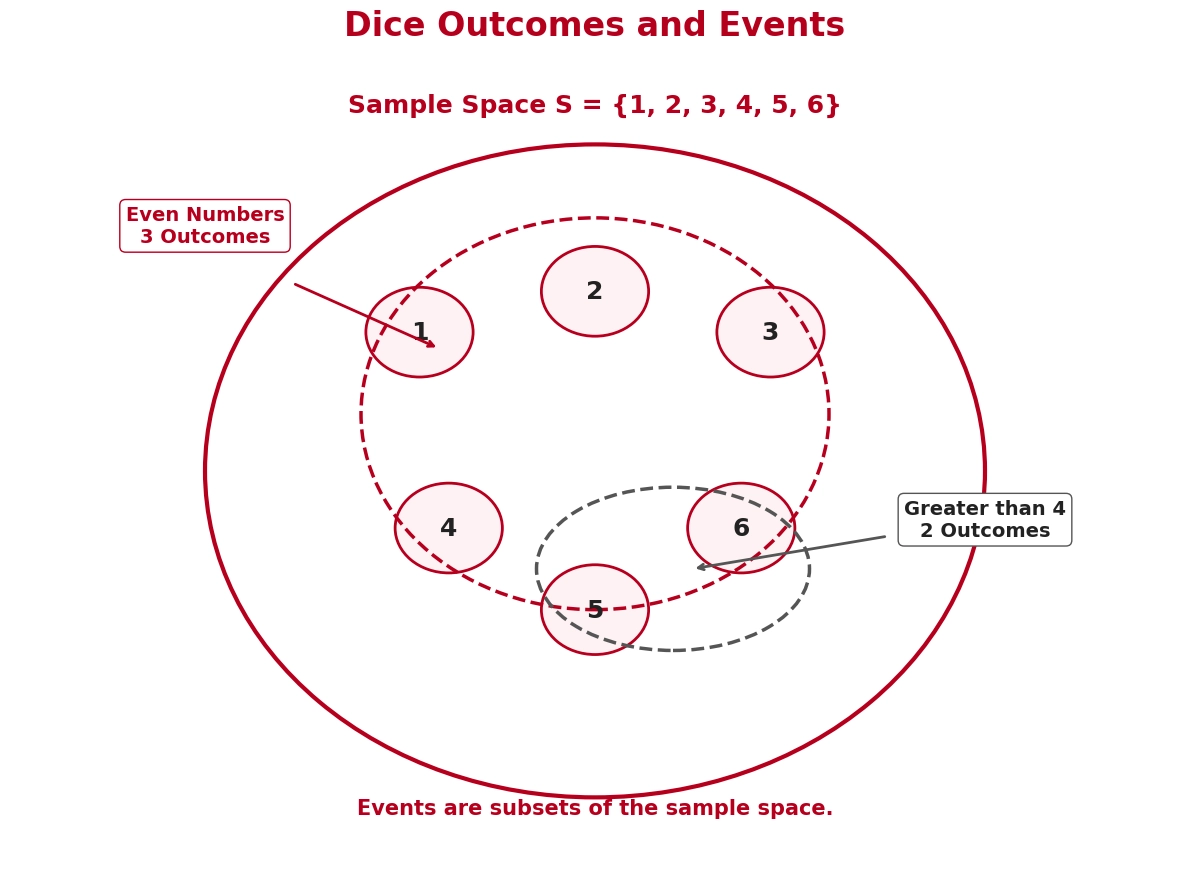
- The sample space is the complete set of all possible outcomes. When tossing a coin, the sample space is {Heads, Tails}. When rolling a six-faced dice, the sample space is {1, 2, 3, 4, 5, 6}.
Certain, Impossible and Likely Events
- A certain event is one that will always happen no matter what. Its probability is 1. Example: When you roll a standard dice, the probability of getting a number less than 7 is 1 it is certain, because every number on the dice (1 to 6) is less than 7.
- An impossible event is one that can never happen. Its probability is 0. Example: When you roll a standard dice, the probability of getting the number 9 is 0 it is impossible.
- A likely event is one that may or may not happen, with a probability between 0 and 1. Example: When you toss a fair coin, the probability of getting heads is 0.5 it is equally likely to happen or not happen.
Know more about related topics:
- Class 9 Maths Mcqs Chapter 7 The Mathematics Of Maybe Introduction To Probability
- Class 9 Maths Notes Chapter 7 The Mathematics Of Maybe Introduction To Probability
- Important Questions Class 9 Maths The Mathematics Of Maybe Introduction To Probability
- Assertion Reason Questions For Class 9 Maths Chapter 7 The Mathematics Of Maybe Introduction To Probability
- Class 9 Maths Case Study Chapter 8 Predicting What Comes Next Exploring Sequences And Progressions
Case Study 1: Tossing a Coin
Aryan and Priya are playing a simple game during their lunch break at school. They use a fair coin to decide who gets to choose the game. A fair coin is one that is not biased it has an equal chance of landing on heads or on tails. They decide to toss the coin three times to make their decision. Before the game begins, their mathematics teacher Mr. Sharma passes by and asks them some questions to test their understanding of chance and probability. Read the scenario carefully and answer the questions that follow.
Questions:
(i) What is the sample space when a fair coin is tossed once?
(ii) What is the probability of getting heads when a fair coin is tossed once?
(iii) What is the probability of getting tails when a fair coin is tossed once?
(iv) When the coin is tossed twice, what is the total number of possible outcomes? List all of them.
(v) When the coin is tossed twice, what is the probability of getting exactly one head?
Solution:
Answer 1: When a fair coin is tossed once, there are only two possible results the coin lands on heads or it lands on tails.
Sample space S = {Heads, Tails}
Total number of outcomes = 2
Answer 2: We want to find the probability of getting heads.
Number of favourable outcomes (heads) = 1 Total number of possible outcomes = 2
P(Heads) = 1 ÷ 2 = 1/2 or 0.5
This means that in a large number of tosses, we would expect heads to come up approximately half the time.
Answer 3: We want to find the probability of getting tails.
Number of favourable outcomes (tails) = 1 Total number of possible outcomes = 2
P(Tails) = 1 ÷ 2 = 1/2 or 0.5
Notice that P(Heads) + P(Tails) = 1/2 + 1/2 = 1. This confirms the rule that all probabilities in a sample space add up to 1.
Answer 4: When a fair coin is tossed twice, each toss has 2 possible outcomes. So the total number of outcomes for two tosses is 2 × 2 = 4.
The complete sample space is: {Heads-Heads, Heads-Tails, Tails-Heads, Tails-Tails}
Often written as: {HH, HT, TH, TT}
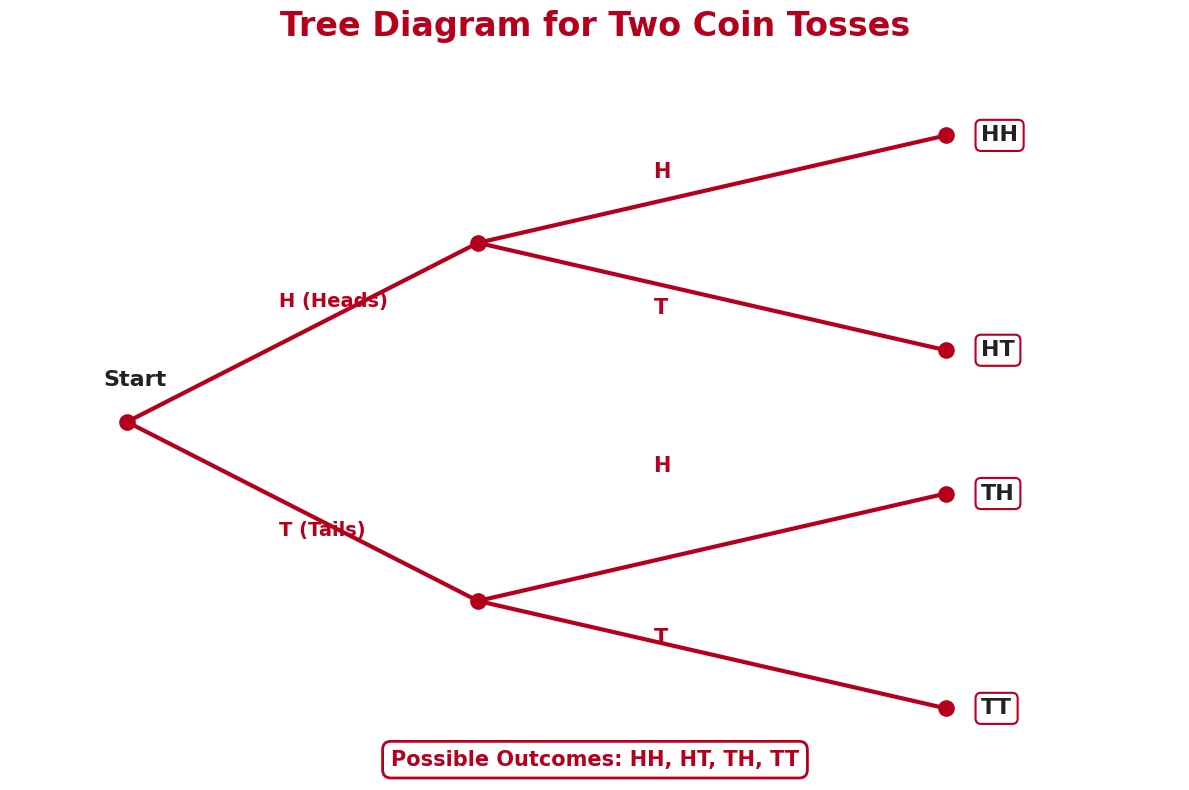
Answer 5: From the sample space {HH, HT, TH, TT}, the outcomes with exactly one head are HT and TH. That is two outcomes.
Number of favourable outcomes = 2 Total number of outcomes = 4
P(Exactly one head) = 2 ÷ 4 = 1/2 or 0.5
Case Study 2: Rolling a Dice
During a board game session, a group of Class 9 students Rohan, Simran, and Dev are playing a game that requires rolling a standard six-faced dice. The faces of the dice are numbered from 1 to 6, and each face has an equal chance of facing up when the dice is rolled. Before their next turn, their elder sibling who is a maths student in Class 11 asks them a series of probability questions based on their game to help them revise Chapter 7 The Mathematics of Maybe.
Questions:
(i) What is the sample space when a dice is rolled once?
(ii) What is the probability of getting the number 4?
(iii) What is the probability of getting an even number?
(iv) What is the probability of getting a number greater than 4?
(v) What is the probability of getting a number less than 7? What type of event is this?
Solution:
Answer 1: A standard dice has six faces numbered 1 to 6. When rolled once, any of these six numbers can come up.
Sample space S = {1, 2, 3, 4, 5, 6}
Total number of outcomes = 6
Answer 2: We want the probability of getting exactly the number 4.
Number of favourable outcomes = 1 (only the face showing 4) Total number of outcomes = 6
P(Getting 4) = 1 ÷ 6 = 1/6
Answer 3: The even numbers on a dice are 2, 4, and 6.
Number of favourable outcomes = 3 Total number of outcomes = 6
P(Even number) = 3 ÷ 6 = 1/2
This makes sense exactly half the numbers on a dice are even.
Answer 4: Numbers greater than 4 on a dice are 5 and 6.
Number of favourable outcomes = 2 Total number of outcomes = 6
P(Greater than 4) = 2 ÷ 6 = 1/3
Answer 5: Every number on a standard dice (1, 2, 3, 4, 5, 6) is less than 7. So every possible outcome qualifies.
Number of favourable outcomes = 6 Total number of outcomes = 6
P(Less than 7) = 6 ÷ 6 = 1
This is a certain event it is guaranteed to happen no matter what number comes up, because all six numbers are less than 7.
Case Study 3: Selecting Coloured Balls from a Bag
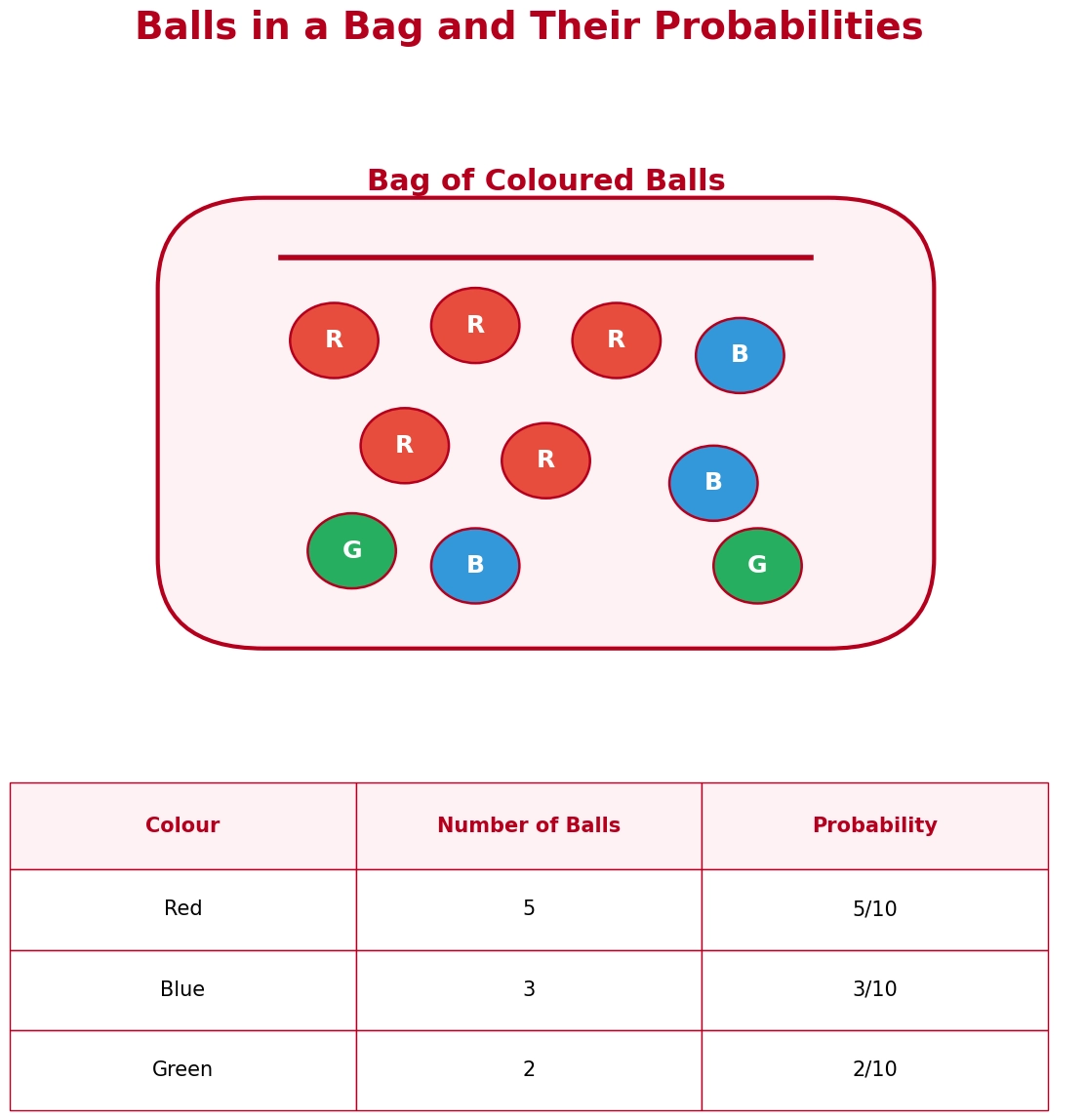
A teacher places a bag on the table at the start of a probability class. She tells the students that the bag contains 5 red balls, 3 blue balls, and 2 green balls. All the balls are identical in size and shape the only difference between them is their colour. She then blindfolds a student named Kavya and asks her to pick one ball from the bag without looking. The teacher then uses this situation to ask the class a series of probability questions. The total number of balls in the bag is 5 + 3 + 2 = 10.
Questions:
(i) What is the probability that Kavya picks a red ball?
(ii) What is the probability that she picks a blue ball?
(iii) What is the probability that she picks a green ball?
(iv) What is the probability that she picks a ball that is NOT red?
(v) Verify that the probabilities of all three colours add up to 1.
Solution:
Answer 1: Total balls in the bag = 10 Number of red balls = 5
P(Red ball) = 5 ÷ 10 = 1/2 or 0.5
There is a 50% chance that Kavya picks a red ball, since half the balls are red.
Answer 2: Number of blue balls = 3
P(Blue ball) = 3 ÷ 10 = 3/10 or 0.3
Answer 3: Number of green balls = 2
P(Green ball) = 2 ÷ 10 = 1/5 or 0.2
Answer 4: Balls that are NOT red = blue balls + green balls = 3 + 2 = 5
P(Not red) = 5 ÷ 10 = 1/2 or 0.5
Alternatively, P(Not red) = 1 − P(Red) = 1 − 1/2 = 1/2. Both methods give the same answer. This is called the complementary rule of probability.
Answer 5: P(Red) + P(Blue) + P(Green) = 5/10 + 3/10 + 2/10 = 10/10 = 1
The probabilities add up to exactly 1, confirming the fundamental rule that the sum of all event probabilities in a sample space is always equal to 1.
Case Study 4: Weather Forecast and Probability
Meera is a Class 9 student who loves watching the evening weather forecast on television with her parents. One evening, the weather reporter says: "There is a 70% chance of rain tomorrow in this city." Meera's father, who is an engineer, asks her what this means in terms of probability and whether she can answer some related questions using what she has studied in Chapter 7 The Mathematics of Maybe. Meera decides to treat weather prediction as a probability problem and use the probability formula to answer her father's questions.
Questions:
(i) If the probability of rain tomorrow is 70%, express this as a decimal and as a fraction.
(ii) What is the probability that it will NOT rain tomorrow?
(iii) The weather report also says there is a 45% chance of thunderstorms if it rains. If we consider only rainy days, what is the probability of thunderstorms on those days?
(iv) Is the event "it will rain or it will not rain tomorrow" a certain event? Justify your answer.
(v) On a scale of 0 to 1, where would the probability of rain (70%) be placed? Is it closer to certain or to impossible?
Solution:
Answer 1: The probability of rain = 70%
As a decimal: 70 ÷ 100 = 0.70
As a fraction: 70/100 = 7/10
So P(Rain) = 7/10 = 0.7
Answer 2: Rain and no-rain are complementary events one of them must happen, and they cannot both happen at the same time.
P(No rain) = 1 − P(Rain) = 1 − 0.7 = 0.3 or 30%
There is a 30% chance it will not rain tomorrow.
Answer 3: The probability of thunderstorms given that it rains = 45%
P(Thunderstorm | Rain) = 45 ÷ 100 = 0.45 or 9/20
This is read as "the probability of thunderstorm given rain is 0.45." It is a conditional probability concept that extends beyond Class 9 but can be understood at this level as: if we are only considering rainy days, then 45 out of every 100 rainy days will have thunderstorms.
Answer 4: The event "it will rain or it will not rain" covers every possible outcome either it rains or it does not rain. There is no other possibility.
P(Rain or No rain) = P(Rain) + P(No rain) = 0.7 + 0.3 = 1
Since the probability is 1, this is a certain event. It will definitely either rain or not rain tomorrow. There is no third option.
Answer 5: On the 0 to 1 probability scale: 0 = Impossible, 0.5 = Equal chance, 1 = Certain
The probability of rain = 0.7
Since 0.7 is greater than 0.5 and closer to 1, rain is more likely than not to occur. It is closer to certain than to impossible.
Download Free PDF - Case Study: Class 9 Chapter 7 - The Mathematics of Maybe - Introduction to Probability
Frequently Asked Questions on Case Study on Class 9 Maths Chapter 7 The Mathematics of Maybe - Introduction to Probability
1. What are case study questions in Introduction to Probability?
Case study questions are application based questions that use real-life situations to test a student's understanding of probability concepts and problem solving skills.
2. What is probability in Class 9 Maths?
Probability is a measure of how likely an event is to occur. It ranges from 0 to 1, where 0 means an impossible event and 1 means a certain event.
3. How do you solve probability case study questions?
Read the situation carefully, identify the possible outcomes, determine the favorable outcomes, and then apply the probability formula to find the answer.
4. What topics are important for probability case study questions?
Important topics include:
- Experimental probability
- Theoretical probability
- Favorable outcomes
- Total outcomes
- Simple events
- Probability of everyday situations
5. What is the probability formula used in case study questions?
The probability of an event is found by dividing the number of favorable outcomes by the total number of possible outcomes.
6. Why is probability called "The Mathematics of Maybe"?
Probability is called "The Mathematics of Maybe" because it helps measure the chance of events that may or may not happen.
7. What are the most common examples used in probability case studies?
Common examples include:
- Tossing a coin
- Rolling a die
- Drawing balls from a bag
- Picking cards from a deck
- Predicting weather conditions
Numbers make sense when they're taught right. To see how Orchids The International School turns Maths from intimidating to intuitive, reach out to our admissions team.


Admissions Open for 2026-27
What type of concept pages would you prefer?
CBSE Schools In Popular Cities
- CBSE Schools in Bangalore
- CBSE Schools in Mumbai
- CBSE Schools in Pune
- CBSE Schools in Hyderabad
- CBSE Schools in Chennai
- CBSE Schools in Gurgaon
- CBSE Schools in Kolkata
- CBSE Schools in Indore
- CBSE Schools in Sonipat
- CBSE Schools in Delhi
- CBSE Schools in Rohtak
- CBSE Schools in Bhopal
- CBSE Schools in Aurangabad
- CBSE Schools in Jabalpur
- CBSE Schools in Jaipur
- CBSE Schools in Jodhpur
- CBSE Schools in Nagpur
- CBSE Schools in Ahmednagar
- CBSE School In Tumkur











Orchids The International School is one of India's leading chains of CBSE and ICSE schools, with 110+ schools across the country.