

DXC Roman Numerals
DXC Roman numerals represents the number 590 in the Roman numeral system. This numeral is formed by combining 500 (D) with 90 (XC), where the subtraction rule is applied; placing a smaller numeral before a larger one indicates subtraction. So, DXC = D + (C − X) = 500 + (100 − 10) = 590. Learning DXC Roman numerals helps students understand how Roman numerals use both addition and subtraction rules, improves logical thinking, and strengthens numeral recognition. It also shows how this ancient numbering system is still relevant today, appearing in clocks, book chapters, movie titles, and historical dates, making number learning more practical and interesting.
Table of Contents
- How to Write DXC Roman Numerals in Numbers?
- Numbers Related to DXC Roman Numerals
- Basic Rules for Writing Roman Numerals
- Solved Examples on DXC Roman Numerals
- Practice Questions on DXC Roman Numerals
- Conclusion
- Frequently Asked Questions on DXC Roman Numerals

How to Write DXC Roman Numerals in Numbers?
To find the value of DXC in numbers, we use the standard Roman numeral rules, which involve adding and subtracting values based on their positions. Here’s a simple step-by-step method:
Step 1: Break the Roman numeral into individual symbols
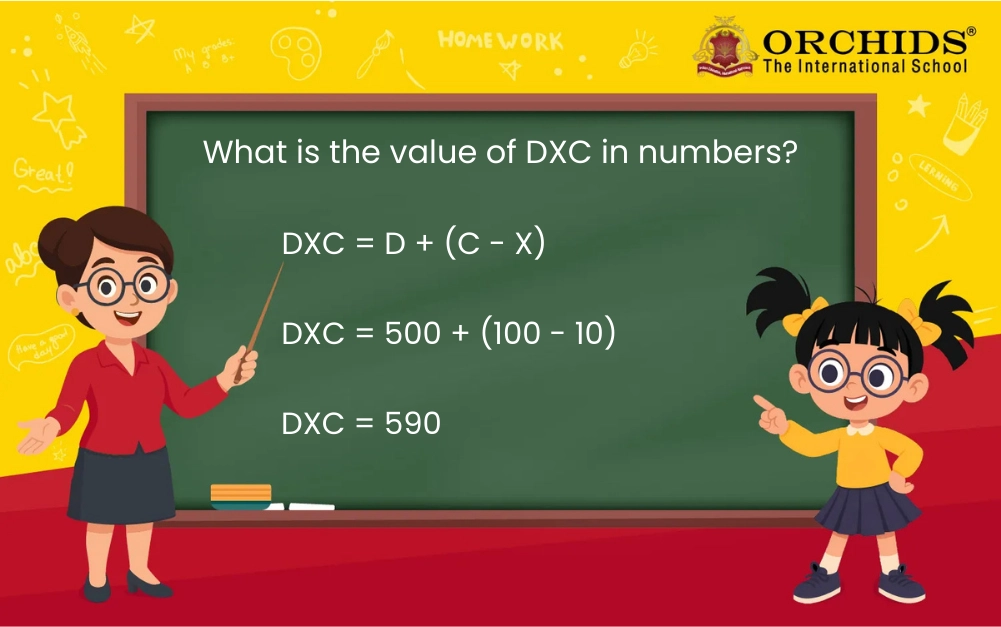
DXC = D + (C - X) = D + XC
Step 2: Identify the value of each symbol
-
D = 500
-
X = 10
-
C = 100
Step 3: Apply Roman numeral rules
In Roman numerals, when a smaller number comes before a larger number, we subtract it. Here, X (10) is before C (100), so we subtract:
-
C - X = 100 - 10 = 90
Step 4: Add all values
-
DXC = 500 + (100 - 10) = 500 + 90 = 590
Know more about related topics:
Numbers Related to DXC Roman Numerals
|
Roman Numeral |
Roman Numeral Expression |
Expanded Form |
Number |
|
DLXXXVI |
D + L + X + X + V + I |
500 + 50 + 10 + 10 + 5 + 1 |
586 |
|
DLXXXVII |
D + L + X + X + V + I + I |
500 + 50 + 10 + 10 + 5 + 1 + 1 |
587 |
|
DLXXXVIII |
D + L + X + X + V + I + I + I |
500 + 50 + 10 + 10 + 5 + 1 + 1 + 1 |
588 |
|
DLXXXIX |
D + L + X + X + (X − I) |
500 + 50 + 10 + 10 + (10 − 1) |
589 |
|
DXC |
D + XC |
500 + (100 − 10) |
590 |
|
DXCI |
D + XC + I |
500 + (100 − 10) + 1 |
591 |
|
DXCII |
D + XC + I + I |
500 + (100 − 10) + 1 + 1 |
592 |
|
DXCIII |
D + XC + I + I + I |
500 + (100 − 10) + 1 + 1 + 1 |
593 |
|
DXCIV |
D + XC + (V − I) |
500 + (100 − 10) + (5 − 1) |
594 |
|
DXCV |
D + XC + V |
500 + (100 − 10) + 5 |
595 |
Basic Rules for Writing Roman Numerals
-
Know the Symbols: I = 1, V = 5, X = 10, L = 50, C = 100, D = 500, M = 1000.
-
Subtraction Rule: A smaller numeral before a larger one subtracts. Example: XC = 100 − 10 = 90
-
Addition Rule: A smaller or equal numeral after a larger one is added. Example: D + X = 500 + 10 = 510
-
Combine Values: D + XC = 500 + 90 = 590
Solved Examples on DXC Roman Numerals
Example 1: A library has DXC (590) history books and CLX (160) science books. How many books are there in total?
Solution:
-
DXC = 590
-
CLX = 160
Now add:
-
590 + 160 = 750
Convert 750 into Roman numerals:
-
750 = 700 + 50 = DCC + L = DCCL
Answer: The library has DCCL books in total.
Example 2: A school has DXC (590) students. After some students transferred to another school, CCLXX (270) students left. How many students remain?
Solution:
-
590 − 270 = 320
Convert 320 into Roman numerals:
-
320 = 300 + 20 = CCC + XX = CCCXX
Answer: CCCXX students remain in the school.
Example 3: A factory produces DXC (590) toys each day. How many toys are produced in 4 days?
Solution:
-
590 × 4 = 2360
Convert 2360 into Roman numerals:
-
2360 = 2000 + 300 + 60 = MM + CCC + LX = MMCCCLX
Answer: The factory produces MMCCCLX toys in 4 days.
Example 4: A total of DXC (590) candies need to be packed equally into X (10) boxes. How many candies go in each box?
Solution:
-
590 ÷ 10 = 59
Convert 59 into Roman numerals:
-
59 = 50 + 9 = L + IX = LIX
Answer: Each box will have LIX candies.
Example 5: A group of DXC (590) students is forming teams of XL (40) each. How many students will be left without a team?
Solution:
590 ÷ 40 = 14 remainder 30
Convert the remainder into Roman numerals:
-
30 = XXX
Answer: XXX students will be left without a team.
Practice Questions on DXC Roman Numerals
1. What is the value of DXC in Hindu-Arabic numbers?
2. If DXC books are on the shelf and a student buys LXX (70) books, how many books are left on the shelf? Write the answer in Roman numerals.
3. Divide DXC by V (5) and write the quotient in Roman numerals.
4. A school has DXC chairs. If CCL (250) chairs are removed, how many chairs are left? Express your answer in Roman numerals.
5. Add DXC and CL (150). Write your answer in Roman numerals.
Conclusion
DXC Roman numerals represent 590, formed by combining D (500) and XC (90) using standard Roman numeral rules. Understanding DXC Roman numerals helps students learn addition and subtraction principles and improves their ability to read and write numbers accurately.
Learn DXC Roman numerals easily with step-by-step explanations at Orchids International School.
Numbers make sense when they're taught right. To see how Orchids The International School turns Maths from intimidating to intuitive, reach out to our admissions team.
Frequently Asked Questions on DXC Roman Numerals
1. What does DXC mean in numbers?
DXC is a Roman numeral where 'D' = 500 and 'XC' = 90.
So, DXC = 500 + 90 = 590.
2. How do you write 590 in Roman numerals?
590 is written as DXC.
It is formed by combining 500 (D) and 90 (XC).
3. How do you find the remainder when DXC is divided by XVIII?
DXC = 590, XVIII = 18.
Divide 590 by 18: 590 ÷ 18 = 32 remainder 14.
14 in Roman numerals is XIV. So, the remainder is XIV.
4. What should be added to DXC to get MCM?
DXC = 590, MCM = 1900.
1900 − 590 = 1310.
1310 in Roman numerals is MCCX. So, MCCX should be added to DXC to get MCM.
5. Why is 590 written as DXC in Roman numerals?
In Roman numerals: D = 500, XC = 100 − 10 = 90.
Adding them together gives DXC = 500 + 90 = 590.
This demonstrates how subtraction is used in Roman numeral rules.
Related Links


Admissions Open for 2026-27
What type of concept pages would you prefer?
CBSE Schools In Popular Cities
- CBSE Schools in Bangalore
- CBSE Schools in Mumbai
- CBSE Schools in Pune
- CBSE Schools in Hyderabad
- CBSE Schools in Chennai
- CBSE Schools in Gurgaon
- CBSE Schools in Kolkata
- CBSE Schools in Indore
- CBSE Schools in Sonipat
- CBSE Schools in Delhi
- CBSE Schools in Rohtak
- CBSE Schools in Bhopal
- CBSE Schools in Aurangabad
- CBSE Schools in Jabalpur
- CBSE Schools in Jaipur
- CBSE Schools in Jodhpur
- CBSE Schools in Nagpur
- CBSE Schools in Ahmednagar
- CBSE School In Tumkur











Orchids The International School is one of India's leading chains of CBSE and ICSE schools, with 110+ schools across the country.