

Quadrilaterals for Class 8: Understanding Important Questions and Answers
Quadrilaterals Class 8 Important Questions are available in this Maths article. Quadrilaterals Class 8 Important Questions are very useful to solve the problems easily. This article helps the students to know the key questions and answers about Quadrilaterals. A quadrilateral is a polygon with four sides, four angles, and four vertices. Our subject experts have provided detailed solutions for these problems based on the old CBSE syllabus and the NCERT textbook. This material helps students revise the chapter easily and perform well in the final examination.
Table of Contents
- Exercise 3.1: Introduction to Quadrilaterals
- Exercise 3.2: Types of Quadrilaterals and Their Properties
- Exercise 3.3: Properties of Quadrilaterals and Angle Relationships
- Exercise 3.4: Constructing Quadrilaterals Part 1
- Tips for Understanding Quadrilaterals
- Most Repeated Board Questions on Quadrilaterals
- Most Common Examination Questions (Board Exams)
- Frequently Asked Questions on Quadrilaterals for Class 8

Exercise 3.1: Introduction to Quadrilaterals
This exercise focuses on understanding basic concepts about quadrilaterals, their elements, and fundamental properties.
Question 1: What is a Quadrilateral?
Answer: A quadrilateral is a polygon with four sides, four angles, and four vertices. It is formed by joining four non-collinear points in order.
Elements of a Quadrilateral:
- Sides: The four line segments forming the boundary (AB, BC, CD, DA)
- Vertices: The four points where sides meet (A, B, C, D)
- Angles: The four interior angles at each vertex
- Diagonals: Line segments joining opposite vertices (AC, BD)
- Adjacent Sides: Sides sharing a common vertex
- Opposite Sides: Sides that do not share a vertex
- Adjacent Angles: Angles sharing a common side
- Opposite Angles: Angles that do not share a side
Question 2: What is the Sum of Interior Angles of a Quadrilateral?
Answer: The sum of all interior angles of a quadrilateral is always 360°.
A quadrilateral can be divided into two triangles by drawing one diagonal. Since the sum of angles in each triangle is 180°, the total sum in a quadrilateral is 180° + 180° = 360°.
Angle Sum Property = 360°
Quadrilateral ABCD:
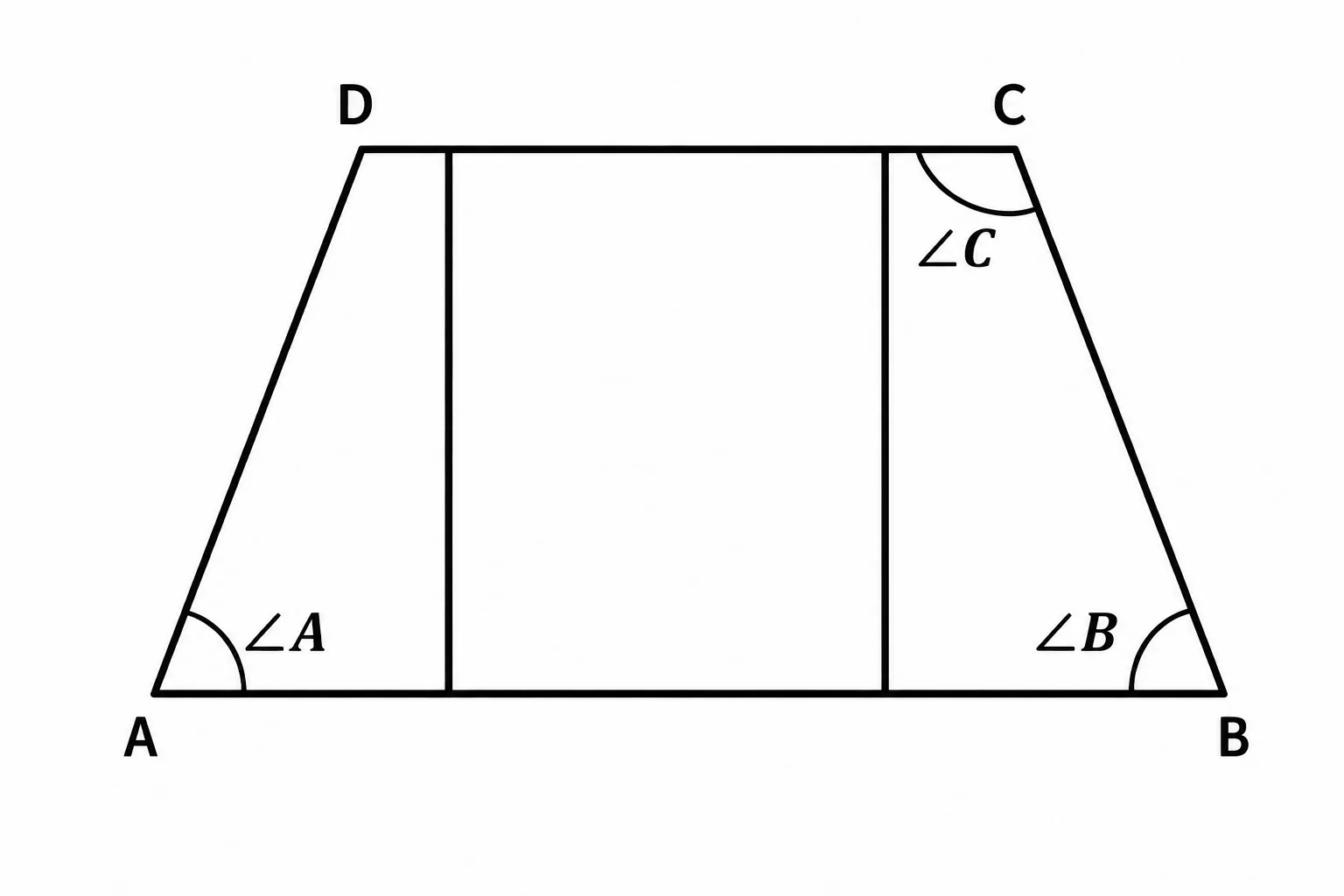
∠C (not shown in front)
∠A + ∠B + ∠C + ∠D = 360°
Example:
If ∠A = 75°, ∠B = 95°, ∠C = 85°
Then ∠D = 360° - 75° - 95° - 85° = 105°
Question 3: Find the Fourth Angle of a Quadrilateral if Three Angles are 70°, 85°, and 95°
Solution: Let the fourth angle = x
Sum of all angles = 360° 70° + 85° + 95° + x = 360° 250° + x = 360° x = 360° - 250° = 110°
Answer: Fourth angle = 110°
Question 4: What is the Difference Between a Convex and a Concave Quadrilateral?
Answer: A Convex Quadrilateral has all interior angles less than 180°. All vertices point outward, and no interior angle is reflex.
A Concave Quadrilateral has at least one interior angle greater than 180° (reflex angle). At least one vertex points inward.
Most quadrilaterals studied in Class 8 are convex quadrilaterals.
Question 5: Can a Quadrilateral Have All Acute Angles?
Answer: No, a quadrilateral cannot have all four acute angles. Since the sum of angles must equal 360°, and an acute angle is less than 90°, if all angles were acute, the sum would be less than 4 × 90° = 360°, which contradicts the angle sum property. Therefore, at least one angle must be 90° or greater.
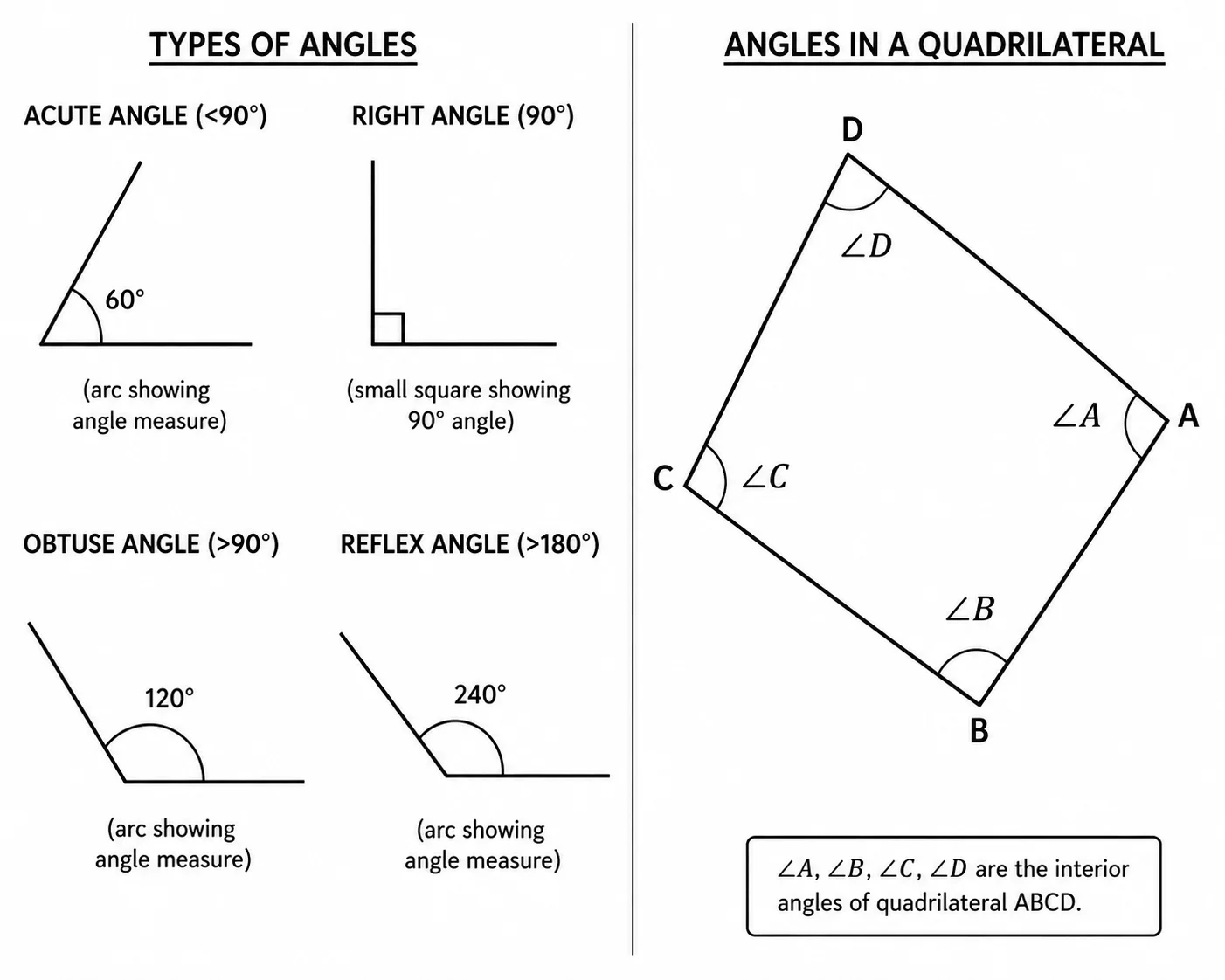
Different angle types shown with proper arc markings:
Know more about related topics:
Exercise 3.2: Types of Quadrilaterals and Their Properties
This exercise covers different types of quadrilaterals, their defining characteristics, and relationships between them.
Question 7: Define and List the Properties of a Parallelogram
Answer: A Parallelogram is a quadrilateral with two pairs of parallel sides.
Parallelogram ABCD with Angles and Properties
Properties shown:
• ∠A = 80°, ∠C = 80° (opposite angles equal)
• ∠B = 100°, ∠D = 100° (opposite angles equal)
• ∠A + ∠B = 180° (adjacent angles supplementary: 80° + 100°)
• Diagonals bisect each other at point O
• Sides: AB || DC and AD || BC
Question 8: Define a Rectangle. How is it Different from a General Parallelogram?
Answer: A Rectangle is a parallelogram with all angles equal to 90°.
• All angles = 90° (each corner)
• Opposite sides equal: AB = DC = 6cm, AD = BC = 10cm
• Both diagonals equal: AC = BD
• Diagonal calculation: d = √(6² + 10²) = √136 ≈ 11.66cm
• Diagonals bisect each other at midpoint
Question 9: What is a Square? List Its Properties
Answer: A Square is a special quadrilateral where all four sides are equal and all four angles are 90°.
• All sides = 5cm (AB = BC = CD = DA = 5cm)
• All angles = 90° (marked at each corner)
• Diagonal d = 5√2 ≈ 7.07cm
• Both diagonals equal and bisect at 90° angle
• 4 lines of symmetry
• Diagonals bisect vertex angles (each 45°)
Question 10: Define a Rhombus and Explain How it Differs from a Square
Answer: A Rhombus is a quadrilateral with all four sides equal.
Rhombus ABCD with Perpendicular Diagonals
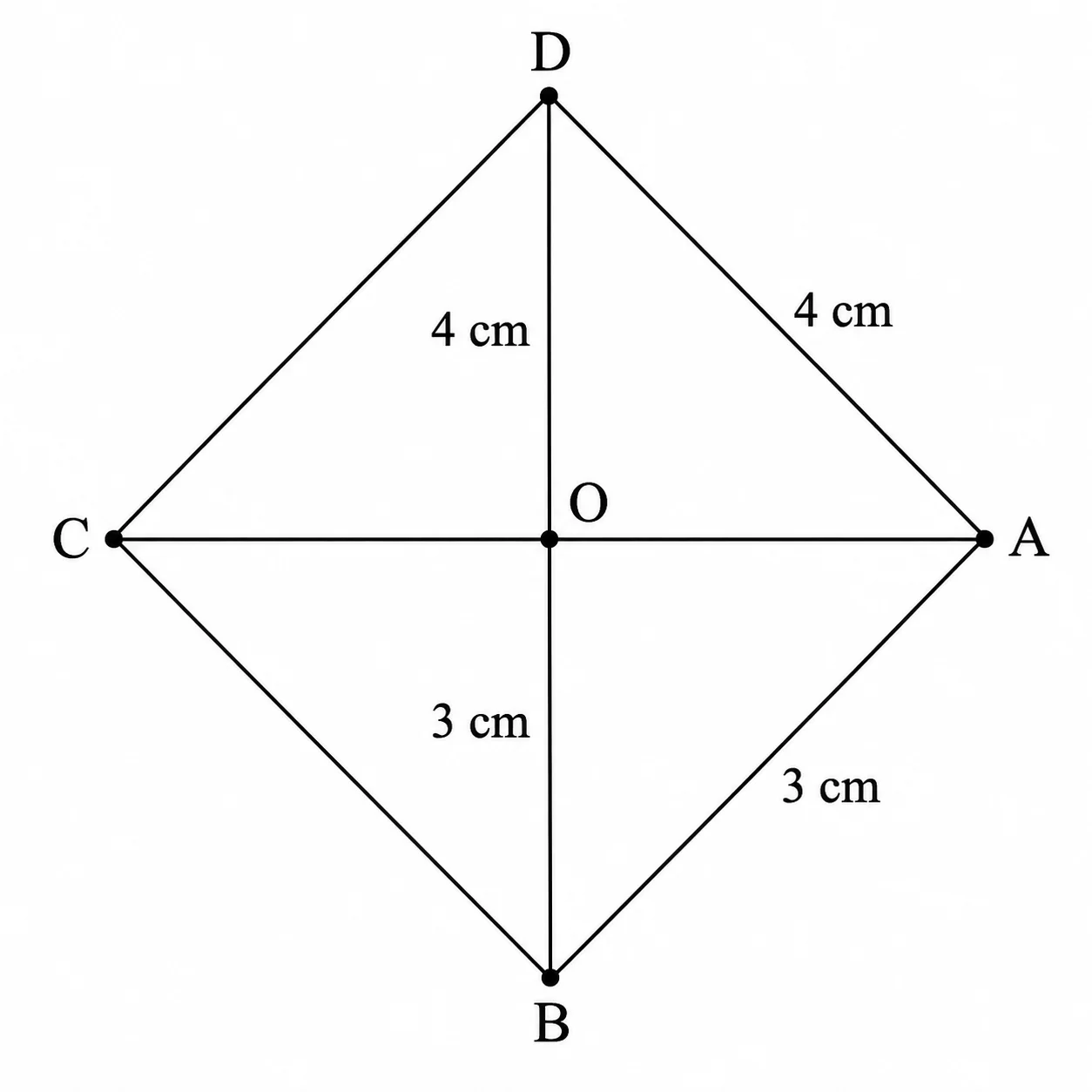
- All sides equal = 5cm (calculated from half-diagonals)
- Diagonal AC = 8cm, Diagonal BD = 6cm
- Diagonals bisect each other at O (right angle 90°)
- Diagonals bisect the vertex angles
- Side length = √(4² + 3²) = √25 = 5cm
- Opposite angles are equal
- Adjacent angles are supplementary
Question 11: Define a Trapezium. How Many Pairs of Parallel Sides Does it Have?
Answer: A Trapezium is a quadrilateral with exactly one pair of parallel sides. The parallel sides are called bases, and the non-parallel sides are called legs.
- AB || CD (parallel sides only one pair)
- AB = 6cm (longer base)
- CD = 4cm (shorter base)
- Height h = 3cm (perpendicular distance)
- AD and BC are non-parallel sides (legs)
- Sum of all angles = 360°
- Area = ½ × (AB + CD) × h = ½ × (6 + 4) × 3 = 15cm²
Question 12: Define a Kite. What are its Distinguishing Features?
Answer: A Kite is a quadrilateral with two pairs of consecutive sides that are equal.
- AD = AB = 3cm (one pair consecutive equal sides)
- CD = CB = 4cm (other pair consecutive equal sides)
- Diagonal AC = axis of symmetry (vertical)
- Diagonal BD perpendicular to AC at O (90°)
- AO bisects the arc, BO doesn't bisect AO
- ∠D = ∠B (angles at ends of symmetry axis)
- ∠A ≠ ∠C (angles on axis are different)
Exercise 3.3: Properties of Quadrilaterals and Angle Relationships
This exercise focuses on understanding and applying the properties of different quadrilaterals to solve problems.
Question 13: In a Parallelogram ABCD, if ∠A = 65°, Find all Other Angles
Solution: In a parallelogram, opposite angles are equal and adjacent angles are supplementary.
∠A = 65° (given) ∠C = ∠A = 65° (opposite angles are equal)
∠A + ∠B = 180° (adjacent angles are supplementary) 65° + ∠B = 180° ∠B = 115°
∠D = ∠B = 115° (opposite angles are equal)
65° + 115° + 65° + 115° = 360°
Answer: ∠A = 65°, ∠B = 115°, ∠C = 65°, ∠D = 115°
Question 14: The Diagonals of a Rectangle are 10 cm Each. What Can You Conclude?
Solution: This confirms the property that diagonals of a rectangle are equal in length.
Since both diagonals are 10 cm, the rectangle has its diagonals equal, which is consistent with the definition of a rectangle.
Additionally, the diagonals bisect each other, so each diagonal is divided into two equal parts of 5 cm each at the point of intersection.
Answer: The rectangle's diagonals are equal (confirming rectangle property); each half measures 5 cm
Pythagoras Theorem:
d² = length² + breadth²
d² = 8² + 6²
d² = 64 + 36
d² = 100
d = √100 = 10cm
Diagonal AC = Diagonal BD = 10cm
Question 15: In a Rhombus, the Diagonals are 12 cm and 8 cm. Find the Side Length
Solution: The diagonals of a rhombus bisect each other at right angles. Let them intersect at point O.
Half diagonals: 12/2 = 6 cm and 8/2 = 4 cm
These form a right triangle with the side as hypotenuse.
Using Pythagoras theorem: Side² = 6² + 4² Side² = 36 + 16 = 52 Side = √52 = 2√13 cm ≈ 7.21 cm
Answer: Side length = 2√13 cm ≈ 7.21 cm
- AC = 8cm (vertical diagonal)
- BD = 6cm (horizontal diagonal)
- Intersection at O: Right angle (90°)
- AO = OC = 4cm (bisected)
- BO = OD = 3cm (bisected)
Side Length Calculation:
Side = √(4² + 3²) = √(16 + 9) = √25 = 5cm
All four sides = 5cm
Question 16: ABCD is a Square with Side 8 cm. Find the Length of its Diagonals
Solution: In a square, the diagonals are equal and can be found using Pythagoras theorem.
If side = 8 cm, then diagonal² = 8² + 8² Diagonal² = 64 + 64 = 128 Diagonal = √128 = 8√2 cm ≈ 11.31 cm
Answer: Diagonal length = 8√2 cm ≈ 11.31 cm
Diagonal Calculation:
d² = side² + side²
d² = 5² + 5²
d² = 25 + 25
d² = 50
d = √50 = 5√2 ≈ 7.07cm
- Both diagonals equal = 5√2cm ≈ 7.07cm
- Diagonals bisect at 90° angle at point O
- Each diagonal bisects two 90° angles into 45° each
Question 17: In Trapezium ABCD with AB || CD, if ∠A = 75° and ∠D = 80°, Find ∠B and ∠C
Solution: In a trapezium with AB || CD, the angles on the same side of a transversal are supplementary.
∠A + ∠B + ∠C + ∠D = 360° 75° + ∠B + ∠C + 80° = 360°
If AB || CD, then ∠B + ∠C = 180° (co-interior angles)
Since 75° + 80° = 155° ≠ 180°, the given angles seem to indicate specific configuration.
For a valid trapezium: ∠B + ∠C = 180° (co-interior angles with AB || CD)
Answer: ∠B + ∠C = 180° (co-interior angles with AB || CD)
If AB || CD (parallel sides):
- Angles on same side add to 180°
- ∠A + ∠D might not = 180° (unless specific case)
- ∠B + ∠C = 180° (if AD and BC are transversals)
USE THIS FOR: Understanding trapezium angle relationships
Question 18: In a Kite ABCD, AB = AD and CB = CD. If ∠A = 70° and ∠C = 130°, Find ∠B and ∠D
Solution: In a kite with AB = AD and CB = CD:
- The kite is symmetric about diagonal AC
- ∠B = ∠D (angles at ends of unequal sides)
∠A + ∠B + ∠C + ∠D = 360° 70° + ∠B + 130° + ∠D = 360°
Since ∠B = ∠D: 70° + ∠B + 130° + ∠B = 360° 200° + 2∠B = 360° 2∠B = 160° ∠B = 80°
Therefore: ∠B = ∠D = 80°
Verification: 70° + 80° + 130° + 80° = 360°
Answer: ∠B = 80°, ∠D = 80°
Exercise 3.4: Constructing Quadrilaterals Part 1
This exercise covers construction methods and solving problems involving quadrilateral constructions.
Question 25: Construct a Square with Side 5 cm. Describe the Steps
Answer: Steps to construct a square with side 5 cm:
- Draw a line segment AB = 5 cm
- At point A, draw a perpendicular line using a set square or compass
- Mark point D on this perpendicular such that AD = 5 cm
- At point B, draw another perpendicular to AB
- Mark point C on this perpendicular such that BC = 5 cm
- Join C and D to complete the square ABCD
- Verify: All sides are 5 cm and all angles are 90°
Properties of the constructed square:
- All four sides = 5 cm
- All angles = 90°
- Diagonals = 5√2 cm ≈ 7.07 cm
- Diagonals bisect each other at right angles
Square Construction Steps (5cm side)
.webp "Square Construction Steps (5cm side)")
Question 26: Construct a Rectangle with Length 6 cm and Breadth 4 cm. Find its Diagonal
Solution: Steps to construct the rectangle:
- Draw line segment AB = 6 cm (length)
- At A, draw perpendicular and mark D such that AD = 4 cm (breadth)
- At B, draw perpendicular and mark C such that BC = 4 cm
- Join C and D to complete rectangle ABCD
Finding the diagonal: Using Pythagoras theorem: Diagonal² = 6² + 4² Diagonal² = 36 + 16 = 52 Diagonal = √52 = 2√13 cm ≈ 7.21 cm
Answer: Diagonal = 2√13 cm ≈ 7.21 cm
Rectangle Construction Steps (6cm × 4cm)
.webp "Rectangle Construction Steps (6cm × 4cm)")
Question 27: Construct a Parallelogram ABCD with AB = 5 cm, BC = 3 cm, and ∠ABC = 60°. Describe the Steps
Answer: Steps to construct the parallelogram:
- Draw line segment AB = 5 cm
- At point B, construct an angle of 60° and mark C such that BC = 3 cm
- Since opposite sides are equal: DC = AB = 5 cm and AD = BC = 3 cm
- From C, draw a line parallel to AB
- From A, draw a line parallel to BC
- These lines intersect at D
- Join AD and CD to complete parallelogram ABCD
Verification:
- AB = CD = 5 cm (opposite sides equal)
- BC = AD = 3 cm (opposite sides equal)
- ∠ABC = 60° (as constructed)
- ∠ADC = 60° (opposite angles equal)
- ∠BAD = ∠BCD = 120° (adjacent angles supplementary)
Question 28: Construct a Rhombus with Side 4 cm and One Diagonal 6 cm
Solution: Steps to construct the rhombus:
- Draw line segment AC = 6 cm (one diagonal)
- Find the midpoint O of AC
- From O, draw a perpendicular to AC
- Since all sides are 4 cm, use the distance formula: If AO = 3 cm and side = 4 cm, then: OB² = 4² - 3² = 16 - 9 = 7 OB = √7 cm
- Mark points B and D on the perpendicular at distances √7 cm on either side of O
- Join AB, BC, CD, DA to complete the rhombus ABCD
Verification:
- All four sides = 4 cm
- One diagonal AC = 6 cm
- Diagonals bisect each other at right angles
- Other diagonal BD = 2√7 cm ≈ 5.29 cm
Answer: Rhombus constructed with side 4 cm and diagonal 6 cm
Question 29: Construct a Trapezium ABCD with AB || CD, AB = 6 cm, CD = 4 cm, BC = 3 cm, and AD = 3 cm
Answer: Steps to construct the trapezium:
- Draw line segment AB = 6 cm (longer parallel side)
- At A, draw a line and mark D such that AD = 3 cm
- At D, draw a line parallel to AB
- From B, with radius 3 cm, draw an arc intersecting the line through D at C
- Join BC and CD such that CD = 4 cm and BC = 3 cm
- Complete the trapezium ABCD
Verification:
- AB || CD (parallel sides)
- AB = 6 cm, CD = 4 cm
- AD = BC = 3 cm (isosceles trapezium)
- Sum of angles = 360°
Question 30: Construct a Kite with AB = AD = 3 cm and CB = CD = 5 cm
Answer: Steps to construct the kite:
- Draw line segment AC (this will be the line of symmetry)
- Mark point B on one side of AC such that AB = 3 cm and CB = 5 cm
- Mirror point B across line AC to get point D
- This ensures AB = AD = 3 cm and CB = CD = 5 cm
- Join all vertices to complete kite ABCD
Properties of the constructed kite:
- Two pairs of consecutive equal sides: AB = AD = 3 cm, CB = CD = 5 cm
- One line of symmetry along AC (diagonal AC is axis of symmetry)
- Diagonal BD is perpendicular to AC
- ∠B = ∠D (angles between unequal sides are equal)
Tips for Understanding Quadrilaterals
Understand how different quadrilaterals are related:
- Quadrilateral = Trapezium (one pair parallel sides)
- Quadrilateral = Parallelogram (two pairs parallel sides)
- Parallelogram = Rectangle (angles 90°)
- Parallelogram = Rhombus (all sides equal)
- Rectangle + Rhombus = Square (special case)
Most Repeated Board Questions on Quadrilaterals
Question 1: Proving Properties of Parallelograms
Prove that the diagonals of a parallelogram bisect each other.
Solution :
- Draw the parallelogram ABCD with diagonals AC and BD intersecting at O
- Use the property that AB || DC
- Prove triangles AOB and COD are congruent (using ASA rule)
- From congruence, AO = OC and BO = OD
- Therefore, diagonals bisect each other
Question 2: Angle Calculations
In parallelogram ABCD, if ∠A = 80°, find all other angles.
Solution :
- Use opposite angles property: ∠C = ∠A = 80°
- Use supplementary angles property: ∠B = ∠D = 180° - 80° = 100°
Question 3: Diagonal Length Problems
The diagonals of a rectangle are 10 cm each. Find its perimeter if one side is 6 cm.
Solution :
- In rectangle, diagonals are equal and bisect each other
- If one side is 6 cm, use Pythagoras: 6² + b² = 10²
- Find b = 8 cm
- Perimeter = 2(6 + 8) = 28 cm
Question 4: Identifying Quadrilateral Types
A quadrilateral has all sides equal but angles are not 90°. Identify it.
Answer: Rhombus
Question 5: Construction and Measurement
Construct a square with side 4 cm. Find the length of its diagonal.
Solution:
- Diagonal = 4√2 cm ≈ 5.66 cm
Question 6: Area and Perimeter of Specific Quadrilaterals
Find the area of a rhombus whose diagonals are 8 cm and 6 cm.
Solution:
- Area of rhombus = (1/2) × d₁ × d₂
- Area = (1/2) × 8 × 6 = 24 cm²
Question 7: Multiple Properties in One Question
ABCD is a parallelogram where AB = 5 cm, ∠A = 75°, and one diagonal is 8 cm. Find the length of the other sides and angles.
Solution
- Use opposite sides property: CD = AB = 5 cm
- Use opposite angles property: ∠C = ∠A = 75°
- Use supplementary angles: ∠B = ∠D = 105°
- Use diagonal length to find BC (requires cosine rule in triangles)
Question 8: Proving Quadrilateral Types
If a quadrilateral has both pairs of opposite sides equal, prove it's a parallelogram.
Solution
- Draw both diagonals
- Use SSS congruence to prove opposite triangles are congruent
- Use congruence to prove opposite sides are parallel
- Therefore, it's a parallelogram
Question 9: Conditional Properties
If a parallelogram has all angles equal, what type of quadrilateral is it?
Answer: Rectangle (because all angles 90° in parallelogram means it's rectangle)
Question 10: Trapezium Problems
In trapezium ABCD with AB || CD, if ∠A = 100° and ∠D = 80°, find ∠B and ∠C.
Solution:
- ∠A + ∠D should = 180° for co-interior angles if AB || CD
- But we need to verify the angle sum property
- If ∠A = 100° and ∠D = 80°, then ∠B + ∠C = 360° - 100° - 80° = 180°
Numbers make sense when they're taught right. To see how Orchids The International School turns Maths from intimidating to intuitive, reach out to our admissions team.
Frequently Asked Questions on Quadrilaterals for Class 8
1. What is a quadrilateral?
A quadrilateral is a polygon with four sides, four angles, and four vertices.
2. What is the sum of the interior angles of a quadrilateral?
3. What are the different types of quadrilaterals?
The main types are:
- Rectangle
- Square
- Parallelogram
- Rhombus
- Trapezium
- Kite
4. What is a parallelogram?
A parallelogram is a quadrilateral in which opposite sides are parallel and equal.
5. What are the properties of a rectangle?
- Opposite sides are equal
- All angles are:
- Diagonals are equal
6. What are the properties of a square?
- All sides are equal
- All angles are:
- Diagonals are equal and bisect each other
Related Links


Admissions Open for 2026-27
What type of concept pages would you prefer?
CBSE Schools In Popular Cities
- CBSE Schools in Bangalore
- CBSE Schools in Mumbai
- CBSE Schools in Pune
- CBSE Schools in Hyderabad
- CBSE Schools in Chennai
- CBSE Schools in Gurgaon
- CBSE Schools in Kolkata
- CBSE Schools in Indore
- CBSE Schools in Sonipat
- CBSE Schools in Delhi
- CBSE Schools in Rohtak
- CBSE Schools in Bhopal
- CBSE Schools in Aurangabad
- CBSE Schools in Jabalpur
- CBSE Schools in Jaipur
- CBSE Schools in Jodhpur
- CBSE Schools in Nagpur
- CBSE Schools in Ahmednagar
- CBSE School In Tumkur











Orchids The International School is one of India's leading chains of CBSE and ICSE schools, with 110+ schools across the country.