

MDII Roman Numerals
MDII Roman numerals represent the number 1502 in the Roman numeral system. Roman numerals are written using the letters M, D, C, L, X, V, and I, where each letter has a specific value. To write 1502 in Roman numerals, the number is divided into parts: 1000 (M), 500 (D), and 2 (II). When these symbols are combined, they form MDII, which equals 1502. Learning to read and write MDII Roman numerals helps students understand how numbers are structured in the Roman system and improves their ability to recognise these symbols, which are still commonly used in years, book chapters, outlines, and clocks.
Table of Contents
- How to Write MDII Roman Numerals in Numbers?
- Numbers Related to MDII Roman Numerals
- Basic Rules for Writing Roman Numerals
- Solved Examples on MDII Roman Numerals
- Practice Questions on MDII Roman Numerals
- Conclusion
- Frequently Asked Questions on MDII Roman Numerals

How to Write MDII Roman Numerals in Numbers?
To convert MDII Roman numerals into numbers, we need to understand the value of each Roman symbol and then add them together.
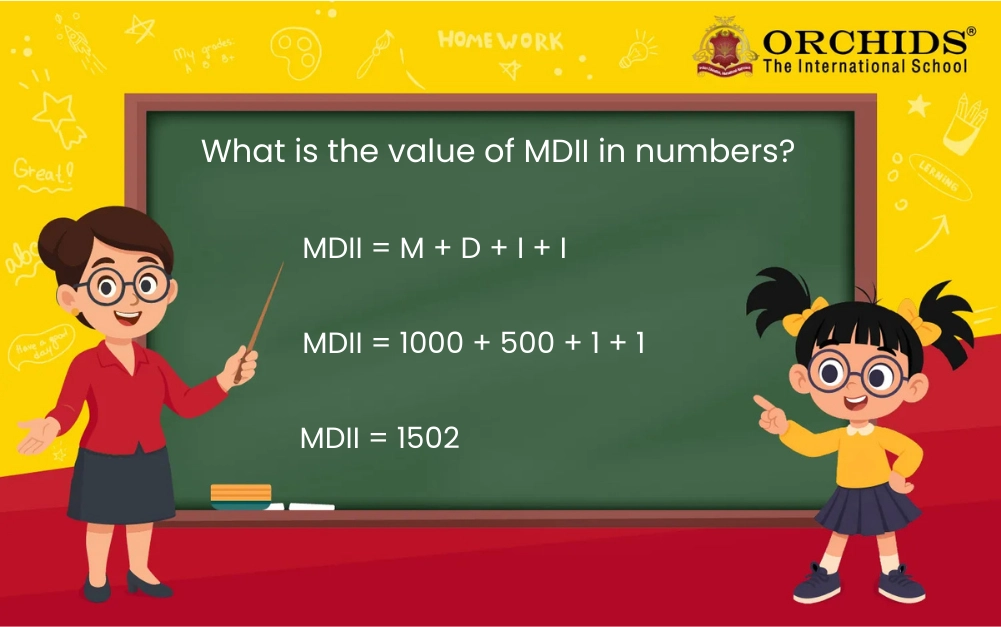
Let us break the Roman numeral MDII into individual symbols:
-
MDII = M + D + I + I
-
MDII = M + D + II
Now replace each symbol with its numerical value:
-
M = 1000
-
D = 500
-
I = 1
-
I = 1
Next, add the values step by step:
-
MDII = 1000 + 500 + 1 + 1 = 1000 + 500 + 2
-
MDII = 1502
Therefore, the number represented by MDII in Roman numerals is 1502.
Know more about related topics:
Numbers Related to MDII Roman Numerals
|
Roman Numerals |
Roman Numeral Expression |
Expanded Form |
Numbers |
|
MD |
M + D |
1000 + 500 |
1500 |
|
MDI |
M + D + I |
1000 + 500 + 1 |
1501 |
|
MDII |
M + D + I + I |
1000 + 500 + 1 + 1 |
1502 |
|
MDIII |
M + D + I + I + I |
1000 + 500 + 1 + 1 + 1 |
1503 |
|
MDIV |
M + D + (V − I) |
1000 + 500 + (5 − 1) |
1504 |
|
MDV |
M + D + V |
1000 + 500 + 5 |
1505 |
|
MDVI |
M + D + V + I |
1000 + 500 + 5 + 1 |
1506 |
|
MDVII |
M + D + V + I + I |
1000 + 500 + 5 + 1 + 1 |
1507 |
|
MDVIII |
M + D + V + I + I + I |
1000 + 500 + 5 + 1 + 1 + 1 |
1508 |
|
MDIX |
M + D + (X − I) |
1000 + 500 + (10 − 1) |
1509 |
|
MDX |
M + D + X |
1000 + 500 + 10 |
1510 |
Basic Rules for Writing Roman Numerals
To read MDII in Roman numerals, we follow the common rules of the Roman numeral system.
1. Remember the standard Roman numeral values
-
I = 1
-
V = 5
-
X = 10
-
L = 50
-
C = 100
-
D = 500
-
M = 1000
2. Identify the symbols in MDII
The numeral MDII contains the following values:
-
M = 1000
-
D = 500
-
I = 1
-
I = 1
3. Add the values from left to right
Since the numbers decrease from left to right, we simply add them:
1000 + 500 + 1 + 1 = 1502
Therefore, MDII represents the number 1502 in the Roman numeral system.
Solved Examples on MDII Roman Numerals
Example 1: Find the sum of MDII and CCL in Roman numerals.
Solution:
-
MDII = 1502
-
CCL = 250
Add the numbers:
1502 + 250 = 1752
Now convert 1752 into Roman numerals.
1752 = 1000 + 700 + 50 + 2
= M + DCC + L + II
= MDCCLII
Therefore, the sum of MDII and CCL in Roman numerals is MDCCLII.
Example 2: Evaluate the expression MDII − CC + XXX.
Solution:
-
MDII = 1502
-
CC = 200
-
XXX = 30
Now solve the expression:
1502 − 200 + 30 = 1332
Convert 1332 into Roman numerals.
1332 = 1000 + 300 + 30 + 2
= M + CCC + XXX + II
= MCCCXXXII
Hence, the result of MDII − CC + XXX is MCCCXXXII.
Example 3: Find the difference between MDII and DXL.
Solution:
-
MDII = 1502
-
DXL = 540
Now subtract the values:
1502 − 540 = 962
Convert 962 into Roman numerals.
962 = 900 + 60 + 2
= CM + LX + II
= CMLXII
Therefore, MDII − DXL = CMLXII.
Example 4: A museum recorded MDII visitors on Monday and CDL visitors on Tuesday. How many visitors came in total? Write the answer in Roman numerals.
Solution:
-
MDII = 1502
-
CDL = 450
Add the visitors:
1502 + 450 = 1952
Now convert 1952 into Roman numerals.
1952 = 1000 + 900 + 50 + 2
= M + CM + L + II
= MCMLII
So, the total number of visitors is MCMLII in Roman numerals.
Example 5: A library had MDII books. If CL books were donated to another school, how many books remain? Write the answer in Roman numerals.
Solution:
-
MDII = 1502
-
CL = 150
Subtract the books:
1502 − 150 = 1352
Now convert 1352 into Roman numerals.
1352 = 1000 + 300 + 50 + 2
= M + CCC + L + II
= MCCCLII
Therefore, the remaining number of books is MCCCLII in Roman numerals.
Practice Questions on MDII Roman Numerals
1. Write MDII in standard number form (Hindu-Arabic numerals).
2. Convert the number 1502 into Roman numerals.
3. Find the sum of MDII and C. Write the final answer in Roman numerals.
4. Subtract CC from MDII and express the result using Roman numerals.
5. Write the Roman numeral that comes just before MDII.
Conclusion
MDII Roman numerals represent 1502, formed by combining M + D + II using the Roman numeral addition rule. Learning MDII Roman numerals helps students understand number patterns and read Roman numeral dates and values more easily.
Understand MDII Roman numerals step by step and build strong number skills with Orchids International School.
Numbers make sense when they're taught right. To see how Orchids The International School turns Maths from intimidating to intuitive, reach out to our admissions team.
Frequently Asked Questions on MDII Roman Numerals
1. What does MDII represent in Roman numerals?
MDII in Roman numerals represents the number 1502. It is formed by adding the values of the symbols: M (1000), D (500), and II (2). When added together, 1000 + 500 + 2 = 1502.
2. How do you write 1502 in Roman numerals?
To write 1502 in Roman numerals, break the number into parts: 1502 = 1000 + 500 + 2. Replace each value with its Roman symbol: M + D + II. Therefore, 1502 is written as MDII.
3. How is MDII read in words?
The Roman numeral MDII is read as “one thousand five hundred two.” It follows the standard reading pattern of Roman numerals from left to right.
4. Which Roman numeral symbols are used in MDII?
The Roman numeral MDII uses three symbols: M (1000), D (500), and I (1). These symbols are placed in decreasing order of value to correctly represent the number 1502.
5. What is the remainder when MDII is divided by XV?
First convert the Roman numerals into numbers: MDII = 1502 and XV = 15. When 1502 is divided by 15, the remainder is 2. In Roman numerals, 2 is written as II. Therefore, the remainder is II.
Related Links


Admissions Open for 2026-27
What type of concept pages would you prefer?
CBSE Schools In Popular Cities
- CBSE Schools in Bangalore
- CBSE Schools in Mumbai
- CBSE Schools in Pune
- CBSE Schools in Hyderabad
- CBSE Schools in Chennai
- CBSE Schools in Gurgaon
- CBSE Schools in Kolkata
- CBSE Schools in Indore
- CBSE Schools in Sonipat
- CBSE Schools in Delhi
- CBSE Schools in Rohtak
- CBSE Schools in Bhopal
- CBSE Schools in Aurangabad
- CBSE Schools in Jabalpur
- CBSE Schools in Jaipur
- CBSE Schools in Jodhpur
- CBSE Schools in Nagpur
- CBSE Schools in Ahmednagar
- CBSE School In Tumkur











Orchids The International School is one of India's leading chains of CBSE and ICSE schools, with 110+ schools across the country.