

Watching World Cup 2026? Here’s all you need to know about yellow cards
By Orchids Editorial Team |
Date 10-07-2026
Watching World Cup 2026? Here’s all you need to know about yellow cards
Admissions Open for 2026-27
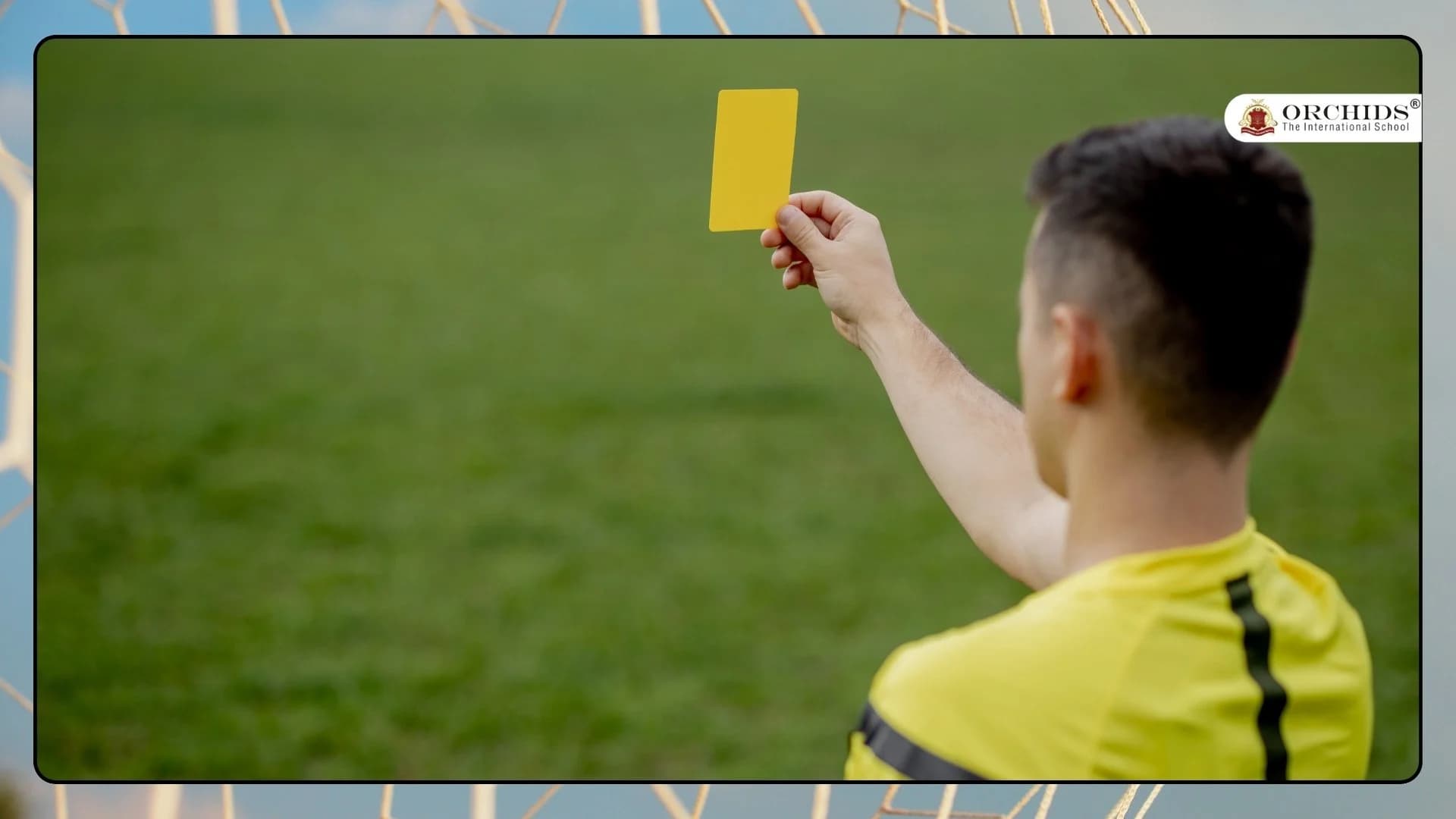
A moment happens in almost every football match, sometimes several times. A tackle goes in too hard. A player protests a decision a beat too long. The referee reaches into their pocket, pulls out a small rectangle of bright yellow, and holds it high. The crowd reacts. The commentators weigh in. And if you are watching with a child who has just discovered football, the questions begin.
What does the yellow card actually mean? Why does getting two of them send a player off? Can a goalkeeper receive one? Does it follow a player into the next match?
With FIFA World Cup 2026 in full swing, there has never been a better moment to understand one of football’s most visible and consequential rules. Here is everything you need to know.
What a yellow card actually is
In football, a yellow card is a formal caution issued by the referee to a player who has broken the rules in a way that warrants a warning but does not yet merit removal from the match. It is not a penalty in the immediate sense: the player stays on the field, and the game continues. But it carries weight, both within the match and, in many competitions, across the tournament as a whole.
The card itself is simple enough: a rectangle of bright yellow cardboard that the referee holds aloft after stopping play. The gesture is visible to everyone, the player, their teammates, the opposing side and the crowd. The player’s name and number are recorded. And from that moment, they are on notice.
Why referees issue yellow cards
Football is a fast-moving, physically competitive sport, and not every infringement is equal. Referees use yellow cards to address behaviour that is serious enough to warrant a formal warning without being severe enough to justify sending the player off entirely.
The most common reasons a player receives a yellow card in World Cup 2026 matches include:
-
Unsporting behaviour: This covers a wide range of actions, from excessive goal celebrations to diving, which is when a player exaggerates contact to win a free kick or penalty, to taunting an opponent.
-
Dangerous or reckless play: A tackle that shows no regard for the safety of an opponent, even if no serious injury results, will typically draw a yellow card. The intent matters less than the recklessness of the action.
-
Wasting time: A player who holds the ball too long, delays a throw-in, or takes excessive time over a free kick when the team is protecting a lead can be cautioned for time-wasting.
-
Dissent: Arguing with the referee, disputing decisions repeatedly or showing disrespect to match officials is one of the more common causes of yellow cards at the highest level of the game.

-
Repeated minor fouls: A player who commits several small fouls in quick succession, none of which individually warrant a card, can be cautioned if the referee judges the pattern to be deliberate.
What happens after a player receives a yellow card
The immediate consequence is straightforward: the player continues playing, but under a heightened level of scrutiny. A second yellow card in the same match automatically becomes a red card, meaning the player is sent off the field for the rest of the game and their team must continue with ten players rather than eleven.
This changes things considerably. A player who has been cautioned will typically adjust how they approach challenges, avoid getting into confrontations with opponents and generally play with more restraint than they might otherwise. Their coach may decide to substitute them before the risk of a second caution becomes too great, particularly if the player is in a position that requires aggressive defending.
The opposing team, meanwhile, may attempt to exploit the situation, targeting the cautioned player with quick runs and sharp passes designed to force them into a challenge that earns them a second yellow.
Yellow card vs red card: The Key differences
The two cards are part of the same disciplinary system but operate very differently.
-
A yellow card is a caution. The player stays on the field, and the team is not reduced in number. One yellow card in isolation has no immediate impact on the match result. Two yellow cards in the same match, however, automatically produce a red card and result in the player being sent off.
-
A red card can also be issued directly, without a preceding yellow card, for serious misconduct: violent conduct, dangerous foul play, deliberately handling the ball to prevent a goal, or using offensive language toward officials. A direct red card dismissal is typically more serious than a dismissal resulting from two yellows.
When a player is sent off, their team plays the remainder of the match with ten outfield players. No replacement is permitted. This is one of the most significant disadvantages a team can face, and matches have frequently turned on a red card.
How yellow cards carry over in the World Cup
This is one of the more important rules to understand during the FIFA World Cup 2026 and one that regularly produces drama in the later stages of tournaments.
Yellow cards accumulated during the group stage carry over into the knockout rounds up to a point. Under FIFA’s standard tournament rules, a player who receives two yellow cards across different matches during the group stage faces a one-match suspension. After the round of sixteen, yellow card tallies are typically reset so that a caution picked up early in the tournament does not automatically affect the final or the semifinals.
This means that during the group stage, managers must track not just how their players are performing but how many cautions they are carrying. A key player sitting on a yellow card ahead of the final group match may be rested or instructed to play more carefully, even if the team needs them at full intensity.
Also read: World Cup 2026: Five ways to make the football championship unforgettable for your kids
Can goalkeepers receive yellow cards
Yes, and it happens more often than casual viewers might expect.
Goalkeepers are subject to exactly the same rules as outfield players. A goalkeeper who wastes time by holding the ball for too long, who leaves their penalty area to make a reckless challenge, or who argues with officials can be cautioned just as any other player can.
A yellow card for a goalkeeper carries the same consequences: a second yellow in the same match means a red card and dismissal. Since teams carry only one substitute goalkeeper on the bench, this situation, while rare, can be dramatic. An outfield substitute may have to don the gloves if the backup goalkeeper has already been used.
Famous yellow card moments in World Cup history
The World Cup has produced some of the most talked-about disciplinary moments in football history.
The most often cited involves referee Graham Poll at the 2006 FIFA World Cup, who gave Croatian player Josip Šimunić three yellow cards in a single match before finally issuing a red. Poll’s error, an extraordinary and unrepresentable oversight, was widely discussed and led to renewed attention on referee accountability at major tournaments.
Yellow card accumulations have also shaped the outcomes of knockout rounds in multiple World Cups, with key players missing crucial matches through suspension after picking up cautions in earlier games. The tactical dimension of managing yellow cards across a tournament is a genuine part of how elite football teams prepare for and navigate major competitions.
A quick reference guide to yellow cards
For easy reference during World Cup 2026 matches:
-
One yellow card: Formal caution, player stays on the field
-
Two yellow cards in the same match: Automatic red card, player sent off
-
Two yellow cards across different group stage matches: One-match suspension
-
Yellow card tallies: Typically reset after the round of sixteen in World Cup tournaments
-
Goalkeepers: Subject to the same yellow card rules as outfield players
-
VAR: Video assistant referees can review incidents and recommend yellow or red card be issues or rescinded
At Orchids The International School, moments like a live World Cup tournament are exactly the kind of real-world context that makes learning stick. Whether it is the geometry of a free kick, the psychology of a penalty shootout, or the rules of a yellow card, sport offers a classroom that children genuinely want to be in.
Explaining yellow cards to children
For younger viewers watching World Cup 2026 for the first time, the yellow card is one of the easier rules to explain because it has a clear visual signal and a tangible consequence.
A useful comparison is the kind of warning system children counter in school: a first reminder that behaviour needs to change, followed by a more serious consequence if it continues. The yellow card is football’s version of that first warning. It does not end the game for the player, but it changes the conditions under which they continue.
Children who understand the yellow card system tend to engage with matches more actively. They notice when a player is sitting on a caution. They understand why a coach makes a particular substitution. They start to read the game as something more than just goals and fouls.
The yellow card is one of football’s simplest ideas with some of its most complex consequences. Understanding it fully makes every match more interesting to watch and every referee decision easier to follow.
Want to know more about how we bring the world into the classroom at Orchids The International School? Reach out to our admissions team to learn more.


Admissions Open for 2026-27
Recent Blogs





CBSE Schools In Popular Cities
- CBSE Schools in Bangalore
- CBSE Schools in Mumbai
- CBSE Schools in Pune
- CBSE Schools in Hyderabad
- CBSE Schools in Chennai
- CBSE Schools in Gurgaon
- CBSE Schools in Kolkata
- CBSE Schools in Indore
- CBSE Schools in Sonipat
- CBSE Schools in Delhi
- CBSE Schools in Rohtak
- CBSE Schools in Bhopal
- CBSE Schools in Aurangabad
- CBSE Schools in Jabalpur
- CBSE Schools in Jaipur
- CBSE Schools in Jodhpur
- CBSE Schools in Nagpur
- CBSE Schools in Ahmednagar
- CBSE School In Tumkur

Call Us to know more about Orchids











Orchids The International School is one of India's leading chains of CBSE and ICSE schools, with 110+ schools across the country.