

Overstimulation: How sensory overload is eroding patience, attention and critical thinking in kids
By Priyadarshini Bhattacharjee |
Date 25-06-2026
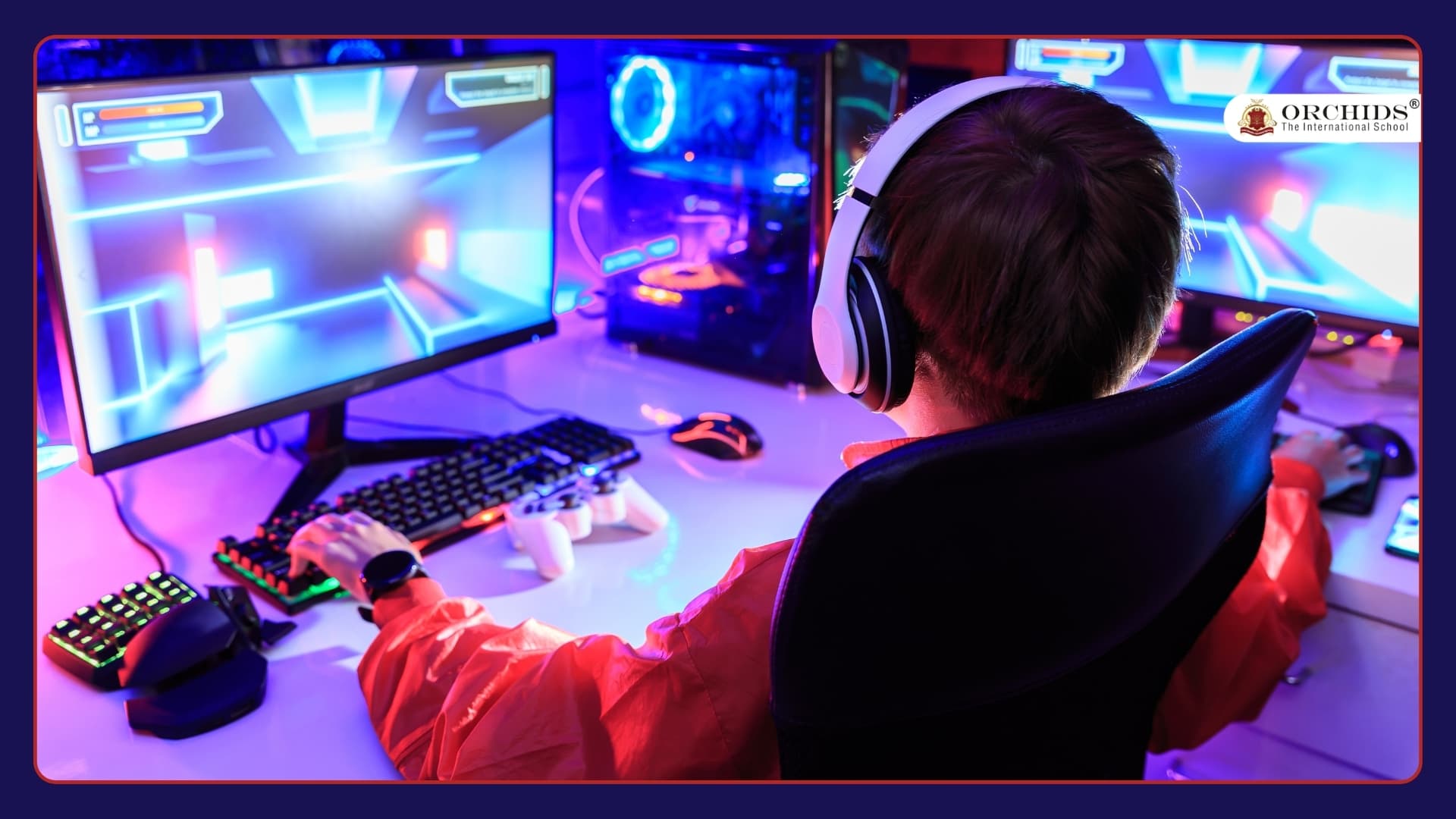
Overstimulation is not simply about too much screen time, though screens are often the most visible delivery mechanism.
Admissions Open for 2026-27
There is a particular kind of stillness that used to be ordinary. A child staring out of a car window. A long wait at a doctor’s office with nothing to do. A quiet afternoon with no plan. These moments were never exciting, but they were not meant to be. They were the spaces in which a young mind learnt to sit with itself. That stillness has become rare. Not because children have changed, but because almost every gap in their day is now filled before it has a chance to open. A notification, a video, a quick answer from an AI tool, a new tab. The space where boredom used to live has been steadily occupied, and what is quietly disappearing in its place is something far more consequential than a moment of idleness: patience, attention and the capacity for critical thought.
This is worth examining carefully, not as a moral panic about screens, but as a genuine question about what constant stimulation is doing to the developing mind.
What overstimulation actually means
Overstimulation is not simply about too much screen time, though screens are often the most visible delivery mechanism. It refers to a state in which the brain and the senses are receiving more input, cognitive and physical, than they can meaningfully process, sort or rest from. A child today is frequently absorbing several layers of stimulation simultaneously: moving images, sound, background notifications, conversation in the room, and sometimes more than one device competing for attention at once. The nervous system, much like the mind, needs genuine downtime to reset, and that downtime is becoming harder to find.
A child’s brain, particularly in the years when it is still developing the architecture for focus and self-regulation, is not built to operate in a constant stream of fast-changing, high-reward input. Much of this comes down to dopamine, the brain chemical associated with reward and motivation. Every notification, every new video, every quick win in a game triggers a small dopamine release, and the brain begins to anticipate that hit before it even arrives. Short videos are engineered to deliver a small reward every few seconds. Games are structured around frequent, unpredictable wins, and the unpredictability matters: a brain that does not know exactly when the next reward is coming stays more engaged than one on a fixed schedule, which is precisely why scrolling feels so difficult to stop.
The result, increasingly documented by researchers and observed by teachers, is a kind of cognitive and sensory restlessness. Children who struggle to stay with a single task. Children who reach for something else within minutes of starting an activity that does not offer instant reward. Children for whom stillness itself has started to feel uncomfortable, not because they are being difficult, but because their brains and bodies are responding exactly as they have been trained to
Also read: Screen time rules for kids are not enough: Here is what actually works!

The quiet erosion of patience
Patience is not an innate personality trait that some children have and others lack. It is a skill, built through repeated experience of waiting, of sitting with discomfort, of working toward something that does not pay off immediately. When nearly every want is met within seconds, that skill has fewer opportunities to develop. A brain trained on frequent, fast reward starts to find slower, less immediately rewarding activities, like reading, a long maths problem, or an unstructured afternoon, comparatively unsatisfying. Not because those activities have become less valuable, but because the baseline for what counts as engaging has shifted. A child who has rarely had to wait for an answer, an entertainment or a resolution to boredom does not arrive at patience naturally. They arrive at it only if someone deliberately creates the conditions for it.
This shows up well beyond entertainment. It shows up in how children approach difficult homework problems, abandoning them faster than they once did. It shows up in friendships and family relationships, where the tolerance for a slow, occasionally frustrating conversation has visibly thinned, sometimes surfacing as irritability or a short fuse that seems disproportionate to whatever triggered it. Patience, once a background skill children simply absorbed through ordinary life, increasingly has to be taught on purpose.
Attention is not simply shrinking. It is being trained differently
It has become common to say that attention spans are shrinking, but the more accurate description is that attention is being trained toward a very specific pattern: short bursts, immediate reward, then a turn toward the next thing.
This pattern works against almost everything meaningful learning requires. Reading a chapter, solving a multi-step maths problem, sitting through a science experiment that takes time to unfold: all of these demand sustained attention without an immediate payoff. A mind trained on fifteen-second loops finds this kind of sustained effort genuinely uncomfortable, not because the child lacks intelligence, but because the muscle of sustained focus has had fewer chances to develop and because a constantly engaged nervous system rarely gets the quiet it needs to settle into something slower.
Teachers report this shift consistently: students who can engage briefly and energetically but struggle to stay with a task long enough to work through real difficulty. Some of this surfaces as restlessness with no obvious single cause, because the cause is cumulative rather than singular, the result of a day spent processing far more sensory and cognitive input than previous generations of children even encountered. The difficulty itself is often where the learning happens, and it is precisely the part that an overstimulated mind is least equipped to tolerate.
What artificial intelligence is quietly accelerating
Artificial intelligence has become one of the more significant accelerants of this pattern, not because the technology itself is harmful, but because of how it is often used.
When a child can get an instant, polished answer to almost any question, the incentive to sit with not knowing, to struggle through a problem, to think it through themselves, diminishes considerably. Critical thinking is built in exactly those uncomfortable moments of not having an answer yet. It is the process of holding uncertainty, testing ideas, getting things wrong and adjusting. If that process is consistently shortcut by an instant, correct-sounding response, the skill underneath it does not get the repetition it needs to strengthen, in much the same way that a brain accustomed to constant reward never quite settles into the discomfort that real thinking requires.
This does not mean AI tools have no place in a child’s learning. It means the way they are used matters enormously. A tool used to explore an idea further, after genuine effort has already been made, supports thinking. A tool used to skip the effort altogether quietly erodes the very capacity it was meant to assist.
The fading capacity to read deeply
Among the more specific casualties of overstimulation is sustained reading, the kind that requires a child to hold a narrative or an argument in their mind across many pages, returning to it patiently over days.
Deep reading asks something that short-form, highly stimulating content does not: tolerance for a slower unfolding of meaning. A book does not reward attention every few seconds the way a video feed does. It asks the reader to wait, to follow, to build understanding gradually. For a mind accustomed to constant, fast payoff and a nervous system rarely given the chance to settle, this can feel less like reading and more like an act of endurance.
This matters because deep reading and critical thinking are closely linked. The ability to follow a complex idea across several paragraphs, to hold multiple threads of an argument simultaneously and to reach a considered conclusion, rather than a quick reaction, is substantially built through the practice of sustained reading. As that practice becomes rarer, so does the kind of thinking it cultivates.
Also read: 2026 summer reads: 7 books worth picking up for your child!
Why boredom deserves to be defended, not eliminated
There is a strong cultural instinct to treat a bored child as a problem to be solved immediately. But boredom, uncomfortable as it is, plays a genuine developmental role. It is in the space of boredom that imagination tends to activate. A child without an immediate source of stimulation will, given enough time, begin to generate their own: a game, a story, a question, a private train of thought. This self-generated activity builds something that externally provided entertainment cannot: the capacity to occupy one’s own mind, to be self-sufficient in moments of stillness and to tolerate the discomfort that almost always precedes a genuinely original idea. It is also, quite simply, one of the few remaining moments in a child’s day when the senses and the mind are not being asked to process anything at all.
Removing boredom entirely does not protect children. It quietly removes one of the conditions under which independent thought is most likely to emerge.
What this looks like in the classroom
A classroom that wants to counter overstimulation has to be deliberate about it, because very little in a child’s environment outside school is working in that direction. It means resisting the instinct to resolve every question quickly, allowing silence after a difficult question instead of rushing to fill it, and treating the discomfort of not knowing as part of the learning process rather than something to be removed as fast as possible.
At Orchids The International School, this understanding shapes how the curriculum is approached. Encouraging critical thinking is not treated as a single lesson or activity but as a thread that runs through how subjects are taught: posing questions that do not have an immediate, single answer, giving students time to sit with a problem before offering help and creating space within the school day for the kind of unstructured thinking that overstimulation tends to crowd out elsewhere.
This is a deliberate counterbalance to a world where instant answers are everywhere. A classroom that protects the time and discomfort that real thinking requires gives children something increasingly rare outside its walls.
What parents and educators can actually do
None of this calls for eliminating technology or treating stimulation itself as the enemy. It calls for a more deliberate approach to the gaps in a child’s day. Protecting some unstructured, unstimulated time each day, even briefly, gives the mind and the senses room to do their own work and genuinely rest. Allowing children to sit with a difficult problem a little longer before offering the answer builds the tolerance that critical thinking depends on. Encouraging sustained reading, even in short, consistent sessions, rebuilds the patience that fast content erodes. And modelling a healthy relationship with technology, including AI tools, teaches children that these are aids to thinking, not replacements for it.
None of these steps are dramatic. All of them work against a current that is, at this point, quite strong. But patience, attention and critical thinking are not lost all at once. They are worn away gradually, in small moments, which means they can also be rebuilt the same way.
Curious about how we build critical thinking into everyday learning? Reach out to our admissions team to learn more about the learning environment at Orchids The International School.


Admissions Open for 2026-27
Recent Blogs





CBSE Schools In Popular Cities
- CBSE Schools in Bangalore
- CBSE Schools in Mumbai
- CBSE Schools in Pune
- CBSE Schools in Hyderabad
- CBSE Schools in Chennai
- CBSE Schools in Gurgaon
- CBSE Schools in Kolkata
- CBSE Schools in Indore
- CBSE Schools in Sonipat
- CBSE Schools in Delhi
- CBSE Schools in Rohtak
- CBSE Schools in Bhopal
- CBSE Schools in Aurangabad
- CBSE Schools in Jabalpur
- CBSE Schools in Jaipur
- CBSE Schools in Jodhpur
- CBSE Schools in Nagpur
- CBSE Schools in Ahmednagar
- CBSE School In Tumkur

Call Us to know more about Orchids











Orchids The International School is one of India's leading chains of CBSE and ICSE schools, with 130+ schools across the country.