

Folk dances of Uttar Pradesh: A complete guide to the state’s most celebrated dance traditions
By Orchids Editorial Team |
Date 16-07-2026
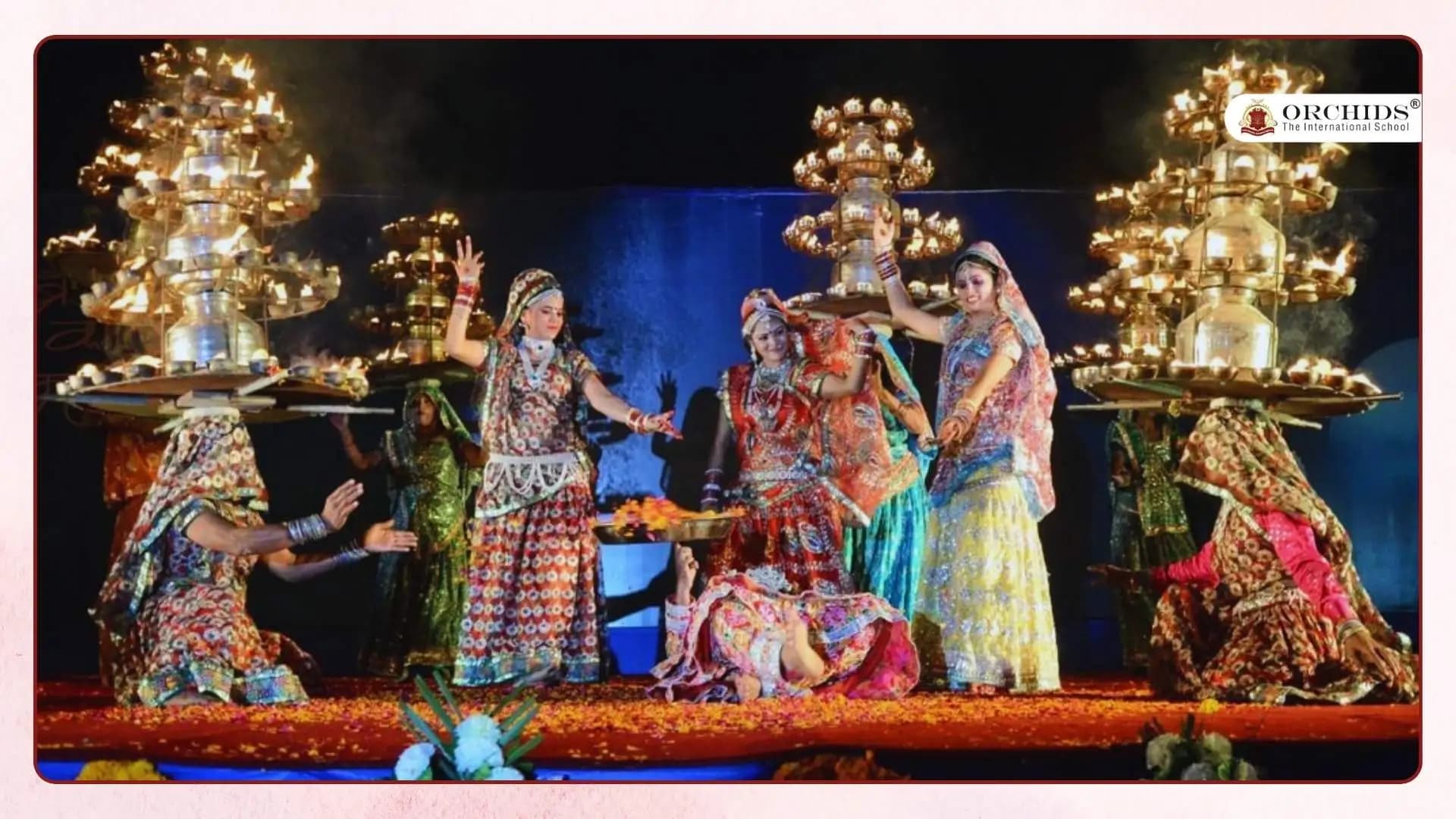
A glimpse of a Charkula Dance performance on stage; (image credit: @UPSC_EDU/X)
Admissions Open for 2026-27
Long before cinema, long before concert halls and long before recorded music, communities across Uttar Pradesh told their stories through dance.
Devotion to Krishna. The harvest coming in. A wedding in the village. The onset of the monsoon. The birth of Radha. Each of these moments had its own rhythm, its own movement, its own way of being celebrated. And many of those traditions are still alive today, performed at festivals, taught to children and carried forward by communities who understand that a dance is never just a dance. It is a way of remembering who you are.
Uttar Pradesh, often called the heartland of India, is home to one of the richest concentrations of folk dance traditions in the country. This guide covers the most celebrated of them: where they come from, what makes each one distinct and why they still matter.
The folk dance traditions of Uttar Pradesh
The dances of Uttar Pradesh did not emerge from a single source. Some grew out of devotion, some out of agricultural life, some out of the specific geography and tribal heritage of regions like Braj and Bundelkhand. What they share is a rootedness in community and a way of making the ordinary feel sacred.
1. Raslila
Of all the folk dance traditions in Uttar Pradesh, Raslila is among the most beloved and widely recognised. It is a devotional dance-drama that originated in the Braj region and reenacts episodes from the life of Lord Krishna, particularly his playful and divine interactions with the Gopis, the milkmaids of Vrindavan.
Rooted in the Bhakti movement of the 16th and 17th centuries and popularised through the compositions of saints like Swami Haridas, Raslila is performed most prominently during Holi and Janmashtami. Performers wear elaborate traditional costumes and jewellery, accompanied by classical instruments, including the flute, tabla and harmonium, with devotional songs called 'bhajans' weaving through the performance.
What makes Raslila particularly distinctive is its improvisational quality. Performers do not follow a rigid script: the dance drama breathes and shifts, allowing artists to bring their own expression to Krishna’s stories. At its heart, Raslila is an act of devotion expressed through movement.
-
Origin: Braj region, Uttar Pradesh
-
Performed during: Holi, Janmashtami and religious festivals
-
Interesting fact: According to tradition, Lord Krishna himself performed the first Raslila with the Gopis, and the dance is considered a living continuation of that divine act.
2. Charkula
Charkula is one of the most visually striking folk dances in India, not just Uttar Pradesh. Performed by women in the Braj region, it involves dancers balancing a large multi-tiered wooden pyramid fitted with as many as 108 lit oil lamps on their heads, all while performing rhythmic, graceful movements to devotional music.
The dance is traditionally performed to celebrate the birth of Radha and is associated with Akshaya Tritiya and other festive occasions. The number 108 is considered sacred in Hindu tradition, and the lit lamps represent joy, devotion and the triumph of light.
What the performance demands is extraordinary: physical endurance, precise balance and a calm concentration that allows a dancer to carry a towering, flame-lit structure on her head without losing a step. Watching Charkula is to watch grace and devotion made entirely physical.

-
Origin: Braj region, Uttar Pradesh
-
Performed during: Akshaya Tritiya and Radha birth celebrations
-
Interesting fact: Each Charkula pyramid can hold up to 108 oil lamps, making every performance a spectacle of light as much as movement.
3. Kathak
Kathak is the only classical dance form on this list, and its origins in Uttar Pradesh give it a special place in the state’s cultural identity. Tracing back to temple traditions around 400 BCE, Kathak began as a form of devotional storytelling performed by kathakars, or storytellers, who used movement, gesture and expression to bring mythological narratives to life for temple audiences.
During the Mughal period, the dance moved from temples to royal courts and evolved significantly, incorporating Persian and Central Asian influences that brought a new elegance and precision to its movements. The result is a dance form with two distinct but equally celebrated schools: the Lucknow Gharana, known for its lyrical grace and emotional subtlety, and the Banaras Gharana, known for its energy, powerful footwork and connection to its devotional roots.
Kathak is characterised by intricate footwork known as 'tatkar', rapid spins called 'chakkar', expressive facial gestures or ‘mudras’ to narrate stories. A skilled Kathak dancer can perform more than 100 consecutive spins without losing balance or rhythm.
-
Origin: Temple traditions of Uttar Pradesh, with significant development under Mughal patronage
-
Performed during: Classical performances, cultural events, festivals
-
Interesting fact: The word 'Kathak' derives from the Sanskrit word 'katha', meaning 'story'. The dance is, at its core, a form of storytelling.
Also read: Oral Storytelling in India: Exploring Voices and Traditions Across Ages
4. Kajri
Kajri is a folk music and dance tradition that belongs to the monsoon season. Deeply embedded in the rural life of Uttar Pradesh, particularly in and around Varanasi, Mirzapur and Allahabad, Kajri songs are expressions of longing, love and the particular emotional texture that arrives with the rains.
Women traditionally sang Kajri while working in the fields during the monsoon months, and the songs carried themes of separation, the beauty of nature and the ache of waiting. The music itself is rich and soulful, accompanied by the tabla, harmonium and sitar, and the movements are gentle and expressive, reflecting the melancholy and beauty of the season.
Kajri has over time become a semi-classical form, performed on stage by trained artists while remaining rooted in its folk origins. It is one of the most emotionally resonant traditions in Uttar Pradesh’s cultural life.
-
Origin: Eastern Uttar Pradesh, particularly Varanasi, Mirzapur and Allahabad
-
Performed during: Monsoon season, particularly the month of Sawan
-
Interesting fact: Kajri is one of the few folk traditions in India that is specifically seasonal, performed almost exclusively during the months of monsoon.
5. Dadra
Dadra is a semi-classical dance and music form that developed in Uttar Pradesh in the 19th century. It is characterised by its light, lilting rhythm and combines elements of classical music with accessible folk melodies, making it one of the more approachable and widely enjoyed forms in the state’s musical tradition.
Where Kajri is tied to the monsoon, Dadra is associated with celebration and the expression of romantic emotion. The movements are graceful and rhythmic, often performed alongside Kajri at the same festivals and gatherings. Together, Dadra and Kajri form a complementary pair that captures both the joy and the longing that run through Uttar Pradesh’s folk music traditions.
-
Origin: Uttar Pradesh, with connections to the classical music traditions of the region
-
Performed during: Monsoon festivals, cultural events
-
Interesting fact: Dadra takes its name from the Dadra tala, a six-beat rhythmic cycle that gives the form its characteristic lightness and swing.
6. Chappeli
Chappeli is a community folk dance performed in the Kumaon foothills region that borders Uttar Pradesh and has been adopted into the folk traditions of the state’s northern areas. It is traditionally performed by women and involves the use of props including mirrors and handkerchiefs, which are woven into the choreography to create a visually playful and technically engaging performance.
The dance is associated with social gatherings, fairs and festive occasions, and its movements are characterised by a lively, rhythmic energy that brings groups of women together in a shared expression of celebration. Chappeli is one of the more joyful folk traditions in the region, its bright costumes and prop-based choreography making it immediately engaging for audiences of all ages.
-
Origin: Kumaon foothills, widely performed in northern Uttar Pradesh
-
Performed during: Fairs, festivals and community celebrations
-
Interesting fact: The use of mirrors and handkerchiefs as props in Chappeli is unusual in Indian folk dance and gives the form a distinct playful visual character.
7. Rai
Rai is a folk dance that originates from the Bundelkhand region of Uttar Pradesh and is closely associated with the Bedia community. It is traditionally performed by women and is known for its quick, intricate footwork and energetic rhythmic movements, accompanied by instruments like the dholak and nagara.
Rai has an interesting cultural history: what began as a dance associated with specific communities and occasions has over time become a broader symbol of Bundelkhand’s cultural identity, performed at weddings, festivals and regional celebrations across the area. The dance is raw, rhythmically complex and deeply rooted in the specific landscape and history of Bundelkhand.
-
Origin: Bundelkhand region, Uttar Pradesh
-
Performed during: Weddings, festivals and regional celebrations
-
Interesting fact: Rai was historically associated with court performances but has since become a dance belonging to the wider community.
8. Shaira
Shaira is another folk dance tradition from the Bundelkhand region, typically performed during weddings and celebrations. It often incorporates storytelling elements and humour, with performers using everyday objects as props to add colour and spontaneity to the performance.
Where Rai is known for its rhythmic intensity, Shaira has a more narrative quality, drawing audiences in through comic moments and culturally resonant stories. Together, Rai and Shaira represent the two complementary strands of Bundelkhand’s folk performance tradition: the visceral and the narrative, the rhythmic and the storytelling.
-
Origin: Bundelkhand region, Uttar Pradesh
-
Performed during: Weddings and festive celebrations
-
Interesting fact: Shaira performances often include improvised comic sequences that are adapted to the specific audience and occasion, making each performance genuinely unique.
Why these traditions matter for children
Folk dances are not simply historical artefacts. They are living connections between generations, between communities and between the people of a region and the land, seasons and stories that have shaped them.
For children, learning about folk dance traditions builds cultural literacy in a way that textbooks rarely can. It connects them to the rhythms and stories of the communities around them, introduces them to the history and geography of their state through something embodied and immediate, and gives them a richer understanding of what culture actually means: not just buildings and monuments, but living, moving, breathing expression.
At Orchids The International School, cultural education goes beyond dates and facts. Understanding why a community in Braj lights 108 lamps and places them on a dancer’s head, or why the women of Varanasi sing a particular kind of song when the monsoon arrives, is a doorway into history, geography, music and the human stories that connect them all.
Preserving what has been built
Many of Uttar Pradesh’s folk dance traditions face genuine challenges. Urbanisation, changing lifestyles and the pull of mass entertainment have all reduced the space in which these forms naturally thrive. Festivals like the Taj Mahotsav and Lucknow Mahotsav provide platforms for folk artists, and organisations like the Sangeet Natak Akademi support documentation and promotion efforts. But the most durable preservation happens not in institutions but in families and communities where children are shown, before they are told, that these dances belong to them.
Curious about how we bring India’s cultural heritage into the classroom? Reach out to our admissions team to learn more about the learning environment at Orchids The International School.


Admissions Open for 2026-27
Recent Blogs



CBSE Schools In Popular Cities
- CBSE Schools in Bangalore
- CBSE Schools in Mumbai
- CBSE Schools in Pune
- CBSE Schools in Hyderabad
- CBSE Schools in Chennai
- CBSE Schools in Gurgaon
- CBSE Schools in Kolkata
- CBSE Schools in Indore
- CBSE Schools in Sonipat
- CBSE Schools in Delhi
- CBSE Schools in Rohtak
- CBSE Schools in Bhopal
- CBSE Schools in Aurangabad
- CBSE Schools in Jabalpur
- CBSE Schools in Jaipur
- CBSE Schools in Jodhpur
- CBSE Schools in Nagpur
- CBSE Schools in Ahmednagar
- CBSE School In Tumkur

Call Us to know more about Orchids











Orchids The International School is one of India's leading chains of CBSE and ICSE schools, with 130+ schools across the country.