

Under my umbrella: A monsoon guide to choosing the perfect shield for your kid
By Priyadarshini Bhattacharjee |
Date 12-07-2026
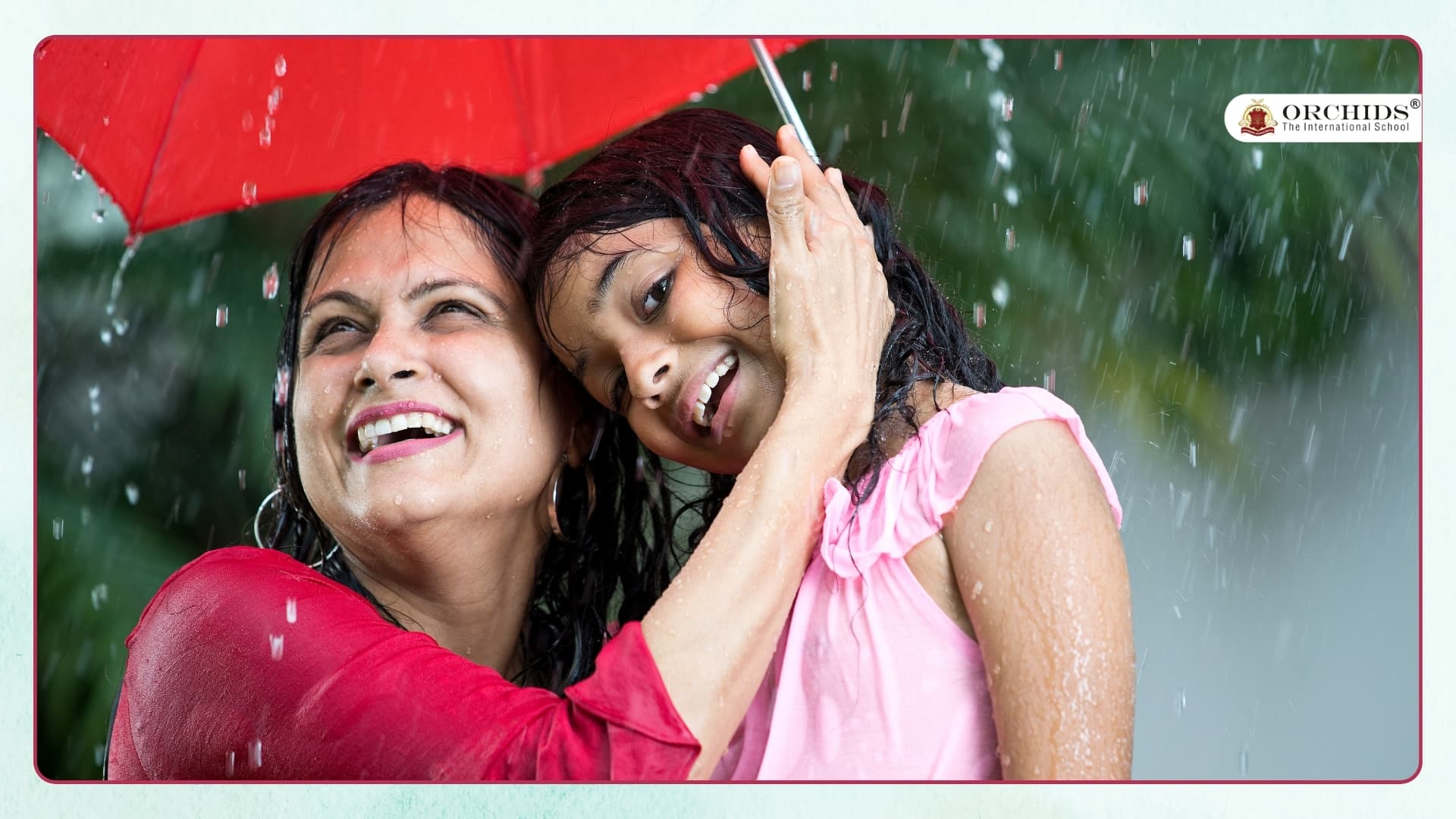
This monsoon, let the conversation with your little one be about raindrops and umbrellas.
Admissions Open for 2026-27
Puddles are back. School bags are getting damp. And somewhere in the house, last year’s umbrella has turned up with a broken spoke and a stubborn rib that refuses to open all the way. Monsoon is in full swing across the country and for families with school-going children, that means one familiar question returns with the rains: which umbrella actually works for a child who is going to swing it, sit on it, forget it on the bus and somehow still expect it to keep them dry?
The good news is that choosing the right monsoon shield for a child is more interesting than it sounds. Umbrellas have more variety, more design intelligence and more personality than most people give them credit for, and 2026 has brought in some genuinely clever options that did not exist a few years ago. Finding the right one is not just about waterproofing. It is about size, weight, durability, ease of use and, if you have ever watched a child lose interest in something within 48 hours, a little bit of staying power. Here’s a guide to every type worth knowing about and how to match one to the child in front of you.
From classic to contemporary: Every umbrella type your child might need this monsoon
Umbrellas today are a far cry from the sturdy black canopy that generations before us grew up with. Designs have evolved to address specific problems, from coastal wind to urban visibility to children who genuinely cannot be trusted with a sharp tip. Here is what is available, what each does well and who it suits best.
1. The compact foldable
If your child regularly arrives home with one fewer item than they left with, the compact foldable is your best friend. These umbrellas collapse into a small cylinder that fits inside a school bag or a jacket pocket, making them the most practical option for children who commute independently.
Modern compact foldables are considerably sturdier than older versions. Look for ones with fibreglass ribs rather than metal, since fibreglass flexes in wind rather than bending permanently, and an auto-open mechanism that a child can manage with one hand. The trade-off is coverage: compact foldables work well in light to moderate rain but may leave a child damp in a proper monsoon downpour.
Best for: younger children, shorter commutes, children who tend to misplace things.
2. The full-length classic
The traditional straight-handle umbrella offers the most coverage of any type, designed for actually staying dry rather than fitting into a bag. Full-length umbrellas have larger canopies, handle gusty monsoon winds better than smaller models and are generally more robust.
The challenge with children is the size. Look for child-specific versions with shorter shafts and lighter frames, which retain the coverage advantage without becoming a tripping hazard. A full-length umbrella with a rubberised, rounded tip is also significantly safer for a child navigating a crowded school corridor.
Best for: older children walking longer distances, heavy monsoon regions, children who take care of their belongings.
3. The transparent umbrella
One of the most visible trends of the past few seasons, transparent umbrellas have become genuinely popular for children, and for good reason. Made from clear PVC or POE plastic, these umbrellas let children see exactly where they are going without tilting the canopy away from their face.

For children navigating busy pavements, crossing roads or walking through crowded school gates in heavy rain, the visibility advantage is real and meaningful. The clear canopy also has an undeniable aesthetic appeal that children respond to, particularly the versions that come printed with subtle cartoon characters or coloured borders.
They are slightly heavier than fabric options and can fog up in warm, humid weather, which is most of the Indian monsoon season. They are not always the most compact option either. But as a primary monsoon umbrella for a child who walks to school, they are among the best-designed options currently available.
Best for: children who walk to school, urban environments with foot traffic, children who find standard umbrellas hard to navigate.
4. The bubble umbrella
A close relative of the transparent umbrella, the bubble or dome umbrella features a deeply curved canopy that wraps around the sides rather than sitting flat above the head. This design offers protection from rain that comes in at an angle, which is, as any Indian monsoon will confirm, almost always how rain actually arrives.
The enclosed dome keeps wind-driven rain off the face and neck in a way that a flat canopy simply cannot. Children particularly enjoy the enclosed feeling, which makes an afternoon in the rain feel more like an adventure than an inconvenience. Bubble umbrellas are available in both opaque and transparent versions.
Best for: children in coastal or high-wind regions, children who particularly dislike getting their face wet, families looking for something a little different.
5. The inverted umbrella
One of the more cleverly designed innovations in recent years, the inverted umbrella features a canopy that folds upward rather than downward when closed. The result is that the wet side of the canopy folds inward when you close it, keeping the drips contained rather than spreading them across a school corridor floor or a car seat.
For older children who get in and out of cars or autorickshaws in the rain, this is a genuinely useful feature. The inverted design also means the umbrella can stand upright on its own when closed, which is a small but satisfying detail. These umbrellas often come with a C-shaped handle that allows the user to hook it over their wrist, keeping both hands free while boarding a vehicle.
The design can initially confuse younger children, since the opening and closing mechanism works in reverse to what they are used to. It is better suited to children aged ten and above.
Best for: older children, children who travel by car or autorickshaw, families who have lost patience with wet umbrella drips everywhere.
6. The windproof umbrella
Families in coastal cities like Mumbai, Chennai or Kochi, or in regions where monsoon arrives with particular force, will know that a regular umbrella in strong wind is a liability. The canopy inverts, the frame bends, and the whole thing becomes more sail than shelter.
Windproof umbrellas use a double-canopy system with a layer of vented fabric that allows wind to pass through rather than catching it, paired with fibreglass frames that flex rather than snap. These umbrellas can handle wind speeds that would destroy a standard model. They are heavier and more expensive, but in areas where monsoon means genuinely challenging conditions, they are worth the investment.
Best for: coastal families, children in regions with heavy seasonal winds, older children who manage their own commute.
7. The UV-protective umbrella
Monsoon does not last forever, and in many parts of India, what follows it is months of sharp, intense sunlight. A UV-protective umbrella, coated with a material that blocks ultraviolet radiation, can be used in both rain and sun. These carry a UPF rating, usually between 30 and 50, and offer protection that sunscreen alone may not fully cover.
They are not always as waterproof as rain-specific umbrellas, so it is worth checking the specifications before buying. But for families looking for year-round value from a single umbrella, a dual-function UV-protective model makes good practical sense.
Best for: families in high-UV regions, children with outdoor activities, parents looking for year-round value.
Also read: Four Seasons for Kids: Names, Descriptions, Vocabulary and Activities in English
8. The character and printed umbrella
Not every child is enthusiastic about carrying an umbrella. Some find them annoying. Some prefer to get wet on principle. For this particular child, the character umbrella is a legitimate parenting strategy.
Umbrellas printed with favourite characters, bold patterns, animal faces or bright geometric designs give a reluctant child a reason to want to carry one. A child who is proud of their umbrella is more likely to remember it, use it correctly and not leave it on the school bus. Look for models where the printing is on the outer fabric rather than a cheap transfer that peels off after two uses, and check that the frame is sturdy enough to survive the enthusiasm with which a child will inevitably open and close it.
Best for: younger children, reluctant umbrella users, children in preschool and early primary.
What about raincoats?
For some children and some situations, a raincoat is simply a better option than an umbrella, and for many families, having both is the most practical approach. Raincoats leave both hands free, which matters enormously for a child carrying a school bag, a lunch box and a water bottle in one direction and trying not to step in a puddle in the other. They protect the entire body rather than just what falls within the canopy’s coverage, which means bags, trousers and shoes are all significantly better protected in heavy rain.
For younger children especially, a good raincoat with a hood is often more manageable than an umbrella, since small children struggle to hold an umbrella steadily while also navigating the world around them. Bright, high-visibility colours are worth prioritising in raincoats for children who walk near roads in low-light monsoon conditions.
A hooded poncho-style raincoat is a popular choice for primary school children: lightweight, easy to pull on over a school uniform and compact enough to fold into a bag. Older children who cycle to school or activities will find a fitted raincoat with sealed seams significantly more practical than any umbrella. The ideal combination for most school-going children during peak monsoon is a compact foldable umbrella for lighter rainy days and a good raincoat for the proper downpours.
What to look for regardless of type
Across all categories, a few practical considerations apply when buying a monsoon shield for a child:
-
Weight matters more than you think. A child who finds their umbrella heavy will not carry it. Look for models that weigh under 400 grams for younger children.
-
The opening mechanism should be child-friendly. Auto-open buttons are easier for small hands than manual mechanisms, but check that the spring is not so strong that it startles a young child when they press it.
-
Canopy size should match the child’s height. An umbrella that is too large becomes unwieldy; one that is too small leaves them half-wet. A canopy diameter of 90 to 100 centimetres works for most primary school children.
-
Grip and handle design matters for comfort. Rubberised or moulded handles are easier for children to hold for extended periods than smooth plastic.
At Orchids The International School, monsoon is a season children engage with curiously, from the science of rainfall patterns to the geography of the Indian monsoon system. The right umbrella is part of how a child steps confidently into that season, and knowing what makes one good is a small but genuinely useful piece of knowledge.
A note on caring for an umbrella
A well-chosen umbrella lasts several monsoon seasons if it is looked after. Shake off excess water before closing it, allow it to dry fully open before storing it in a bag, and check the ribs periodically for bends or loose connections. Children who are taught to care for their belongings from an early age tend to extend that habit to the rest of what they own.
The right umbrella, chosen carefully and used consistently, means one less damp school bag, one fewer wet uniform and a more confident child walking through the rain.
Want to know more about how Orchids The International School prepares children to engage with the world around them, in every season? Reach out to our admissions team to learn more.


Admissions Open for 2026-27
Recent Blogs


CBSE Schools In Popular Cities
- CBSE Schools in Bangalore
- CBSE Schools in Mumbai
- CBSE Schools in Pune
- CBSE Schools in Hyderabad
- CBSE Schools in Chennai
- CBSE Schools in Gurgaon
- CBSE Schools in Kolkata
- CBSE Schools in Indore
- CBSE Schools in Sonipat
- CBSE Schools in Delhi
- CBSE Schools in Rohtak
- CBSE Schools in Bhopal
- CBSE Schools in Aurangabad
- CBSE Schools in Jabalpur
- CBSE Schools in Jaipur
- CBSE Schools in Jodhpur
- CBSE Schools in Nagpur
- CBSE Schools in Ahmednagar
- CBSE School In Tumkur

Call Us to know more about Orchids











Orchids The International School is one of India's leading chains of CBSE and ICSE schools, with 110+ schools across the country.