

Class 8 - Construction of Quadrilaterals
The Construction of quadrilateral is a four sided polygon that has four vertices, four sides, and four interior angles. The sum of all interior angles in any quadrilateral is always 360 degrees. To construct a quadrilateral, we need certain measurements. These could be sides, angles, or diagonals. Different combinations of these measurements help us draw different quadrilaterals using a compass, ruler, and protractor.
Table of Contents
- Method 1: Four Sides and One Diagonal
- Method 2: Two Sides and Three Angles
- Method 3: Three Sides and Two Diagonals
- Method 4: Two Adjacent Sides and Three Angles
- Frequently Asked Questions on Construction of Quadrilaterals

Method 1: Four Sides and One Diagonal
When we have the lengths of all four sides and one diagonal, we can construct the quadrilateral by dividing it into two triangles. The diagonal acts as a common side for both triangles.
Solution:
Construct quadrilateral PQRS with the following measurements:
PQ = 5 cm
QR = 3 cm
RS = 5 cm
SP = 4 cm
Diagonal SQ = 6 cm
Diagonal PR = Not given
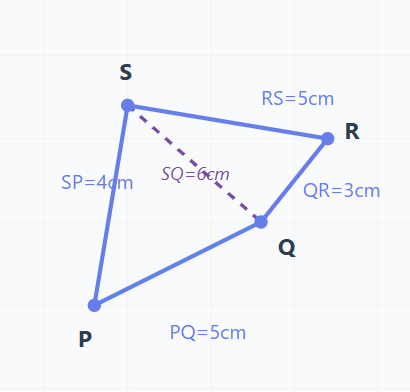
Now starting with the construction, the steps are:
Step 1: Draw the base segment SR with length 5 cm. Mark the endpoints as S and R.
Step 2: Use compass to find Q by drawing an arc from R with radius 3 cm (length QR).
Step 3: Draw another arc from S with radius 6 cm (length of diagonal SQ).
Step 4: Mark point Q where both arcs intersect. Join S to Q and R to Q.
Step 5: Find point P by drawing an arc from Q with radius 5 cm (length QP).
Step 6: Draw final arc from S with radius 4 cm (length SP).
Step 7: Mark point P where the two arcs meet. Join P to Q and P to S.
Step 8:Complete the quadrilateral PQRS by connecting all vertices.
Points to Remember:
• The diagonal divides the quadrilateral into two triangles
• Triangle 1 has sides SR, RQ, and diagonal SQ
• Triangle 2 has sides SQ, QP, and SP
• Always draw the base segment first
Read more: Important Questions on Quadrilaterals - Class 8
Know more about related topics:
Method 2: Three Sides and Two Diagonals
When we know three consecutive sides and two angles between them, we can construct the quadrilateral. The two angles are usually at the endpoints of one of the known sides.
Solution:
Construct quadrilateral PQRS with the following measurements:
QR = 6 cm
RS = 5 cm
SP = 4 cm
∠S = 100°
∠R = 120°
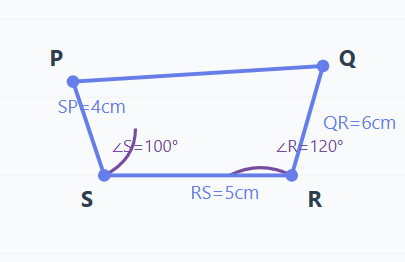
Now starting with the construction, the steps are:
Step 1: Draw segment SR with length 5 cm. Mark the endpoints clearly.
Step 2: Use protractor at point S to draw a line making an angle of 100° with SR.
Step 3: Use protractor at point R to draw a line making an angle of 120° with RS.
Step 4: Mark point P on the 100° line at a distance of 4 cm from S.
Step 5: Mark point Q on the 120° line at a distance of 6 cm from R.
Step 6: Join points P and Q to complete the quadrilateral PQRS.
Points to Remember:
• The angles must be at the endpoints of one of the given sides
• Use a protractor to measure angles accurately
• The fourth angle can be found: ∠P = 360° - (100° + 120° + ∠Q)
• Start construction from the side between the two known angles
Method 3: Two Sides and Three Angles
When we know two consecutive sides and three angles, we have enough information to construct the quadrilateral. The fourth angle can be calculated since all angles sum to 360°.
Solution:
Construct quadrilateral ABCD with the following measurements:
AB = 5 cm
BC = 3 cm
∠A = 120°
∠B = 110°
∠C = 90°
A B C D AB=5cm BC=3cm ∠A=120° ∠B=110° ∠C=90°
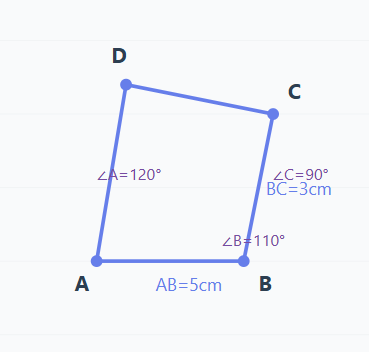
Now starting with the construction, the steps are:
Step 1: Draw segment AB with length 5 cm. Mark points A and B.
Step 2: Use protractor at point A to draw a line making an angle of 120° with AB.
Step 3: Use protractor at point B to draw a line making an angle of 110° with AB.
Step 4: Mark point C on the 110° line at a distance of 3 cm from B.
Step 5: Use protractor at point C to draw a line making an angle of 90° with BC.
Step 6: Mark point D where this line intersects the 120° line drawn from A.
Step 7: Complete the quadrilateral ABCD by joining all vertices.
Calculating the Fourth Angle:
∠D = 360° - (∠A + ∠B + ∠C)
∠D = 360° - (120° + 110° + 90°)
∠D = 360° - 320°
∠D = 40°
Points to Remember:
• The sum of all angles in a quadrilateral is always 360°
• You can calculate the missing angle before construction
• Start with the side whose endpoints have known angles
• Be precise with angle measurements using a protractor
Method 4: Two Adjacent Sides and Three Angles
This method is similar to Method 3 but specifically emphasizes that the two given sides must be adjacent (sharing a common vertex). We use three known angles and calculate the fourth.
Solution:
Construct quadrilateral WXYZ with the following measurements:
WX = 4 cm
XY = 5 cm
∠W = 100°
∠X = 130°
∠Y = 85°
W X Y Z WX=4cm XY=5cm ∠W=100° ∠X=130° ∠Y=85°
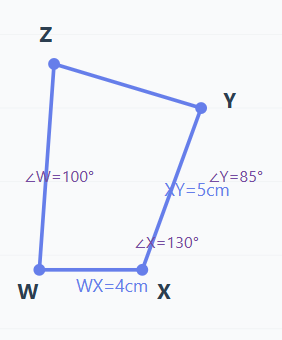
Now starting with the construction, the steps are:
Step 1: Calculate the fourth angle: ∠Z = 360° - (100° + 130° + 85°) = 45°
Step 2: Draw segment WX with length 4 cm. Mark points W and X clearly.
Step 3: Use protractor at point W to draw a line making an angle of 100° with WX.
Step 4: Use protractor at point X to draw a line making an angle of 130° with XW.
Step 5: Mark point Y on the 130° line at a distance of 5 cm from X.
Step 6: Use protractor at point Y to draw a line making an angle of 85° with YX.
Step 7: Mark point Z where the line from Y intersects the line from W.
Step 8: Complete quadrilateral WXYZ by joining all four vertices.
Calculating the Fourth Angle:
∠Z = 360° - (∠W + ∠X + ∠Y)
∠Z = 360° - (100° + 130° + 85°)
∠Z = 360° - 315°
∠Z = 45°
Points to Remember:
• The two sides must share a common vertex (be adjacent)
• WX and XY are adjacent sides with common vertex X
• Three angles must be given; the fourth is calculated
• Protractor accuracy is very important for this method
• Draw from the vertex where the two sides meet
Conclusion
To construct a quadrilateral uniquely, we need at least five independent measurements. These could be four sides and one diagonal, three sides and two angles, two sides and three angles, or other valid combinations.
With fewer than five measurements, multiple different quadrilaterals can be constructed. With more than five measurements, a quadrilateral might not exist that satisfies all conditions.
Numbers make sense when they're taught right. To see how Orchids The International School turns Maths from intimidating to intuitive, reach out to our admissions team.
Frequently Asked Questions on Construction of Quadrilaterals
1. What is the construction of quadrilaterals in geometry?
Construction of quadrilaterals in geometry means drawing a four sided figure using given measurements like sides, angles, and diagonals with tools such as a ruler and compass.
2. How do you construct a quadrilateral step by step?
To construct a quadrilateral:
- Draw a base side or diagonal
- Use given measurements to construct triangles
- Locate intersection points using arcs
- Join all points to complete the quadrilateral
3. What are the conditions required to construct a quadrilateral?
A quadrilateral can be constructed when at least five independent measurements are provided, such as:
- Four sides and one diagonal
- Three sides and two diagonals
- Two sides and three angles
4. Can a quadrilateral be constructed with only side lengths?
No, side lengths alone are not sufficient. At least one angle or diagonal is required to uniquely determine the shape.
5. What are the different cases of construction of quadrilaterals?
- Construction of quadrilateral with 4 sides and 1 diagonal
- Construction using 3 sides and 2 diagonals
- Construction with 2 adjacent sides and 3 angles
- Construction of special quadrilaterals
6. How do you construct special quadrilaterals like squares and rectangles?
- Square: Draw one side, construct 90° angles, and keep all sides equal
- Rectangle: Opposite sides equal, all angles 90°
- Parallelogram: Opposite sides parallel and equal
- Rhombus: All sides equal, diagonals bisect each other
Related Links


Admissions Open for 2026-27
What type of concept pages would you prefer?
CBSE Schools In Popular Cities
- CBSE Schools in Bangalore
- CBSE Schools in Mumbai
- CBSE Schools in Pune
- CBSE Schools in Hyderabad
- CBSE Schools in Chennai
- CBSE Schools in Gurgaon
- CBSE Schools in Kolkata
- CBSE Schools in Indore
- CBSE Schools in Sonipat
- CBSE Schools in Delhi
- CBSE Schools in Rohtak
- CBSE Schools in Bhopal
- CBSE Schools in Aurangabad
- CBSE Schools in Jabalpur
- CBSE Schools in Jaipur
- CBSE Schools in Jodhpur
- CBSE Schools in Nagpur
- CBSE Schools in Ahmednagar
- CBSE School In Tumkur











Orchids The International School is one of India's leading chains of CBSE and ICSE schools, with 110+ schools across the country.