

Did the sky light up over Ladakh recently? Decoding the science behind the spectacular auroras
By Bharati Wakchaure |
Date 15-06-2026
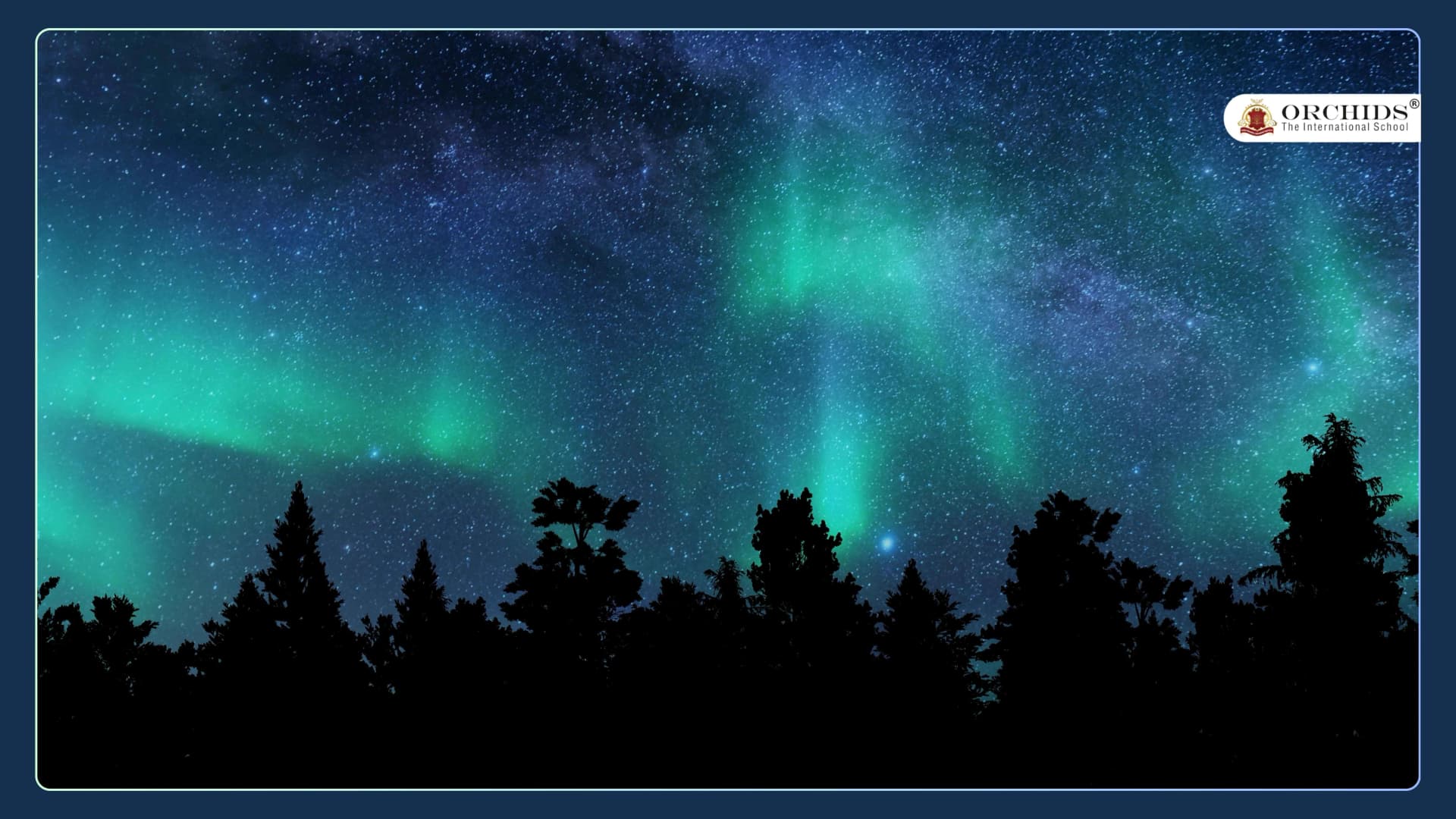
The Northern Lights appear when Earth’s upper atmosphere reacts with charged particles from the Sun.
Admissions Open for 2026-27
Have you ever looked at the night sky and thought: what if it suddenly started glowing? One night, the sky does not look dark anymore. It begins to shimmer with waves of green, red and purple light, as if the universe were painting its own canvas right above you. This is called the Northern Lights, also known as the Aurora Borealis. It is usually seen near the North Pole. But sometimes, it surprises people closer home.
During a particularly strong solar storm, news began spreading across India that this rare light show might become visible in parts of the country. Scientists, students, parents and curious skywatchers all turned their eyes toward the sky. And just like that, space science became something everyone wanted to talk about.
What are the Northern Lights and why do they glow
The Northern Lights appear when Earth’s upper atmosphere reacts with charged particles from the Sun. They usually show up as moving waves of green, red or purple light, most often near the North Pole in countries like Norway, Sweden, Finland and Iceland.
Here’s how it works: the Sun constantly releases streams of charged particles into space. When a particularly large burst reaches Earth, these particles interact with gases in our atmosphere. That interaction produces the glowing, shifting colours we see in the sky.
The colours depend on which gas is involved and how high up the reaction occurs. Oxygen at high altitudes tends to produce red light. Oxygen lower down creates green. Nitrogen can give off blue and purple hues. It is the kind of real-world chemistry and physics that, at Orchids The International School, forms the bridge between what students learn in the classroom and what they see unfolding in the world above them.

Also read: Aurora Borealis: Formation, Causes, and Northern Lights Explained
Can the Northern Lights really be seen in India
Most auroras are confined to regions close to the Earth’s magnetic poles. But during very strong geomagnetic storms, the aurora can extend much further toward the equator than usual.
So the answer is: yes, but only under rare conditions.
When the Sun releases an unusually powerful burst of energy, called a Coronal Mass Ejection, and it reaches Earth directly, the resulting geomagnetic storm can push auroral activity toward lower latitudes. In such moments, people in India’s high-altitude mountain regions may catch a faint red glow in the northern sky.
Best places to see Northern Lights in India
These locations offer the combination of altitude, clear skies and minimal light pollution that makes rare skywatching events like auroras possible:
-
Hanle Dark Sky Reserve, Ladakh
-
Pangong Tso and Nubra Valley, Ladakh
-
Drass in Kargil
-
Kashmir
-
Upper Himalayan regions of Uttarakhand
-
Tawang, Arunachal Pradesh
Auroras over Ladakh: A rare sight captured by Indian scientists
In recent years, scientists have recorded something remarkable in the night sky over Ladakh. Researchers from the Indian Institute of Astrophysics (IIA) have observed and photographed auroras using all-sky cameras at the Indian Astronomical Observatory in Hanle and Merak.
November 2023, Hanle
A faint red aurora was recorded over Hanle, Ladakh, linked to a Coronal Mass Ejection from the Sun. The event was captured by all-sky cameras and confirmed that auroras can occasionally appear over India during strong solar activity.
October 2024, Hanle and Merak
A powerful geomagnetic storm produced a bright red aurora visible across Hanle and Merak. According to the IIA, the glow was strong enough to be seen with the naked eye and was recorded throughout the night using observatory cameras.
1 January 2025, Hanle
Hanle began the new year with an auroral display caused by intense solar activity. The Indian Astronomical Observatory captured the event shortly after midnight, showing a clear red glow in the northern sky.
What causes these lights to appear
When the Sun releases a large burst of charged particles in a Coronal Mass Ejection, those particles travel through space and interact with Earth’s magnetic field and upper atmosphere. This interaction produces the glowing light we call an aurora.
The red colour seen over Ladakh is particularly linked to high-altitude atmospheric reactions involving oxygen. This is different from the more familiar green auroras seen near the poles, which occur at lower altitudes.
Why Ladakh is one of the best places in India to witness auroras
Ladakh functions almost like a natural observatory. It sits at high altitude; its skies are exceptionally dark, and there is virtually no light pollution from surrounding cities or towns. These conditions make it far easier to observe faint astronomical events that would be invisible from most other parts of the country
The Indian Astronomical Observatory at Hanle was established precisely because of these qualities, and the aurora sightings recorded there reflect just how ideal the location is for space observation.
What these lights remind us
The Northern Lights are a reminder that the universe is constantly active, even on the quietest nights.
Whether or not you ever see an aurora in person, understanding how they form makes the night sky feel different. It becomes a place where the Sun’s energy is visible, where Earth’s magnetic field is doing something extraordinary, and where science and wonder occupy exactly the same space.
Sometimes the most lasting lessons come not from textbooks but from a moment of looking up and asking why.
Curious about how we bring moments like these into the classroom? Reach out to our admission team to learn more about the learning environment at Orchids The International School.


Admissions Open for 2026-27
Recent Blogs






CBSE Schools In Popular Cities
- CBSE Schools in Bangalore
- CBSE Schools in Mumbai
- CBSE Schools in Pune
- CBSE Schools in Hyderabad
- CBSE Schools in Chennai
- CBSE Schools in Gurgaon
- CBSE Schools in Kolkata
- CBSE Schools in Indore
- CBSE Schools in Sonipat
- CBSE Schools in Delhi
- CBSE Schools in Rohtak
- CBSE Schools in Bhopal
- CBSE Schools in Aurangabad
- CBSE Schools in Jabalpur
- CBSE Schools in Jaipur
- CBSE Schools in Jodhpur
- CBSE Schools in Nagpur
- CBSE Schools in Ahmednagar
- CBSE School In Tumkur

Call Us to know more about Orchids











Orchids The International School is one of India's leading chains of CBSE and ICSE schools, with 130+ schools across the country.