

Thought it’s cool to use AI to do your child’s homework? Think again!
By Reema Gowalla |
Date 01-12-2025
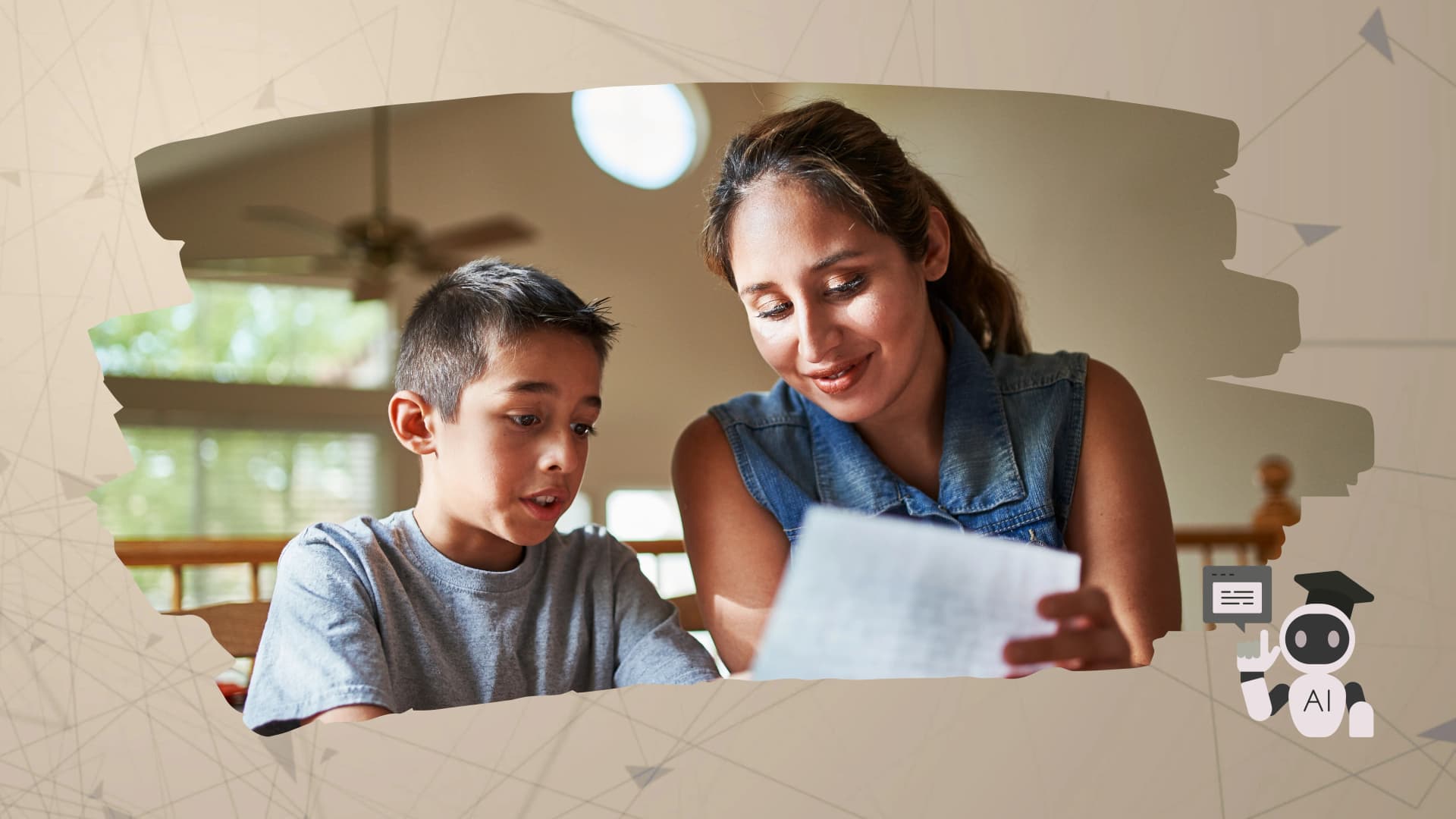
A parent guiding their child through homework, highlighting the importance of real learning over AI dependence.
Admissions Open for 2026-27
Do you like homework? The popular answer would probably be no! But whether or not we are in favour of it, assignments have been an intrinsic part of our academic life. Although arguably designed to develop skills and improve performance among youngsters, homework has often been blamed for increasing students and parents’ stress levels, while also jeopardising the time and energy children must spend on other activities for their well-being and holistic development. The adage ‘practise makes man perfect’ comes in handy here as consistent and repeated effort is at the core of homework. That said, the advent of artificial intelligence (AI) seems to be negatively influencing students in palming off their tasks to ChatGPT, compromising the actual learning process. At a time when the term ‘AI literacy’ is dominating the news cycle, Pope Leo XIV is urging teenagers not to outsource their schoolwork to generative AI tools, saying, “Even God is worried about ChatGPT.”
Also read: ‘Google it’ or ‘ask Perplexity’: Is the new AI tool breaking the grand old search engine’s monopoly?
A brief history of homework

It’s difficult to put a finger on when and how the term ‘homework’ came into practice, but the routine of students bringing home assignments on writing and oratory can be traced back to olden days. A quick search on Google indicates that Italian educator Roberto Nevelis may have formalised ‘homework’ in the early 1900s, while American educational reformer Horace Mann - who was deeply influenced by the Prussian education system - is said to have played a pivotal role in introducing ‘homework’ as a ‘structured part of schooling’ in 19th century US.
All said and done, the purpose of homework has been to ‘reinforce classroom learning, promote discipline, enhance long-term retention, as well as develop independent study habits and critical thinking skills’. But again, in this day and age when educational institutions are increasingly exploring innovative learning methods to meet the individual needs of students, the benefits of common assignments are probably debatable.
Word of caution for Gen Z and Gen Alpha
Septuagenarian Pope Leo XIV, who is known to play Wordle every day, has urged youngsters not to rely on AI when it comes to completing their coursework, as it misses the human element and cannot offer real wisdom. Speaking to children via a video talk during the recently held National Catholic Youth Conference in Indianapolis, the pontiff said, “AI can process information quickly, but it cannot replace human intelligence. Don’t ask it to do your homework for you. AI will not judge between what is truly right and wrong, and it won’t stand in authentic wonder before the beauty of God’s creation.”
The pope’s message comes amid growing concerns about students overly turning to generative AI tools for writing and problem solving. While the power of technology seems to be at its peak, young people’s cognitive skills and natural capabilities are also at high risk of being eroded.
“Be prudent, be wise, be careful that your use of AI does not limit your true human growth. Use it in such a way that if it disappeared tomorrow, you would still know how to think, how to create, how to act on your own and how to form authentic friendships. AI cannot ever replace the unique gift that you are to the world,” he elaborated.
Also read: India’s big push to bolster AI-driven education in schools: Are we ready for it?
How homework in India is evolving
The National Education Policy (NEP) 2020 has underlined a clear shift from ‘rote learning’ toward ‘more creative and application-based assignments’. Under the revised policy, projects, experiments and critical thinking have gained more weightage, as opposed to the traditional patterns of assignments. There’s no homework for students from classes I-II, while for students of classes III-V a maximum of two hours of homework per week is recommended. In order to ensure fair and rational distribution, teachers must coordinate the homework they assign to students. Keeping in mind the aspect of parental guidance, efforts are also being made to make homework a more balanced and less stressful part of a child’s life. Needless to say, technology plays a crucial role in assignments, but mostly to complete tasks like creating videos and presentations.
Speaking of incorporating AI into classroom learning, the Ministry of Skill Development and Entrepreneurship (MSDE) recently introduced a new programme, called Skilling for AI Readiness (SOAR). Aimed at students from classes 6 to 12 as well as teachers, the programme is expected to help raise AI awareness among youngsters and educators via foundational AI concepts, such as machine learning (ML) basics and ethical AI.


Admissions Open for 2026-27
Recent Blogs



CBSE Schools In Popular Cities
- CBSE Schools in Bangalore
- CBSE Schools in Mumbai
- CBSE Schools in Pune
- CBSE Schools in Hyderabad
- CBSE Schools in Chennai
- CBSE Schools in Gurgaon
- CBSE Schools in Kolkata
- CBSE Schools in Indore
- CBSE Schools in Sonipat
- CBSE Schools in Delhi
- CBSE Schools in Rohtak
- CBSE Schools in Bhopal
- CBSE Schools in Aurangabad
- CBSE Schools in Jabalpur
- CBSE Schools in Jaipur
- CBSE Schools in Jodhpur
- CBSE Schools in Nagpur
- CBSE Schools in Ahmednagar
- CBSE School In Tumkur

Call Us to know more about Orchids











Orchids The International School is one of India's leading chains of CBSE and ICSE schools, with 110+ schools across the country.