

Earthrise to Earthset: How our view of the planet has changed with time
By Bharati Balasaheb Wakchuare |
Date 19-04-2026
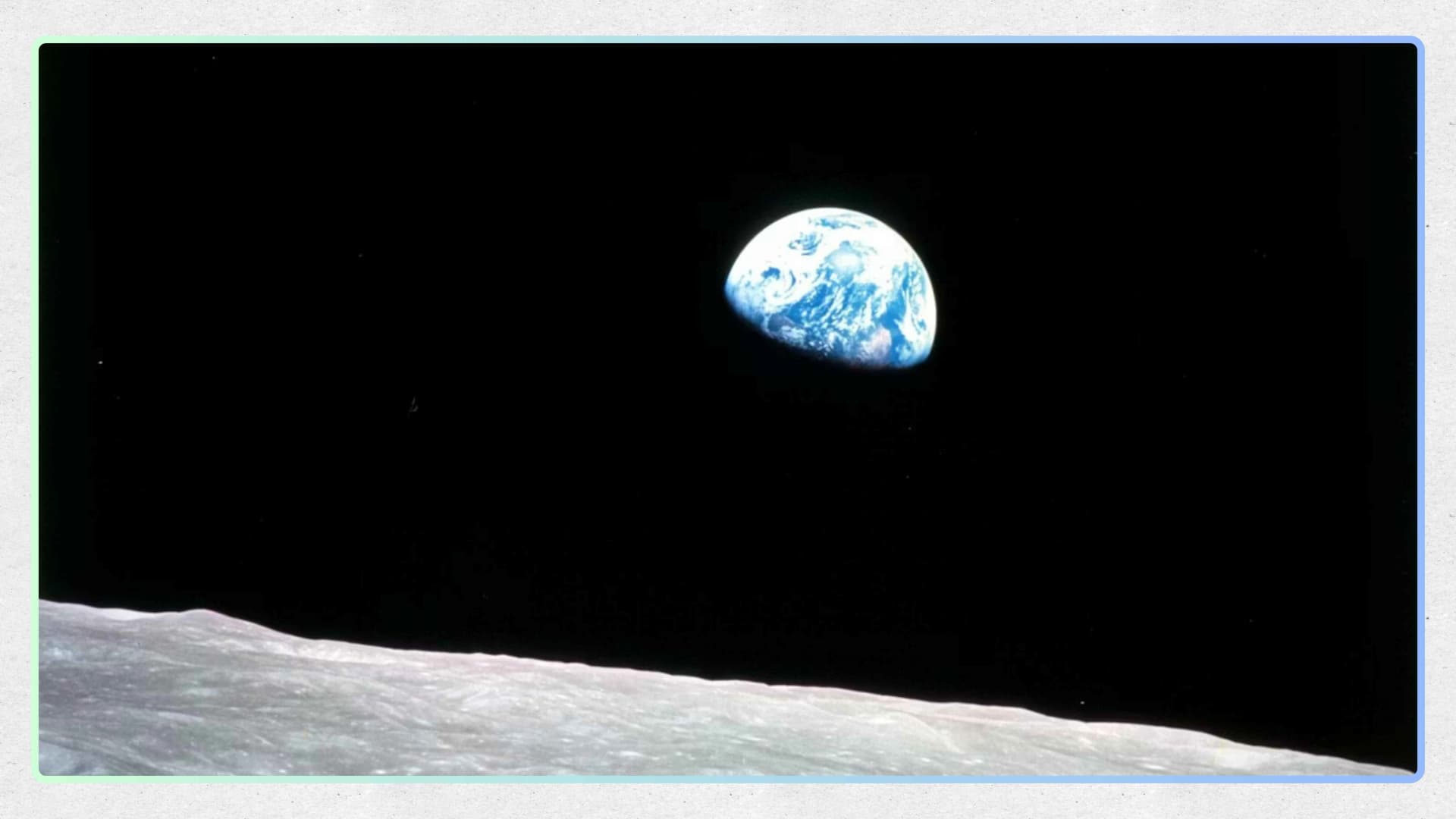
The ‘Earthrise’ image was captured by astronaut William Anders during the ‘Apollo 8’ mission in December 1968.
Admissions Open for 2026-27
On a special day in 1968, something unexpected happened far away from Earth, in space. As astronauts aboard Apollo 8 orbited the Moon, they witnessed a breathtaking sight: our planet rising above the lunar horizon. This unforgettable moment gave the world the famous Earthrise image.
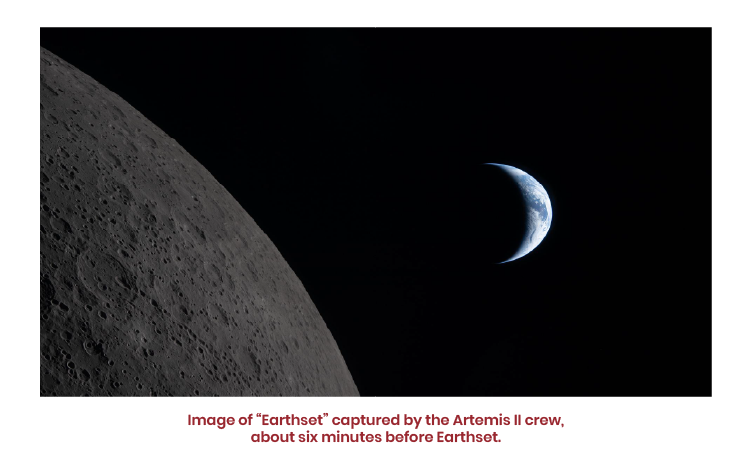
Just imagine seeing Earth from space for the very first time. It must have felt truly unbelievable. Nearly six decades later, in April 2026, another powerful image was captured. This time, astronauts on the Artemis II mission photographed Earthset, where Earth appeared to slowly disappear behind the Moon.
Two moments. Two images. One planet. But what changed over time?
At first glance, both images may look similar. But when you look closer, they reveal a deeper story about science, technology, and how our understanding of Earth has evolved.
A moment that took everyone by surprise: Earthrise
You might think the photograph of Earthrise was planned, but it wasn’t! In 1968, during the Apollo 8 mission, astronaut Bill Anders witnessed something unexpected. As the spacecraft moved around the Moon, Earth slowly appeared above the lunar surface.
“Oh my God, look at that picture over there. There's the Earth coming up. Wow, is that pretty,” he said, quickly capturing the moment.
What made this image so powerful was its simplicity. A small blue planet floating in the darkness of space changed how people saw their home. Earth no longer looked vast and endless. It looked delicate, distant, and alone.

Also read: This day, that year: When Comet Hale-Bopp lit up the sky on April 1, 1997
A new perspective in 2026: Earthset
In 2026, the Artemis II mission brought a new way of looking at Earth. The Earthset image showed our planet slowly disappearing behind the Moon, glowing like a crescent. Unlike the surprise of 1968, this moment was carefully planned. Astronauts used advanced digital tools to capture high-quality images that could be shared almost instantly.
Space missions today are not just about exploration. They are also about connection. Even before the mission, simulations of the Earthset view were shared to build curiosity and excitement among people on Earth.
What has changed over time
While both Earthrise and Earthset show Earth from the Moon, they differ in meaningful ways. Apollo 8 orbited close to the Moon, which made Earth appear larger. Artemis II travelled farther, making Earth look smaller in comparison.
Lighting also plays an important role. Earthrise shows a fully illuminated Earth, while Earthset captures only a portion of it, creating a softer, crescent-like glow. Technology has evolved significantly as well. Earlier astronauts relied on film cameras, and images could only be viewed after returning to Earth. Today, digital technology allows images to be captured, viewed, and shared instantly.
Perhaps the biggest difference lies in intention. Earthrise was a spontaneous discovery. Earthset was a moment that scientists and the world were waiting for.
What these images reveal about our planet
Even though Earth continues to shine in shades of blue and white, modern observations reveal important changes.
-and-1972-(Apollo-17)_20260424_120949.webp "Side-by-side images of Earth from 2026 (Artemis II) and 1972 (Apollo 17)")
Have you ever wondered what changes scientists have noticed over time?
Over the years, scientists have noticed:
-
Reduced ice in polar regions
-
Expanding deserts
-
Loss of forests in many parts of the world
These changes highlight how both human activity and natural processes are shaping our planet.
The term ‘Earthset’ may sound poetic, but it can also be seen as a quiet reminder. It suggests that if we are not careful, the beauty we admire today could gradually change over time.
Looking beyond Earth
During the Artemis II mission, astronauts also captured stunning views of space, including our galaxy, the Milky Way.
The Milky Way stretches across more than 100,000 light-years, offering a powerful reminder of how small Earth is within the vast universe. The mission also revealed parts of the Moon never seen before and captured rare events such as a solar eclipse from space. These discoveries remind us that there is still so much to explore and understand.
A story that continues
These images are more than just photographs. They tell a story of progress, curiosity, and perspective.
From the surprise of Earthrise to the planned beauty of Earthset, they show how far space exploration has come and how our understanding of Earth continues to grow. Both images carry a shared message: Earth is unique, beautiful, and worth protecting.
If astronauts can look back at Earth and feel a sense of wonder, what can we do while living on it every day?
Simple actions can make a difference. Saving water, reducing waste, planting trees, and learning more about the environment are small steps that matter. Because the next time Earth is seen from space, wouldn’t it be wonderful if it still looks just as bright and full of life?
At Orchids The International School, students are encouraged to stay curious, ask questions, and connect classroom learning with real-world discoveries like these.
Want your child to develop a love for science and a deeper understanding of the world?
Explore how Orchids The International School nurtures curiosity, critical thinking and a lifelong love for learning. Connect with our admissions team to know more.


Admissions Open for 2026-27
Recent Blogs




CBSE Schools In Popular Cities
- CBSE Schools in Bangalore
- CBSE Schools in Mumbai
- CBSE Schools in Pune
- CBSE Schools in Hyderabad
- CBSE Schools in Chennai
- CBSE Schools in Gurgaon
- CBSE Schools in Kolkata
- CBSE Schools in Indore
- CBSE Schools in Sonipat
- CBSE Schools in Delhi
- CBSE Schools in Rohtak
- CBSE Schools in Bhopal
- CBSE Schools in Aurangabad
- CBSE Schools in Jabalpur
- CBSE Schools in Jaipur
- CBSE Schools in Jodhpur
- CBSE Schools in Nagpur
- CBSE Schools in Ahmednagar
- CBSE School In Tumkur

Call Us to know more about Orchids











Orchids The International School is one of India's leading chains of CBSE and ICSE schools, with 110+ schools across the country.