

What do top scorers have in common? Lessons from Orchids’ pan-India ICSE 2026 results
By Priyadarshini Bhattacharjee |
Date 01-05-2026
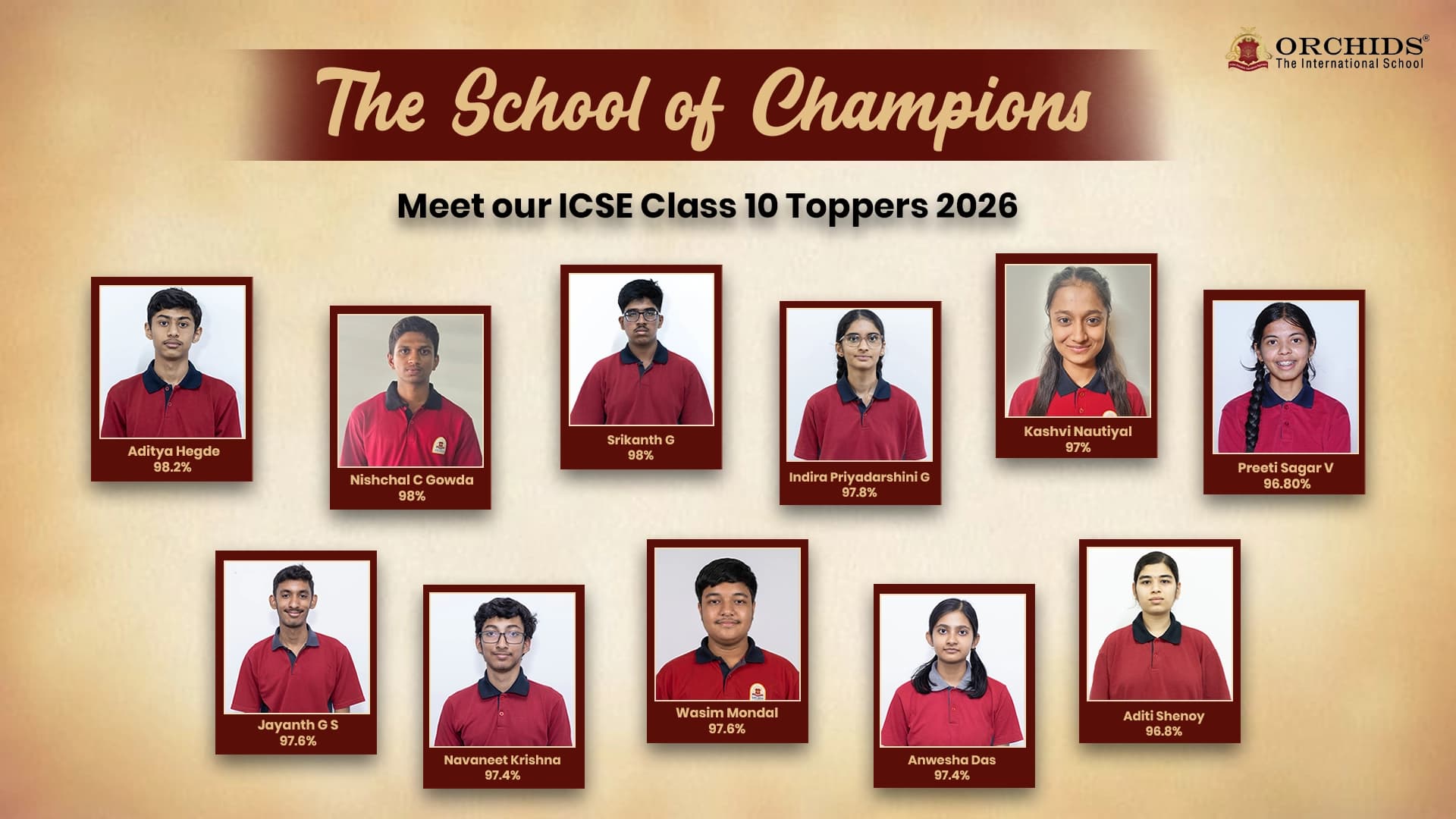
A glimpse of Orchids’ pan-India ICSE 2026 toppers
Admissions Open for 2026-27
Results day carries a weight that is hard to describe to anyone who has not lived it. Not just for the students, but for every parent who dropped their child off at the examination centre and drove home with the radio off. For every teacher who knew, quietly, which students had truly prepared and which ones had only believed they had. For every family that had rearranged its entire rhythm over the past year around something that would eventually come down to a number on a screen.
This year, when the pan-India Indian Certificate of Secondary Education (ICSE) rankings were released across Orchids The International School branches, ten students found themselves at the very top of that list. Different cities. Different campuses. Different stories that led to the same extraordinary outcome. The scores are worth celebrating. But what built them is worth understanding.
The morning nobody talks about
Here is the thing about a 98% score: nobody sees the Tuesday morning in September that went into it. The morning, eight months before results day, when a student sat down to revise a chapter they already believed they understood because something told them to make sure. Not because an exam was coming. Not because a teacher asked. Simply because that was the kind of student they had decided to be. Or the November evening when exhaustion was real and the motivation was genuinely low, and they studied anyway, not heroically, just quietly and without drama, because the habit was already built. Or the moment inside the examination hall when a question arrived in a form they had never quite seen before. And instead of the cold drop of panic that visits every student in that instant, there was something steadier. A kind of earned confidence. Because their understanding of the subject did not depend on the question looking familiar.
Top scores are not produced on results day. They are assembled, in ordinary moments, long before.
What separates a good student from a great one
Most students who score in the 70s and 80s are not less capable than those who score in the 90s. This is worth saying plainly, because the story we tell about academic high achievers often implies otherwise. The difference is rarely about intelligence. It is rarely even about effort in any simple sense. It is about the quality of certain habits and how early those habits took root.
-
They revised before it became urgent. There is a very particular kind of student who returns to earlier material not because an exam is approaching, but because they understand that knowledge, if left unattended, quietly slips. These students do not discover gaps during revision week. They close them in September and October, when there is still time and space to do so properly.
-
They asked why, not just what. A student who learns that a particular chemical reaction produces a particular outcome will answer most questions adequately. A student who understands the mechanism behind that reaction, the reasoning, and the logic underneath the fact can work through a question they have never encountered before. The ICSE curriculum is designed to reward exactly this. At the highest score ranges, it is almost the only thing that separates one student from the next.
-
They held a higher bar for 'done'. Finishing an answer and genuinely finishing an answer are two different things. Top scorers tend to know the difference intuitively. They go back. They check. They ask whether the argument is complete, whether the working is clear, and whether the answer actually addresses what was asked. It is a small habit. Over an entire examination, it adds up significantly.
None of this is innate. Every one of these habits is a choice, made consistently, over a long stretch of time.
The people behind the score
Every topper has a story, and in every one of those stories, there is someone who does not appear in the rankings.
-
The parent who understood, without being told, when their child needed to be left alone to work and when they needed to be called for dinner. The one who kept the household calmer than they perhaps felt because they knew that anxiety is contagious and so is steadiness.
-
The teacher who noticed, somewhere around October, that a student had a small but significant gap in their understanding of a particular concept. Who addressed it matter-of-factly, without alarm, in a way that fixed the problem without planting self-doubt. Who will never know, precisely, how many marks that conversation was worth.
-
The classmates who made the seriousness feel normal. Who studied, who asked questions in class, who talked about their subject with genuine curiosity rather than weary obligation. The peer group whose standards became the standard.

Exceptional academic performance is never purely individual. It is always, to some meaningful degree, environmental. The student brings the effort and the ability. The environment determines what the effort produces. When those two things are well-matched, the results tend to speak for themselves.
On pressure, and what the best students do with it
Nobody performs at the top of a demanding national curriculum without feeling the weight of it. The expectations accumulate. The syllabus is genuinely broad. And somewhere in the final months of preparation, every student hits a moment where the gap between where they are and where they want to be feels larger than the time left to close it. This is not a sign of inadequacy. It is simply what high-stakes preparation feels like from the inside. What the best students have learned, usually through experience rather than instruction, is that this feeling is not a signal to panic. It is a signal to return to work.
The capacity to sit with uncertainty and keep going anyway, to attempt the question they are not fully confident about rather than leaving it blank, to walk out of a paper that did not go as hoped and still prepare properly for the next one: this quality is, arguably, more decisive than any single subject skill. And it is not something a student either possesses or does not. It is something built gradually, over many smaller moments of choosing to trust the preparation they have put in.
Also read: Stress-busting activities at home that can help kids stay calm during exams
When the habits met the moment
This year’s pan-Indian ICSE rankings across Orchids The International School branches were, in many ways, a portrait of everything described above. Aditya Hegde from Sahakar Nagar led the rankings with 491 marks and 98.2%. Behind him, nine more students from Orchids campuses in Sahakar Nagar, Yelahanka, Joka, and Golden Heights, each with scores that tell their own story of sustained, well-supported effort.
A special mention belongs to the Sahakar Nagar branch, which placed seven of the 10 students on this list. That alone would be a remarkable achievement. But there is a wider story behind that branch that deserves to be told. Sahakar Nagar is the only Orchids branch, across both CBSE and ICSE, that has maintained a 100% pass rate year after year, without a single failure. Not as a one-time result, not as a particularly good year, but as a consistent, sustained record built over time. Seven students in the national top 10 is a headline. Zero failures, every year, is a culture.
To put the branch’s performance in sharper context: nationally, only 2% of ICSE students score above 95%. At Sahakar Nagar, 19 out of 102 students crossed that mark this year. That is 18.6%, nine times the national average. At Yelahanka ICSE, 3 out of 39 students scored above 95%, a figure of 7.6%, four times what the national average would predict. These are not marginal gains over a benchmark. They are a fundamentally different outcome, and they point to something about the quality of preparation happening inside these classrooms that goes well beyond what results season tends to reveal.
What stands out, beyond the individual scores, is the breadth. These are students from different branches, different cities, taught by different teachers in different classrooms. Yet they arrived at the same level of excellence.
That does not happen by chance, and it does not happen in a single year. It is the outcome of a learning culture that runs consistently across Orchids campuses: one where high expectations are paired with genuine support, where students are challenged in ways that build them rather than diminish them, and where the habits that produce results like these are treated as something worth cultivating long before examination season arrives.
What this means if your child is still years away from boards
If you are a parent of a younger child, the rankings above might feel like a distant concern. They are not. The habits that carried Aditya and Srikanth and Nishchal and Anwesha and the rest to the top of a nationwide Orchids ranking did not take shape in Grade 10. They were built earlier, much earlier, in classrooms and at study tables and in the accumulated weight of small decisions made consistently enough that they eventually became second nature.
The most important question a parent can ask is not how to produce a particular score. It is what kind of learner their child is becoming right now, and whether the environment they are in is genuinely helping them become that learner. The score, when the moment eventually comes, will reflect everything that preceded it. The question is what you are building in the meantime.
Congratulations to each of this year’s toppers, and to every family and educator who walked that journey with them. The scores are yours. Everything that built them is worth even more.
If you are looking for an environment where your child can develop the habits, the confidence, and the academic foundation to perform at their genuine best, we would be glad to tell you more. Reach out to our admissions team to learn how Orchids The International School supports every student in reaching their potential.


Admissions Open for 2026-27
Recent Blogs






CBSE Schools In Popular Cities
- CBSE Schools in Bangalore
- CBSE Schools in Mumbai
- CBSE Schools in Pune
- CBSE Schools in Hyderabad
- CBSE Schools in Chennai
- CBSE Schools in Gurgaon
- CBSE Schools in Kolkata
- CBSE Schools in Indore
- CBSE Schools in Sonipat
- CBSE Schools in Delhi
- CBSE Schools in Rohtak
- CBSE Schools in Bhopal
- CBSE Schools in Aurangabad
- CBSE Schools in Jabalpur
- CBSE Schools in Jaipur
- CBSE Schools in Jodhpur
- CBSE Schools in Nagpur
- CBSE Schools in Ahmednagar
- CBSE School In Tumkur
Call Us to know more about Orchids











Orchids The International School is one of India's leading chains of CBSE and ICSE schools, with 130+ schools across the country.