

‘Cosmic Kiss’: When Jupiter and Venus align for a rare celestial event in the sky
By Bharati Wakchaure |
Date 10-06-2026
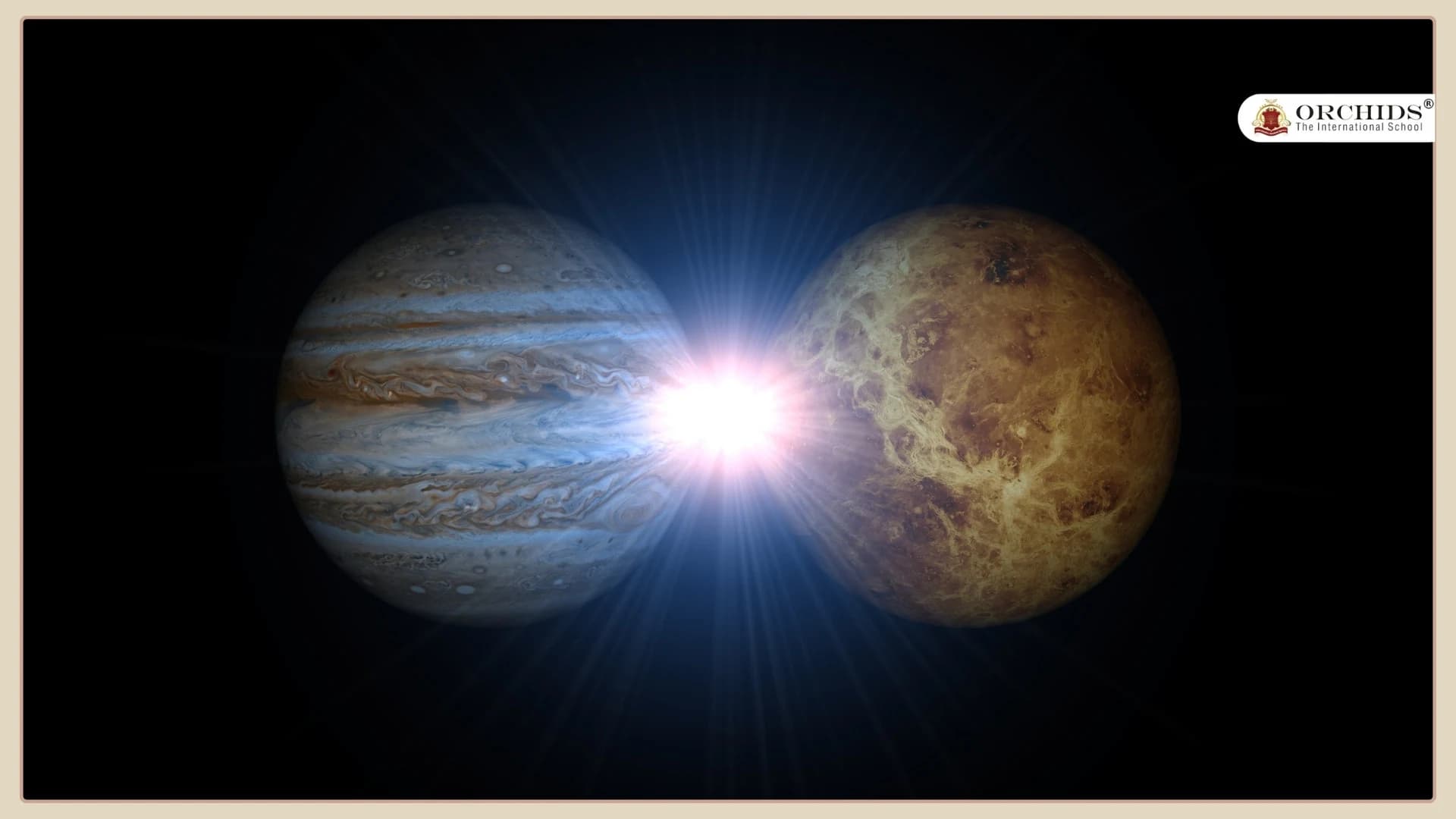
While the celestial event appears romantic in the sky, the science behind it is even more fascinating.
Admissions Open for 2026-27
Have you ever paused to stare at the night sky without checking your phone? Some nights make that pause feel entirely worth it. Every so often, skywatchers are treated to a rare alignment of Jupiter and Venus, visible to the naked eye in the evening sky.
Step outside on one of these evenings, glance upward, and you might notice two unusually bright points of light shining side by side. They seem close enough to touch, almost as though they are meeting in silence across the vastness of space. For many, this moment feels poetic. For astronomers, it has a name: a planetary conjunction.
This rare alignment of Jupiter and Venus, two of the brightest planets visible from Earth, is what many call a ‘cosmic kiss’. And while it appears romantic in the sky, the science behind it is even more fascinating.
What is a ‘cosmic kiss’
The term ‘cosmic kiss’ is not a scientific definition but a popular way of describing a planetary conjunction. At first glance, it feels like the planets are meeting, but are they really close, or is it just our eyes playing tricks on us?
A planetary conjunction occurs when two planets appear very close together in the sky from Earth’s perspective, even though they are actually separated by millions of kilometres in space. Their alignment is only an optical effect caused by their orbital positions
In this case, Jupiter and Venus appear to almost meet in the night sky, creating a striking visual that is easy to observe even without a telescope.
Also read: Earthrise to Earthset: How our view of the planet has changed with time

Why do Jupiter and Venus look so close in the sky?
If you have ever wondered why two planets suddenly look like neighbours, you are not alone.
1. The same line of view
All planets move around the Sun in almost the same flat path, called the ecliptic. Sometimes, two planets line up in the same direction from Earth. When this happens, they look close together in the sky even though they are nowhere near each other in space.
2. Different speeds in space
Planets move around the Sun at different speeds. Venus moves faster and Jupiter moves more slowly. Because of this, Venus appears to catch up with Jupiter from our point of view, creating a short window when they look side by side in the sky.
3. A visual effect, not a physical one
This close appearance is an illusion. Jupiter and Venus are actually millions of kilometres apart. What we see is the result of viewing angle, not proximity.
Why do they look so bright?
Both planets are among the brightest objects in the night sky, which makes this event easy to observe with the naked eye. Venus shines brilliantly because it is relatively close to Earth and reflects sunlight strongly through its thick cloud layers. Jupiter stands out because it is the largest planet in our solar system.
When they appear near each other, the combined effect is particularly striking.
When and how to observe the conjunction
The best time to watch is approximately 45 minutes after sunset, when the sky is dark enough for the planets to stand out clearly but still bright enough to reveal the horizon. The alignment can typically be observed for about two hours after sunset before the planets gradually slip below the horizon
Where to look
This phenomenon is visible from most parts of the world, including India, Europe and North America, provided the sky is clear.
For the best view, choose an open western horizon and avoid tall buildings, trees or other obstructions. Terraces, rooftops, parks and open fields all work well. Venus will appear very bright, and Jupiter will be visible nearby as a steady, bright companion.
A few things to keep in mind
No telescope or binoculars are required. Allow your eyes a few minutes to adjust to low light. The planets typically remain close for several days, so there is no need to rush out on a single evening. If clouds obscure the view one night, try again the next.
The physics behind the alignment
At the centre of this phenomenon is the ecliptic plane, the imaginary path along which the planets travel around the Sun. Because all planets share this orbital structure, they sometimes appear to align from the viewpoint of Earth, their positions overlapping visually even though they are far apart in space.
This alignment is governed entirely by predictable orbital motion. At Orchids The International School, events like these are treated as live lessons in astronomy, bringing abstract concepts from the classroom into something students can actually look up and see. Astronomers use such events to better understand planetary movement, orbital timing and celestial geometry. What looks like a coincidence is, in fact, precise physics playing out exactly as expected.
Interesting facts about Venus and Jupiter
-
Venus is the brightest planet visible from Earth
-
Jupiter is the largest planet in our solar system
-
Venus appears bright due to its thick cloud layers that reflect sunlight
-
Jupiter is a gas giant with a powerful magnetic field
-
Their conjunctions are among the most visually striking planetary pairings in the night sky
When the sky is clear, step outside and look up. How often do two planets appear to share the same stage?
A moment to observe, not just imagine
The Venus-Jupiter conjunction is more than just a visual treat. It is a reminder that the solar system is constantly in motion, even when the sky looks perfectly still.
What appears to be two planets drawing close is actually a carefully timed alignment shaped by orbital mechanics and perspective. So the next time you notice two bright points of light drawing close in the evening sky, remember: you are not witnessing a coincidence. You are watching a cosmic pattern written in motion.
Curious about how we bring the universe into our classrooms? Reach out to our admissions team to learn more about the learning environment at Orchids The International School.


Admissions Open for 2026-27
Recent Blogs






CBSE Schools In Popular Cities
- CBSE Schools in Bangalore
- CBSE Schools in Mumbai
- CBSE Schools in Pune
- CBSE Schools in Hyderabad
- CBSE Schools in Chennai
- CBSE Schools in Gurgaon
- CBSE Schools in Kolkata
- CBSE Schools in Indore
- CBSE Schools in Sonipat
- CBSE Schools in Delhi
- CBSE Schools in Rohtak
- CBSE Schools in Bhopal
- CBSE Schools in Aurangabad
- CBSE Schools in Jabalpur
- CBSE Schools in Jaipur
- CBSE Schools in Jodhpur
- CBSE Schools in Nagpur
- CBSE Schools in Ahmednagar
- CBSE School In Tumkur

Call Us to know more about Orchids











Orchids The International School is one of India's leading chains of CBSE and ICSE schools, with 130+ schools across the country.