

What Iceland’s first mosquitoes tell us about a warming planet
By Priyadarshini Bhattacharjee |
Date 14-05-2026
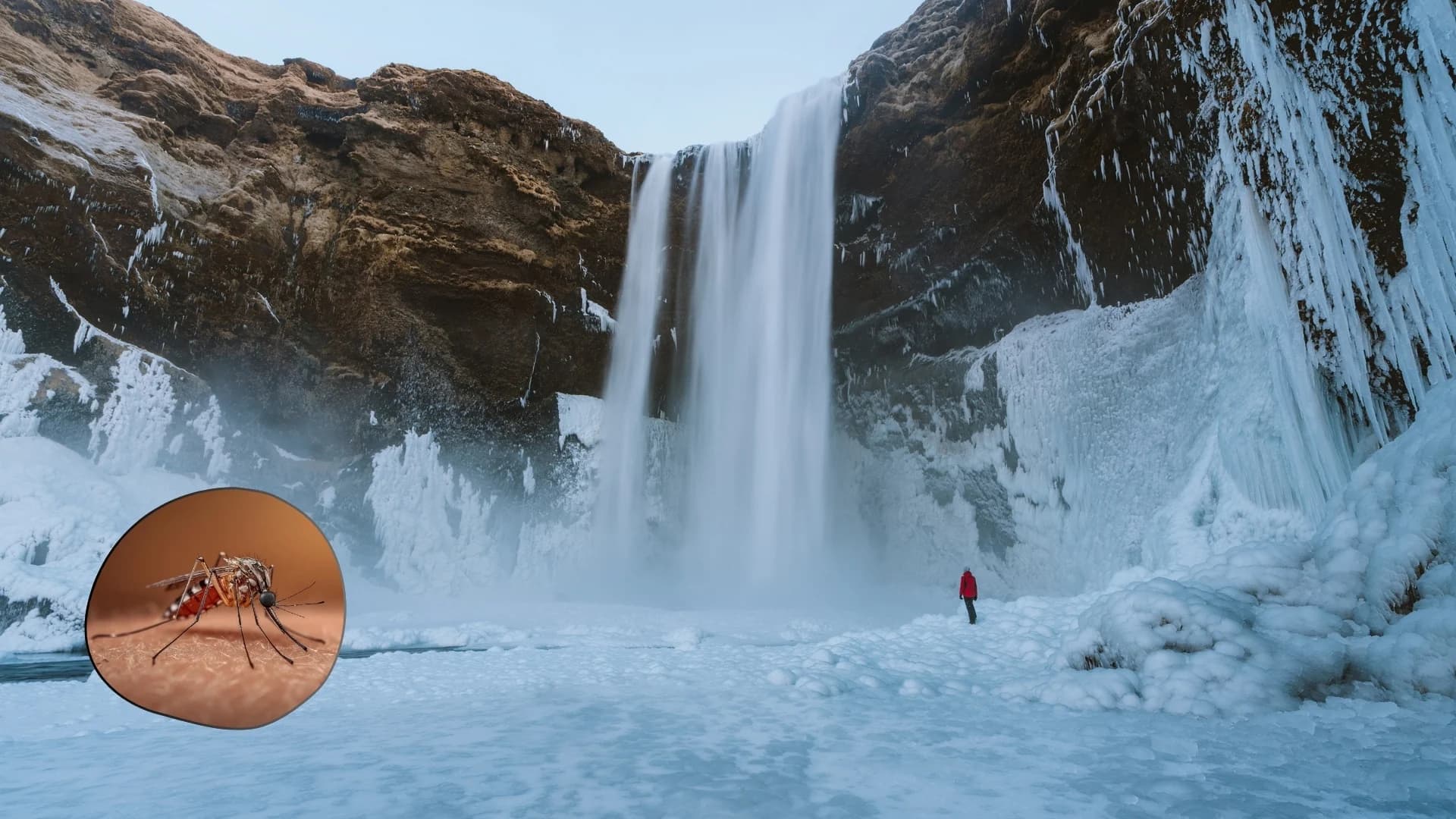
The Nordic island nation’s first mosquito was spotted in October last year, in a small glacial valley called Kjós.
Admissions Open for 2026-27
In the evening of October 16, 2025, an insect enthusiast named Björn Hjaltason was in his garden in Kjós, a small glacial valley in western Iceland, doing what he often did at dusk: watching for moths using wine-soaked ropes as traps. What landed on those ropes that night was not a moth.
Hjaltason noticed the unfamiliar insect immediately. He collected it carefully, then caught two more over the following nights. When he sent all three to Matthías Alfreðsson, an entomologist at the Icelandic Institute of Natural History, the confirmation came back with a weight that went far beyond a single garden in a small Icelandic town. They were mosquitoes. The first ever recorded living freely in Iceland’s natural environment.
For a country that had been one of only two mosquito-free places on the entire planet, it was, as Hjaltason himself put it, the fall of the last fortress.
Why Iceland had no mosquitoes to begin with
To understand why this discovery matters, it helps to understand what made Iceland mosquito-free in the first place. Mosquitoes need two things above almost everything else: warmth and standing water in which to breed. Iceland, for most of its history, offered neither in reliable enough quantities. Its winters are long and severe, its temperatures rarely climbing high enough for long enough to sustain a mosquito population through the full cycle of breeding, hatching and survival.
There is no shortage of ponds and marshes in Iceland, so the missing ingredient was always temperature. The cold was, in effect, the country’s natural defence. It is worth pausing on how unusual that defence made Iceland. Mosquitoes are among the most widely distributed creatures on Earth. They exist on every continent except Antarctica, in environments ranging from equatorial rainforests to the edges of the Arctic. The list of places they have not reached is extraordinarily short. Until October 2025, Iceland was on that list. Now, only Antarctica remains.
Three mosquitoes, and what they represent
The species Hjaltason found, Culiseta annulata, is not considered a disease carrier. It is common across Europe and North Africa and, crucially, it is cold-resistant. Unlike many mosquito species, Culiseta annulata adults can survive winter by sheltering in barns, basements and other enclosed spaces, waiting out the freeze rather than dying in it. This adaptation is precisely what makes its presence in Iceland significant. It is not a fragile visitor that stumbled in and will not last. It is a species built to endure.

How it arrived is not entirely certain. Hjaltason himself noted that the industrial site of Grundartangi, roughly six kilometres from his garden, receives regular shipments by sea and that insects have been known to travel in containers and on ships. It is a plausible theory. But whether it arrived by boat or on the wind, the more pressing question is whether it will stay.
Alfreðsson has said that further monitoring through the spring will be needed to determine whether the species has truly established itself. Given that Hjaltason found three specimens in a single garden over a few evenings, the possibility that there were more nearby is not a small one.
The temperature that made it possible
The timing of this discovery is not coincidental. The spring and summer of 2025 were historically warm in Iceland, in ways that broke records the country had held for decades. Temperatures in May exceeded 20 degrees Celsius for ten consecutive days across different parts of the country, a threshold Iceland typically reaches only briefly and rarely. The hottest day ever recorded in Iceland in May came this year, with temperatures reaching 26.6 degrees Celsius at Egilsstaðir Airport. For a country whose entire mosquito defence rested on the cold, a spring like that represented something more than an uncomfortable few weeks. It represented a window. A period warm enough, long enough, for a cold-adapted mosquito species to survive, potentially breed and wait for the following season.
The Arctic region, which includes Iceland, has been warming at nearly four times the rate of the rest of the planet. Glaciers that have defined Iceland’s landscape for centuries are retreating. Glaciers that have defined Iceland’s landscape for centuries are retreating. Fish species from warmer, southern waters, including mackerel, have begun appearing in Icelandic waters. The mosquito discovery is, in this context, one entry in a longer list of signals that Iceland’s ecosystem is changing in ways it has not experienced before.
What this means beyond Iceland
The story of Iceland’s first mosquitoes is striking on its own terms. But its significance extends well beyond one island in the North Atlantic.
As global temperatures rise, mosquito populations around the world are not just growing; they are moving. Species that were once confined to tropical and subtropical regions are establishing themselves in places that were previously too cold to support them. In the United Kingdom, eggs of the Egyptian mosquito, a species capable of spreading dengue fever, yellow fever and the Zika virus, were found in 2025. The Asian tiger mosquito, another disease-carrying species, has been discovered in Kent. Scientists have noted that the south coast of England has been suitable for this species since the 2010s. This matters because mosquitoes are not merely a nuisance. They are among the most consequential disease vectors in the world, responsible for more human illness and death than any other animal. When their range expands, the diseases they carry can expand with them into populations and healthcare systems that have no prior experience of managing them.
The species found in Iceland, Culiseta annulata, does not carry disease. But its arrival demonstrates something important: that Iceland’s climate has crossed a threshold. If one cold-adapted species can now survive there, the question scientists are already asking is which species might follow as temperatures continue to rise.
A citizen scientist and a lesson worth remembering
There is another dimension to this story that deserves attention, and it has nothing to do with climate data or disease vectors. Björn Hjaltason was not a professional scientist. He was an enthusiast, someone who spent his evenings in his garden with wine-soaked ropes, watching for moths. He noticed something unfamiliar, collected it carefully and had the presence of mind to send it to someone who could identify it. That sequence of events, curiosity, observation and follow-through, led directly to a discovery of genuine scientific significance.
This is how much of the world's most important environmental monitoring actually works. Citizen scientists, people with no formal qualifications but genuine interest and careful attention, have contributed to discoveries that professional researchers might not have made for months or years. The willingness to look closely at the ordinary world and ask whether what you are seeing is truly ordinary is not a small thing. It is, in fact, the foundation of scientific thinking, and it is precisely the habit of mind that Orchids The International School works to develop in every student, long before they ever set foot in a laboratory.
What the planet is telling us
Iceland’s mosquitoes are a small story in the scale of global climate change. Three insects in a garden in a glacial valley, identified by an entomologist who drove out to look at them in person. In isolation, it sounds almost charming. But climate change does not announce itself through single dramatic events. It announces itself through accumulation: through the mackerel in Icelandic waters, the retreating glaciers, the ten consecutive days of unusual heat and, now, the mosquitoes in Hjaltason’s garden. Each one is a data point. Together, they describe a planet in transition, moving steadily away from the conditions that shaped the ecosystems, the agriculture and the human societies that have depended on them.
Understanding that transition, what drives it, what it affects and what responses are available is one of the defining challenges of this century. It is also, increasingly, one of the most important things a young person can learn to think clearly about.
Curious about how we bring current science to life in the classroom? Reach out to our admissions team to learn more about the learning environment at Orchids The International School.


Admissions Open for 2026-27
Recent Blogs






CBSE Schools In Popular Cities
- CBSE Schools in Bangalore
- CBSE Schools in Mumbai
- CBSE Schools in Pune
- CBSE Schools in Hyderabad
- CBSE Schools in Chennai
- CBSE Schools in Gurgaon
- CBSE Schools in Kolkata
- CBSE Schools in Indore
- CBSE Schools in Sonipat
- CBSE Schools in Delhi
- CBSE Schools in Rohtak
- CBSE Schools in Bhopal
- CBSE Schools in Aurangabad
- CBSE Schools in Jabalpur
- CBSE Schools in Jaipur
- CBSE Schools in Jodhpur
- CBSE Schools in Nagpur
- CBSE Schools in Ahmednagar
- CBSE School In Tumkur

Call Us to know more about Orchids











Orchids The International School is one of India's leading chains of CBSE and ICSE schools, with 130+ schools across the country.