

Rainbow Colours Names: List, Meaning, Order and VIBGYOR Explained
Rainbows have always captured our attention with their bright and beautiful arc of colours stretching across the sky. Whether we are children or adults, spotting a rainbow after a gentle rainfall brings the same sense of wonder and excitement. To understand this natural phenomenon better, it is helpful to learn the names of the colours that appear in a rainbow and how they are arranged. In this guide, you will explore the list of rainbow colours, learn how a rainbow is formed, and understand the significance of each colour in its sequence.
Table of Contents
- What Are the Rainbow Colours?
- How Are Rainbow Colours Formed?
- Rainbow Colours Names with Their Meaning
- Rainbow Colours in Order – VIBGYOR Explained
- Examples of Rainbow Colours in Daily Life
- Frequently Asked Questions on Rainbow Colours Names

What Are the Rainbow Colours?
A rainbow is a natural optical phenomenon that occurs when sunlight passes through water droplets in the atmosphere. The light bends, splits, and reflects, forming a spectrum of seven distinct colours. These colours are always arranged in the same order, making the rainbow a reliable visual pattern in nature.
The seven rainbow colours are Violet, Indigo, Blue, Green, Yellow, Orange, and Red, commonly remembered by students through the acronym VIBGYOR. Each colour has its own characteristics, wavelength, and appearance that make it unique.
How Are Rainbow Colours Formed?
Understanding the formation of rainbow colours helps you to connect science with real-world observation. When sunlight enters a raindrop, it refracts (bends), then reflects inside the drop, and finally refracts again as it exits. This double process of bending and reflection separates white sunlight into a band of colours.
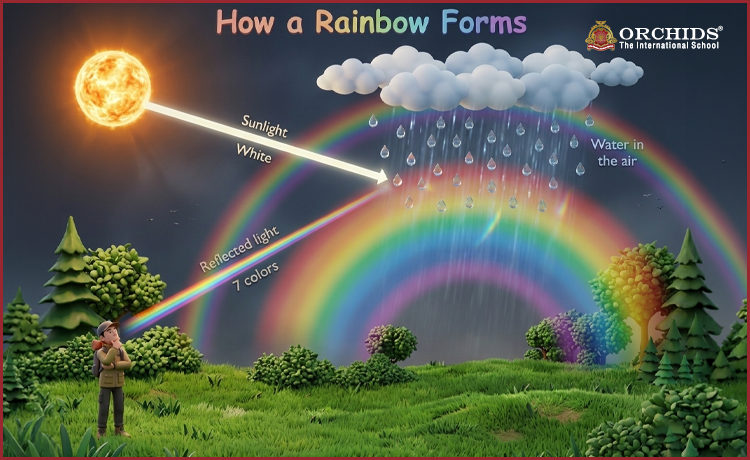
Because each colour has a different wavelength, they spread out to form the rainbow. This is also why the colours appear in a fixed order from red at the top to violet at the bottom. Knowing this process helps you to appreciate that rainbow colours are not random but scientifically arranged.
Rainbow Colours Names with Their Meaning
Before exploring detailed descriptions, it is helpful to know what each colour represents. Each colour carries symbolic meanings and is associated with certain natural objects. These associations help you to identify and remember the colours easily.
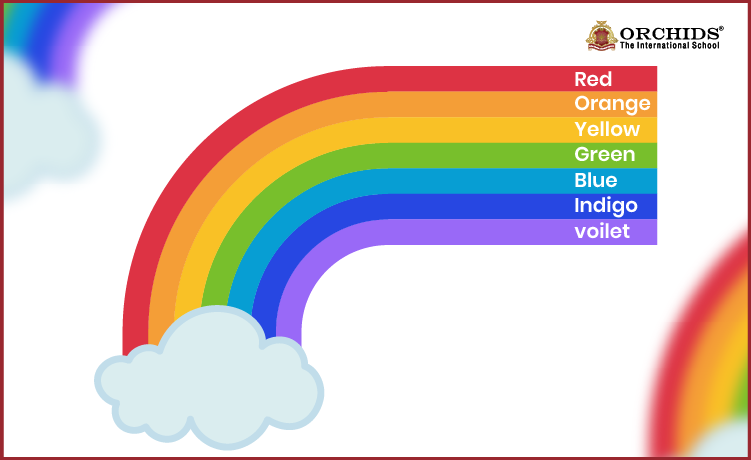
Below are explanations for each rainbow colour in the order they appear:
Red
Red is the first and outermost colour of the rainbow. It has the longest wavelength among all the colours, which is why it appears at the top. Red is often associated with warmth, energy, passion, and visibility. It is found in ripe fruits like apples and strawberries, as well as in signs that attract attention. Because of its bold appearance, red is commonly used for warnings and symbols that must stand out.
Orange
Orange is a blend of red and yellow and represents enthusiasm and creativity. It is commonly seen in fruits such as oranges, pumpkins, and marigold flowers. In the rainbow, it appears just below red because its wavelength is slightly shorter. Orange often symbolises joy, brightness, and change, making it a popular colour in art and design. Many sunsets display beautiful shades of orange.
Yellow
Yellow is known for its brightness and cheerful appearance. It resembles the colour of sunlight and is associated with positivity, freshness, and happiness. In nature, yellow appears in flowers like sunflowers and in fruits such as lemons and bananas. Yellow is also used for highlighting important information due to its high visibility.
Learn More: List of 300+ Flower Names with Types and Uses for Students
Green
Green lies at the centre of the rainbow and represents balance and harmony. It is the colour most commonly associated with nature, trees, grass, leaves, and plants. Green is known to have a calming effect on the human mind. It symbolises growth, renewal, and life, making it an important colour in environmental studies and biology.
Blue
Blue is seen below green in the rainbow and is a colour linked to calmness, stability, and depth. It is the colour of the sky and the ocean that makes it familiar to learners. Blue is often used to represent trust, peace, and intelligence. In light theory, it has a shorter wavelength than green, which is why it appears lower in the rainbow.
Indigo
Indigo is a deep shade between blue and violet. Although it may appear darker and sometimes difficult to spot, it plays an important role in the spectrum. Indigo is associated with mystery, intuition, and depth. It is commonly seen in the night sky and in fabrics dyed with natural indigo dye.
Violet
Violet is the last and innermost colour of the rainbow. It has the shortest wavelength and appears faint yet distinct. Violet symbolises creativity, imagination, and spirituality. Flowers like violets and lavender carry this shade naturally. Because violet blends into ultraviolet light, it marks the end of the visible spectrum.
Rainbow Colours in Order – VIBGYOR Explained
Many of you find it hard to remember the sequence of colours. The acronym VIBGYOR makes it easier by listing the colours from top to bottom. The order never changes because each colour bends differently based on its wavelength.
Each letter in VIBGYOR stands for:
-
V – Violet
-
I – Indigo
-
B – Blue
-
G – Green
-
Y – Yellow
-
O – Orange
-
R – Red
Knowing this arrangement allows you to quickly identify colours and recall them in examinations or practical observations.
Examples of Rainbow Colours in Daily Life
Rainbow colours are not restricted to the sky after rainfall. They appear in everyday objects and surroundings. Understanding these examples helps students apply the concept of colour identification in real situations.
Natural Occurrences
-
Colourful flowers display multiple shades found in the rainbow.
-
Birds such as parrots and peacocks show natural gradients.
-
Sunsets and sunrises often show red, orange, and yellow hues.
Everyday Objects
-
Clothing, art supplies, and painted materials exhibit rainbow shades.
-
Traffic signals use red, yellow, and green for clarity.
-
Toys and stationery items use rainbow colours to make them attractive.
Human Creations
-
Flags often contain rainbow-inspired colour combinations.
-
Festivals and decorations use vibrant colour patterns.
-
Lighting in shows and events displays the spectrum in moving patterns.
These examples help you to strengthen their recognition of rainbow colours in practical contexts.
List of Rainbow Colours with Objects
This list helps you to connect each rainbow colour with familiar examples.
-
Red: rose, apple, tomato, traffic STOP sign
-
Orange: pumpkin, carrot, marigold flower, autumn leaves
-
Yellow: banana, sunflower, corn, lemons
-
Green: grass, cucumber, leaves, peas
-
Blue: sky, ocean, blueberries, denim
-
Indigo: night sky, ink, fabric dyes
-
Violet: lavender flower, grapes, amethyst stone
Learn More: List of 200+ Fruits Names with Pictures and Uses in English
Frequently Asked Questions on Rainbow Colours Names
1. How many colours are in a rainbow, and name them?
There are seven colors in a rainbow: red, orange, yellow, green, blue, indigo, and violet. These colors always appear in this specific order, which can be remembered by the acronym ROYGBIV.
2. What are 7 colours in a rainbow?
A rainbow has 7 colours, they are: red, orange, yellow, green, blue, indigo, violet.
3. What are the 12 types of rainbows?
Atmospheric scientists classify rainbows into 12 distinct types based on how light interacts with the atmosphere. These classifications are determined by the visibility of the six primary colors (red, orange, yellow, green, blue, violet), the presence of dark or supernumerary bands, and light missing due to specific sun.
4. How many colours are in rainbow?
There are are seven colours in the rainbow. These are red, orange, yellow, green, blue, indigo and violet.
5. What are two types of rainbows?
The two most common and fundamental types of rainbows are primary and secondary rainbows. Together, they often form what is known as a double rainbow.
Strong language skills open doors well beyond the classroom, shaping how confidently a child reads, writes and expresses ideas. If you want to know more about how Orchids The International School builds these skills through its English curriculum, get in touch with our admissions team.


Admissions Open for 2026-27
What type of concept pages would you prefer?
CBSE Schools In Popular Cities
- CBSE Schools in Bangalore
- CBSE Schools in Mumbai
- CBSE Schools in Pune
- CBSE Schools in Hyderabad
- CBSE Schools in Chennai
- CBSE Schools in Gurgaon
- CBSE Schools in Kolkata
- CBSE Schools in Indore
- CBSE Schools in Sonipat
- CBSE Schools in Delhi
- CBSE Schools in Rohtak
- CBSE Schools in Bhopal
- CBSE Schools in Aurangabad
- CBSE Schools in Jabalpur
- CBSE Schools in Jaipur
- CBSE Schools in Jodhpur
- CBSE Schools in Nagpur
- CBSE Schools in Ahmednagar
- CBSE School In Tumkur











Orchids The International School is one of India's leading chains of CBSE and ICSE schools, with 130+ schools across the country.