

Carnivorous Plants: Names, Characteristics, Special Adaptations and Common Species in India
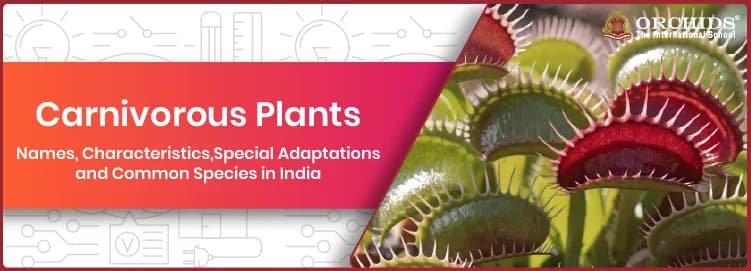
Carnivorous plants are among nature’s most fascinating creatures. These extraordinary species of plants have evolved jaws, sticky traps, vacuum pumps and pitfall pools. There are over 600 species of carnivorous plants found around the world in different habitats. In this article, we will learn some interesting facts about carnivorous plants, their unique adaptations, characteristics and famous species.
Table of Contents
- What are Carnivorous Plants
- How do Carnivorous Plants Trap their Prey
- Famous Carnivorous Plants of the World
- Carnivorous Plants in India
- Frequently Asked Questions about Carnivorous Plants

What are Carnivorous Plants
The word carnivorous comes from the Latin words caro which means flesh and vorare means to devour, together it means flesh-eating. Carnivorous plants are a group of plants that have evolved the ability to attract, trap and digest animals, primarily insects and other small creatures. They eat them to supplement their nutrient intake. However, carnivorous plants are not truly flesh-eaters in the way animals are. Like other plants, these plants also prepare their food via photosynthesis. But they have gradually evolved to obtain nutrients such as nitrogen and phosphorus which are missing in the soil where they grow. This unique adaptation has made these plants special and different from others.
How Do Carnivorous Plants Trap Their Prey
Carnivorous plants have evolved to develop five distinct types of trapping mechanisms:
- Snap Traps: The plant has two hinged lobes with hairs within. These lobes close quickly when a prey comes into contact with these hairs.
- Pitfall Traps: The plant has a deep leaf that resembles a tube. It has some digestive liquid in it that helps the plant to decompose its prey. Insects get attracted to their colour, nectar and scent. Once they land on the waxy rim, it slips them off and traps them into the liquid below. The liquid then slowly digested them.
- Flypaper Traps: The leaves of the plant have sticky glands called tentacles. These tentacles secrete a substance that insects get stuck on and cannot escape. Then these tentacles or leaves gradually curl around the prey to digest them.
- Suction Traps: Found only in bladderworts, this is the most sophisticated and fastest trap in the plant kingdom. Tiny underwater bladders create a vacuum inside. When trigger hairs at the entrance are touched, a trapdoor opens and the prey is sucked in within 1/15,000th of a second.
- Lobster-Pot Traps: The plant has a tubular structure lined with inward-pointing hairs. Prey can easily enter but cannot exit.
Famous Carnivorous Plants of the World
One of the most famous carnivorous plants is venus flytrap which originally belongs to only a specific region of the USA including North and South Carolina. It has jaw-like leaves that close rapidly in a few milliseconds.
Sundews or Drosera: One of the most widespread carnivorous plant genera, with over 200 species found across the world including India. Their leaves are covered with red, hair-like tentacles tipped with glistening sticky droplets. Charles Darwin spent over a decade studying sundews and wrote extensively about their movement and digestion.
Utricularia: The largest genus of carnivorous plants, with over 230 species found across the world including many in India. They grow in water or wet soil and use their remarkable vacuum-powered bladder traps to catch tiny aquatic organisms.
Cobra Lilly: Found only in Northern California and Oregon, the US, the Cobra Lily gets its name from its hooded, cobra-like appearance. It uses a lobster-pot mechanism and has transparent patches on its hood that confuse trapped insects, preventing them from finding the exit.
Butterworts: Found across Europe, Asia and the Americas, butterworts have flat, greasy-feeling leaves covered in sticky glands. They primarily trap tiny insects and even digest pollen grains that land on them.
Pitcher Plants: These plants are found in two different forms - Nepenthes and Sarracenia.
Nepenthes are tropical pitcher plants and Sarracenia are North American pitcher plants.
Carnivorous Plants in India
|
Common Name |
Scientific Name |
Trap Type |
Where found in India |
|
Pitcher Plant |
Nepenthes khasiana |
Pitfall trap |
Khasi & Jaintia Hills, Meghalaya |
|
Indian Sundew |
Drosera indica |
Flypaper trap |
Western Ghats (Kerala, Karnataka, Tamil Nadu), Northeastern India |
|
Burmese Sundew |
Drosera burmannii |
Flypaper trap |
Western Ghats, Assam, Odisha, Chhattisgarh |
|
Shield Sundew |
Drosera peltata |
Flypaper trap |
Nilgiri Hills, Western Ghats, Himachal Pradesh |
|
Golden Bladderwort |
Utricularia aurea |
Bladder trap |
Ponds and lakes across India |
|
Two-lipped Bladderwort |
Utricularia bifida |
Bladder trap |
Western Ghats wetlands, Northeastern India |
|
Rock Bladderwort |
Utricularia striatula |
Bladder trap |
Rocky wet surfaces, Western Ghats and Northeastern India |
|
Corkscrew Plant |
Genlisea margaretae |
Lobster-pot trap |
Wet grasslands, Western Ghats. It is very rare. |
Frequently Asked Questions about Carnivorous Plants
1. Can carnivorous plants eat humans?
No, it is a myth. Some of the largest species of carnivorous plants can only trap small frogs or rats. There is no such carnivorous plant which can eat human beings. These plants have only evolved to trap some small organisms such as insects.
2. How many species of carnivorous plants are there?
There are over 600 known species of carnivorous plants that are spread across more than 10 plant families.
3. Are there any carnivorous plants found in India?
Yes, India is home to several native carnivorous plants, including pitcher plant in Meghalaya, multiple species of sundews in Western ghats and northeastern India.
Understanding the world starts with the environment around us. To see how Orchids The International School brings EVS to life, reach out to our admissions team.


Admissions Open for 2026-27
What type of concept pages would you prefer?
CBSE Schools In Popular Cities
- CBSE Schools in Bangalore
- CBSE Schools in Mumbai
- CBSE Schools in Pune
- CBSE Schools in Hyderabad
- CBSE Schools in Chennai
- CBSE Schools in Gurgaon
- CBSE Schools in Kolkata
- CBSE Schools in Indore
- CBSE Schools in Sonipat
- CBSE Schools in Delhi
- CBSE Schools in Rohtak
- CBSE Schools in Bhopal
- CBSE Schools in Aurangabad
- CBSE Schools in Jabalpur
- CBSE Schools in Jaipur
- CBSE Schools in Jodhpur
- CBSE Schools in Nagpur
- CBSE Schools in Ahmednagar
- CBSE School In Tumkur











Orchids The International School is one of India's leading chains of CBSE and ICSE schools, with 130+ schools across the country.