

Class 10 Maths Chapter 9 ‘Some Applications of Trigonometry’ Notes: A Complete NCERT Guide for CBSE Board Exams
Chapter 9: Some Applications of Trigonometry Notes for Class 10 offer a clear, student-friendly guide to using trigonometry to find heights and distances in real-life situations. Aligned with the NCERT syllabus and CBSE exam patterns, this lesson explains how to form right-triangle models from angle of elevation or depression, choose the correct trigonometric ratio, and solve for unknown heights or distances with step-by-step worked examples. You’ll learn standard problem types, shortcut setup tips, common sign-and-diagram errors to avoid, quick revision bullets, practice problems with answers, and assertion–reason questions to prepare confidently for tests.
Know more about related topics:
- Class 10 Maths Notes Chapter 8 Introduction To Trigonometry
- Class 10 Maths Mcqs Chapter 9 Some Applications Of Trigonometry
- Class 10 Maths Chapter 9 Some Applications Of Trigonometry Worksheets
- Important Questions Class 10 Maths Some Applications Of Trigonometry
- Assertion Reason Questions For Class 10 Maths Chapter 9 Applications Of Trigonometry
Chapter 9: Some Applications of Trigonometry Notes for Class 10
1. The Horizontal Line
The horizontal line is a straight, flat line drawn through the eye of the observer, perfectly parallel to the ground.
2. The Line of Sight
The line of sight is the straight line drawn from the observer's eye to the object they're looking at. If you're standing on the ground looking at the top of a tower, the line from your eye to the top of that tower is your line of sight.
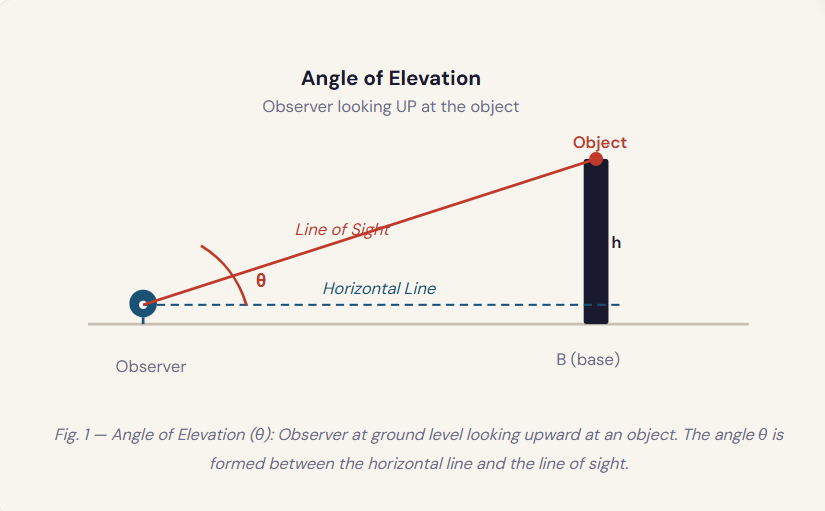
3. Angle of Elevation
When the object is above the observer's horizontal level, like the top of a building, a flying kite, or a cloud, the observer tilts their line of sight upward. The angle between the horizontal line and this upward-tilted line of sight is called the angle of elevation.
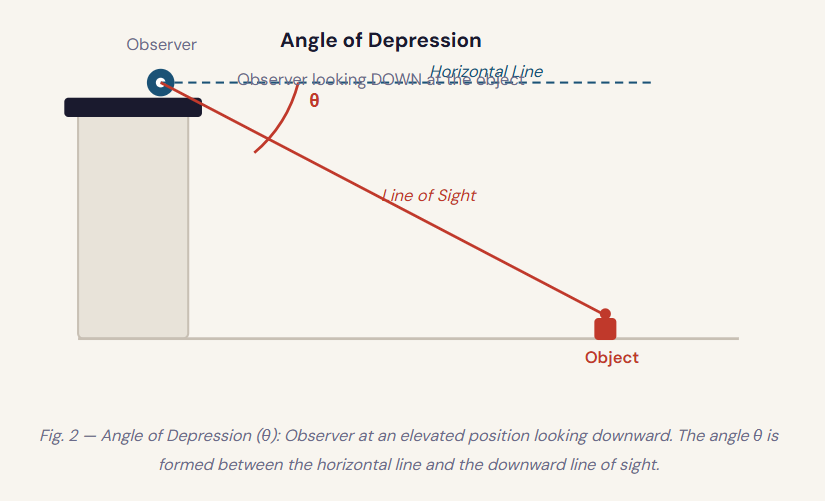
4. Angle of Depression
When the object is below the observer's horizontal level, like when you're standing on a rooftop looking down at a car on the street, the line of sight dips below the horizontal. The angle between the horizontal line and this downward line of sight is called the angle of depression.
5. Trigonometric Ratios: Standard Angle Values
You must know these values cold before solving any problem. The three angles that appear in almost every NCERT exercise problem are 30°, 45°, and 60°. The angles 0° and 90° appear occasionally in special cases.

6. How to Solve Any Heights & Distances Problem
Here's the four-step method that works for every single problem in this chapter.
Step 1: Identify every number in the problem : angles (like 30°, 60°) and distances (like ‘20 m away’).
Step 2: Draw the Diagram. Mark the observer, the object, the line of sight, and all known values. Label the unknown as x or h.
Step 3: Apply tan (or sin)
Form the right-angled triangle. Use tan θ = opp/adj (most common) or sin θ = opp/hyp when the string/rope is given.
Step 4: Solve & Verify
Substitute the angle value from the table. Solve for the unknown. Check if the answer makes physical sense.
7. Previous Year Questions
Q1: CBSE 2017
The ratio of the height of a tower to the length of its shadow on the ground is √3 : 1. What is the angle of elevation of the sun?
Solution: Let the tower height = √3 units and shadow length = 1 unit.
Let θ be the angle of elevation.
tan θ = Height / Shadow = √3 / 1 = √3
tan 60° = √3
⇒ θ = 60°
Angle of elevation of the sun = 60°
Q2: A ladder 10 m long just reaches the top of a wall. If the ladder makes an angle of 30° with the wall, find the height of the wall.
Solution: Ladder = hypotenuse = 10 m.
Angle with wall = 30°. Height = adjacent side to this angle.
cos 30° = height / ladder ⇒ √3/2 = h/10
⇒ h = 10 × √3/2 = 5√3 m
Height of the wall = 5√3 m ≈ 8.66 m
Q3: A circus artist is climbing a 20 m long rope, which is tightly stretched and tied from the top of a vertical pole to the ground. Find the height of the pole if the angle made by the rope with the ground level is 30°.
Solution: Rope AC = 20 m (hypotenuse). ∠ACB = 30°.
AB = height of pole (opposite side).
sin 30° = AB / AC
⇒ 1/2 = AB/20
⇒ AB = 10 m
Height of the pole = 10 m
Q4: CBSE 2020
An observer 1.5 metres tall is 20.5 metres away from a tower 22 metres high. Determine the angle of elevation of the top of the tower from the eye of the observer.
Solution: Effective vertical height above observer's eye = 22 − 1.5 = 20.5 m. Horizontal distance = 20.5 m.
tan θ = 20.5 / 20.5 = 1
⇒ tan 45° = 1 ⇒ θ = 45°
Angle of elevation = 45°
Q5: CBSE 2019 & 2022
The shadow of a tower standing on a level ground is found to be 40 m longer when the Sun's altitude is 30° than when it is 60°. Find the height of the tower.
Solution: Let: AB = h (tower), BC = x (shadow at 60°),
BD = x + 40 (shadow at 30°).
tan 60° = h/x h = √3x
tan 30° = h/(x+40) ⇒ h = (x+40)/√3
√3x = (x+40)/√3 ⇒ 3x = x+40 ⇒ x = 20 m ⇒ h = 20√3 m
Height of the tower = 20√3 m ≈ 34.64 m
Q6: CBSE 2021
A vertical tower stands on a horizontal plane and is surmounted by a flagstaff of height 7 m. From a point on the plane, the angle of elevation of the bottom of the flagstaff is 30° and that of the top of the flagstaff is 45°. Find the height of the tower. (Use √3 = 1.732)
Solution:
Let: AB = tower (h), BC = flagstaff = 7 m, D = point, AD = d (horizontal).
tan 30° = h/d ⇒ d = h√3
tan 45° = (h+7)/d ⇒ d = h+7
h√3 = h+7
⇒ h(√3−1) = 7 ⇒ h = 7/(√3−1)
h = 7(√3+1)/2 = 7(2.732)/2 ≈ 9.56 m
Height of tower = 7(√3+1)/2 ≈ 9.56 m
Q7: CBSE 2023
Two poles of equal heights are standing opposite each other on either side of a road 80 m wide. From a point between them on the road, the angles of elevation of the tops of the poles are 60° and 30° respectively. Find the height of the poles and the distances of the point from the poles.
Solution:
Let: AB = CD = h. O = point on road. OB = a, OD = b. a + b = 80 m.
tan 60° = h/a ⇒ h = a√3 …(i)
tan 30° = h/b ⇒ h = b/√3 …(ii)
a√3 = b/√3 ⇒ 3a = b.
Also a+b = 80 ⇒ a+3a = 80 ⇒ a = 20 m, b = 60 m
h = 20√3 m
Height = 20√3 m. Distances: 20 m (from 60° pole) and 60 m (from 30° pole).
Q9: CBSE 2019 & 2023
From the top of a 7 m high building, the angle of elevation of the top of a cable tower is 60° and the angle of depression of its foot is 45°. Determine the height of the cable tower.
Solution:
Let: AB = building = 7 m. CE = cable tower.
Observer at A. Horizontal distance = d.
Depression to foot (45°): tan 45° = 7/d ⇒ d = 7 m
Elevation to top (60°): tan 60° = DE/7 ⇒ DE = 7√3 m
Total tower height = DE + AB = 7√3 + 7 = 7(√3 + 1) m
Height of cable tower = 7(√3 + 1) m ≈ 19.12 m
8. Chapter Summary at a Glance
Click below to download your free Class 10 Maths Chapter 9: Some Applications of Trigonometry PDF Notes perfect for last-minute CBSE board exam revision.
Download PDF - Class 10 Maths Chapter 9: Some Applications of Trigonometry Notes
Frequently Asked Questions of Class 10 Maths Chapter 9: Some Applications of Trigonometry Notes
1. What does it mean when the answer involves √3 should I leave it or convert?
In CBSE board exams, it is perfectly acceptable (and preferred) to leave answers in surd form like 10√3 or 25√3/3. Only convert to decimal approximations if the question explicitly asks for it.
2. What is the line of sight in trigonometry?
The line of sight is the straight line drawn from the observer's eye to the object being observed.
3. How is Chapter 9 different from Chapter 8 (Introduction to Trigonometry)?
Chapter 8 introduces trigonometric ratios: sin, cos, tan, and their values, in the context of a static right-angled triangle. Chapter 9 takes those ratios and applies them to word problems involving physical situations like towers, buildings, kites, ships, and shadows.
4. How do you solve a problem with two angles of elevation?
The approach: let the height of the object = h and the nearer horizontal distance = x. Write one tan equation for each observer point. You'll get two equations with two unknowns. Solve simultaneously.
Numbers make sense when they're taught right. To see how Orchids The International School turns Maths from intimidating to intuitive, reach out to our admissions team.


Admissions Open for 2026-27
What type of concept pages would you prefer?
CBSE Schools In Popular Cities
- CBSE Schools in Bangalore
- CBSE Schools in Mumbai
- CBSE Schools in Pune
- CBSE Schools in Hyderabad
- CBSE Schools in Chennai
- CBSE Schools in Gurgaon
- CBSE Schools in Kolkata
- CBSE Schools in Indore
- CBSE Schools in Sonipat
- CBSE Schools in Delhi
- CBSE Schools in Rohtak
- CBSE Schools in Bhopal
- CBSE Schools in Aurangabad
- CBSE Schools in Jabalpur
- CBSE Schools in Jaipur
- CBSE Schools in Jodhpur
- CBSE Schools in Nagpur
- CBSE Schools in Ahmednagar
- CBSE School In Tumkur











Orchids The International School is one of India's leading chains of CBSE and ICSE schools, with 130+ schools across the country.