

NCERT Solutions for Class 8 Maths Chapter 1 A Square and A Cube
Access NCERT Solutions for Class 8 Maths Chapter 1 A Square and A Cube to help you understand the topics clearly from the start. These concepts are important because they form the base for higher-level maths. To score well in exams, it is recommended to practice all questions given at the end of the chapter. These solutions make learning easier and help students solve problems step by step.
A square is a number multiplied by itself, and a cube is a number multiplied by itself twice more. While simple, these ideas are very useful for algebra, geometry, and other maths problems in higher classes.
Contents Covered:
- Square Numbers
- Perfect Squares
- Cube Numbers
- Perfect Cubes
- Applications
Using NCERT Solutions for Class 8 Maths Chapter 1 A Square and A Cube, students can solve exercises without confusion. Each solution is explained in detail, showing the method behind it. Practising with these solutions helps strengthen your basics and increases confidence in solving math problems.
Learn How to Solve Class 8 Maths Chapter 1 A Square and A Cube
Get your answers to NCERT Solutions Class 8 Maths Chapter 1 A Square and A Cube
1.1 Square Numbers
Patterns and Properties of Perfect Squares
NCERT In-Text Questions (Pages 4-5)
1. Find the squares of the first 30 natural numbers and fill in the table below.
|
1² = 1 |
11² = |
21² = |
|---|---|---|
|
2² = 4 |
12² = |
22² = |
|
3² = 9 |
13² = |
|
|
4² = 16 |
14² = |
|
|
5² = 25 |
15² = |
|
|
6² = |
16² = |
|
|
7² = |
17² = |
|
|
8² = |
18² = |
|
|
9² = |
19² = |
|
|
10² = |
20² = |
Solution:
To understand perfect squares clearly, refer to the table below showing numbers from 1 to 30 and their squares.
|
Number |
Square (Calculation) |
Square Value |
Number |
Square (Calculation) |
Square Value |
|---|---|---|---|---|---|
|
1 |
1² = 1 × 1 |
1 |
16 |
16² = 16 × 16 |
256 |
|
2 |
2² = 2 × 2 |
4 |
17 |
17² = 17 × 17 |
289 |
|
3 |
3² = 3 × 3 |
9 |
18 |
18² = 18 × 18 |
324 |
|
4 |
4² = 4 × 4 |
16 |
19 |
19² = 19 × 19 |
361 |
|
5 |
5² = 5 × 5 |
25 |
20 |
20² = 20 × 20 |
400 |
|
6 |
6² = 6 × 6 |
36 |
21 |
21² = 21 × 21 |
441 |
|
7 |
7² = 7 × 7 |
49 |
22 |
22² = 22 × 22 |
484 |
|
8 |
8² = 8 × 8 |
64 |
23 |
23² = 23 × 23 |
529 |
|
9 |
9² = 9 × 9 |
81 |
24 |
24² = 24 × 24 |
576 |
|
10 |
10² = 10 × 10 |
100 |
25 |
25² = 25 × 25 |
625 |
|
11 |
11² = 11 × 11 |
121 |
26 |
26² = 26 × 26 |
676 |
|
12 |
12² = 12 × 12 |
144 |
27 |
27² = 27 × 27 |
729 |
|
13 |
13² = 13 × 13 |
169 |
28 |
28² = 28 × 28 |
784 |
|
14 |
14² = 14 × 14 |
196 |
29 |
29² = 29 × 29 |
841 |
|
15 |
15² = 15 × 15 |
225 |
30 |
30² = 30 × 30 |
900 |
2. What patterns do you notice? Share your observations and make conjectures.
Solution:
Observations:
- A perfect square number can end only with the digits 0, 1, 4, 5, 6, or 9. It can never have 2, 3, 7, or 8 in the units place.
- When a number ends in 0, 1, 5, or 6, its square will also end in the same digit.
For example,
-
- 102 = 100 → ends in 0
- 112 = 121→ ends in 1
- 152 = 225 → ends in 5
- 162 = 256 → ends in 6
- Numbers ending in 2, 3, 4, 7, 8, and 9 always follow a fixed pattern in their squares:
- If a number ends in 2 or 8, its square ends in 4
- If it ends in 3 or 7, its square ends in 9
- If it ends in 4 or 6, its square ends in 6
- If it ends in 9, its square ends in 1
- The difference between two consecutive square numbers is always an odd number.
For example:
- 4 − 1 = 3
- 9 − 4 = 5
- 16 − 9 = 7
- 25 − 16 = 9
This shows that the gap between squares increases by 2 each time.
- The square of an even number is always even, while the square of an odd number is always odd.
For example,
- 62 = 36 (even)
- 72 = 49 (odd).
3. If a number ends in 0, 1, 4, 5, 6, or 9, is it always a square?
Solution:
No. Even though every perfect square ends in one of the digits 0, 1, 4, 5, 6, or 9, the reverse is not true. A number ending in these digits is not necessarily a perfect square.
For example, numbers like 10, 14, 135, 4006, and 90109 all end with one of these digits, yet none of them are perfect squares when checked.
This clearly shows that the unit digit alone cannot be used to confirm whether a number is a perfect square. It is only useful for eliminating numbers that cannot be squares, not for proving that a number is one.
4. Write 5 numbers such that you can determine by looking at their units digit that they are not squares.
Solution:
Perfect square numbers always end in particular digits. A square number can only have 0, 1, 4, 5, 6, or 9 as its units digit. It can never end in 2, 3, 7, or 8.
So, by simply looking at the last digit of a number, we can often tell whether it is a square or not.
If a number ends in 2, 3, 7, or 8, it is definitely not a perfect square.
Using this rule, the numbers 222, 4503, 27, 68, and 142 are clearly not square numbers because their units digits are 2, 3, 7, or 8.
Hence, we can determine just by inspection that these numbers cannot be perfect squares.
5. Let us consider square numbers ending in 6: 16 = 42, 36 = 62, 196 = 142, 256 = 162, 576 = 242, and 676 = 262. Which of the following numbers has the digit 6 in the units place?
(i) 382
(ii) 342
(iii) 462
(iv) 562
(v) 742
(vi) 822
Solution:
From the table of squares of natural numbers, we notice an important pattern:
Any number ending in 4 or 6, when squared, always ends with the digit 6.
Let us now check the unit digit of each given number:
- 38 ends with 8, so its square will not end with 6.
- 34 ends with 4, so its square will end with 6.
- 46 ends with 6, so its square will end with 6.
- 56 ends with 6, so its square will end with 6.
- 74 ends with 4, so its square will end with 6.
- 82 ends with 2, so its square will not end with 6.
The numbers whose squares end with the digit 6 are:
(ii) 34², (iii) 46², (iv) 56², and (v) 74²
6. Find more such patterns by observing the numbers and their squares from the table you filled earlier.
Solution:
Refer to the table below showing numbers alongside their squares:
|
Number |
Calculation of Square |
Square Value |
Number |
Calculation of Square |
Square Value |
|---|---|---|---|---|---|
|
1 |
1² = 1 × 1 |
1 |
16 |
16² = 16 × 16 |
256 |
|
2 |
2² = 2 × 2 |
4 |
17 |
17² = 17 × 17 |
289 |
|
3 |
3² = 3 × 3 |
9 |
18 |
18² = 18 × 18 |
324 |
|
4 |
4² = 4 × 4 |
16 |
19 |
19² = 19 × 19 |
361 |
|
5 |
5² = 5 × 5 |
25 |
20 |
20² = 20 × 20 |
400 |
|
6 |
6² = 6 × 6 |
36 |
21 |
21² = 21 × 21 |
441 |
|
7 |
7² = 7 × 7 |
49 |
22 |
22² = 22 × 22 |
484 |
|
8 |
8² = 8 × 8 |
64 |
23 |
23² = 23 × 23 |
529 |
|
9 |
9² = 9 × 9 |
81 |
24 |
24² = 24 × 24 |
576 |
|
10 |
10² = 10 × 10 |
100 |
25 |
25² = 25 × 25 |
625 |
|
11 |
11² = 11 × 11 |
121 |
26 |
26² = 26 × 26 |
676 |
|
12 |
12² = 12 × 12 |
144 |
27 |
27² = 27 × 27 |
729 |
|
13 |
13² = 13 × 13 |
169 |
28 |
28² = 28 × 28 |
784 |
|
14 |
14² = 14 × 14 |
196 |
29 |
29² = 29 × 29 |
841 |
|
15 |
15² = 15 × 15 |
225 |
30 |
30² = 30 × 30 |
900 |

Observations:
- The square of a single-digit number usually results in a two-digit number, except for 1, 2, and 3, whose squares (1, 4, and 9) remain single-digit.
- The square of a two-digit number generally gives a three-digit or four-digit number, depending on the size of the number.
- When a two-digit number ends with 0 (such as 10, 20, or 30), its square always ends with two trailing zeros.
This happens because
(a0)2 = a2 x 100
Which shifts the digits two places to the right.
Examples:
-
- 202 = 400
- 302 = 900
These patterns help in quickly estimating squares and checking answers without detailed calculations.
7. If a number contains 3 zeros at the end, how many zeros will its square have at the end?
Solution:
A number that ends with 3 zeros will have 6 zeros at the end when it is squared.
This happens because squaring means multiplying the number by itself, so each zero present in the number gets doubled.
For example:
1000² = 1000000 (6 zeros)
2000² = 4000000 (6 zeros)
Hence, the square of any number ending in 3 zeros will always end in 6 zeros.
8. What do you notice about the number of zeros at the end of a number and the number of zeros at the end of its square? Will this always happen? Can we say that squares can only have an even number of zeros at the end?
Solution:
From the observations in the table above, we notice that the squares of two-digit numbers ending with a zero always have two trailing zeros.
This pattern is consistent and will always hold true: the square of a number that ends with ‘n’ zeros will end with ‘2n’ zeros.
Therefore, we can conclude that the perfect square of a number ending in zero will always have an even number of trailing zeros.
9. What can you say about the parity of a number and its square?
Solution:
By observing the squares of the first 30 natural numbers, we can conclude the following:
- The square of any even number is always even.
An even number can be expressed algebraically as 2n, where n is any integer. Squaring this number gives:
(2n)2 = 22⋅n2 = 4n2 = 2 (2n2)
Since the result is a multiple of 2, it is always even.
- The square of any odd number is always odd.
An odd number can be represented algebraically as 2n+1, where n is any integer. Squaring this number yields:
(2n+1)2 = (2n+1)(2n+1) = 4n2 + 4n + 1 = 2(2n2 + 2n) + 1
Here, the term 2(2n2 + 2n) is clearly divisible by 2, which makes it even. Adding 1 to this even number results in an odd number.
Thus, squaring preserves the parity in a predictable way: the square of an even number is always even, and the square of an odd number is always odd.
Perfect Squares and Odd Numbers
NCERT In-Text Questions (Page 7)
1. Find how many numbers lie between two consecutive perfect squares. Do you notice a pattern?
Solution:
Consider the table below:
|
n |
n2 |
(n+1)2 |
Numbers in between |
Count |
2n |
|---|---|---|---|---|---|
|
1 |
1 |
4 |
2, 3 |
2 |
2 |
|
2 |
4 |
9 |
5, 6, 7, 8 |
4 |
4 |
|
3 |
9 |
16 |
10, 11, 12, 13, 14, 15 |
6 |
6 |
|
4 |
16 |
25 |
17, 18, 19, 20, 21, 22, 23, 24 |
8 |
8 |
|
5 |
25 |
36 |
26, 27, 28, 29, 30, 31, 32, 33, 34, 35 |
10 |
10 |
From the table, we observe an interesting pattern: the number of integers that lie between the squares of a number ‘n’ and ‘(n+1)’ is always equal to 2n.
Example: Between 32 = 9 and 42 = 16, there are 2 × 3 = 6 numbers: 10, 11, 12, 13, 14, and 15.
The pattern shows that the count of integers between any two consecutive perfect squares is always twice the smaller of the two square roots. This provides a simple way to determine the number of integers between squares without listing them all.
2. How many square numbers are there between 1 and 100? How many are between 101 and 200?
|
1 - 100 |
101 - 200 |
201 - 300 |
301 - 400 |
401 - 500 |
|---|---|---|---|---|
|
__ |
__ |
__ |
__ |
__ |
|
501 - 600 |
601 - 700 |
701 - 800 |
801 - 900 |
901 - 1000 |
|
__ |
__ |
__ |
__ |
__ |
Solution:
Using the table of squares you filled earlier, enter the values below, tabulating the number of squares in each block of 100. What is the largest square less than 1000?
We find the number of perfect squares in each block of 100 as shown below in the table:
|
Block of 100 |
Perfect Squares in this Range |
Squares |
|---|---|---|
|
1 – 100 |
10 |
1², 2², 3², 4², 5², 6², 7², 8², 9², 10² |
|
101 – 200 |
4 |
11², 12², 13², 14² |
|
201 – 300 |
3 |
15², 16², 17² |
|
301 – 400 |
3 |
18², 19², 20² |
|
401 – 500 |
3 |
21², 22², 23² |
|
501 – 600 |
3 |
24², 25², 26² |
|
601 – 700 |
3 |
27², 28², 29² |
|
701 – 800 |
2 |
30², 31² |
|
801 – 900 |
1 |
32² (exceeds 900, so only 31² = 961 fits below 1000) |
|
901 – 1000 |
0 |
– |
Therefore, the largest square less than 1000 is 312 = 961.
Perfect Squares and Triangular Numbers
NCERT In-Text Questions (Page 7)
1. Can you see any relation between triangular numbers and square numbers? Extend the pattern shown and draw the next term.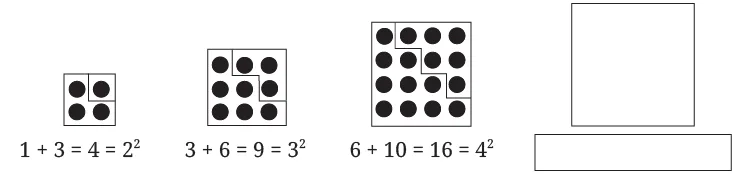
Solution:
Interestingly, the sum of any two consecutive triangular numbers always results in a perfect square number. Observing the pattern, you can extend it to predict the next term, confirming that this relationship consistently holds.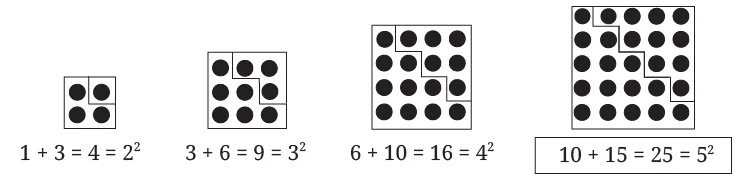
Square Roots
NCERT In-Text Questions (Page 9)
1. Find whether 1156 and 2800 are perfect squares using prime factorisation.
Solution:
Prime factorisation of 1156: 1156 = 2 × 2 × 17 × 17 = 22 × 172 = (2 × 17)2
Now, the prime factors can be divided into two equal groups, i.e., (2 × 17) and (2 × 17).
Therefore, 1156 is a perfect square.
Similarly, the prime factorisation of 2800:
2800 = 2 × 2 × 2 × 2 × 5 × 5 × 7 = 22 × 22 × 52 × 7.
These factors cannot be divided into equal groups because 7 appears only once.
Therefore, 2800 is not a perfect square.
We start by expressing 1156 as a product of prime numbers:
1156: 1156 = 2 × 2 × 17 × 17 = 22 × 172 = (2 × 17)2
Here, all the prime factors can be grouped into two identical sets: (2 × 17) and (2 × 17).
Since the prime factors can be completely paired, 1156 is a perfect square.
Step 2: Prime factorisation of 2800
Next, we factorise 2800:
800: 2800 = 2 × 2 × 2 × 2 × 5 × 5 × 7 = 22 × 22 × 52 × 7.
Although some factors can form pairs (like 24 and 52), the factor 7 occurs only once and cannot be paired.
Since not all prime factors can be grouped equally, 2800 is not a perfect square.
Therefore, we can say that
- 1156 is a perfect square.
- 2800 is not a perfect square.
Figure it Out (Pages 10-11)
1. Which of the following numbers are not perfect squares?
(i) 2032
(ii) 2048
(iii) 1027
(iv) 1089
Solution:
To check if a number is a perfect square, we can look at its last digit or use prime factorisation.
Perfect squares only end with 0, 1, 4, 5, 6, or 9.
- 2032 ends with 2 → Not a perfect square.
- 2048 ends with 8 → Not a perfect square.
- 1027 ends with 7 → Not a perfect square.
- 1089 ends with 9 → Could be a perfect square.
Now, prime factorisation of 1089: 3 × 3 × 11 × 11 = 32 × 112 = (3 × 11)2
The prime factors can be equally grouped into two parts.
So, 1089 is a perfect square. So, (i) 2032, (ii) 2048, and (iii) 1027 are not perfect squares.
2. Which one among 642, 1082, 2922, 362 has the last digit 4?
Solution:
Consider the last digit of each number and its square. The last digit of a squared number depends only on the last digit of the original number.
|
Number |
Square of Last Digit of the Given Number |
|---|---|
|
642 |
42 = 16 |
|
1082 |
82 = 64 |
|
2922 |
22 = 4 |
|
362 |
62 = 36 |
On examining the squares, we see that 1082 and 2922 are the numbers whose squares end with the digit 4.
3. Given 1252 = 15625, what is the value of 1262?
(i) 15625 + 126
(ii) 15625 + 262
(iii) 15625 + 253
(iv) 15625 + 251
(v) 15625 + 512
Solution:
We know an important property: the square of a number ‘n’ can be written as the sum of the first ‘n’odd numbers.
So,
1252 = sum of the first 125 odd numbers = 15625
To calculate 1262, we simply add the next (i.e., 126th) odd number to 1252.
The nnn-th odd number is given by:
nth odd number = 2n − 1
Thus, the 126th odd number is:
2 × 126 − 1 = 251
Adding this to 1252:
1262 = 1252 + 251 = 15625 + 251 = 15876
So, the answer is option (iv) 15625 + 251
4. Find the length of the side of a square whose area is 441 m².
Solution:
The area of a square is calculated using the formula:
Area = side × side
We are asked to find the length of the side, so we need a number whose square equals 441 m².
In other words, we need to calculate:
Side = 4412
We can find the square root of 441 by using prime factorization:
441 = 3 × 3 × 7 × 7 = 3² × 7² = (3 × 7)2
Now, by pairing the prime factors into two equal groups, we get:
(3 × 7) and (3 × 7)
Therefore, the length of the side of the square is:
Side = 3 × 7 = 21 m
5. Find the smallest square number that is divisible by each of the following numbers: 4, 9, and 10.
Solution:
To find the smallest square number divisible by given numbers, we first determine their LCM (Least Common Multiple). Then, we multiply the LCM by the smallest factor that converts it into a perfect square.
Step 1: Prime factorisation
Let’s write each number as a product of primes:
- 4 = 2 × 2
- 9 = 3 × 3
- 10 = 2 × 5
Step 2: Find the LCM
The LCM is obtained by taking each prime factor at its highest power:
LCM of 4, 9, and 10 = 22 × 32 × 5 = 180
Step 3: Check if the LCM is a perfect square
Prime factors of 180: 2 × 2 × 3 × 3 × 5.
All primes appear in pairs except 5. To make 180 a perfect square, we need one more factor of 5.
180 × 5 = 900
Thus, the smallest square number divisible by 4, 9, and 10 is 900.
6. Find the smallest number by which 9408 must be multiplied so that the product is a perfect square. Find the square root of the product.
Solution:
To determine the smallest number that 9408 must be multiplied by to obtain a perfect square, we first perform the prime factorization of 9408. This allows us to check whether all prime factors can be arranged into pairs, as a perfect square requires every prime factor to appear an even number of times.
Prime factorization of 9408:
9408 = 26 × 3 × 72
Here, notice that the prime factor 3 appears only once, which means it does not form a complete pair. To make all prime factors appear in pairs, we need to multiply 9408 by 3.
9408 × 3 = 28224
Now, 28224 becomes a perfect square. Let’s confirm by looking at its prime factorization:
28224 = 26 × 32 × 72
We can now group the prime factors into equal pairs:
(23 × 3 × 7) x (23 × 3 × 7)
Hence, the square root of 28224 is:
23 × 3 × 7 = 8 × 3 × 7 = 168.
Answer:
- Smallest number to multiply = 3
- Square root of the product = 168
7. How many numbers lie between the squares of the following numbers?
(i) 16 and 17
(ii) 99 and 100
Solution:
To determine the number of integers between the squares of any two consecutive numbers, we use the formula:
Number of integers between n2 and (n+1)2 = 2n
Step-by-step:
(i) Between 16² and 17²:
162 = 256 and 172 = 289
Using the formula:
2 × 16 = 32
So, there are 32 integers lying between 256 and 289.
(ii) Between 99² and 100²:
992 = 9801 and 1002 = 10000
Using the formula:
2 × 99 = 198
Hence, there are 198 integers lying between 9801 and 10000.
8. In the following pattern, fill in the missing numbers:
12 + 22 + 22 = 32
222 + 322 + 622 = 722
322 + 422 + 1222 = 1322
422 + 522 + 2022 = (___)2
922 + 1022 + (___)2 = (___)2
Solution:
Let’s examine the pattern step by step:
The given numbers follow the relation:
n2 + m2 + (n × m)2 = [(n × m) + 1]22
where nnn and mmm are consecutive integers.
Applying this formula:
42 + 52 + (20)2 = (21)2
92 + 102 + (90)2 = (91)2
Thus, the missing numbers are 20, 21, 90, 91, completing the pattern.
9. How many tiny squares are there in the following picture? Write the prime factorisation of the number of tiny squares.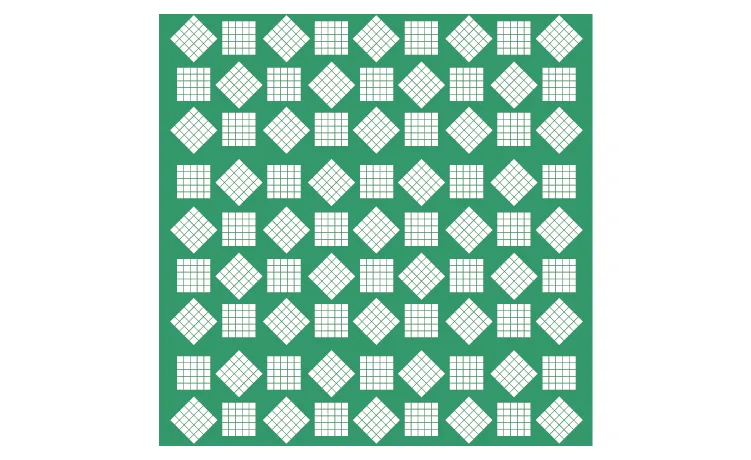 Solution:
There are 25 tiny squares in each set, and the given picture contains (9 × 9) such identical sets. Therefore, the total number of tiny squares in the figure is calculated as:
9 × 9 × 25 = 2025
Now, let us find the prime factorisation of 2025:
2025 = 3 × 3 × 3 × 3 × 5 × 5
Grouping the same prime factors together, we can write it in exponential form as:
2025 = 34 × 52
This expresses 2025 completely as a product of prime numbers.
1.2 Cubic Numbers
NCERT In-Text Questions (Pages 11-13)
1. How many cubes of side 1 cm make a cube of side 2 cm?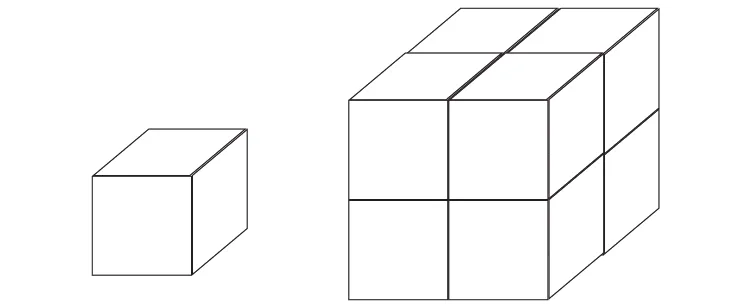
Solution:
If we observe the arrangement carefully, the larger cube of side 2 cm can be divided into smaller cubes of side 1 cm along each edge.
On the top face, there are 2 × 2 = 4 small unit cubes arranged.
Since the height of the cube is also 2 cm, there are 2 such layers stacked on top of each other.
Therefore, the total number of cubes is:
2 × 2 × 2 = 8
Hence, 8 small cubes of side 1 cm are needed to form one cube of side 2 cm.
2. How many cubes of side 1 cm will make a cube of side 3 cm?
Solution:
To form a cube of side 3 cm using small cubes of side 1 cm, we need to arrange the cubes along the length, width, and height.
On the top layer, there will be 3 × 3 small cubes because each side has a length of 3 cm and each small cube measures 1 cm.
So, one layer contains 3 × 3 = 9 unit cubes.
Since the height of the large cube is also 3 cm, there will be 3 such layers placed one above the other.
Therefore, the total number of small cubes required is:
3 × 3 × 3 = 27
So, 27 cubes of side 1 cm are needed to make a cube of side 3 cm.
3. Complete the table below:
|
13 = 1 |
113 = 1331 |
|---|---|
|
23 = 8 |
123 = |
|
33 = 27 |
133 = 2197 |
|
43 = 64 |
143 = 2744 |
|
53 = 125 |
153 = |
|
63 = |
163 = |
|
73 = |
173 = 4913 |
|
83 = |
183 = 5832 |
|
93 = |
193 = 6859 |
|
103 = |
203 = |
Solution:
Refer to the below completed list of cube numbers:
|
Number |
n³ |
Number |
n³ |
|---|---|---|---|
|
13 |
1 |
113 |
1331 |
|
23 |
8 |
123 |
1728 |
|
33 |
27 |
133 |
2197 |
|
43 |
64 |
143 |
2744 |
|
53 |
125 |
153 |
3375 |
|
63 |
216 |
163 |
4096 |
|
73 |
343 |
173 |
4913 |
|
83 |
512 |
183 |
5832 |
|
93 |
729 |
193 |
6859 |
|
103 |
1000 |
203 |
8000 |
4. What patterns do you notice in the table above?
Solution:
(i) When a number ends in 1, its cube also ends in 1. The unit digit remains unchanged after cubing.
(ii) If a number ends in 2, its cube ends in 8, and if a number ends in 8, its cube ends in 2. These two digits interchange their positions as unit digits when cubed.
(iii) A number ending in 3 gives a cube ending in 7, and a number ending in 7 gives a cube ending in 3. Here too, the unit digits swap when the numbers are raised to the power of 3.
(iv) Numbers with unit digits 4, 5, 6, 9, or 0 retain the same unit digit in their cubes. This means the last digit of the number and its cube remains the same for these cases.
5. We know that 0, 1, 4, 5, 6, 9 are the only last digits possible for squares. What are the possible last digits of cubes?
Solution:
Unlike square numbers, whose unit digits are limited, cubes can end in any digit from 0 to 9. This means there is no restriction on the possible last digits of cubic numbers.
If a number ends with 0, 1, 4, 5, 6, or 9, then its cube also ends with the same digit. For example:
- 13= 1
- 43 = 64
- 53 = 125
However, for numbers ending with 2, 3, 7, or 8, the last digit changes in a pattern:
- A number ending in 2 has a cube ending in 8
- A number ending in 3 has a cube ending in 7
- A number ending in 7 has a cube ending in 3
- A number ending in 8 has a cube ending in 2
So, every digit from 0 to 9 can appear as the last digit of a cube.
6. Similar to squares, can you find the number of cubes with 1 digit, 2 digits, and 3 digits? What do you observe?
Solution:
Yes, this can be found by observing the cubes of natural numbers carefully.
From the given table, we can see that:
- There are 2 one-digit cube numbers, which are 1 and 8.
- There are 2 two-digit cube numbers, which are 27 and 64.
- There are 5 three-digit cube numbers, which are 125, 216, 343, 512, and 729.
As the number of digits increases, the count of cube numbers also increases. However, cube numbers grow faster than square numbers, so the number of cube values in each digit group changes more quickly. This shows that cubes become larger at a faster rate compared to squares as the base number increases.
7. Can a cube end with exactly two zeroes (00)? Explain.
Solution:
No, a cube can never end with exactly two zeroes.
To find the cube of a number, we multiply the number by itself three times. Any zero at the end of a number comes from a factor of 10 (that is, 2 × 5).
When we cube a number that ends in zero, each factor of 10 also gets multiplied three times. As a result, each zero in the original number becomes three zeroes in its cube.
Let us understand this with examples:
- 203 = 8000 → one zero becomes three zeroes
- 2003 = 8,000,000 → two zeroes become six zeroes
- 20003 = 8,000,000,000 → three zeroes become nine zeroes
From this, we observe a clear pattern:
The number of zeroes at the end of a perfect cube is always a multiple of 3 (such as 0, 3, 6, 9, etc.).
Since 2 is not a multiple of 3, it is not possible for a cube to end with exactly two zeroes.
Therefore, a perfect cube can never end with exactly 00.
Taxicab Numbers
NCERT In-Text Questions (Page 13)
1. The next two taxicab numbers after 1729 are 4104 and 13832. Find the two ways in which each of these can be expressed as the sum of two positive cubes.
Solution:
A taxicab number is a number that can be expressed as the sum of two positive cubes in more than one way. After 1729, the next two such numbers are 4104 and 13832.
Let us verify this by expressing each of them as the sum of two cubes in two different forms.
For 4104
We try to split 4104 into two cube numbers:
First way
4104 = 4096 + 8 = 163 + 23
Second way
4104 = 3375 + 729 = 153 +93
Thus, 4104 can be written as the sum of two cubes in two distinct pairs:
- 163 + 23
- 153 + 93
This confirms that 4104 is a taxicab number.
For 13832
Now let us express 13832 similarly:
First way
13832 = 8000 + 5832 = 203 + 183
Second way
13832 = 13824 + 8 = 243 + 23
So, 13832 also gives two different cube pairs:
- 203 + 183
- 243 + 233
This shows that 13832 is also a taxicab number.
Both 4104 and 13832 qualify as taxicab numbers because each can be represented as the sum of two positive cubes in two distinct ways.
Perfect Cubes and Consecutive Odd Numbers
NCERT In-Text Questions (Page 14)
1. Can you tell what this sum is without doing the calculation?
Solution:
The given expression is the sum of ten consecutive odd numbers, starting from 91. Notice that:
91 = 10 × 9 + 1
This confirms that the series begins with the correct odd number for a set of ten consecutive odd numbers. Therefore, we are adding:
91 + 93 + 95 + 97 + 99 + 101 + 103 + 105 + 107 + 109
Instead of adding each term individually, we use the known result that the sum of n consecutive odd numbers, starting from
n² − n + 1, is equal to n³.
Here,
n = 10
First term = 10² − 10 + 1 = 91
So, the required sum is:
10³ = 1000
Hence, the value of the expression is 1000.
Alternative Explanation:
There is a well-known pattern in sequences of consecutive odd numbers:
When n consecutive odd numbers are added starting from (n² − n + 1), their sum is always n³.
Since the first term in the given series is 91, which matches the formula for n = 10, the sum is simply:
10³ = 1000
Therefore, the answer is 1000, without needing to perform the full addition.
Cube Roots NCERT
In-Text Questions (Page 15)
1. Find the cube roots of these numbers:
(i) 3 √ 64 = ____
(ii) 3 √ 512 = ____
(iii) 3 √ 729 = ____
Solution:
(i) Cube root of 64
First, we find the prime factors of 64:
64 = 2 × 2 × 2 × 2 × 2 × 2
These six factors can be arranged into three identical groups:
64 = (2 × 2) × (2 × 2) × (2 × 2) = (2 × 2)3
Since the cube root removes the power of 3, we get:
3 √ 64 = ( 2 × 2 ) = 4
⇒ 641/3 = ( 2 × 2 ) = 4
(ii) Cube root of 512
Prime factorisation of 512 gives:
512 = 2 × 2 × 2 × 2 × 2 × 2 × 2 × 2 × 2
These nine 2’s can be grouped into three equal sets of three factors:
512 = (2 × 2 × 2) × (2 × 2 × 2) × (2 × 2 × 2) = (2 × 2 × 2)3
Taking the cube root, we get:
3 √ 512 = ( 2 × 2 × 2 ) = 8
⇒ 5121/3 = ( 2 × 2 × 2 ) = 8
(iii) Cube root of 729
Prime factorisation of 729 is:
729 = 3 × 3 × 3 × 3 × 3 × 3
These factors can be arranged into three pairs of identical groups:
729 = (3 × 3) × (3 × 3) × (3 × 3) = (3 × 3)3
Removing the cube gives us:
⇒ 3 √ 729 = ( 3 × 3 ) = 9
7291/3 = ( 3 × 3 ) = 9
Successive Differences
NCERT In-Text Questions (Page 15)
1. Compute successive differences over levels for perfect cubes until all the differences at a level are the same. What do you notice?
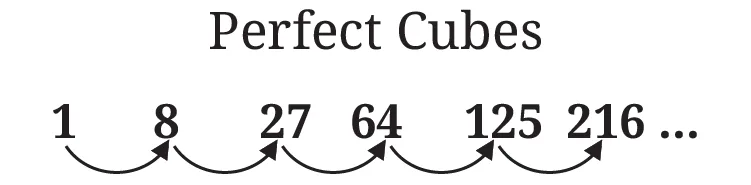
Solution:
Observe the successive differences carefully. The first-level differences do not follow any fixed pattern. However, when the second-level differences are calculated, they appear as multiples of 6, starting from the second multiple onward.
On computing the third-level differences, we find that all the values become equal to 6.
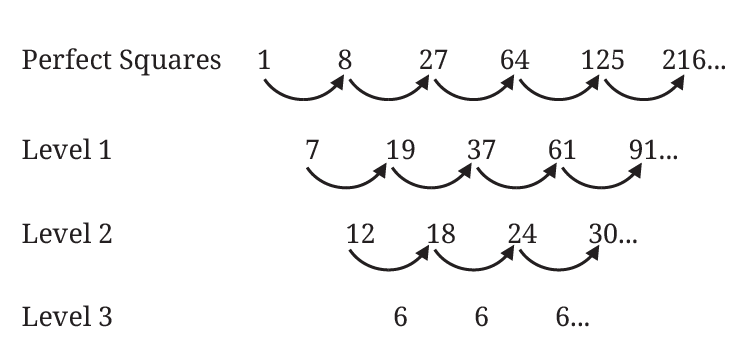
Therefore, the constant difference occurs at the third level, and its value is 6.
1.3 A Pinch of History - Figure it Out (Pages 16-17)
1. Find the cube roots of 27000 and 10648.
Solution:
To determine the cube root of a number, we can use prime factorization.
Step 1: Cube root of 27000
First, factorise 27000 into its prime factors:
27000 = 2 × 2 × 2 × 3 × 3 × 3 × 5 × 5 × 5
Now, group the factors in sets of three (since it’s a cube root):
= (2 × 3 × 5) × (2 × 3 × 5) × (2 × 3 × 5)
Therefore, the cube root of 27000 is:
= (2 × 3 × 5)3 = (2 × 3 × 5) = 30
Step 2: Cube root of 10648
Similarly, factorise 10648 into its prime factors:
10648 = 2 × 2 × 2 × 11 × 11 × 11
Group them in sets of three:
= (2 × 11) × (2 × 11) × (2 × 11)
Thus, the cube root of 10648 is:
= (2 × 11)3 = 2 × 11 = 22
2. What number will you multiply by 1323 to make it a cube number?
Solution:
Let’s start by expressing 1323 in terms of its prime factors.
1323 = 3 × (3 × 7) × (3 × 7) = 33 x 72
To form a perfect cube, every prime factor in the number must have an exponent that is a multiple of 3. Here, the factor 33 is already a perfect cube, but 72 is not. We need one more 7 to make the exponent of 7 equal to 3.
Hence, multiplying 1323 by 7 gives:
1323 × 7 = 9261
Now, 9261 = 33 x 73 = (3 x 7)3 = 213, which is a perfect cube.
Multiply 1323 by 7 to make it a cube number. The cube root of the resulting number is 21.
3. State true or false. Explain your reasoning.
(i) The cube of any odd number is even.
(ii) There is no perfect cube that ends with 8.
(iii) The cube of a 2-digit number may be a 3-digit number.
(iv) The cube of a 2-digit number may have seven or more digits.
(v) Cube numbers have an odd number of factors.
Solution:
(i) False.
The cube of an odd number is always odd. This is because:
Odd × Odd = Odd ⇒ Odd × Odd × Odd = Odd
For example, 33 = 27, which is clearly an odd number.
(ii) False.
Some perfect cubes do end with 8. Specifically, the cube of any number ending in 2 will end in 8.
For instance:
23 = 8, 123 = 1728, 223 = 10648
(iii) False.
The cube of a 2-digit number cannot be a 3-digit number. The smallest 2-digit number is 10:
103 = 1000
This is already a 4-digit number. Hence, the cube of all 2-digit numbers will have at least 4 digits.
(iv) False.
The cube of a 2-digit number cannot have 7 or more digits. The largest 2-digit number is 99:
993 = 970,299
This is a 6-digit number. Therefore, no 2-digit number produces a cube with 7 or more digits.
(v) False.
Cube numbers do not always have an odd number of factors.
- For example, 8 = 23 is a perfect cube and has 4 factors: 1,2,4,8 (even number of factors).
- On the other hand, 64 = 43 =26 is both a perfect cube and a perfect square. Its factors are 1, 2, 4, 8, 16, 32, 64, a total of 7 factors (odd).
Thus, only those cube numbers that are also perfect squares have an odd number of factors. Hence, the statement is false in general.
4. You are told that 1331 is a perfect cube. Can you guess without factorisation what its cube root is? Similarly, guess the cube roots of 4913, 12167, and 32768.
Solution:
a. 1331
This is a 4-digit number, which means it could be the cube of a 2-digit number.
The number ends with 1, so the cube root must have 1 in its units place.
We can test the first such possibility: 11 × 11 × 11 and we get 1331
Hence, the cube root of 1331 is 11.
b. 4913
This is a 4-digit number, indicating that its cube root is likely a 2-digit number.
It ends with 3, which means the units digit of the cube root should be 7..
Knowing that 203 = 8000, the cube root must be less than 20.
Testing 17 × 17 × 17 = 4913, we confirm that the cube root is 17.
c. 12167
This is a 5-digit number, so its cube root is expected to be a 2-digit number.
It ends with 7, which implies that the units digit of the cube root is 3.
Since 253 = 15625, the cube root must be less than 25.
Trying 23 × 23 × 23 = 12167, we find that the cube root is 23.
d. 32768
Being a 5-digit number, its cube root should also be a 2-digit number.
It ends with 8, which tells us that the units digit of the cube root is 2.
The cube of 30 is 27000, so the cube root must be slightly larger than 30.
Testing 32 × 32 × 32 = 32768, we conclude that the cube root is 32.
5. Which of the following is the greatest? Explain your reasoning.
(i) 673 – 6633
(ii) 433 – 423
(iii) 672 – 662
(iv) 432 – 422
Solution:
We know the following formulas:
- Difference of cubes: (n + 1)3 – n3 = 3 × (n + 1) × n + 1
- Difference of squares: (n + 1)2 – n2 = (n + 1) + n
Now, let’s calculate each expression using these formulas:
- (i) 673 – 663 = 3 × 67 × 66 + 1 = 13267
- (ii) 433 – 423 = 3 × 43 × 42 + 1 = 5419
- (iii) 672 – 662= 67 + 66 = 133
- (iv) 432– 422 = 43 + 42 = 85
From these calculations, it is clear that 673 – 663 has the greatest value among the given options.
Using the difference of cubes and squares formulas allows us to compare the values quickly without directly performing the long multiplications or exponentiation.
Puzzle Time (Page 18)
1. Try arranging the numbers 1 to 17 (without repetition) in a row in a similar way — the sum of every adjacent pair of numbers should be a square.
Solution:
Below is one valid way to arrange the numbers from 1 to 17 such that each pair of adjacent numbers adds up to a perfect square:
16, 9, 7, 2, 14, 11, 5, 4, 12, 13, 3, 6, 10, 15, 1, 8, 17
In this sequence, every number sits next to another in such a way that their total forms a square number. For instance,
- 16 + 9 = 25
- 9 + 7 = 16
- 7 + 2 = 9
and this same rule applies to the rest of the arrangement.
Therefore, the given order correctly fulfills the condition of the problem.
2. Can you arrange them in more than one way? If not, can you explain why?
Solution:
No, the arrangement cannot be changed in more than one way. Since there is only one unique path, the only other possible arrangement is to follow the same path in the reverse direction.
This simply gives the sequence in the opposite order and does not create a new arrangement. Therefore, apart from reversing the sequence, no other different ordering is possible.

3. Can you do the same with numbers from 1 to 32 (again, without repetition), but this time arranging all the numbers in a circle?
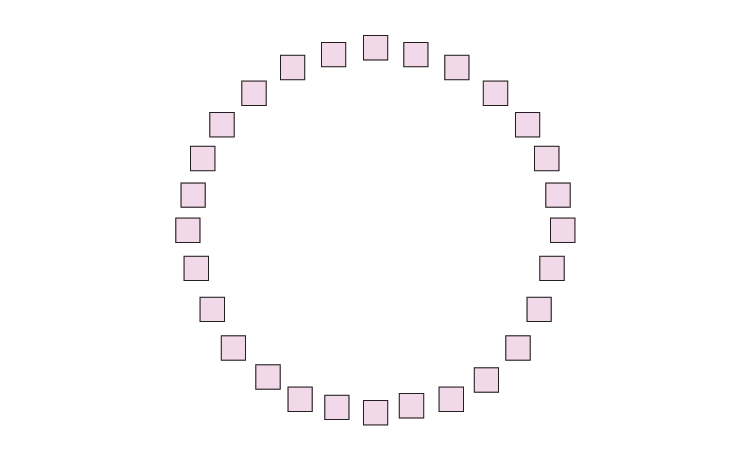
Solution:
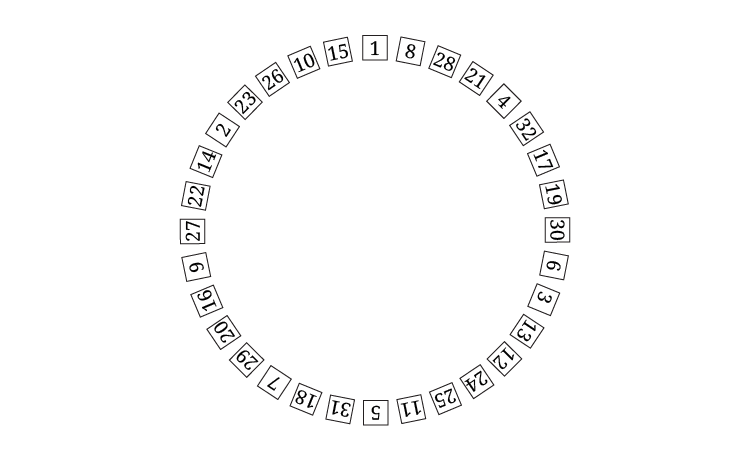
The numbers from 1 to 32 are arranged in a circular pattern without repeating any number.
The clockwise arrangement is as follows:
1, 2, 3, 4, 7, 6, 5, 8, 9, 10, 13, 16, 15, 14, 17, 12, 11, 18, 19, 24, 23, 20, 21, 26, 27, 32, 29, 30, 31, 22, 25, 28.
Since the numbers are placed in a circle, 28 is adjacent to 1, completing the loop.
Each pair of neighbouring numbers has been checked, and the sum of every adjacent pair is a prime number.
For example:
- 1 + 2 = 3
- 2 + 3 = 5
- 4 + 7 = 11
- 10 + 13 = 23
- 18 + 19 = 37
- 25 + 28 = 53
- 28 + 1 = 29
All other adjacent pairs also give prime sums using the same rule.
Since every neighbouring pair adds up to a prime number and no number is repeated, the circular arrangement is correct and valid.
One possible arrangement of the numbers from 1 to 32 in a circular pattern (without repetition) is shown below:
Understanding squares and cubes is fundamental in mathematics as it helps us recognise number patterns and relationships. Learning their properties and how to calculate them enhances our problem-solving abilities and logical thinking.
These NCERT Solutions for Class 8 Maths Chapter 1 A Square and A Cube are not only important for academic purposes but also have practical applications in daily life, such as in measurement, geometry, and various calculations. Mastery of squares and cubes lays a strong foundation for more advanced mathematical topics.
Frequently Asked Questions on NCERT Solutions for Class 8 Maths Chapter 1 A Square and A Cube
1. What is a perfect square and a perfect cube?
A perfect square is a number obtained when a natural number is multiplied by itself, for example, 1,4,9,16 and so on. A perfect cube is a number obtained when a natural number is multiplied by itself three times, for example, 1,8,27,64 etc.
2. How can we tell if a number cannot be a perfect square?
In base 10, a perfect square never ends with the digits 2, 3, 7, or 8. Moreover, if a number ends with an odd number of zeros, it cannot be a perfect square, because squares that end with zeros always have an even number of zeros.
3. How does prime factorisation help in identifying perfect squares or cubes?
Prime factorisation is useful because for a perfect square, all the exponents of the prime factors must be even. For a perfect cube, all the exponents of the prime factors must be multiples of three. This method helps in both identifying and constructing perfect squares and cubes.
4. Can a number be both a perfect square and a perfect cube?
Yes, a number can be both if all the exponents in its prime factorisation are multiples of 6. For example, 64 = 26 = (23)2 = (22)3, which is both a square and a cube. Recognising such numbers is helpful in problems involving both square roots and cube roots.
5. What are the key properties of squares and cubes that students should remember?
The square of an even number is even, and the square of an odd number is odd. The cube of an even number is even, and the cube of an odd number is odd. The difference between the squares of two consecutive natural numbers is always an odd number. These patterns help in quickly checking and solving problems without lengthy calculations.
6. How do we find the number to multiply to make a number a perfect square or cube?
To make a number a perfect square or cube, first factorise it into primes. For a square, multiply by any missing primes to make all exponents even. For a cube, multiply by missing primes so all exponents become multiples of three. For example, 1323 = 33 × 72, multiplying by 7 gives 9261 = 213, a perfect cube.
7. Why is it important to memorise squares and cubes of numbers up to 20?
Memorising these helps in saving time during exams, enables quick calculations, and aids in solving square-root, cube-root, and factorisation problems efficiently without performing long computations.
Admissions Open for 2026-27
What type of concept pages would you prefer?
CBSE Schools In Popular Cities
- CBSE Schools in Bangalore
- CBSE Schools in Mumbai
- CBSE Schools in Pune
- CBSE Schools in Hyderabad
- CBSE Schools in Chennai
- CBSE Schools in Gurgaon
- CBSE Schools in Kolkata
- CBSE Schools in Indore
- CBSE Schools in Sonipat
- CBSE Schools in Delhi
- CBSE Schools in Rohtak
- CBSE Schools in Bhopal
- CBSE Schools in Aurangabad
- CBSE Schools in Jabalpur
- CBSE Schools in Jaipur
- CBSE Schools in Jodhpur
- CBSE Schools in Nagpur
- CBSE Schools in Ahmednagar
- CBSE School In Tumkur











Orchids The International School is one of India's leading chains of CBSE and ICSE schools, with 110+ schools across the country.