

NCERT Solutions Class 8 Maths Chapter 2 Power Play
NCERT Solutions for Class 8 Maths Chapter 2 Power Play are designed to help students understand the concept of powers, exponents, and large numbers in a clear and easy way. This chapter explains how repeated multiplication can be written in a shorter form using exponents, making calculations simpler and faster.
Students will learn about laws of exponents, exponential notation, and how powers are used in real-life situations such as scientific measurements and calculations.
Get more Learning Resources for Class 8 Maths Chapter 2 Power Play
These NCERT Solutions provide step-by-step explanations, solved examples, and clear methods to help students build strong fundamentals. They are useful for regular practice, exam preparation, and improving problem-solving confidence in mathematics.
NCERT Solutions Class 8 Maths Chapter 2 Power Play: Download FREE PDF
NCERT Solutions for Class 8 Maths Chapter 2 Power Play are designed to help students while solving in-text questions for practice. This chapter introduces an easier way of writing very large and very small numbers using exponents, making calculations faster and more efficient. This chapter covers,
- Exponents
- Laws of Exponents
- Standard Forms
- Comparing and solving Expressions
- Exponents in Scientific Notations
With these NCERT Solutions for Class 8 Maths, students can clear their doubts easily, understand each concept better, and gain confidence while solving textbook exercises. Students can also download the FREE PDF to revise concepts anytime and practice offline for better exam preparation.
Learn How to Solve NCERT Solutions Class 8 Maths Chapter 2 Power Play
Get complete and step-by-step answers to the NCERT Solutions Class 8 Maths Chapter 2 Power Play, explained in a simple language to help you understand powers, exponents, and their applications easily.
2.1 Experiencing the Power Play (Page 19-20)
Q1. Now, what do you think the thickness would be after 30 folds? 45 folds? Make a guess.
Solution:
As the number of folds increases, the thickness of the paper grows very rapidly. Based on this pattern, we can make a reasonable estimate. After 30 folds, the thickness would be approximately 10 km. Going further, after 45 folds, the thickness would increase dramatically to about 20,000 km. This clearly shows how repeated doubling leads to extremely large values in a short span.
2. Fill the table below.
|
Fold Thickness |
Fold Thickness |
Fold Thickness |
|---|---|---|
|
18 ≈ 262cm |
21 |
24 |
|
19 ≈ 524cm |
22 |
25 |
|
20 ≈ 10.4m |
23 |
26 |
Solution:
The thickness of the paper doubles with each fold. Using this pattern, the thickness for successive folds can be calculated by multiplying the previous thickness by 2. Based on the given values, the table can be filled as follows:
|
Fold |
Thickness |
Fold |
Thickness |
Fold |
Thickness |
|---|---|---|---|---|---|
|
18 |
≈ 262 cm |
21 |
≈ 20.8 m |
24 |
≈ 166.4 m |
|
19 |
≈ 524 cm |
22 |
≈ 41.6 m |
25 |
≈ 332.8 m |
|
20 |
≈ 10.4 m |
23 |
≈ 83.2 m |
26 |
≈ 665.6 m |
3. After 26 folds, the thickness is approximately 670 m. Burj Khalifa in Dubai, the tallest building in the world, is 830 m tall.
|
Fold |
Thickness |
Fold |
Thickness |
|---|---|---|---|
|
27 |
29 |
|
|
|
28 |
|
30 |
|
Solution:
|
Fold |
Thickness |
Fold |
Thickness |
|---|---|---|---|
|
27 |
≈ 1.3 km |
29 |
≈ 5.2 km |
|
28 |
≈ 2.6 km |
30 |
≈ 10.4 km |
4. After 30 folds, the thickness of the paper is about 10.7 km, the
typical height at which planes fly. The deepest point discovered in
The ocean is the Mariana Trench, with a depth of 11 km.
|
Fold |
Thickness |
Fold |
Thickness |
Fold |
Thickness |
|---|---|---|---|---|---|
|
31 |
|
36 |
|
41 |
|
|
32 |
|
37 |
|
42 |
|
|
33 |
|
38 |
|
43 |
|
|
34 |
|
39 |
|
44 |
|
|
35 |
|
40 |
|
45 |
|
Solution:
|
Fold |
Thickness |
Fold |
Thickness |
Fold |
Thickness |
|---|---|---|---|---|---|
|
31 |
≈20 km |
36 |
≈665.6 km |
41 |
≈21,299.2 km |
|
32 |
≈41.6 km |
37 |
≈1331.2 km |
42 |
≈42,598.4 km |
|
33 |
≈83.2 km |
38 |
≈2662.5 km |
43 |
≈85,196.8 km |
|
34 |
≈166.4 km |
39 |
≈5324.8 km |
44 |
≈170,393.6 km |
|
35 |
≈332.8 km |
40 |
≈10649.6 km |
45 |
≈340,787.2 km |
2.2 Exponential Notation and Operations (Pages 21-22)
1. Which expression describes the thickness of a sheet of paper after it is folded 10 times? The initial thickness is represented by the letter-number v.
(i) 10 v
(ii) 10+v
(iii) 2×10×v
(iv) 2¹⁰
(v) 2¹⁰ v
(vi) 10² v
Solution:
Let us consider the initial thickness of a sheet of paper is v. Now, let's try to find from the above given expressions that correctly explains the thickness of a sheet of paper after it is folded 10 times :
Here, First time = 2v,
Second times = 2 × 2v = 2² v,
Third times = 2 × 2 × v = 2³ v,
…,
Tenth times = 2 × 2 × 2 × 2 × 2 × 2 × 2 × 2 × 2 × v = 2¹⁰ v.
So here, 2¹⁰ v correctly describes the thickness of a sheet of paper after it is folded 10 times.
2. What is (−1)⁵? Is it positive or negative? What about (−1)⁵⁶?
Solution:
To determine the sign of powers of −1, let's look at how multiplication works with negative numbers:
Since, −ve × −ve = +ve
Since, +ve × −ve = −ve
Since, +ve × +ve = +ve
From the above examples, we can generalise a rule:
- If the exponent is even, the result (−1)^{even} is positive (+1).
- If the exponent is odd, the result (−1)^{Odd} is negative (-1).
Therefore,
(-1)⁵ = −1, since 5 is odd, the result is −1
(-1)⁵⁶ = +1. Since 56 is even, the result is +1
The sign of depends entirely on whether the exponent n is odd or even. Odd exponents give a negative result, and even exponents give a positive result.
3. Is (−2)⁴ = 16 ? Verify.
Solution:
Yes, we can verify (−2)⁴ step by step:
(−2)⁴ = [(-2) × (-2)] × [(-2) × (-2)]
= (+4) × (+4)
= 16
When a negative number is raised to an even power, the result is always positive, because multiplying two negatives gives a positive result.
Figure it Out (Pages 22-23)
1. Express the following in exponential form:
(i) 6 × 6 × 6 × 6
(ii) y × y
(iii) b × b × b × b
(iv) 5 × 5 × 7 × 7 × 7
(v) 2 × 2 × a × a
(vi) a × a × a × c × c × c × c × d
Solution:
(i) 6 × 6 × 6 × 6 = 6⁴
(ii) y × y = y²
(iii) b × b × b × b = b⁴
(iv) 5 × 5 × 7 × 7 × 7 = 5² × 7³
(v) 2 × 2 × a × a = 2² × a²
(vi) a × a × a × c × c × c × c × d = a³ × c⁴ × d
2. Express each of the following as a product of powers of their prime factors in exponential form.
(i) 648
(ii) 405
(iii) 540
(iv) 3600
Solution:
We use prime factorisation to write each number as a product of powers of prime numbers:
(i) 648 = 2 × 2 × 2 × 3 × 3 × 3 × 3 = 2³ × 3⁴
(ii) 405 = 3 × 3 × 3 × 3 × 5 = 3⁴ × 5¹
(iii) 540 = 2 × 2 × 3 × 3 × 3 × 5 = 2² × 3³ × 5¹
(iv) 3600 = 2 × 2 × 2 × 2 × 3 × 3 × 5 × 5 = 2⁴ × 3² × 5²
3. Write the numerical value of each of the following:
(i) 2 × 10³
(ii) 7² × 2³
(iii) 3 × 4⁴
(iv) (-3)² × (-5)²
(v) 3² × 10⁴
(vi) (-2)⁵ × (-10)⁶
Solution:
(i) 2 × 10³ = 2 × 1000 = 2000
(ii) 7² × 2³ = 49 × 8 = 392
(iii) 3 × 4⁴ = 3 × 256 = 768
(iv) (-3)² × (-5)² = 9 × 25 = 225
(v) 3² × 10⁴ = 9 × 10000 = 90000
(vi) (-2)⁵ × (-10)⁶ = -32 × 1000000 = -32000000

The Stones that Shine (Pages 23-24)
1. 3⁷ can also be written as 3² × 3⁵. Can you reason out why?
Solution:
Yes, we know that:
3⁷ = 3 × 3 × 3 × 3 × 3 × 3 × 3
Now, we can group the first two 3’s and the remaining five 3’s separately
= (3 × 3) × (3 × 3 × 3 × 3 × 3)
After simplifying the group, we get
= 3² × 3⁵
This works because of the law of exponents
na+nb=na+b
2. Use this observation to compute the following:
(i) 2⁹
(ii) 5⁷
Solution:
(i) 2⁹
We can break the power into smaller equal groups for easy calculation.
2⁹ = (2 × 2 × 2) × (2 × 2 × 2) × (2 × 2 × 2)
= 2³ × 2³ × 2³
Each group of three 2’s is
= 8 × 8 × 8
2⁹ = 512
(ii) 5⁷
Similarly, we group the factors of 5 to simplify the calculation.
5⁷ = (5 × 5 × 5) × (5 × 5 × 5) × 5
= 5³ × 5³ × 5
Each group of three 5’s is 53=125 So we can write
= 125 × 125 × 5
= 15,625 × 5
= 78,125
3. Write the following expressions as a power of a power in at least two different ways.
(i) 8⁶
(ii) 7¹⁵
(iii) 9¹⁴
(iv) 5⁸
Solution:
(i) 8⁶
Way 1: 8⁶ = (8 × 8 × 8) × (8 × 8 × 8)
= 8³ × 8³
= (8³)²
Way 2: 8⁶ = (8 × 8) × (8 × 8) × (8 × 8)
= 8² × 8² × 8²
= (8²)³
(ii) 7¹⁵
Way 1: 7¹⁵ = (7 × 7 × 7) × (7 × 7 × 7) × (7 × 7 × 7) × (7 × 7 × 7) × (7 × 7 × 7)
= 7³ × 7³ × 7³ × 7³ × 7³
= (7³)⁵
Way 2: 7¹⁵ = (7 × 7 × 7 × 7 × 7) × (7 × 7 × 7 × 7 × 7) × (7 × 7 × 7 × 7 × 7)
= 7⁵ × 7⁵ × 7⁵
= (7⁵)³
(iii) 9¹⁴
Way1: 9¹⁴ = (9 × 9) × (9 × 9) × (9 × 9) × (9 × 9) × (9 × 9) × (9 × 9) × (9 × 9)
= 9² × 9² × 9² × 9² × 9² × 9² × 9²
= (9²)⁷
Way 2: 9¹⁴ = (9 × 9 × 9 × 9 × 9 × 9 × 9) × (9 × 9 × 9 × 9 × 9 × 9 × 9)
= 9⁷ × 9⁷
= (9⁷)²
(iv) 5⁸
Way1: 5⁸ = (5 × 5) × (5 × 5) × (5 × 5) × (5 × 5)
= 5² × 5² × 5² × 5²
= (5²)⁴
Way 2: 5⁸ = (5 × 5 × 5 × 5) × (5 × 5 × 5 × 5)
= 5⁴ × 5⁴
= (5⁴)²
Magical Pond (Page 25)
1. Write the number of lotuses (in exponential form) when the pond was:
(i) Fully covered
(ii) Half covered
Solution:
Let’s understand the situation first. The number of lotuses in the pond doubles every day. So, on the 29th day, the pond must be half full.
That means the number of lotuses,
- After 1 day → 21 lotuses
- After 2 days → 22 lotuses
- After 3 days → 23 lotuses
- …
- After 29 days → 229 lotuses
(i) When the pond was fully covered
The pond became full after 30 days.
So, the number of lotuses =230
(ii) When the pond was half covered
Now, think carefully.
If the number of lotuses doubles every day, then one day before the pond was full, it must have been half full.
So, Half covered day = 30 − 1 = 29 days
Number of lotuses = 229
2. What if Damayanti had changed the order in which she placed the flowers in the lakes? How many lotuses would be there?
Solution:
By regrouping the numbers,
= (3 × 2) × (3 × 2) × (3 × 2) × (3 × 2)
= (3 × 2)4
= 64.
3. In general form,
ma × na = (mn)a, where a is a counting number.
Use this observation to find the value of 25 ×55
Solution:
Notice that both numbers have the same exponent (5).
Using the rule:
2⁵ × 5⁵ = (2 × 5)⁵
= 10⁵
= 100,000
4. Simplify 10454 and write it in exponential form
Solution:
10454=(10×10×10×10)(5×5×5×5)
= 2 × 2 × 2 × 2
= 2⁴
Hence, the exponential form is 2⁴.
How Many Combinations (Pages 26–27)
1. Roxie has 7 dresses, 2 hats, and 3 pairs of shoes. How many different ways can Roxie dress up?
Solution:
Let’s think step by step.
- For every dress D1 to D7, Roxie can choose 2 hats H1 and H2
- For each hat, she can choose 3 pairs of shoes: S1, S2 and S3
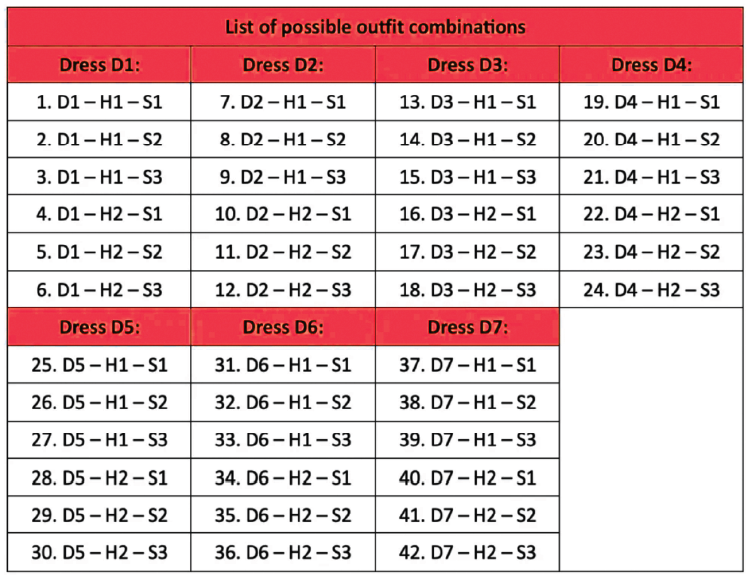
So, for one dress, the number of combinations is:
2×3=6
Now, Roxie has 7 dresses, so:
7×6=42
Roxie can dress up in 42 different ways.
2. Estu says, “Next time, I will buy a lock that has 6 slots with the letters A to Z. I feel it is safer.”
How many passwords are possible with such a lock?
Solution:
The lock has 6 slots, and each slot can be filled with any one of the 26 letters from A to Z.
So, for each slot, there are 26 choices.
To find the total number of possible passwords, we multiply the choices for all 6 slots:
26×26×26×26×26×26=266
Hence, the total number of different passwords possible is 266
3. Think about how many combinations are possible in different contexts. Some examples are
(i) Pin codes of places in India - The Pin code of Vidisha in Madhya Pradesh is 464001. The Pincode of Zemabawk in Mizoram is 796017.
(ii) Mobile numbers.
(iii) Vehicle registration numbers.
Try to find out how these numbers or codes are allotted/generated.
Solution:
(i) PIN Codes in India
We already know that India uses a 6-digit Postal Index Number (PIN) system, which was introduced in 1972.
Here is the structure of indian pin code.
- 1st digit: Region (9 zones total)
- 2nd digit: Sub-region
- 3rd digit: Sorting district
- Last 3 digits: Specific post office
Combinations:
- Theoretical: 10⁶ = 1,000,000 combinations
- Practical: Only valid combinations are used based on geography and postal infrastructure. For Example: 464001 → Vidisha, Madhya Pradesh, 796017 → Zemabawk, Mizoram
(ii) Mobile numbers in India
We already know that Indian mobile numbers are 10 digits, starting with digits 6–9.
Here is the basic structure of indian mobile numbers
- 1st digit: Must be 6, 7, 8, or 9
- Remaining 9 digits: Any number from 0–9
Combinations:
4 × 10⁹ = 4,000,000,000 possible mobile numbers
This mobile number is managed by the Department of Telecommunications
- Prefixes (like 91x, 98x) are assigned to different telecom operators
(iii) Vehicle Registration Numbers
Vehicle numbers follow a format like DL 01 AB 1234.
Here is the basic Structure of a vehicle registration number
- 2 letters: State/UT code (e.g., DL for Delhi)
- 2 digits: RTO code
- 1-2 letters: Series
- 4 digits: Unique vehicle number
Combinations:
- Varies by state and RTO
- For one RTO: 26² letter combinations × 10⁴ numbers = 676 × 10,000 = 6,760,000 combinations per RTO
The allocations are managed by the Ministry of Road Transport & Highways via the Parivahan portal. Fancy numbers can be bid for, and older vehicles may require re-registration
2.3 The Other Side of Powers (Pages 27-29)
1. What is 2¹⁰⁰ ÷ 2²⁵ in powers of 2?
Solution:
2¹⁰⁰ ÷ 2²⁵ = 2¹⁰⁰⁻²⁵ = 2⁷⁵ [∵ nᵃ ÷ nᵇ = nᵃ⁻ᵇ]
Here we can see that dividing powers is the same as reducing the number of times we multiply the base. You may wonder after knowing that this simple rule helps us to solve problems faster and understand how powers behave.
2. Why can’t n be 0?
Solution:
Consider the following general rules for powers that we have identified:
- nᵃ × nᵇ = nᵃ⁺ᵇ
- (nᵃ)ᵇ = (nᵇ)ᵃ = nᵃ×ᵇ
- nᵃ ÷ nᵇ = nᵃ⁻ᵇ
If we put n = 0 in nᵃ ÷ nᵇ, we get 0ᵃ ÷ 0ᵇ.
We know that division by 0 is not defined. Therefore, 0ᵃ ÷ 0ᵇ is not defined.
Thus, we cannot take n = 0.
When Zero is in Power! (Page 29)
3. We had required a and b to be counting numbers. Can a and b be any integers? Will the generalised forms still hold true?
Solution:
Yes, the laws are formulated so that they remain consistent and valid for all integers. Let us examine these laws with examples using both positive and negative integral exponents.
1. Product Rule
Generalised Form: nᵃ × nᵇ = nᵃ⁺ᵇ (where a, b are counting numbers)
It holds for all integers a, b (as long as n ≠ 0).
Example:
2⁴ × 2⁻³ = 2⁴⁺⁻³ = 2¹ = 2
Check: 2⁴ × 2⁻³ = 16 × 1/8 = 2
2. Power of a Power Rule
Generalised Form: (nᵃ)ᵇ = (nᵇ)ᵃ = nᵃ×ᵇ (where a, b are counting numbers)
It holds for all integers a, b (as long as n ≠ 0).
Example 1:
(2²)⁻³ = 2²×⁻³ = 2⁻⁶ = 1/2⁶ = 1/64
Example 2:
(2⁻³)² = 2⁻³×² = 2⁻⁶ = 1/64
Check: (2²)⁻³ = 4⁻³ = 1/4³ = 1/64, and (2⁻³)² = (1/8)² = 1/64
3. Quotient Rule
Generalised Form: nᵃ ÷ nᵇ = nᵃ⁻ᵇ (where a, b are counting numbers)
It holds for all integers a, b (as long as n ≠ 0).
Example:
3⁴ ÷ 3⁻² = 3⁴⁻⁻² = 3⁶ = 729
Check: 3⁴ ÷ 3⁻² = 81 ÷ 1/9 = 81 × 9 = 729
From above, it can be concluded that all the exponent laws (product rule, power of a power, and quotient rule) hold for all integers a and b, provided n≠0.
4. Write equivalent forms of the following:
(i) 2⁻⁴
(ii) 10⁻⁵
(iii) (−7)⁻²
(iv) (−5)⁻³
(v) 10⁻¹⁰⁰
Solution:
To write equivalent forms, we use the law of negative exponents:
where,
This law tells us that a negative exponent means the reciprocal of the base raised to the positive exponent.
(i) 2⁻⁴ = 1/2⁴
(ii) 10⁻⁵ = 1/10⁵
(iii) (−7)⁻² = 1/(−7)²
(iv) (−5)⁻³ = 1/(−5)³
(v) 10⁻¹⁰⁰ = 1/10¹⁰⁰
Here, you will observe that a negative exponent means taking the reciprocal of the base.
The rule helps us to convert negative powers into equivalent positive-power forms.
5. Simplify and write the answers in exponential form:
(i) 2-4 × 27
(ii) 32 × 3-5×36
(iii) p3 × p-10
(iv) 24 × (-4)-2
(v) 8p × 8q
Solution:
We use the following laws of exponents:
- nᵃ × nᵇ = nᵃ⁺ᵇ
- nᵃ ÷ nᵇ = nᵃ⁻ᵇ (n ≠ 0)
- (nᵃ)ᵇ = nᵃᵇ
- n⁻ᵃ = 1 ÷ nᵃ
- n⁰ = 1 (n ≠ 0)
(i) 2-4 × 27 =2-4+7=23
(ii) 32 ×3-5 ×36 =32+(-5)+6 =33
(iii) p3 × p-10=p3+(-10)=p-7
(iv) 24×(−4)−2=24×1−42=16×116=1=20
(v) 8p × 8q = 8p+q
Here, when bases are the same, add the exponents. Negative exponents are written as reciprocals. Any non-zero number raised to the power of zero equals 1.
Power Lines NCERT In-Text Questions (Pages 29-30)
1. Let us arrange the powers of 4 along a line.
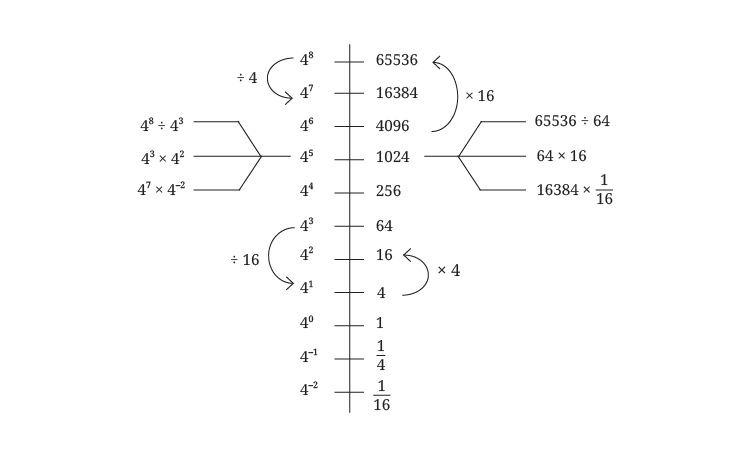
How many times larger than 4-2 is 42?
Solution:
We know that the powers of 4 along a line are represented as,
To find how many times one quantity is larger than another, we divide the first by the second.
Required value= 444−2
Using the law of exponents:
ᵃ⁻ᵇnanb=nᵃ⁻ᵇ
We get, 444−2=42−(−2)=44
Now evaluate:
44=256ab
So here 44 is 256 times larger than 4-2 .
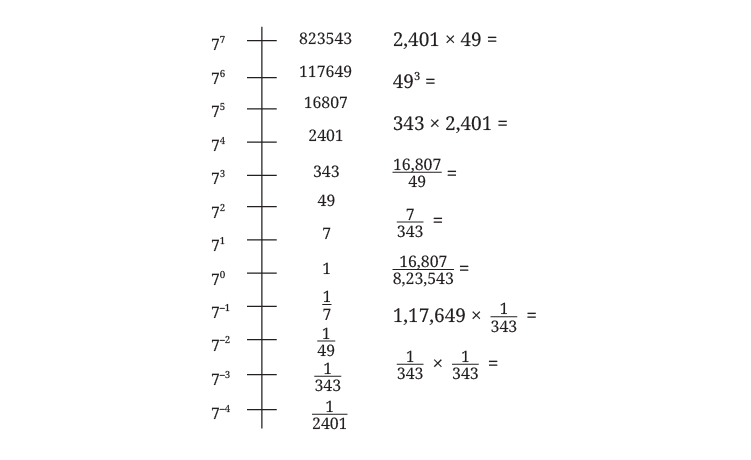
2. Use the power line for 7 to answer the following questions.
Solution:
When numbers are written as powers of the same base (here, 7), we use the law of exponents:
7a×7b=7a+b
7a÷7b=7a−b
(i) 2401×49=74×72=74+2=76=117649
(ii) 493=(72)3=72×3=76=117649
(iii) 343×2401=73×74=73+4=77=823543
(iv) 1680749=7572=75−2=73=343
(v) 7343=7173=172=149
(vi) 16807823543=7577=172=149
(vii) 117649×1343=76×173=76−3=73=343
(viii) 1343×1343
= 173×173
= 176
= 1117649
Powers of 10 (Page 30)
We have used numbers like 10, 100, 1000, and so on when writing Indian numerals in an expanded form. For example:
47561 = (4×10000)+(7×1000)+(5×100)+(6×10)+1
This can be written using powers of 10 as
47561 = (4×10⁴)+(7×10³)+(5×10²)+(6×101)+(1×100)
1. Write these numbers in the same way:
(i) 172
(ii) 5642
(iii) 6374
Solution:
(i)172
In the number 172:
- 1 is in the hundreds place
- 7 is in the tens place
- 2 is in the ones place
172 = (1 × 100) + (7 × 10) + 2
Writing 100, 10, and 1 as powers of 10,
= (1×10²)+(7×101)+(2×100)
(ii)5642
In the number 5642:
- 5 is in the thousands place
- 6 is in the hundreds place
- 4 is in the tens place
- 2 is in the ones place
5642=(5×1000)+(6×100)+(4×10)+2
Writing each place value using powers of 10,
5642=(5×10³)+(6×10²)+(4×101)+(2×100)
(iii) 6374
In the number 6374:
- 6 is in the thousands place
- 3 is in the hundreds place
- 7 is in the tens place
- 4 is in the ones place
6374=(6×1000)+(3×100)+(7×10)+4
Expressing each term using powers of 10,
6374=(6×10³)+(3×10²)+(7×101)+(4×100)
Scientific Notation (Pages 31-32)
The distance between the Sun and Saturn is,
14,33,50,00,00,000 m =1.4335 × 10¹² m.
The distance between Saturn and Uranus is,
14,39,00,00,00,000 m = 1.439× 10¹² m.
The distance between the Sun and Earth is,
1,49,60,00,00,000 m = 1.496 × 10¹¹ m.
1. Can you say which of the following distances is the smallest?
Solution:
We have the three distances as,
1.4335×10¹²m=14.335×10¹¹m
1.439×10¹²m=14.39×10¹¹m
1.496×10¹¹m
Since powers of 10 are the same, comparing the decimal factors, we have 14.39>14.335>1.496
Thus, the distance between the sun and the earth, that is, 1.496×10¹¹m is smallest.
3. The number line below shows the distance between the Sun and Saturn(1.4335 × 10¹²m). On the number line below, mark the relative position of the Earth. The distance between the Sun and the Earth is 1.496 × 10¹²m.
Solution:
1. 4335×1012m=14.335×10¹¹
14.335×10111.496×1011≈10
So here the relative position of the Earth on the number line can be marked as shown below,
4. Express the following numbers in standard form.
(i) 59,853
(ii) 65,950
(iii) 34,30,000
(iv) 70,04,00,00,000
Solution:
A number is said to be in standard form (scientific notation) when it is written as, a times\ 10^{n}
where:
- 1≤ a<10
- n is a whole number
To convert a number into standard form, we move the decimal point so that only one non-zero digit remains on the left. The number of places the decimal point moves gives the power of 10.
(i) 59,853
Move the decimal point 4 places to the left
59,853 = 5.9853 × 10⁴
(ii) 65,950
Move the decimal point 4 places to the left
65,950 = 6.595 × 10⁴
(iii) 34,30,000
(Indian system: 34,30,000 = 3,430,000)
Move the decimal point 6 places to the left,
34,30,000 = 3.43 × 10⁶
(iv) 70,04,00,00,000
(Indian system: 70,04,00,00,000 = 7,004,000,000)
Move the decimal point 10 places to the left,
70,04,00,00,000 = 7.004 × 10¹⁰
Did You Ever Wonder? (Page No 33)
1. Nanjundappa wants to donate jaggery equal to Roxie’s weight and
wheat equal to Estu’s weight. He is wondering how much it would cost.
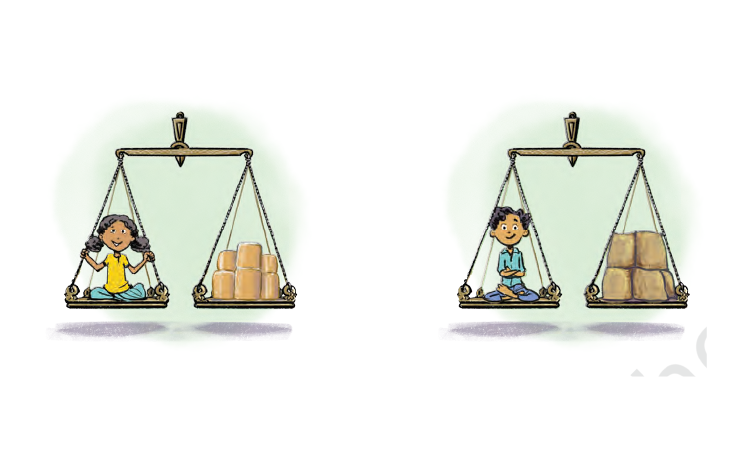
What would be the worth (in rupees) of the donated jaggery? What would be the worth (in rupees) of the donated wheat?
Make necessary and reasonable assumptions for the unknowns and find the answers. Remember, Roxie is 13 years old and Estu is 11 years old. (Page 33)
Solution:
To find the total cost of the donation, we first need to make reasonable assumptions about the weights of Roxie and Estu.
Since Roxie is 13 years old, we can take the average weight of a 13-year-old child as 45 kg.
Similarly, Estu is 11 years old, and the average weight of an 11-year-old child can be assumed to be 38 kg.
Now, let us calculate the cost of each item: Price of jaggery = ₹60 per kg and Price of wheat = ₹30 per kg
Cost of jaggery donated:
45 kg × ₹60
Cost of wheat donated:
38 kg × ₹30
Worth for jaggery and wheat donation = 45 × 60 + 38 × 30
Total worth of the donation = ₹2700 + ₹1140 = ₹3840=2700+1140
=3840
The donated jaggery is worth ₹2700, and the donated wheat is worth ₹1140.
So, the total value of the donation is ₹3840.
2. Roxie wonders, “Instead of Jaggery, if we use 1 1-rupee coin, how many coins are needed to equal my weight?” How can we find out? For questions like these, you can consider following the steps suggested below:
Guessing: Make an instinctive (quick) guess of what the answer could be, without any calculations.
Solution:
Guessing- Before doing any exact calculation, Roxie first makes a quick guess. Since she is 13 years old, it is reasonable to think that her weight may be around 40 to 45 kg.
We already know that 1 kg of jaggery costs ₹60.
So, if Roxie’s weight is taken as 45 kg, the total value of jaggery equal to her weight would be: 45× 60=2700
Since each coin is worth ₹1, the number of 1-rupee coins needed to match this value would be 2700 coins.
By making a sensible guess, Roxie would need about 2700 one-rupee coins to equal her weight in terms of value.
3. Calculating using estimation and approximation:
(i) Describe the relationships among the quantities that are needed to find the answer.
(ii) Make reasonable assumptions and approximations if the required information is not available.
(iii) Compute and find the answer (and check how close your guess was).
Solution:
(i) Relationship between the quantities:
To find how many ₹1 coins are equal in value to Roxie’s weight, we need to understand the connection between the following quantities:
Roxie’s weight is measured in kilograms, and the price of jaggery per kilogram
The total value of jaggery is calculated by multiplying Roxie’s weight by the price per kg.
Since each coin is worth ₹1, the number of coins required will be equal to the total value in rupees.
(ii) Assumptions and approximations:
As Roxie’s exact weight is not given, we make a reasonable estimate. A 13-year-old child generally weighs about 45 kg.
We also assume the average market price of jaggery to be ₹60 per kg.
Using these values:
Value of jaggery = 45 × 60 = ₹2700
(iii) Calculation and result:
Each coin is worth ₹1, so the number of ₹1 coins needed is:
₹2700 ÷ ₹1 = 2700 coins
Roxie would need approximately 2,700 one-rupee coins to match the value of jaggery equal to her weight.
4. Would the number of coins be in hundreds, thousands, lakhs, crores, or even more? Make an instinctive guess.
Solution:
Roxie’s weight is roughly 45 kg, and the cost of jaggery is about ₹60 per kg.
So, the total value comes to around ₹2700.
If we use ₹1 coins, the number of coins required will also be about 2700.
This clearly falls in the thousands range.
It is more than hundreds, but far less than lakhs or crores.
The number of coins needed would be in thousands.
5. Estu asks, “What if we use 5-rupee coins or 10-rupee notes instead? How much money could it be?
Solution:
From earlier calculations, the total value of Estu’s donation is ₹1140.
Using ₹5 coins:
₹1140 ÷ 5 = 228 coins
Using ₹10 notes:
₹1140 ÷ 10 = 114 notes
Estu would need 228 five-rupee coins or 114 ten-rupee notes.
6. Estu says, “When I become an adult, I would like to donate notebooks worth my weight every year.”
Roxie says, “When I grow up, I would like to do annadana (offering grains or meals) worth my weight every year.”
How many people might benefit from each of these offerings in a year? Again, guess first before finding out. (Page 34)
Solution:
Quick Guess:
Estu’s notebook donation may help around 20–30 students each year.
Roxie’s annadana may provide meals to around 80–100 people.
Estimation and Calculation
Here are some assumptions:
Estu’s weight ≈ 38 kg
Cost of one notebook ≈ ₹20
Each student needs 2 notebooks
Roxie’s weight ≈ 45 kg
Cost of grain/meal per kg ≈ ₹30
Cost of one meal ≈ ₹15
Estu’s Donation (Notebooks),
Value of donation = 38 × 20 = ₹760
Cost per student = 2 × 20 = ₹40
Number of students helped = ₹760 ÷ ₹40 = 19 students
Roxie’s Donation (Meals),
Value of donation = 45 × 30 = ₹1350
Number of meals provided = ₹1350 ÷ ₹15 = 90 meals
This could mean 90 people get one meal, or fewer people get multiple meals.
So here, Estu’s donation can help about 19 students each year.
Roxie’s annadana can provide around 90 meals annually.
7. Roxie and Estu overheard someone saying, “We did a padayatra for about 400 km to reach this place! We arrived early this morning.” How long ago would they have started their journey? Find answers by making necessary assumptions and approximations. Do guess first before calculating to check how close your guess was!
Solution:
Guess:
A person may walk about 25–30 km per day.
At that rate, a 400 km walk might take around 13 to 16 days.
Lets assume daily walking distance = 30 km
Number of days = 400 ÷ 30 ≈ 13.3 days
The journey likely started about 13–14 days earlier.
8. How many times can a person circumnavigate (go around the world) the Earth in their lifetime, if they walk non-stop? Consider the distance around the Earth as 40,000 km.
Solution:
Assumptions,
Circumference of Earth = 40,000 km
Walking speed = 5 km/hour
Walking time per day = 8 hours
Active walking years = 60 years
Here, Distance walked per day = 8 × 5 = 40 km
Total walking days = 60 × 365 = 21,900 days
Total distance walked = 21,900 × 40 = 8,76,000 km
Number of times around Earth = 8,76,000 ÷ 40,000 ≈ 21.9
A person could walk around the Earth about 21 times in their lifetime.
Linear Growth Vs Exponential Growth (Page 35)
1. Can you come up with some examples of linear growth and of exponential growth?
Solution:
We can observe growth in many situations around us. Some grow at a constant rate, while others grow faster and faster over time. These can be grouped into linear growth and exponential growth.
Examples of Linear Growth:
- Pocket Money Savings
If parents add ₹50 every week to a child’s savings, the total amount increases evenly:
₹50, ₹100, ₹150, ₹200, and so on.
Since the increase is the same each time, this is linear growth. - Climbing Stairs
If someone climbs 10 steps every minute, then after each minute,the total steps climbed are:
10, 20, 30, 40…
The steps increase by a fixed number, showing linear growth. - Plant Growth
If a plant grows 5 cm each day, its height becomes 5 cm, 10 cm, 15 cm, etc.
Because the growth is steady, it follows a linear pattern.
Examples of Exponential Growth:
- Spread of a Virus
If one person infects two people, and each of them infects two more, the numbers increase as:
1, 2, 4, 8, 16…
This rapid increase is an example of exponential growth. - Coins Doubling Every Day
Suppose you get 1 coin on the first day, 2 on the second, 4 on the third, and so on.
The number keeps doubling, which is exponential growth. - Bacterial Growth
If bacteria double every hour, their number rises very quickly from just one to thousands or even millions in a short time.
This is a classic example of exponential growth.
From both examples, it can be concluded that,
- Linear growth increases by the same amount each time.
- Exponential growth increases by multiplying, so it becomes very large very fast.
Getting a Sense for Large Numbers (Pages 38-42)
1. With a global human population of about 8 × 10⁹ and about 4 × 10⁵ African elephants, can we say that there are nearly 20,000 people for every African elephant?
Solution:
Yes, we can say that there are nearly 20,000 people for every African elephant because there are exactly 20,000 people per elephant
Human PopulationElephant Population
=8×1094×105
=84×109−5
=2×104
=20000 people per elephant.
Here, the calculation shows precisely 20,000 people for each elephant, given those numbers, so the statement is correct.
2. Calculate and write the answer using scientific notation:
(i) How many ants are there for every human in the world?
(ii) If a flock of starlings contains 10,000 birds, how many flocks could there be in the world?
(iii) If each tree had about 104 leaves, find the total number of leaves on all the trees in the world.
(iv) If you stacked sheets of paper on top of each other, how many would you need to reach the Moon?
Solution:
(i)How many ants are there for every human in the world?
Estimated ant population globally = 2×10¹⁶
Estimated global human population = 8×10⁹
Now, divide the two quantities, we get,
2×10168×109
= 28×1016−9
= 14×107
= 0.25×107
= 2.5×10⁶
After converting to standard scientific notation, we get
= 2.5×10⁶
So, there are approximately 2.5×10⁶ ants for every human in the world.
(ii) If a flock of starlings contains 10,000 birds, how many flocks could there be in the world?
The estimated global population of starlings = 1.3×10⁹
The population of birds in a flock of starlings = 10,000 = = 104
So, the number of flocks of starlings in the world = 1.3×109104=1.3×10⁵
So, there could be about 1.3×10⁵ flocks of starlings in the world
(iii) If each tree had about 104 leaves, find the total number of leaves on all the trees in the world.
The estimated number of trees (2023) globally =3×10¹²
The average number of leaves on each tree =104
So, the total number of leaves on all the trees in the world =3×1012×104 = 3×10¹²+4 = 3×10¹⁶
Thus, the total number of leaves on all trees is approximately 3×10¹⁶
(iv) If you stacked sheets of paper on top of each other, how many would you need to reach the Moon?
Estimated distance from Earth to Moon = 3.844 ×10⁸ m
The thickness of a standard single sheet of paper = 0.1 mm = 1 × 10⁻⁴ m
∴ Number of Sheets = 3.844×10⁸m1×10−4m=3.844×10⁸−(−4)3.844×10¹²
Therefore, about 3.844×10¹² sheets of paper would be needed to reach the Moon.
3. If you have lived for a million seconds, how old would you be?
Solution:
A million seconds means,
1 million seconds=106seconds
We know that,
1 day=24×60×60=86,400 seconds
Now let's convert seconds into days,
Number of days= 10686400≈11.57days
If you have lived for one million seconds, you would be approximately 11.57 days old (that is, about 11 days and 14 hours).
4. 105seconds ~ 1.16 days and 106 seconds ~ 11.57 days. Think of some events or phenomena whose time is of the order of
(i)105 seconds and
(ii) 106 seconds.
Write them in scientific notation.
Solution:
(i) Events of the order of 105 seconds (about 1.16 days)
- A major hurricane’s lifetime: The lifespan of a tropical cyclone, from formation to dissipation, can be of the order of a few days, approximately 1 × 10⁵ seconds to 5 × 10 5 seconds.
- The time from a new moon to a quarter moon: The lunar cycle (synodic period) is approximately 29.5 days.
The time from a new moon to the first quarter is approximately one-quarter of this cycle, or 6.5 × 10⁵ seconds.
- The time taken by a strong storm to pass through a region
Such storms may last for about one to two days, which is approximately 1 ×10⁵seconds
(ii) Events of the order of 106 seconds (about 11.57 days)
- The orbital period of the International Space Station (ISS) over multiple orbits: The ISS orbits Earth approximately every 90 minutes. Over a period of 1 × 10⁶ seconds, it completes approximately 187 orbits.
- A typical period of a solar flare’s activity: The active phase of a major solar flare can last for this duration, which is 1 × 10⁶ seconds, from the initial eruption to the return to a stable state.
- The time it takes for a full-term human fetus to develop from conception to birth: The gestation period is approximately 40 weeks, ~ 2.4 × 10⁶ seconds.
- Time taken for seeds to germinate and show visible growth
Many plants begin noticeable growth in about 10 days, which is approximately 1 × 10⁶ seconds.
5. Calculate and write the answer using scientific notation:
(i) If one star is counted every second, how long would it take to count all the stars in the universe? Answer in terms of the number of seconds using scientific notation.
(ii) If one could drink a glass of water (200 ml) every 10 seconds, how long would it take to finish the entire volume of water on Earth?
Solution:
(i) The estimated number of stars in the observable universe is 2 × 10²³.
If one star is counted every second, then the time taken in seconds will be equal to the total number of stars.
Time taken=2 × 10²³ seconds
It would take 2 × 10²³ seconds to count all the stars in the universe.
(ii) The estimated total number of drops of water on Earth is 2 × 1025
Assuming 16 drops per millilitre,
The volume of water on Earth = 2 × 1025 ÷ 16 ~ 1024ml.
Now,
- One glass = 200 ml
- Time taken to drink one glass = 10 seconds
So, water consumed per second: 2040=20 ml per seconds
Total time required, (1.25×1024)20= 0.0625 1024=6.251022seconds
It would take approximately 6.251022 seconds to drink all the water on Earth.
A Pinch of History - Figure it Out (Pages 44-45)
1. Find out the units digit in the value of 2224÷4 32? [Hint: 4 = 22]
Solution:
To find the unit digit, we do not need to calculate the entire value.
We only need to observe the pattern of unit digits of powers of 2.
Let us write the first few powers of 2,
= 2, = 4, = 8, = 16, = 32, = 64, and so on
Here we can clearly observe that the unit digits repeat in a cycle of 4: 2,4,8,6,2,4,…. And repeat after every fourth term.
Here we have,
2224 ÷ 432 = 2224 ÷ (22)32 = 2224 ÷ 264 = 2224-64 = 2160
Here, in 2160 exponent 160 = 4 × 40, so the unit digit 2160 would be 6.
The units digit in the value of 2224÷4 32 is 6.
2. There are 5 bottles in a container. Every day, a new container is brought in. How many bottles would be there after 40 days?
Solution:
Here, we already know that each container has 5 bottles.
Since one new container is brought every day, the number of bottles added per day is: 5 bottles
In 40 days, the total number of bottles added will be
5 bottles/day × 40 days = 200 bottles
Now, there are two possible interpretations. Let us consider the standard one used in such questions:
- The containers are brought daily, starting from Day 1
- So, after 40 days, 40 containers have been brought
To find the total number of bottles after 40 days, we simply multiply: i.e.,
∴ Total number of bottles after 40 days = 5 + 200 = 205 bottles
3. Write the given number as the product of two or more powers in three different ways. The powers can be any integers.
(i)643
(ii) 1928
(iii) 32-2
Solution:
We use the law of exponents to solve this,
(ab)2 =an × bn
(ab)-n =a-n× b-n
(i) 643
Way 1: 643 = (22 × 42)3
= (22)3 × (42)3
= 26×46
Way 2: 643 = (16 × 4)3
= (16)3 × (4)3
= 163 ×43
Way 3: 643 = (23×8)3
=(23)3×(8)3
=29×83
(ii) 1928
Way 1: 1928
= (22 × 42×3)8
= (22)8 × (42)8 ×38
= 216×416×38
Way 2: 1928
= (24 × 4×3)8
=(24)8 × (4)8 ×38
= 232×48×38
Way 3: 1928
= (22 × 16×3)8
= (22)8 × (16)8 ×38
= 216×168×38
(iii) 32-2
Way 1: 32-2
= (23 × 4)-5
= (23)-5 × (4)-5
= 2-15 ×4-5
Way 2: 32-2
= (8 × 4)-5
= (8)-5 × (4)-5
= 8-5×4-5
Way 3: 32-2
= (242)-5
=(2)-5(42)-5
=2-5×4-10
4. Examine each statement below and find out if it is ‘Always True’, ‘Only Sometimes True’, or ‘Never True’. Explain your reasoning.
(i) Cube numbers are also square numbers.
(ii) Fourth powers are also square numbers.
(iii) The fifth power of a number is divisible by the cube of that number.
(iv) The product of two cube numbers is a cube number.
(v) q46 is both a 4th power and a 6th power (q is a prime number).
Solution:
(i) Cube numbers are also square numbers.
Answer: Only Sometimes True
Explanation: Some cube numbers are also perfect squares, but not all.
Let us consider a few cube numbers, such as 8= 23, 27 =33, and 64 =43
Here, 8 and 27 are the only perfect cubes. But 64 = is a perfect square as well as a perfect cube.
So, only some cube numbers are square numbers, not all.
(ii) Fourth powers are also square numbers.
Answer: Always True
Explanation:
A fourth power of a number nnn can be written as:
n4=(n2)2
Here is always an integer (when nnn is an integer), (n2)2 is a perfect square.
Let us consider the fourth power of 2 and 3.
24= 16 and 16 = 42
Similarly, 34= 81 and 81 = 92
Therefore, every fourth power is a square number.
(iii) The fifth power of a number is divisible by the cube of that number.
Answer: Always True
Explanation:
Using the rules of exponents,
For any non-zero integer n,
n5n3= n5-3= n2
Since n2 is an integer, n5 is always divisible by n3.
For example, consider 35= 243 and 33= 27 Clearly, 243 ÷ 27 = 9 = 32
(iv) The product of two cube numbers is a cube number.
Answer: Always True
Explanation: Let the two cube numbers be a3 and b3.
Their product is: a3×b3=(ab)3
Since it is also a cube, the product of two cube numbers is always a cube number.
For example, consider 23 = 8 and 53= 125.
Their product is 8 × 125 = 1000, and 1000 =103.
(v) q46 is both a 4th power and a 6th power (q is a prime number).
Answer: Never True
Explanation:
For a number to be a 4th power, its exponent must be divisible by 4
But 46 ÷ 4 = 11.5, which is not an integer.
For a number to be a 6th power, its exponent must be divisible by 6.
46 ÷ 6 = 7.67, which is not an integer.
Since 46 is divisible by neither 4 nor 6, q46 it cannot be written as a 4th power or a 6th power.
5. Simplify and write these in the exponential form.
(i) 10-2×10⁻⁵
(ii) 57 ÷ 54
(iii) 9-7 ÷ 94
(iv) (13-2)-3
(v) m5 n12 (mn)9
Solution:
Key Laws of Exponents Used
na×nb=na+b
na÷nb=na−b
(na)b=nab
mna=mana
(i)10-2×10⁻⁵
Since the bases are the same, add the exponents:
10-2×10-5=10-2+(-5)=10−7
(ii) 57 ÷ 54
Subtract the exponents:
57 ÷ 54=57−4=53
(iii)9-7 ÷ 94
Subtract the exponents:
9−7÷94=9−7−4 =9−11
(iv) (13-2)-3
Multiply the exponents:
(13−2)−3=13−2×(−3) =136
(v)m5 n12 (mn)9
First expand (mn)9=m9n9
Now combine like bases: m5n12×m9n9
=(m5×m9)(n12×n9)
=m14n21
Here, when multiplying powers with the same base, add the exponents. When dividing powers with the same base, subtract the exponents. The power of a power means multiplying the exponents.
6. If 122=144, what is
(i) (1.2)2
(ii) 0.122
(iii) (0.012)2
(iv) 1202
Solutions:
To solve this, we use the law of exponents,
(mn)a=mana
(i)(1.2)2=(1210)2
=122102
=144100
= 1.44
(ii)(0.12)2=(12100)2
=1221002
=14410000
= 0.0144
(iii)(0.012)2=(121000)2
=12210002
=1441000000
= 0.000144
(iv)1202=(12×10)2
=122×102
=144×100
7. Circle the numbers that are the same-
24 × 36, 64 × 32, 610, 182 × 62, 624
Solution:
To compare the given numbers, we express each in terms of prime factors using the laws of exponents.
1. 2⁴ × 3⁶
This expression is already in prime factor form.
2. 6⁴ × 3²
6 = 2 × 3
6⁴ × 3²
= (2 × 3)⁴ × 3²
= 2⁴ × 3⁴ × 3²
= 2⁴ × 3⁶
3. 6¹⁰
6 = 2 × 3
6¹⁰
= (2 × 3)¹⁰
= 2¹⁰ × 3¹⁰
This is not equal to 2⁴ × 3⁶.
4. 18² × 6²
18 = 2 × 3² and 6 = 2 × 3
18² × 6² = (2 × 3²)² × (2 × 3)²
= (2² × 3⁴) × (2² × 3²)
= 2⁴ × 3⁶
5. 6²⁴
6 = 2 × 3
6²⁴ = (2 × 3)²⁴
= 2²⁴ × 3²⁴
This is not equal to 2⁴ × 3⁶
8. Identify the greater number in each of the following:
(i) 4³ or 3⁴
(ii) 2⁸ or 8²
(iii) 100² or 2¹⁰⁰
Solution:
(i) 4³ or 3⁴
4³ = 4 × 4 × 4 = 64
3⁴ = 3 × 3 × 3 × 3 = 81
Since 64 < 81,
4³ < 3⁴
(ii) 2⁸ or 8²
2⁸ = 256
8² = 64
Since 256 > 64,
2⁸ > 8²
(iii) 100² or 2¹⁰⁰
From the above cases, we can generalise:
If a > b, then generally aᵇ < bᵃ,
where a and b are positive integers greater than 1
(except for the special case 3² and 2³).
Here,
100 > 2
So, 100² < 2¹⁰⁰
9. A dairy plans to produce 8.5 billion packets of milk in a year. They want a unique ID (identifier) code for each packet. If they choose to use the digits 0–9, how many digits should the code consist of?
Solution:
Let us consider the number of digits in the code be n.
Since the digits 0–9 are used, each digit has 10 possible choices.
Each digit can be any of 0–9, so the total number of unique codes possible with nnn digits is: 10ⁿ
We need the total codes to be at least 8.5 billion:
10ⁿ ≥ 8,500,000,000
Checking powers of 10:
|
Power of 10 |
Value |
Name |
|---|---|---|
|
10¹ |
10 |
Ten |
|
10² |
100 |
Hundred |
|
10³ |
1,000 |
Thousand |
|
10⁴ |
10,000 |
Ten Thousand |
|
10⁵ |
100,000 |
One Lakh / Hundred Thousand |
|
10⁶ |
1,000,000 |
One Million |
|
10⁷ |
10,000,000 |
Ten Million |
|
10⁸ |
100,000,000 |
Hundred Million |
|
10⁹ |
1,000,000,000 |
One Billion |
|
10¹⁰ |
10,000,000,000 |
Ten Billion |
To determine the smallest n
109=1,000,000,000<8,500,000,000<1010=10,000,000,000
The smallest number of digits required to generate at least 8.5 billion unique codes is 10 digits.
10. 64 is a square number 82 and also a cube number 43 .
Are there other numbers that are both squares and cubes?
Is there a way to describe such numbers in general?
Solution:
Yes, other numbers are both perfect squares and perfect cubes.
Let us first understand the idea clearly.
- A square number is a number of the form a2 .
- A cube number is a number of the form b3 .
For a number to be both a square and a cube, it must be divisible by both 2 and 3.
The smallest common multiple of 2 and 3 is 6.
So, such numbers are of the form n6 , where nnn is a natural number.
Here are some examples for your reference,
729= 27²= 9³= 3⁶
4096= 64²= 16³= 4⁶
15625 = 125² = 25³ = 5⁶
46656 = 216² = 36³ = 6⁶
Here we can see that all numbers that can be written in the form n⁶, where n is a natural number, are both perfect squares and perfect cubes.
11. A digital locker has an alphanumeric passcode (it can contain both digits and letters) of length 5. Some example codes are G89P0, 38098, BRJKW, and 003AZ. How many such codes are possible?
Solution:
To find the total number of possible alphanumeric passcodes, we first count the number of choices for each character.
Digits available: 0 to 9 → 10 choices
Letters available: A to Z → 26 choices
So, the total number of possible characters for each position is:
10 + 26 = 36
The passcode has 5 characters.
Each character can be chosen independently from the 36 available characters.
Therefore, the total number of possible passcodes is:
36 × 36 × 36 × 36 × 36
= Now,
= 60,466,176
There are 60,466,176 possible alphanumeric passcodes of length 5.
12. The worldwide population of sheep (2024) is about 10⁹, and that of goats is also about the same. What is the total population of sheep and goats?
Options:
(i)209
(ii)1011
(iii)1010
(iv) 1018
(v) 2 × 10⁹
(vi) 10⁹ + 10⁹
Solution:
Here we have the worldwide population of sheep (2024) ≈ 10⁹
The worldwide population of goats (2024) ≈ 10⁹
So, the total worldwide population of sheep and goats ≈ is 10⁹ + 10⁹ = 2 × 10⁹
This uses the basic addition of powers of 10 with the same exponent.
Hence, options (v) and (vi) are both correct.
13. Calculate and write the answer in scientific notation:
(i) If each person in the world had 30 pieces of clothing, find the total number of pieces of clothing.
(ii) There are about 100 million bee colonies in the world. Find the number of honeybees if each colony has about 50,000 bees.
(iii) The human body has about 38 trillion bacterial cells. Find the bacterial population residing in all humans in the world.
(iv) Total time spent eating in a lifetime in seconds.
Solution:
(i) Total number of pieces of clothing
- The global human population as of 2025 ≈ is 8.2 billion = 8.2 × 10⁹
- Each person has 30 pieces of clothing.
Total pieces of clothing = 30 × (8.2 × 10⁹) = 246 × 10⁹ = 2.46 × 10¹¹
(ii) Total number of honeybees
Number of bee colonies ≈ 100 million = 100 × 10⁶ = 10⁸
Honeybees per colony ≈ 50,000 = 5 × 10⁴
Total honeybees = 10⁸ × (5 × 10⁴) = 5 × 10¹²
(iii) Total bacterial population in all humans
- Number of bacterial cells per human ≈ 38 trillion = 38 × 10¹²
- Global human population ≈ 8.2 × 10⁹
Total bacterial population = (8.2 × 10⁹) × (38 × 10¹²) = 311.6 × 10²¹ = 3.116 × 10²³
(iv) Total time spent eating in a lifetime (in seconds)
- The average human lifespan ≈ is 73.5 years
- Average time spent eating per day = 2 hours = 2 × 3600 seconds
1 year ≈ 365.25 days
Total time = 2 × 3600 × 365.25 × 73.5 ≈ 193,290,300 seconds = 1.93 × 10⁸ seconds
14. What was the date 1 arab/1 billion seconds ago?
Solution:
Here we know, 1 arab/1 billion seconds = 10⁹ seconds ≈ 31.7 years
Convert seconds into years
1 year≈365.25 days×24 hours/day×3600 seconds/hour≈31,557,600 seconds
09 seconds÷31,557,600 seconds/year≈31.7 years
Subtract 31.7 years from December 17, 2025
- 31 years back → December 17, 1994
- 0.7 years ≈ 0.7 × 365.25 ≈ 256 days back from December 17, 1994
- Counting 256 days back → April 9, 1994
Here, the answer will vary depending on the date of calculation.
H3: Puzzle Time! (Page 47)
1. In Round 2, Roxie wrote 10¹⁰⁰⁰⁰ + 10¹⁰⁰⁰⁰ + 10¹⁰⁰⁰⁰ + 10¹⁰⁰⁰⁰, and Estu wrote (10¹⁰⁰⁰⁰⁰⁰) × 9000. Can you say which is greater?
Solution:
Roxie wrote:
10¹⁰⁰⁰⁰ + 10¹⁰⁰⁰⁰ + 10¹⁰⁰⁰⁰ + 10¹⁰⁰⁰⁰ = 4 × 10¹⁰⁰⁰⁰
Estu wrote:
10¹⁰⁰⁰⁰⁰⁰ × 9000 = 10¹⁰⁰⁰⁰⁰⁰ × 9 × 10³ = 9 × 10¹⁰⁰⁰⁰⁰³
Compare the numbers,
Roxie:e:4×10¹⁰⁰⁰⁰
Estu: 9×101000003
Exponent comparison: 1000003≫10000
Clearly, the power of 10 in Estu’s number is far larger than that of Roxie’s number. Even though Roxie multiplied by 4 and Estu by 9, the exponent dominates.
Estu’s number is much greater than Roxie’s number
These NCERT Solutions for Class 8 Maths Chapter 2 Power Play are important not only for academic success but also for practical use in science, measurements, and real-life calculations. Mastery of powers and exponents builds a strong foundation for advanced topics in algebra, physics, and higher mathematics.
Frequently Asked Questions on NCERT Solutions Class 8 Maths Chapter 2 Power Play
1. What are the laws of exponents?
The laws of exponents are rules that help simplify expressions involving powers. They include:
- nᵃ × nᵇ = nᵃ⁺ᵇ
- nᵃ ÷ nᵇ = nᵃ⁻ᵇ (n ≠ 0)
- (nᵃ)ᵇ = nᵃᵇ
- n⁻ᵃ = 1 ÷ nᵃ
- n⁰ = 1 (n ≠ 0)
These laws are used to simplify and solve problems in powers and exponential notation.
2. What is a power in mathematics?
A power is the result of multiplying a number by itself a certain number of times. It has two parts:
- Base: The number being multiplied
- Exponent: The number of times the base is multiplied
3. What is exponential notation?
Exponential notation (or power notation) is a way of expressing repeated multiplication in a compact form:
an=a⋅a⋅⋯⋅a (n times)
4. What is scientific notation?
Scientific notation expresses very large or small numbers as a×10n.
For example, 1,000,000=1×10⁶.
5. How do exponents help in NCERT Class 8 Maths?
They simplify calculations, compare large numbers, and convert numbers into exponential or scientific form.
6. Why use exponential and scientific notation?
They make handling huge or tiny numbers easier and calculations faster in Maths and Science.
Admissions Open for 2026-27
What type of concept pages would you prefer?
CBSE Schools In Popular Cities
- CBSE Schools in Bangalore
- CBSE Schools in Mumbai
- CBSE Schools in Pune
- CBSE Schools in Hyderabad
- CBSE Schools in Chennai
- CBSE Schools in Gurgaon
- CBSE Schools in Kolkata
- CBSE Schools in Indore
- CBSE Schools in Sonipat
- CBSE Schools in Delhi
- CBSE Schools in Rohtak
- CBSE Schools in Bhopal
- CBSE Schools in Aurangabad
- CBSE Schools in Jabalpur
- CBSE Schools in Jaipur
- CBSE Schools in Jodhpur
- CBSE Schools in Nagpur
- CBSE Schools in Ahmednagar
- CBSE School In Tumkur











Orchids The International School is one of India's leading chains of CBSE and ICSE schools, with 110+ schools across the country.