

NCERT Solutions for Class 8 Maths Chapter 7 Proportional Reasoning
Use NCERT Solutions for Class 8 Maths Chapter 7 Proportional Reasoning to understand the ideas of ratio and proportion in a clear and systematic way. These solutions follow the latest CBSE syllabus and are written in easy language, helping students prepare well for exams and daily practice.
This chapter explains how quantities are compared using ratios and how proportional relationships work. Students learn to recognise proportional situations and apply these concepts to real-life problems involving speed, time, money, and measurements. Step-by-step solutions make learning smooth and effective.
Topics Covered:
- Meaning and use of ratios
- Comparing and reducing ratios
- Equivalent ratios
- Concept and properties of proportion
- Identifying proportional relationships
- Unitary method and its applications
- Direct proportion with examples
- Everyday uses of ratios and proportions
With NCERT Solutions for Class 8 Maths Chapter 7 Proportional Reasoning, students can practise all textbook problems confidently. The clear explanations and exam-orientated answers support better understanding, quick revision, and improved performance in mathematics.
Gain Access to NCERT Solutions for Class 8 Maths Chapter 7 Proportional Reasoning
7.1 Observing Similarity in Change
NCERT In-Text Questions (Page 160)
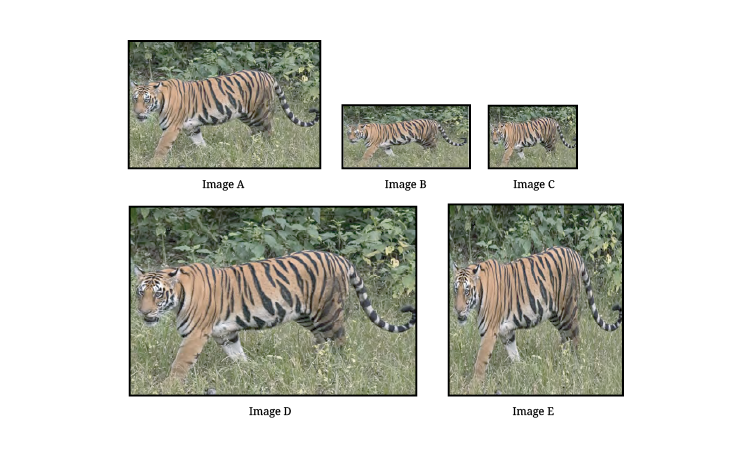
1. Can you check by what factors the width and height of image D change as compared to image
A? Are the factors the same?
Solution:
When we compare image D with image A, we look at how much each dimension has increased. The width changes from 60 mm in image A to 90 mm in image D. This means the width becomes one and a half times the original, or
Width comparison:
Width of image A = 60 mm
Width of image D = 90 mm
= 9060 =32
So, the width of image D is times the width of image A.
In the same way, the height increases from 40 mm in image A to 60 mm in image D.
Height comparison:
- Height of image A = 40 mm
- Height of image D = 60 mm
= 6030 = 32
Thus, the height of image D is also times the height of image A.
Because both the width and the height increase by exactly the same factor, the proportions of the image remain unchanged. The image becomes larger, but its shape does not get stretched or squashed in any direction. That is why image D looks similar to image A, even though it is bigger in size.
7.2 Ratios NCERT In-Text Questions (Page 161)
1. By what factor should we multiply the ratio 60 : 40 (image A) to get 90 : 60 (image D)?
Solution:
The ratio of width to height in Image A is 60 : 40, while the ratio of width to height in Image D is 90 : 60. To find the required multiplying factor, we compare the corresponding terms of the two ratios.
First, we compare the widths. The width of Image A is 60 units and the width of Image D is 90 units. The multiplying factor is therefore
= 9060 = 32
This shows that the width of Image D is one and a half times the width of Image A.
Next, we compare the heights. The height of Image A is 40 units and the height of Image D is 60 units. The multiplying factor is
= 6040 = 32
This shows that the height of Image D is also one and a half times the height of Image A.
Since both the width and the height are multiplied by the same factor, the ratio of width to height remains unchanged. This confirms that Images A and D are proportional, which is why they look similar in shape even though their sizes are different.
Finally, multiplying both terms of the ratio 60 : 40 by , we get
60 × : 40 × = 90:60. 60×32 :40×32 =90:60.
So, the final answer is to convert the ratio 60 : 40 into 90 : 60, both terms must be multiplied by 32 .
Filter Coffee! NCERT In-Text Questions (Page 165)
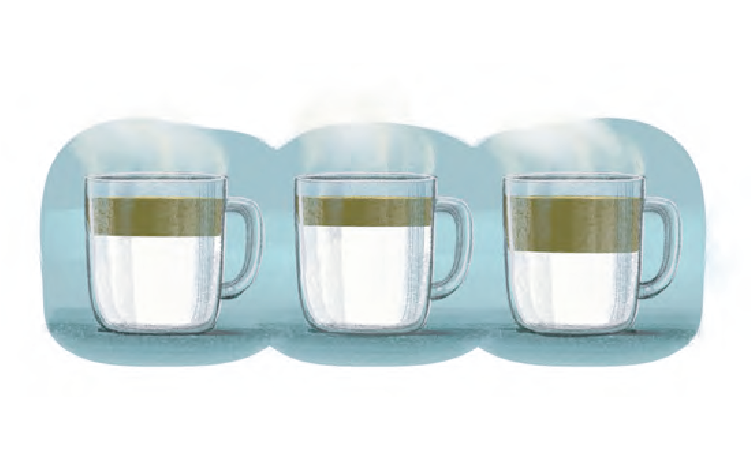
1. Why is this coffee stronger?
Solution:
To understand why one coffee tastes stronger than the other, we need to look at the ratio of decoction (coffee concentrate) to milk in both types. The coffee with a higher proportion of decoction relative to milk will naturally taste stronger.
Step 1: Identify the given ratios
- Regular coffee: decoction : milk = 15 : 35
- Stronger coffee: decoction : milk = 20 : 30
These ratios show how much decoction is mixed with milk in each type of coffee. A higher ratio of decoction indicates a more concentrated and stronger flavour.
Step 2: Make the ratios comparable
Since the decoction quantities in the two coffees are different, we cannot compare them directly. To compare fairly, we first equalise the decoction amount.
- Regular coffee: multiply both terms by 4 → 15 × 4 : 35 × 4 = 60 : 140
- Stronger coffee: multiply both terms by 3 → 20 × 3 : 30 × 3 = 60 : 90
Now, both coffees are prepared with 60 mL of decoction, allowing us to directly compare the amount of milk used in each.
Step 3: Compare milk quantities
- Regular coffee uses 140 mL of milk for 60 mL of decoction
- Stronger coffee uses 90 mL of milk for 60 mL of decoction
The stronger coffee has less milk for the same amount of decoction, meaning the coffee concentrate is less diluted.
Step 4: Analyze the difference
The difference in milk quantity explains the variation in strength. Less milk in the stronger coffee results in a more intense and concentrated flavour compared to regular coffee.
Even though both coffees have the same amount of decoction, the proportion of milk determines how diluted or strong the coffee tastes.
Since the ratio of decoction to milk is higher in the stronger coffee (60 : 90) than in the regular coffee (60 : 140), the stronger coffee tastes stronger.
When comparing mixtures, equalising one component first helps to clearly see the effect of the other component, making it easier to understand which mixture is stronger or more concentrated.
2. Why is this coffee lighter?
Solution:
The coffee tastes lighter because the proportion of milk to decoction is higher in lighter coffee.
- For regular coffee, the ratio of decoction to milk is 15 : 35.
- For lighter coffee, the ratio of decoction to milk is 10 : 40.
To compare the two fairly, we adjust the ratios to have the same amount of decoction:
- Regular coffee: 15 : 35 = 15 × 2 : 35 × 2 = 30 : 70
- Lighter coffee: 10 : 40 = 10 × 3 : 40 × 3 = 30 : 120
Now, both coffees have 30 mL of decoction, making it easier to compare the milk content.
- In regular coffee: 30 mL decoction + 70 mL milk
- In lighter coffee: 30 mL decoction + 120 mL milk
We can see that lighter coffee has significantly more milk for the same amount of decoction. Milk dilutes the coffee, reducing its intensity. Therefore, the flavour of lighter coffee is milder compared to regular coffee.
The key idea is that the strength of coffee depends on the ratio of decoction to milk. A higher milk-to-decoction ratio means the coffee is more diluted, giving it a lighter taste. In lighter coffee, the decoction is “stretched” over more milk, so the coffee flavour is less concentrated.
In contrast, regular coffee has less milk relative to decoction, making it stronger and darker in taste.
3. The following table shows the different ratios in which. Manjunath mixes coffee decoction with milk.
Write in the last column if the coffee is stronger or lighter than the regular coffee.
|
Coffee Decoction (in mL) |
Milk (in mL) |
Regular / Strong / Light |
|---|---|---|
|
300 |
600 |
|
|
150 |
500 |
|
|
200 |
400 |
|
|
24 |
56 |
|
|
100 |
300 |
Solution:
The strength of coffee depends on the ratio of coffee decoction to milk. A higher proportion of coffee decoction compared to milk makes the coffee stronger, while a lower proportion makes it lighter. If the ratio matches that of regular coffee, the coffee is considered normal in strength.
For comparison, we assume that regular coffee has a ratio of 1:2 (coffee decoction : milk). By calculating the ratio of each mixture, we can determine whether it is stronger, lighter, or the same as regular coffee.
- For 300 mL decoction and 600 mL milk, the ratio is 300:600 = 1:2. This matches the regular coffee ratio, so it is regular.
- For 150 mL decoction and 500 mL milk, the ratio is 150:500 = 3:10 ≈ 0.3:1. This is less than 1:2, so the coffee is lighter.
- For 200 mL decoction and 400 mL milk, the ratio is 200:400 = 1:2, which is the same as regular coffee, so it is regular.
- For 24 mL decoction and 56 mL milk, the ratio is 24:56 = 3:7 ≈ 0.43:1, which is lower than 1:2, making the coffee lighter.
- For 100 mL decoction and 300 mL milk, the ratio is 100:300 = 1:3, which is less than 1:2, so the coffee is lighter.
Filling these results in the table gives:
|
Coffee Decoction (in mL) |
Milk (in mL) |
Regular / Strong / Light |
|---|---|---|
|
300 |
600 |
Regular |
|
150 |
500 |
Light |
|
200 |
400 |
Regular |
|
24 |
56 |
Light |
|
100 |
300 |
Light |
By comparing the ratio of coffee to milk for each mixture with the standard 1:2 ratio of regular coffee, it becomes easy to understand why some coffees are stronger, some lighter, and some regular.
This method helps students visualise the effect of changing proportions and strengthens their understanding of ratios in practical situations.
Figure it Out (Pages 165-167)
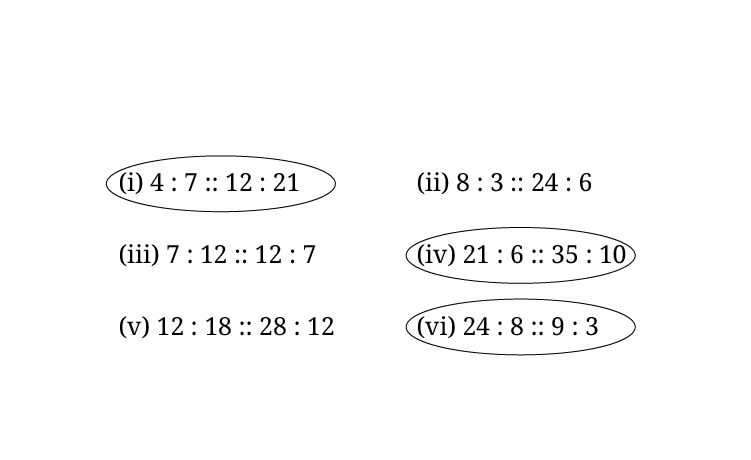
1. Circle the following statements of proportion that are true.
(i) 4 : 7 :: 12 : 21
(ii) 8 : 3 :: 24 : 6
(iii) 7 : 12 :: 12 : 7
(iv) 21 : 6 :: 35 : 10
(v) 12 : 18 :: 28 : 12
(vi) 24 : 8 :: 9 : 3
Solution:
(i) 4 : 7 :: 12 : 21
The first ratio, 4 : 7, is already in its simplest form.
To compare it with 12 : 21, we simplify the second ratio by dividing both terms by their highest common factor (HCF), which is 3.
This gives 12 ÷ 3 : 21 ÷ 3 = 4 : 7. Since both ratios are equal in simplest form, these ratios are proportional.
(ii) 8 : 3 :: 24 : 6
The ratio 8 : 3 is already in simplest form.
Simplifying 24 : 6 involves dividing both terms by their HCF, which is 6, giving 24 ÷ 6 : 6 ÷ 6 = 4 : 1.
Comparing the two ratios, 8 : 3 is clearly not equal to 4 : 1. Therefore, these ratios are not proportional.
(iii) 7 : 12 :: 12 : 7
Both ratios are already in the simplest form. However, 7 : 12 is not equal to 12 : 7. Since the two ratios are different, they do not form a true proportion.
(iv) 21 : 6 :: 35 : 10
Simplifying 21 : 6 by dividing both terms by their HCF, 3, gives 7 : 2.
Similarly, simplifying 35 : 10 by dividing both terms by their HCF, 5, also gives 7 : 2.
Since both ratios are identical after simplification, these ratios are proportional.
(v) 12 : 18 :: 28 : 12
The ratio 12 : 18 can be simplified by dividing both terms by their HCF, 6, resulting in 2 : 3.
The ratio 28 : 12 can be simplified by dividing both terms by 4, resulting in 7 : 3.
Since 2 : 3 is not equal to 7 : 3, these ratios are not proportional.
(vi) 24 : 8 :: 9 : 3
Simplifying 24 : 8 by dividing both terms by their HCF, 8, gives 3 : 1.
Simplifying 9 : 3 by dividing both terms by 3 also gives 3 : 1.
Since both ratios are equal in simplest form, these ratios are proportional.
Therefore, the correct answer is
2. Give 3 ratios that are proportional to 4 : 9, ____ : ____, ____ : ____ ,____ : ____
Solution:
The given ratio is 4 : 9. Two ratios are proportional when the relationship between their terms remains the same.
In other words, multiplying or dividing both terms of a ratio by the same non-zero number produces a new ratio that is proportional to the original. This is because the relative size of the two numbers does not change.
Step 1: Multiply both terms of 4 : 9 by 2:
4 × 2 : 9 × 2 = 8 : 18
The ratio 8 : 18 has the same relationship as 4 : 9 because each term is exactly twice the corresponding term in the original ratio. Therefore, 8 : 18 is proportional to 4 : 9.
Step 2: Multiply both terms of 4 : 9 by 3:

4 × 3 : 9 × 3 = 12 : 27
Here, 12 : 27 is proportional to 4 : 9 since both numbers have been scaled by the same factor of 3, keeping the ratio constant.
Step 3: Multiply both terms of 4 : 9 by 4:
4 × 4 : 9 × 4 = 16 : 36
The ratio 16 : 36 is also proportional to 4 : 9 because multiplying by the same factor preserves the proportion between the two quantities.
Hence, the ratios 8 : 18, 12 : 27, and 16 : 36 are all proportional to 4 : 9.
3. Fill in the missing numbers for these ratios that are proportional to 18 : 24. 3 : ____, 12 : ____, 20 : ____, 27 : ____
Solution:
To solve these problems, we use the concept of proportionality. Two ratios are proportional if their corresponding terms have the same multiplicative relationship. This means one ratio can be obtained from the other by multiplying or dividing both terms by the same number.
Step 1: Simplify the given ratio
The given ratio is:
18 : 24
Divide both numbers by their greatest common divisor (GCD = 6) to simplify:
18 ÷ 6 : 2
This shows the basic ratio between the two numbers. Any other ratio proportional to 18:24 must have the same relationship between its terms.
Step 2: Find the missing number when the first term is 3
Since the simplified ratio is 3:4, the second term must be 4 to maintain the same proportion:
3:4
Step 3: Find the missing number when the first term is 12
Let the second term be xxx:
12:x=18:241
We use the property of proportion:
12x=1824=34⇒x=12×43=16
Hence, the ratio is:
12:16
Step 4: Find the missing number when the first term is 20
Let the second term be y:
20 : y = 18 : 24
20y = 34
Y = 20 × 43 = 803
Thus, the ratio is:
20 : 803
Step 5: Find the missing number when the first term is 27
Let the second term be z:
27 : z = 18 : 24
First, simplify the ratio 18 : 24
18 : 24 = 3 : 4
So, we have:
27z =34
By cross-multiplying, we get
3z=27×4
3z=108
Z=1083=36
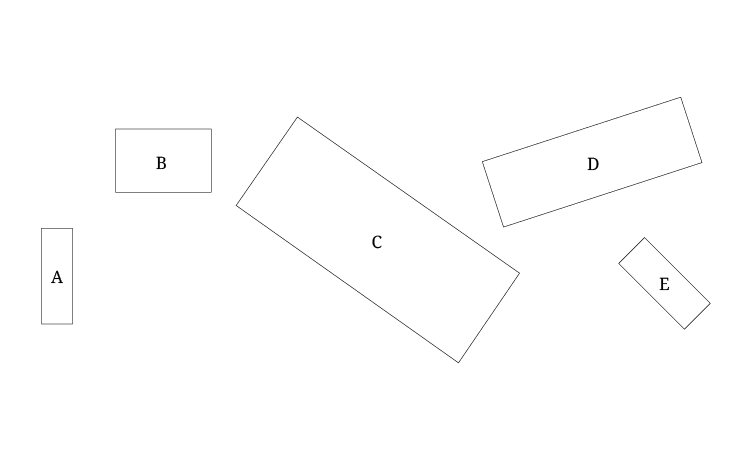
4. Look at the following rectangles. Which rectangles are similar to each other? You can verify this by measuring the width and height using a scale and comparing their ratios.
Solution:
To determine whether two rectangles are similar, we compare the ratio of width to height for each rectangle. Rectangles are said to be similar if their corresponding sides are in the same ratio.
The measured dimensions and ratios are given below:
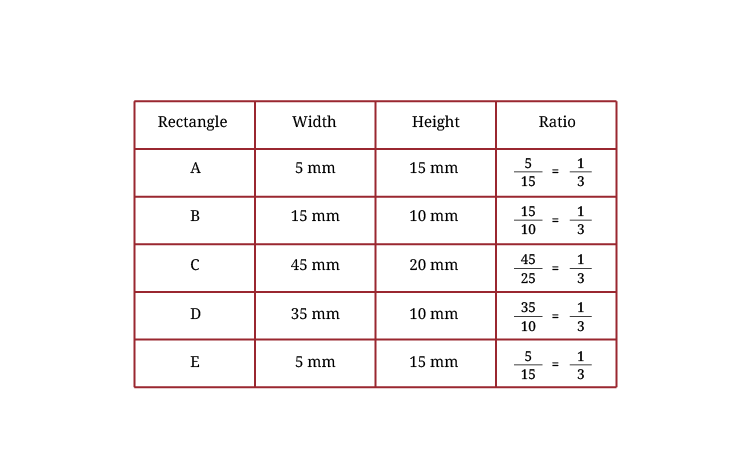
From the table, we observe that:
- Rectangle A has a width-to-height ratio of 1 : 3.
- Rectangle E also has a width-to-height ratio of 1 : 3.
- Rectangles B, C, and D all have different ratios, so they do not match with A or E or with each other.
Since rectangles A and E have the same simplified ratio, their sides are proportional. This means that even though their sizes may differ, their shape remains the same.
Therefore, rectangles A and E are similar to each other because the ratio of their width to height is the same, that is, 1 : 3.
5. Look at the following rectangle. Can you draw a smaller rectangle and a bigger rectangle with the same width-to-height ratio in your notebooks? Compare your rectangles with your classmates’ drawings. Are all of them the same? If they are different from yours, can you think why? Are they wrong?

Solution:
The given rectangle has:
- Width = 32 mm
- Height = 18 mm
The width-to-height ratio of the rectangle is.
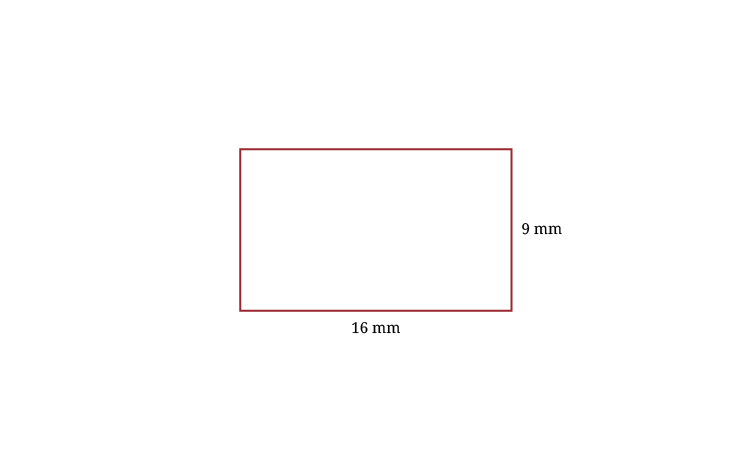
Ratio = 32 : 18 = 3218 = 169
To draw rectangles similar to this one, the width-to-height ratio must remain the same.
This can be achieved by multiplying both the width and the height by the same number, called the factor of change or scale factor.
To draw a smaller rectangle, let the factor of change be 12. The new width is then 12x 32 = 16 mm, and the new height is 12x 18 = 9 mm.
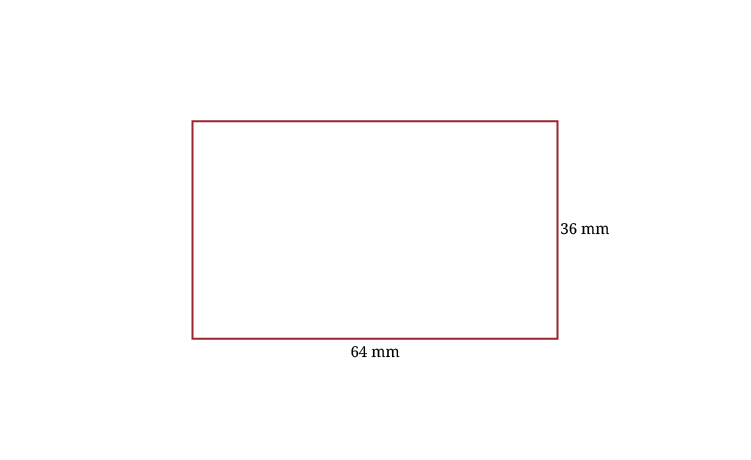
The dimensions of the smaller rectangle are therefore 16 mm × 9 mm, and its width-to-height ratio is 16 : 9, which is the same as that of the original rectangle.
To draw a larger rectangle, let the factor of change be 2. The new width becomes 2 × 32 = 64 mm, and the new height becomes 2 × 18 = 36 mm.
The dimensions of the larger rectangle are 64 mm × 36 mm, and the ratio 64 : 36 also simplifies to 16 : 9, which matches the original ratio.
When comparing the rectangles drawn by classmates, it can be observed that their sizes are different. However, all the rectangles are correct because they all maintain the same width-to-height ratio of 16 : 9. The difference in size occurs because different scale factors were used.
Key Concept:
- Similar rectangles have the same shape but different sizes.
- The ratio of corresponding sides remains constant for similar rectangles.
- Any rectangle drawn with the ratio 16 : 9 will be similar to the original, regardless of its actual dimensions.
All rectangles drawn by different students are valid as long as the width-to-height ratio is preserved. This exercise demonstrates the idea of similarity and how scaling works in geometry.
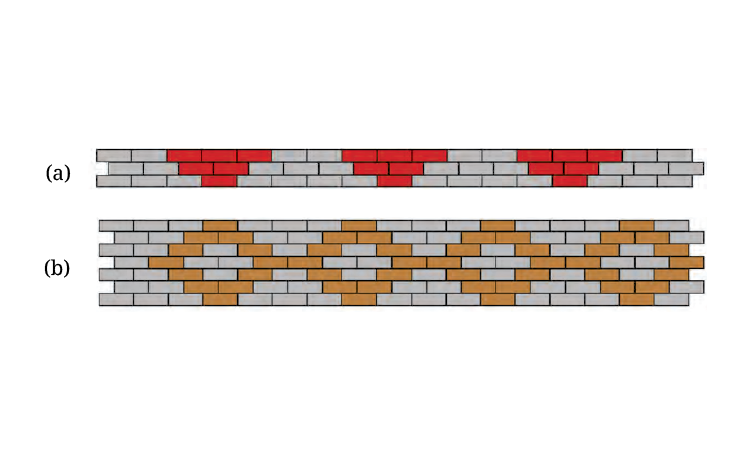
6. The following figure shows a small portion of a long brick wall with patterns made using coloured bricks. Each wall continues this pattern throughout the wall. What is the ratio of grey bricks to coloured bricks? Try to give the ratios in their simplest form.
Solution:
(a) In the given pattern of the bricks, there are 6 coloured bricks after 9 grey bricks. The ratio of grey bricks to coloured bricks is 9 : 6.
We can convert it in simplest form as 9 ÷ 3 : 6 ÷ 3 = 3 : 2 So, the ratio of grey bricks to coloured bricks is 3 : 2.
(b) In the given pattern, there are 12 coloured bricks for every 16 grey bricks. Therefore, the ratio of grey bricks to coloured bricks is 16 : 12. In simplest form, 16 ÷ 4 : 12 ÷ 4 = 4 : 3.
Therefore, the required ratio is 4 : 3.
(a)
Observe the pattern carefully. In this section, there are 9 grey bricks followed by 6 coloured bricks.
Write the ratio of grey bricks to coloured bricks as:
Grey: Coloured = 9:6
To simplify the ratio, divide both numbers by their greatest common divisor (GCD), which is 3:
9 ÷ 3 : 6 ÷ 3 = 3 : 2
Therefore, the simplest ratio of grey bricks to coloured bricks is 3 : 2.
Explanation: This means that for every 3 grey bricks, there are 2 coloured bricks in the wall. Expressing the ratio in its simplest form makes it easier to understand the proportional relationship between the two types of bricks.
(b)
In this portion of the wall, there are 16 grey bricks and 12 coloured bricks.
Write the ratio of grey bricks to coloured bricks:
Grey : Coloured = 16 : 12
The GCD of 16 and 12 is 4. Divide both numbers by 4 to simplify:
16 ÷ 4 : 12 ÷ 4 = 4 : 3
Therefore, the simplest ratio is 4 : 3.
Explanation: This tells us that for every 4 grey bricks, there are 3 coloured bricks. Simplifying ratios helps compare quantities clearly and shows the proportion between different elements of a pattern, regardless of the actual numbers involved.
7. Let us draw some human figures. Measure your friend’s body — the lengths of their head, torso, arms, and legs. Write the ratios as mentioned below— Now, draw a figure with a head, torso, arms, and legs with equivalent ratios as above.
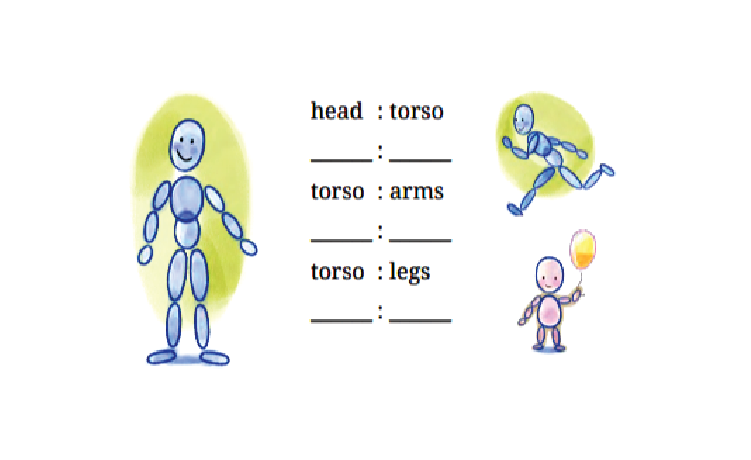
Solution:
To draw a realistic human figure, it is important to maintain the correct proportions between different body parts. In this activity, we will measure a friend’s body, calculate the ratios, and then use these ratios to draw a proportionally accurate figure.
Step 1: Measure your friend’s body
Before we start drawing, we need the actual measurements of the main body parts such as the head, torso, arms, and legs. Accurate measurements form the foundation for maintaining correct proportions in the figure.
|
Body Part |
Measurement (cm) |
|---|---|
|
Head |
22 |
|
Torso (neck to hip) |
50 |
|
Arms (shoulder to fingertip) |
60 |
|
Legs (hip to foot) |
80 |
Step 2: Calculate the ratios
Once we have the measurements, we compare the sizes of different body parts by finding their ratios. Simplifying these ratios makes it easier to scale them correctly while drawing.
|
Body Parts |
Ratio |
Simplified Ratio |
|---|---|---|
|
Head : Torso |
22:50 |
11:25 |
|
Torso : Arms |
50 : 60 |
5 : 6 |
|
Torso : Legs |
50 : 80 |
5 : 8 |
Step 3: Drawing the Figure
Now that we have the ratios, we can start sketching. Begin with the head, then draw the torso, arms, and legs while keeping the simplified ratios in mind. Maintaining these ratios ensures the figure looks balanced and proportionate. After drawing, observe how the figure looks.
Does the drawing look more realistic if the ratios are maintained? Why or why not?
Yes, following the ratios makes the figure more realistic because human body parts have natural proportions:
- The torso is longer than the head.
- The arms are slightly longer than the torso.
- The legs are the longest part of the body.
Ignoring these ratios can make the figure look distorted, such as having an overly short torso or unusually long legs. Using proportional reasoning preserves the relative size of each part, resulting in a lifelike drawing.
Figure it Out (Pages 170-172)
1. The Earth travels approximately 940 million kilometres around the Sun in a year. How many kilometres will it travel in a week?
Solution:
To find out how far it travels in one week, we can use the concept of direct proportion, because the distance travelled is directly related to the time. A week is a small part of the year, so the Earth will cover the same fraction of the total yearly distance in seven days.
Let the distance travelled in a week be ‘x’ km. Setting up a proportion, we have:
= Distance Travelled in 1 YearDistance Travelled in 1 Week = Number of Days in a YearNumber of Days in a Week
= 940,000,000x = 3657
To find the value of ‘x’, we multiply 940,000,000 by 7 and divide the result by 365.
Therefore, we have 365 : 7 :: 940,000,000 : x
⇒ X = 940 , 000 , 000 × 7 365
⇒ x = 18,027,397 ⇒ x ~ 18 million
This gives approximately 18,027,397 kilometres.
Rounding this value to the nearest million, we find that the Earth travels about 18 million kilometres in one week.
This method works because the distance travelled changes proportionally with time. By calculating the fraction of the year that one week represents and applying it to the total yearly distance, we can accurately determine the distance travelled in a week.
Rounding the final answer makes it easier to understand and use in practical situations.
∴ The Earth travels approximately 18 million kilometres in a week.
2. A mason is building a house in the shape shown in the diagram. He needs to construct both the outer walls and the inner wall that separates the two rooms. To build a wall of 10 feet, he requires approximately 1450 bricks. How many bricks would he need to build the house? Assume all walls are of the same height and thickness.
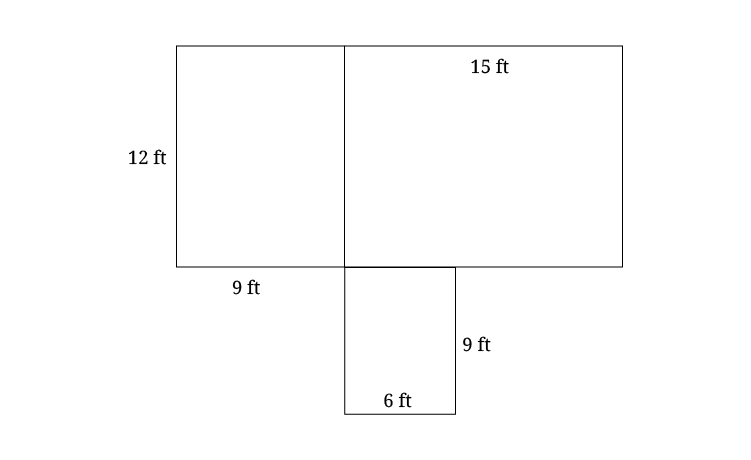
Solution:
Number of bricks required for a 10 ft wall = 1450
∴ Ratio of length of wall to number of bricks = 10 : 1450
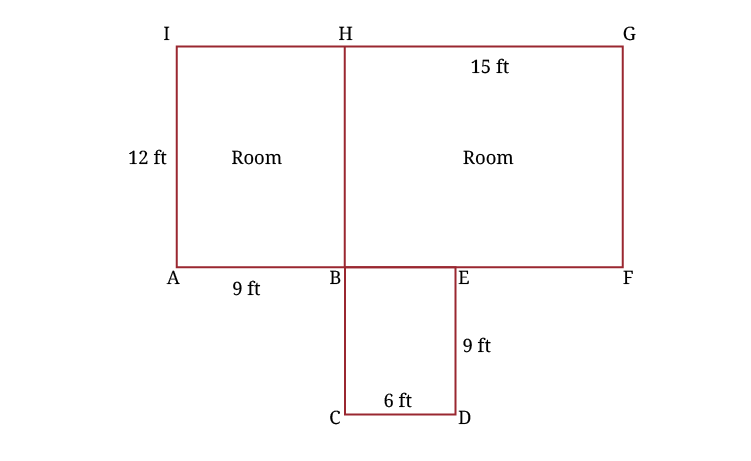
Total length of walls = AI + CH + DE + FG + IG + AF + CD = 12 + (9 + 12) + 9 + 12 + (9 + 15) + (9 + 15) + 6 = 108 ft
Let x bricks be required for a 108 ft long wall. ∴ Ratio of length of wall to number of bricks = 108 : x
These ratios are in proportion.
∴ 10 : 1450 :: 108 : x.
⇒ 10 1450 = 108 x
⇒ 10 1450 = 108 𝑥
⇒ 1 145 = 108 x
⇒ 1 145 = 108 𝑥
⇒ x = 145 × 108 = 15,660
∴ Number of required bricks = 15,660.
Step 1: Understand the problem clearly
Before solving, let’s understand what’s given and what is asked:
- Given:
- A 10 ft wall requires 1450 bricks.
- All walls have the same height and thickness.
- Asked: Total number of bricks required for all walls (outer + inner).
Here, the number of bricks is directly proportional to the length of the wall because height and thickness are the same.
- More wall length → more bricks.
- Less wall length → fewer bricks.
Step 2: Express the given information as a ratio
From the problem:
10 ft wall → 1450 bricks
We can write the ratio of wall length to bricks as:
Length : Bricks = 10 : 1450
This ratio will help us scale up for the total wall length.
Step 3: Calculate total wall length
The total wall length includes all outer walls and inner walls. From the diagram:
Total length = AI + CH + DE + FG + IG + AF + CD
Substitute the lengths:
12 + (9 + 12) + 9 + 12 + (9 + 15) + (9 + 15) + 6 = 108 ft
Total wall length = 108
Always check that all wall segments are included: outer walls + inner wall.
Step 4: Set up the proportion
Let x = total bricks needed for 108 ft of wall.
Since the number of bricks is proportional to the wall length:
10 : 1450 :: 108 : x.
Number of bricks = 101450 = 108 𝑥
This proportion states: "10 ft of wall uses 1450 bricks, so 108 ft will use x bricks."
Step 5: Solve the proportion using cross-multiplication
⇒ 10x= 1450 × 108
⇒ x = 1450 × 10810
⇒ x = 145 × 108 = 15,660
∴ Number of required bricks = 15,660.
The mason will need 15,660 bricks to build all the walls of the house.
3. Puneeth’s father went from Lucknow to Kanpur in 2 hours by riding
his motorcycle at a speed of 50 km/h. If he drives at 75 km/h, how long will it take him to reach Kanpur? Can we form this problem as
a proportion - 50 : 2 :: 75 : __. Would it take Puneeth’s father more time or less time to reach
Kanpur? Think about it.
At first glance, it might seem natural to set up the problem as a proportion:
50:2::75:?
50 : 2 :: 75 : ?
50:2::75:?.
However, this approach does not work here because time and speed are inversely related.
- In the previous problems, an increase in quantity led to a direct increase in the related value, so the Rule of Three (direct proportion) applied.
- Here, as speed increases, the travel time decreases. This is an inverse relationship, not a direct one.
To solve the problem correctly:
1. Calculate the distance from Lucknow to Kanpur using the first speed:
Distance = Speed × Time = 50 × 2 = 100 km
2. Use the new speed to find the new time:
Time = Distance / Speed = 10075 ≈ 1.33 hours (or 1 hour 20 minutes)
Since Puneeth’s father is riding faster, it will take less time to reach Kanpur.
This is why a simple proportion like
50:2::75:?
50 : 2 :: 75 : ?
50:2::75:? cannot be used, because time decreases when speed increases.
Problems involving speed and time often require checking whether the quantities are directly or inversely proportional.
Here, speed and time are inversely proportional, so the Rule of Three (direct proportion) does not apply.
Figure it Out (Page 175)
1. Divide ₹ 4,500 into two parts in the ratio 2 : 3.
Solution:
Step 1: Understand what the ratio represents
A ratio of 2 : 3 tells us how the total amount should be shared between two parts. It means the first part should receive 2 portions while the second part should receive 3 portions of the total amount.
Ratios express a relationship, not the actual amounts, so we first need to determine the value of one portion.
Step 2: Calculate the total number of parts
Add the numbers in the ratio to find the total parts:
2 + 3 = 5 parts in total
This means the total sum of ₹4,500 is divided into 5 equal portions.
Step 3: Find the value of one part
To find the value of a single part, divide the total amount by the total number of parts:
Value of 1 part = Total Amount
Total Parts = 45005 = 900
So, each part is worth ₹900.
Step 4: Determine the value of each share
First share (2 parts):
2 × 900 = 1800
Second share (3 parts):
3 × 900 = 2700
Step 5: Verify the division
Check if the sum of the two parts equals the total amount:
1800 + 2700 = 4500
The calculation is correct, so the division is accurate.
The total amount of ₹4,500 divided in the ratio 2 : 3 gives:
First part = ₹1,800
Second part = ₹2,700
2. In a science lab, acid and water are mixed in the ratio of 1 : 5 to make a solution. In a bottle that has 240 mL of the solution, how much acid and water does the solution contain?
Solution:
In a science lab, acid and water are mixed in the ratio 1 : 5 to prepare a solution. This means that for every one part of acid, there are five parts of water in the mixture.
If a bottle contains 240 mL of this solution, we can determine the quantities of acid and water by first considering the total number of parts in the ratio. Since the ratio is 1 : 5, the total number of parts is 1 + 5 = 6 parts.
The total solution of 240 mL is therefore divided into six equal parts, with each part representing 40 mL (240 ÷ 6 = 40 mL).
The acid corresponds to one part, so the solution contains 40 mL of acid. The water corresponds to five parts, so the solution contains 200 mL of water (5 × 40 = 200 mL).
Thus, in the 240 mL solution, there are 40 mL of acid and 200 mL of water. This method works because ratios divide the total quantity into proportional parts.
By understanding the relationship between the parts and the total, we can easily calculate the amount of each component.
3. Blue and yellow paints are mixed in the ratio of 3 : 5 to produce green paint. To produce 40 mL of green paint, how much of these two colours are needed? To make the paint a lighter shade of green, I added 20 mL of yellow to the mixture. What is the new ratio of blue and yellow in the paint?
Solution:
Blue and yellow paints are mixed in the ratio 3 : 5. This means that for every 3 parts of blue paint, there are 5 parts of yellow paint.
The total number of parts in the mixture is 3 + 5 = 8 parts
The total quantity of green paint required is 40 mL.
So, the quantity corresponding to 1 part is 40 ÷ 8 = 5 mL
Now, we find the quantity of each colour:
- Blue paint = 3 parts = 3 × 5 = 15 mL
- Yellow paint = 5 parts = 5 × 5 = 25 mL
Thus, to make 40 mL of green paint, 15 mL of blue paint and 25 mL of yellow paint are required.
To make the paint a lighter shade of green, an additional 20 mL of yellow paint is added.
The new quantities become:
- Blue paint = 15 mL (unchanged)
- Yellow paint = 25 + 20 = 45 mL
The new ratio of blue to yellow paint is therefore: 15 : 45
Dividing both terms by their greatest common factor, 15:
15 ÷ 15 : 45 ÷ 15 = 1 : 3
Final Answer:
- Initial mixture: 15 mL blue and 25 mL yellow
- New ratio after adding yellow paint: 1 : 3
This shows that increasing the amount of yellow paint changes the proportion, making the green colour lighter.
4. To make soft idlis, you need to mix rice and urad dal in the ratio of 2 : 1. If you need 6 cups of this mixture to make idlis tomorrow morning, how many cups of rice and urad dal will you need?
Solution:
The ratio of rice to urad dal = 2 : 1
Total parts = 2 + 1
Number of cups of rice needed = 2 × 6 2 + 1 = 4 2 × 6 2 + 1 = 4 cups
Number of cups of urad dal needed = 1 × 6 2 + 1 = 2 1 × 6 2 + 1 = 2 cups
Therefore, you will need 4 cups of rice and 2 cups of urad dal.
To make soft idlis, rice and urad dal need to be mixed in the ratio of 2 : 1. This means that for every 2 parts of rice, 1 part of urad dal is required. The total number of parts in this mixture is 2 + 1 = 3 parts.
Since you need 6 cups of the mixture, each part represents an equal share of the total mixture. The amount corresponding to one part is calculated by dividing the total mixture by the total number of parts:
One part = 63 = 2 cups
The rice portion, being 2 parts, is therefore:
Rice = 2 × 2 = 4 cups
The urad dal portion, being 1 part, is:
Urad dal = 1 × 2 = 2 cups
Hence, to prepare 6 cups of idli mixture in the correct proportion, you will need 4 cups of rice and 2 cups of urad dal.
This method ensures that the ingredients are combined in the right ratio, giving soft and evenly textured idlis. By dividing the mixture according to parts, the balance between rice and dal is maintained perfectly, which is essential for the desired softness and taste.
5. I have one bucket of orange paint that 1 made by mixing red and yellow paints in the ratio of 3 : 5. I added another bucket of yellow paint to this mixture. What is the ratio of red paint to yellow paint in the new mixture?
Solution:
Step 1: Let the capacity of one bucket be ‘x’ litres.
The original ratio of red paint to yellow paint is 3:5
- Total parts = 3 + 5 = 8 parts.
- Quantity of red paint in one bucket = 3 x8 litres
- Quantity of yellow paint in one bucket = 5 x8 litres
Step 2: Add another bucket of yellow paint.
- Quantity of red paint remains the same = 3 x8 litres.
- Quantity of yellow paint increases by ‘x’ litres:
New yellow paint = 5 x8 + x = 5 x + 8x 8 = 13x8 litres
Step 3: Find the new ratio of red paint to yellow paint.
New ratio = Red : Yellow = 3x 8 = 13x8=
Therefore, the ratio of red paint to yellow paint in the new mixture is 3 : 13.
Adding extra yellow paint increases the proportion of yellow compared to red. The red paint remains the same, so the ratio decreases from the original 3:5 to 3:13. This shows how adding more of one component in a mixture affects the overall ratio.
Figure it Out (Pages 176-177)
1. Anagh mixes 600 mL of orange juice with 900 mL of apple juice to make a fruit drink. Write the ratio of orange juice to apple juice in its simplest form.
Solution:
First, we express the quantity of orange juice and apple juice as a ratio:
600 : 900
To simplify a ratio, we divide both numbers by their Highest Common Factor (HCF), which is the largest number that divides both quantities exactly. For 600 and 900, the HCF is 300.
Dividing both terms of the ratio by 300 gives:
600 ÷ 300 : 900 ÷ 300 = 2 : 3600
Thus, the ratio of orange juice to apple juice in its simplest form is 2 : 3.
This means that in the fruit drink, for every 2 parts of orange juice, there are 3 parts of apple juice.
Understanding the ratio in this way helps us compare the quantities directly and can also be used to scale the recipe up or down while keeping the same proportion of juices.
2. Last year, we hired 3 buses for the school trip. We had a total of 162 students and teachers who went on that trip, and all the buses were full. This year we have 204 students. How many buses will we need? Will all the buses be full?
Solution:
First, we note that the capacity of each bus remains the same as last year. Last year, 162 people were transported using 3 buses, so each bus carried:
Capacity of each bus = 1623 = 54 people per bus
This year, there are 204 students. To find the number of buses needed, we divide the total number of students by the capacity of one bus:
Number of buses = 20454 ≈ 3.78
Since the number of buses must be a whole number, we round 3.78 up to 4 buses.
To check if all buses will be full, we calculate how many students would go in each bus if 4 buses are used:
Students per bus = 2044 = 51
The buses can carry 54 people each, but now each bus will have only 51 students. This shows that all buses will not be full.
- The school will need 4 buses to accommodate 204 students.
- All buses will not be full since each bus will carry slightly fewer students than its full capacity.
Using proportional reasoning, we can compare last year and this year directly:
162 : 204 :: 3 : x
X = 204 × 3 162 = 3.78 ≈ 4
This confirms the same result and demonstrates how proportional relationships can help in planning real-life situations like arranging buses for a school trip.
3. The area of Delhi is 1,484 sq. km, and the area of Mumbai is 550 sq. km. The population of Delhi is approximately 30 million, and that of Mumbai is 20 million people. Which city is more crowded? Why do you say so?
Solution:
To determine which city is more crowded, we compare the population density of the two cities. Population density is the number of people living per unit area and helps us understand how crowded a place is.
Step 1: Write down the data
- Delhi: Area = 1,484 sq. km, Population = 30 million
- Mumbai: Area = 550 sq. km, Population = 20 million
Step 2: Calculate the ratio of area to population
- For Delhi: 1,484 : 30 ≈ 49.47 sq. km per million people
- For Mumbai: 550 : 20 = 27.5 sq. km per million people
The smaller the area per person, the more crowded the city.
Step 3: Compare the factors of change
- Factor of change of area: 5501484 ≈ 0.371
- Factor of change of population: 2030 ≈ 0.667
Since 0.667>0, the population has decreased less proportionally than the area, which indicates that Mumbai is more crowded than Delhi.
Step 4: Real-life connection:
Understanding population density is useful in planning real-life scenarios. For example, if a school is arranging buses for a trip, knowing how crowded an area is can help decide the number of buses, routes, and travel time efficiently. Similarly, city planners use density data to plan housing, transport, and public services.
Answer:
Mumbai is more crowded than Delhi because its population density (people per sq. km) is higher.
Alternative Method using Proportion (Optional):
We can also solve this using ratios:
Let the population of Mumbai be proportional to its area if the density were the same as Delhi.
Delhi area : Delhi population = Mumbai area : Mumbai population (x)
: Delhi population = Mumbai area : Mumbai population (x)
550 : x1484 : 30
Convert this into an equation:
148030= 550 x ⟹ 1484x = 30 × 550 = 16,500
X = 148416,500 ≈ 11.12 million
This means that if Mumbai had the same population density as Delhi, it would have 11.12 million people, but the actual population is 20 million. Hence, Mumbai is much more crowded than Delhi.
4. A crane of height 155 cm has its neck and the rest of its body in the ratio 4 : 6. For your height, if your neck and the rest of your body also had this ratio, how tall would your neck be?
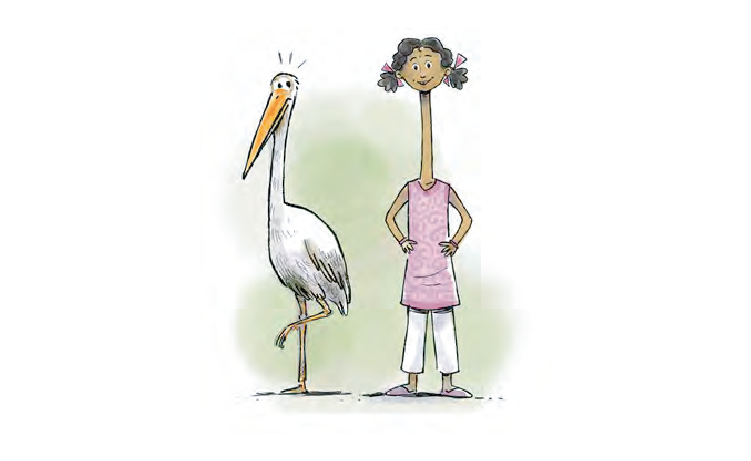
Solution:
Step 1: Divide it into parts
The problem involves dividing the total height into parts proportional to a given ratio. For the crane, the ratio of neck to the rest of the body is 4 : 6, meaning the total height is split into 4 + 6 = 10 equal parts, where 4 parts correspond to the neck and 6 parts to the body.
Step 2: Apply the ratio to your height
If your height is 165 cm and your neck and body follow the same 4 : 6 ratio, your height is similarly divided into 10 equal parts. Each part represents:
One part = Total HeightTotal Parts = 16510 = 16.5 cm per part
Step 3: Determine the height of the neck
The neck corresponds to 4 parts:
Neck height = 4 × 16.5 = 66 cm
Step 4: Optional verification
The rest of the body corresponds to 6 parts:
Body height = 6 × 16.5 = 99 cm
Adding the neck and body heights: 66 + 99 = 165 cm
This confirms our calculation.
Answer: The height of your neck would be 66 cm.
5. Let us try an ancient problem from Lilavati. At that time, weights were measured in a unit named palas, and niskas was a unit of money. “If 2 12 palas of saffron costs 37 niskas, O expert businessman! Tell me quickly what quantity of saffron can be bought for 9 niskas?”
Solution:
We are asked to find how many palas of saffron can be purchased for 9 niskas when 2 12 palas cost 37 niskas. This is a classic direct proportion problem, where the quantity bought changes in proportion to the money spent.
Let the unknown quantity of saffron be x palas. According to the rule of three, we can write:
37 : 9 :: 212:x
This means that 37 niskas is to 9 niskas as 2 palas is to ‘x’ palas. Using cross multiplication, we get:
X = 2 12 × 9 37
Multiplying, 2 12 × 9 = 1908, and dividing by 37 gives:
X = 190837 = 51.6
Thus, for 9 niskas, one can buy approximately 51.6 palas of saffron.
6. Harmain is a 1-year-old girl. Her elder brother is 5 years old. What will be Harmain’s age when the ratio of her age to her brother’s age is 1 : 2?
Solution:
Harmain is 1 year old, and her elder brother is 5 years old. The difference in their ages is 5 − 1 = 4 years, which will remain the same as they grow older.
Let Harmain’s age at the time when the ratio of her age to her brother’s age becomes 1 : 2 be ‘x’ years. Since her brother is always 4 years older, his age at that time will be x + 4 years.
According to the problem, the ratio of Harmain’s age to her brother’s age is 1 : 2. Substituting the ages gives:
xx + 4=12
Cross-multiplying, we get:
2x = x + 4
Subtracting ‘x’ from both sides, we find:
x = 4
Therefore, Harmain will be 4 years old when her age is half of her brother’s age.
Answer: 4 years
7. The mass of equal volumes of gold and water is in the ratio 37 : 2. If 1 litre of water is 1 kg in mass, what is the mass of 1 litre of gold?
Solution:
The problem states that equal volumes of gold and water have masses in the ratio 37 : 2. We also know that 1 litre of water has a mass of 1 kg. We are asked to find the mass of 1 litre of gold.
Let the mass of 1 litre of gold be ‘x’ kg. Since the volumes of gold and water are equal, their masses will also be in the same ratio as given. That is, the ratio of the mass of gold to the mass of water can be written as x:1.
According to the problem, this ratio is equal to the given ratio of 37 : 2. This gives the proportion:
372 = x
Solving for x, we multiply both sides by 1:
X = 372 kg = 18.5 kg
Therefore, 1 litre of gold has a mass of 18.5 kg.
Explanation:
- The ratio 37 : 2 means that for the same volume, gold is much heavier than water.
- By letting the unknown mass of gold be xxx, we create a proportion comparing it to water’s mass.
- Solving the proportion gives the exact mass of gold corresponding to the given volume.
- This method can be applied to any similar problem involving the mass of substances with equal volumes.
8. It is good farming practice to apply 10 tonnes of cow manure for 1 acre of land. A farmer is planning to grow tomatoes in a plot of size 200 ft by 500 ft. How much manure should he buy? (Please refer to the section on Unit Conversions earlier in this chapter).
Solution:
The area of the rectangular plot is found by multiplying its length and breadth:
Area = 200 ft × 500 ft = 100,000 sq ft
Since 1 acre is equal to 43,560 sq ft, the size of the plot in acres is:
Area in acres = 43,560100,000 ≈ 2.296 acres
The recommended quantity of cow manure is 10 tonnes per acre. Therefore, the total manure needed for 2.296 acres can be calculated using proportional reasoning:
Required manure = 2.296 × 10 ≈ 22.96 tonnes = 2.296
The farmer should purchase approximately 23 tonnes of cow manure for his plot.
9. A tap takes 15 seconds to fill a mug of water. The volume of the mug is 500 mL. How much time does the same tap take to fill a bucket of water if the bucket has a 10-litre capacity?
Solution:
A tap takes 15 seconds to fill a mug of 500 mL. We are asked to find how long it will take to fill a bucket with 10 litres (10,000 mL).
Since the tap flows at a constant rate, the time it takes is directly proportional to the volume of water. This means that if the volume increases, the time increases in the same ratio.
To solve the problem, we compare the volumes of water. The mug holds 500 mL and the bucket holds 10,000 mL.
We can set up a ratio of the volume of the mug to the time it takes to fill it, which is 500 : 15.
Similarly, the ratio for the bucket is 10,000 : x, where x represents the time in seconds needed to fill the bucket. Because these ratios are proportional, we can write:
= Volume for MugTime for Mug = Volume for BucketTime for Bucket
= 50015 = 10,000x
500⋅x=15⋅10,000
X = 1, 50, 000500 = 30 seconds
Converting seconds into minutes:
300 ÷ 60 = 5 minutes
Thus, it will take 5 minutes for the tap to fill the bucket.
10. One acre of land costs ₹ 15,00,000. What is the cost of 2,400 square feet of the same land?
Solution:
We know that 1 acre is equal to 43,560 square feet, and its cost is ₹ 15,00,000. To find the cost of 2,400 square feet, we use the concept of direct proportion, which tells us that the cost changes in the same ratio as the area.
Let the cost of 2,400 square feet be ₹ x. Setting up the proportion gives:
Area of 1 acre : Required area = Cost of 1 acre : Cost of required area
Substituting the values:
43,560 : 2,400 = 15,00,000 :x
By solving this, we find:
= 2,400×15,00,00043,560 = 36,00,00,00043,560≈82,645
Therefore, the cost of 2,400 square feet of land is approximately ₹ 82,645.
11. A tractor can plough the same area of a field 4 times faster than a pair of oxen. A farmer wants to plough his 20-acre field. A pair of oxen takes 6 hours to plough an acre of land. How much time would it take if the farmer used a pair of oxen to plough the field? How much time would it take him if he decides to use a tractor instead?
Solution:
The speed of work and the time taken are in inverse proportion. This means that if the efficiency of work increases, the time required decreases in the same ratio.
The efficiency ratio of a tractor to a pair of oxen is 4 : 1.
A pair of oxen takes 6 hours to plough 1 acre of land. Therefore, the time taken by a tractor to plough 1 acre of land is:
64 = 1.5 hours
The total area of the field is 20 acres.
Time taken by a pair of oxen to plough the entire field:
20 × 6 = 120 hours
Time taken by a tractor to plough the entire field:
20 × 1.5 = 30 hours
12. The ₹ 10 coin is an alloy of copper and nickel called ‘cupro-nickel’. Copper and nickel are mixed in a 3 : 1 ratio to get this alloy. The mass of the coin is 7.74. grams. If the cost of copper is ₹ 906 per kg and the cost of nickel is ₹ 1,341 per kg, what is the cost of these metals in a ₹ 10 coin?
Solution:
The mass of nickel in the coin is one-fourth of 7.74 grams, which is equal to 1.935 grams.
The ratio of copper to nickel in the coin is 3 : 1. This means the total number of equal parts in the alloy is:
3 + 1 = 4 parts
a. Finding the mass of each metal
The total mass of the coin is 7.74 grams.
The mass of copper in the coin is three out of four parts of the total mass:
34 × 7.74 = 5.805 grams
The mass of nickel in the coin is one out of four parts of the total mass:
14 × 7.74 = 1.935 grams
b. Converting grams to kilograms
Since the cost is given per kilogram, the masses are converted into kilograms.
5.805 = 5.8051000 = 0.005805 kg
c. Calculating the cost of each metal
The cost of copper used in the coin is:
906 × 0.005805 = ₹5.26
The cost of nickel used in the coin is:
1314 × 0.001935 = ₹2.54
The cost of copper in the ₹10 coin is approximately ₹5.26, and the cost of nickel is approximately ₹2.54.
Therefore, the total cost of the metals used in one ₹10 coin is:
₹5.26 + ₹2.54 = ₹7.80 ≈ ₹8
The total cost of copper and nickel used to make one ₹10 coin is approximately ₹8.
It’s Puzzle Time! (Page 178)
Binairo, also known as Takuzu, is a logic puzzle with simple rules. Binairo is generally played on a square grid with no particular size. Some cells start filled with two symbols: horizontal and vertical lines. The rest of the cells are empty. The task is to fill cells in such a way that:
1. Each row and each column must contain an equal number of horizontal and vertical lines.
2. More than two horizontal or vertical lines can’t be adjacent.
3. Each row is unique. Each column is unique. Solve the following Binairo Puzzles:
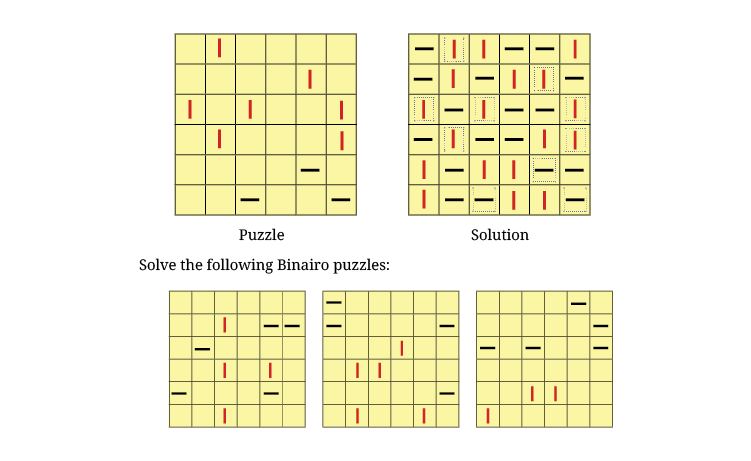
Solution:
Binairo, also called Takuzu, is a logic-based puzzle played on a square grid of any size. Some of the cells in the grid are pre-filled with two symbols, usually represented as horizontal lines and vertical lines. The remaining cells are empty, and your task is to fill them while following a set of simple rules:
- Balanced Rows and Columns: Each row and each column must have an equal number of horizontal and vertical lines.
- No Three in a Row: You cannot place more than two identical symbols consecutively, either horizontally or vertically.
- Uniqueness: Every row must be different from every other row, and every column must be unique as well.
The goal is to fill the entire grid while satisfying all these rules. Binairo encourages logical thinking, pattern recognition, and careful planning.
Tips for Solving Binairo Puzzles:
- Start by filling obvious cells where only one symbol is possible.
- Look for rows or columns nearing completion to maintain balance.
- Watch for patterns that would violate the “no three in a row” rule.
- Compare rows and columns to ensure uniqueness.
Here is the solution:
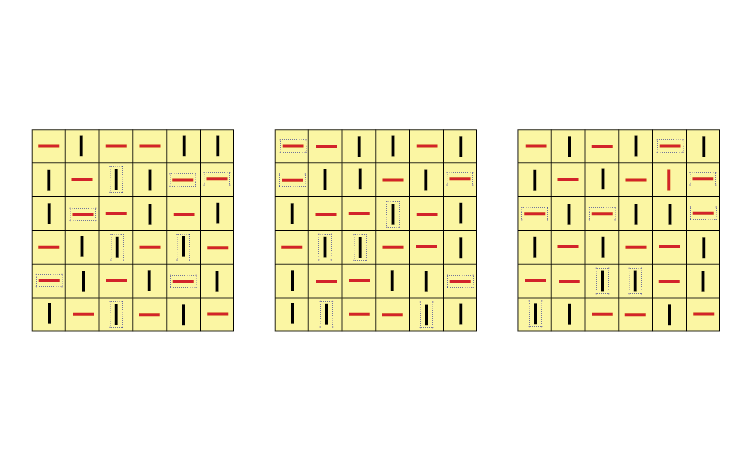
With practice, Binairo puzzles become an engaging way to train reasoning and problem-solving skills.
Engaging with Proportional Reasoning helps students see mathematics as a subject focused on understanding connections between quantities rather than rote learning. This chapter guides learners to examine how quantities relate to one another, identify proportional relationships, and use logical steps to solve real-world problems based on ratios and proportions, thereby enhancing their reasoning skills.
The NCERT Solutions for Class 8 Maths Chapter 7 Proportional Reasoning provide clear explanations that strengthen conceptual understanding and help students tackle application-based and reasoning questions in exams with confidence. Beyond academic learning, the ideas from this chapter support better estimation, practical thinking, and daily problem-solving. Developing confidence in proportional reasoning builds a reliable base for more advanced mathematics in future classes.
Frequently Asked Questions on NCERT Solutions for Class 8 Maths Chapter 7 Proportional Reasoning
1. What is Proportional Reasoning?
Proportional Reasoning is the skill of understanding how two or more quantities are related and how changes in one quantity affect another. It focuses on logical analysis rather than memorising formulas.
2. Why are ratios important?
Ratios allow clear comparison between quantities, helping students analyse relationships, make predictions, and solve practical problems systematically.
3. What is the significance of proportion in this chapter?
Proportion shows the equality between two ratios. Learning proportions helps students identify relationships and solve problems using properties of proportion step by step.
4. What types of questions are asked in exams?
Typical questions include simplifying ratios, checking proportionality, using the unitary method, and applying direct proportion in real-life situations such as speed, distance, cost, and time.
5. How does this chapter relate to everyday life?
Proportional reasoning is used in real-life situations like shopping, cooking, travelling, and budgeting. Students learn how to adjust quantities and make practical calculations.
6. Are the calculations difficult?
Most problems are straightforward. The main focus is on understanding the relationship between quantities and applying correct reasoning, rather than performing complex arithmetic.
7. How should students prepare for this chapter?
Students should practice all exercises, focus on stepwise problem-solving, and write clear explanations. Regular revision enhances accuracy and confidence.
8. Why is Proportional Reasoning important in Class 8 Maths?
This chapter develops logical thinking and problem-solving skills, laying the foundation for advanced mathematics and real-world applications.
Admissions Open for 2026-27
What type of concept pages would you prefer?
CBSE Schools In Popular Cities
- CBSE Schools in Bangalore
- CBSE Schools in Mumbai
- CBSE Schools in Pune
- CBSE Schools in Hyderabad
- CBSE Schools in Chennai
- CBSE Schools in Gurgaon
- CBSE Schools in Kolkata
- CBSE Schools in Indore
- CBSE Schools in Sonipat
- CBSE Schools in Delhi
- CBSE Schools in Rohtak
- CBSE Schools in Bhopal
- CBSE Schools in Aurangabad
- CBSE Schools in Jabalpur
- CBSE Schools in Jaipur
- CBSE Schools in Jodhpur
- CBSE Schools in Nagpur
- CBSE Schools in Ahmednagar
- CBSE School In Tumkur











Orchids The International School is one of India's leading chains of CBSE and ICSE schools, with 110+ schools across the country.