

NCERT Solutions Class 8 Maths Chapter 4 Quadrilaterals
NCERT Solutions Class 8 Maths Chapter 4 Quadrilaterals are designed to help learners solve in-text questions, which are based on the concepts related to different types of quadrilaterals, clearly and simply. This chapter explains how shapes with four sides differ from each other based on their sides, angles, and diagonals.
Students will learn about various quadrilaterals, including parallelograms, rectangles, squares, rhombuses, kites, and trapeziums, along with their properties. The chapter focuses on developing logical thinking and helping students identify quadrilaterals using given conditions.
Get More Learning Resources for Class 8 Maths Chapter 4 Quadrilaterals
NCERT Solutions Class 8 Maths Chapter 4 Quadrilaterals: Download FREE PDF
NCERT Solutions Class 8 Maths Chapter 4 Quadrilaterals are designed to help students understand the properties and types of quadrilaterals in a clear and simple way. This chapter explains the properties of quadrilaterals and helps students identify and compare their sides, angles, and diagonals using logical reasoning.
This chapter covers the following topics:
- What is a Quadrilaterals?
- Properties of Quadrilaterals
- Types of Quadrilaterals: Parallelogram, Rectangle, Square, Rhombus, Trapezium, Kite
- Special Quadrilaterals and Their Properties
- Identifying Quadrilaterals Using Given Conditions
With these NCERT Solutions for Class 8 Maths, students can clear their doubts easily, understand each concept step by step, and gain confidence while solving textbook exercises.
Complete NCERT Solutions Class 8 Maths Chapter 4 Quadrilaterals
Here are complete and step-by-step answers to NCERT Solutions Class 8 Maths Ganita Prakash Chapter 4 Quadrilaterals, explained in simple language to help students understand the properties, types, and applications of quadrilaterals with ease.
Figure it Out (Page 94)
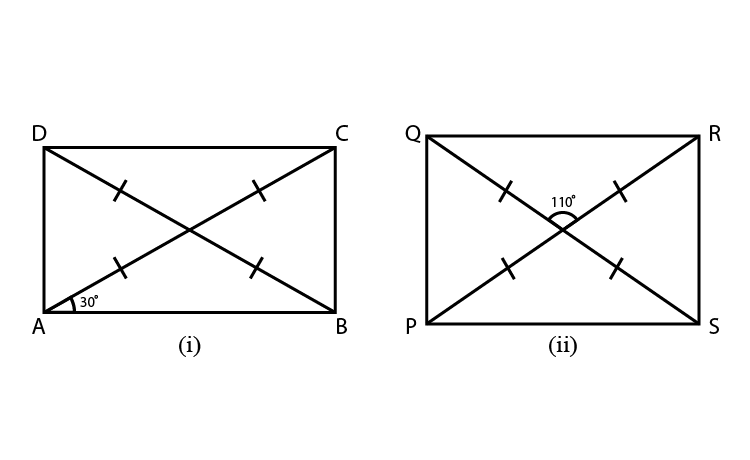
1. Find all the other angles inside the following rectangles.
Solution:
(i) We are given a rectangle with some angles marked. Use the properties of rectangles, parallel lines, and triangles to find the remaining angles.
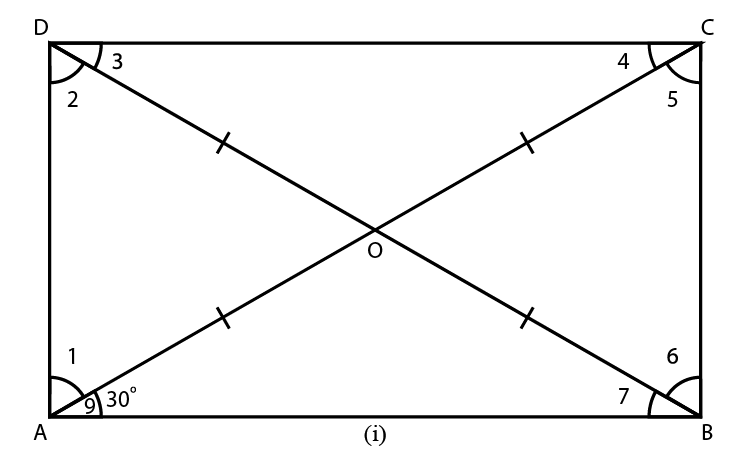
Step 1: Use the property of a rectangle
All corner angles of a rectangle are 90°.
∠1 + ∠9 = 90° ……… (All corner angles of a rectangle are 90°)
∠1 + 30° = 90°
∠1 = 90° – 30°
∠1 = 60°
Step 2: Use alternate interior angles
Since opposite sides of a rectangle are parallel:
∠1 = ∠5 = 60°
∠9 = ∠4 = 30°
Step 3: Use properties of isosceles triangles
In △AOB, OA = OB, then the angles opposite them are equal
So, angles opposite equal sides are equal
∴ ∠9 = ∠7 = 30°
Again, using parallel lines,
∠7 = ∠3 = 30°
Step 4: Another isosceles triangle
In △AOD, OA = OD, then the angles opposite them are equal
∴ ∠2 = ∠1 = 60°
Using alternate interior angles
∠2 = ∠6 = 60°
Step 5: Use the sum of angles of a triangle
In △AOB,
∠9 + ∠7 + ∠AOB = 180° ………. (Sum of angles of a triangle)
30° + 30° + ∠AOB = 180°
60° + ∠AOB = 180°
∠AOB = 180° – 60°
∠AOB = 120°
Step 6: Use vertically opposite angles,
∠AOB = ∠COD = 120°
Step 7: Use a linear pair
∠AOB + ∠AOD = 180° …………. (Linear pair)
120° + ∠AOD = 180°
∠AOD = 180° – 120°
∠AOD = 60°
Again, using vertically opposite angles:
∠AOD = ∠BOC = 60°
Therefore, ∠1 = ∠5 = ∠2 = ∠6 = ∠AOD = ∠BOC = 60°.
∠AOB = ∠COD = 120°.
∠9 = ∠4 = ∠7 = ∠3 = 30°.
(ii) We are given a rectangle PQRS with diagonals and intersecting line segments. Using basic angle properties, we find all the unknown angles step by step.
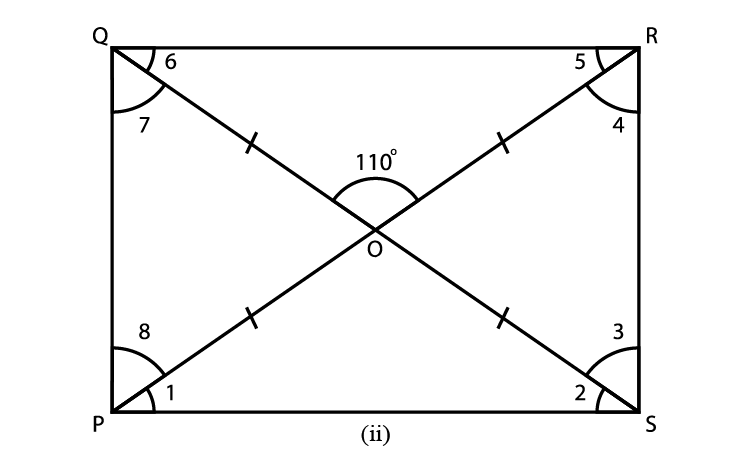
Step 1: Vertically opposite angles
Vertically opposite angles are always equal.
∠POS = ∠ROQ = 110°
Step 2: Linear pair
Angles forming a straight line add up to 180°.
∠POS + ∠POQ = 180° …………. (Linear Pair)
110° + ∠POQ = 180°
∠POQ = 180° – 110°
∠POQ = 70°
Again, using vertically opposite angles, we get
∠POQ = ∠SOR = 70°
Step 3: Isosceles triangle property
In △POS, OP = OS,
So, the angles opposite equal sides are equal.
∴ ∠1 = ∠2 = a
Using the angle sum property of a triangle, we get
In △POS,
∠1 + ∠2 + ∠POS = 180°
a + a + 110° = 180°
2a = 180° – 110°
2a = 70°
a = 35°
∴ ∠1 = ∠2 = a = 35°
Step 4: Alternate interior angles
Since opposite sides of a rectangle are parallel:
∠1 = ∠5 = 35°
∠2 = ∠6 = 35°
Step 5: Right angle of a rectangle
Each interior angle of a rectangle is 90°.
At point P:
Since ABCD is a rectangle, ∠P = 90°
∠9 = ∠1 + ∠8
90° = 35° + ∠8
∠8 = 90° – 35°
∠8 = 55°
Using alternate interior angles
∠8 = ∠4 = 55°
Step 6: Another isosceles triangle
In △POQ, OP = OQ, then the angles opposite them are equal
i.e. ∠7 = ∠8 = 55°
Using alternate interior angles
∠7 = ∠2 = 55°
Therefore, ∠POS = ∠ROQ = 110°.
∠POQ = ∠SOR = 70°.
∠1 = ∠2 = ∠5 = ∠6 = 35°.
∠8 = ∠4 = ∠7 = ∠2 = 55°.
2. Draw a quadrilateral whose diagonals have equal lengths of 8 cm that bisect each other, and intersect at an angle of
(i) 30° (ii) 40° (iii) 90° (iv) 140°
Solution:
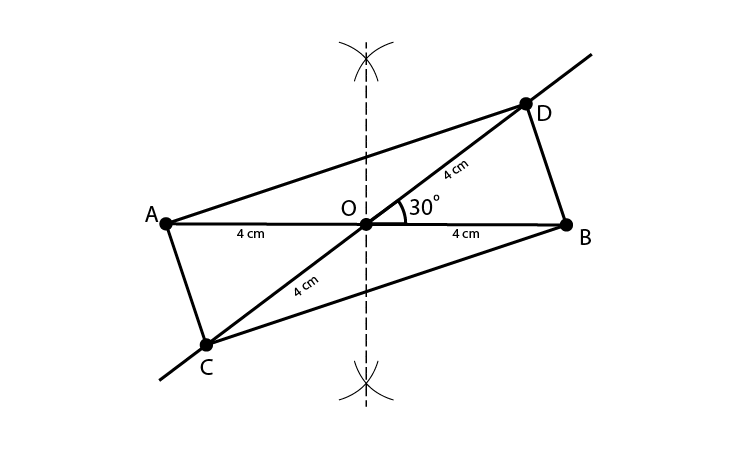
(i) When the diagonals intersect at 30°
Complete Steps:
- Draw a line segment AC = 8 cm.
- Mark its midpoint O.
- Through point O, draw another line BD = 8 cm such that it makes an angle of 30° with AC.
- Mark OB = OD = 4 cm on either side of O.
- Join A–B, B–C, C–D, and D–A.
(ii) When the diagonals intersect at 40°
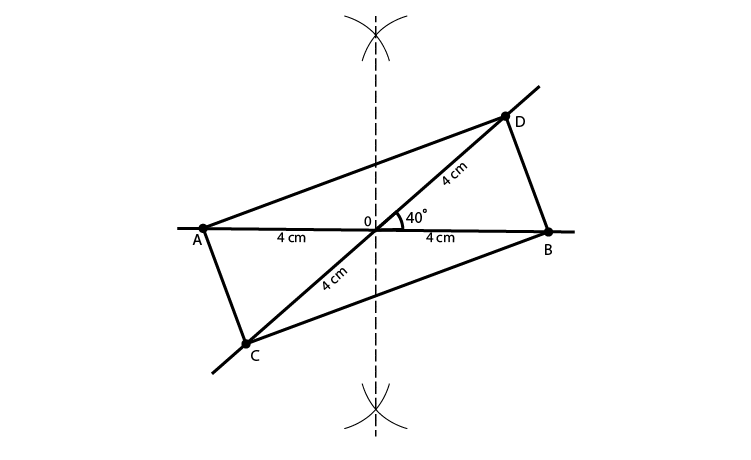
Complete Steps:
- Draw diagonal AC = 8 cm.
- Find its midpoint O.
- Through O, draw a diagonal BD = 8 cm, making an angle of 40° with AC.
- Mark OB = OD = 4 cm.
- Join the endpoints to form a quadrilateral ABCD.
(iii) When the diagonals intersect at 90°
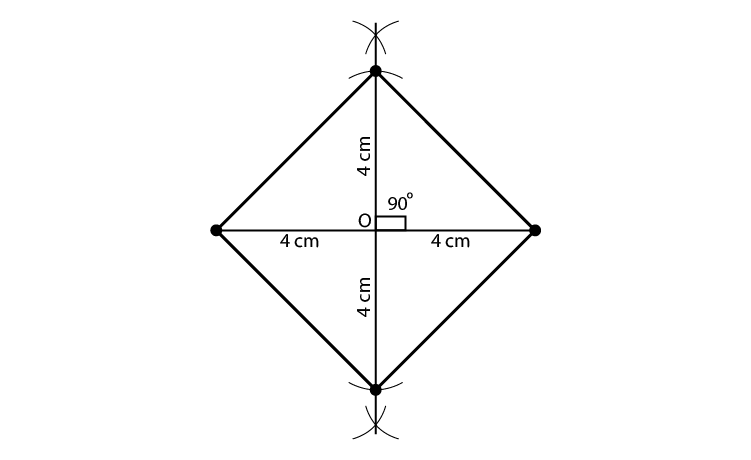
Complete Steps:
- Draw AC = 8 cm and mark its midpoint O.
- Through O, draw a line perpendicular to AC.
- On this perpendicular line, mark OB = OD = 4 cm to form diagonal BD = 8 cm.
- Join A–B, B–C, C–D, and D–A.
(iv) When the diagonals intersect at 140°
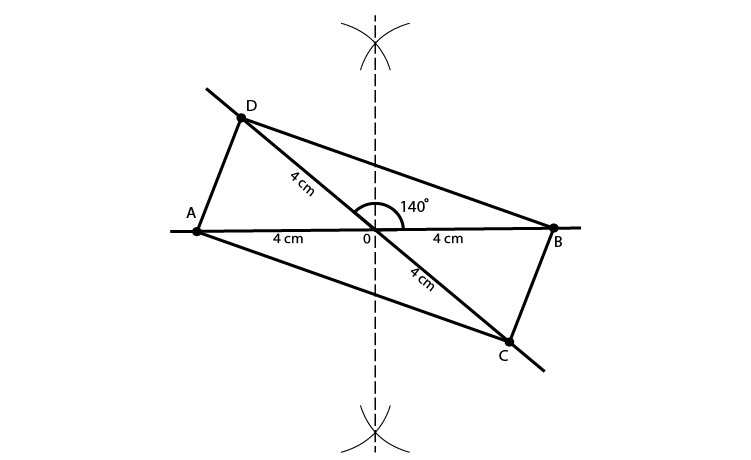
Complete Steps:
- Draw a diagonal AC = 8 cm and locate its midpoint O.
- Through O, draw a diagonal BD = 8 cm such that it makes an angle of 140° with AC.
- Mark OB = OD = 4 cm.
- Join the four endpoints to complete the quadrilateral.
3. Consider a circle with centre O. Line segments PL and AM are two perpendicular diameters of the circle. What is the figure APML? Reason and/or experiment to figure this out.
Solution:
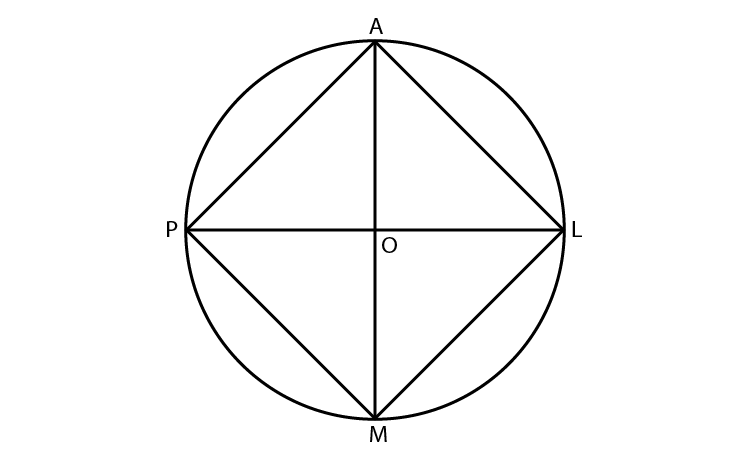

Let PL and AM be two perpendicular diameters of a circle with centre O and radius r.
Step 1: Lengths of the radii
Since all radii of a circle are equal
PO = OL = AO = OM = r
Step 2: Lengths of the diagonals
PL is a diameter, so
PL = PO + OL = r + r = 2r
Similarly, AM = AO + OM = r + r = 2r
Hence, PL = AM.
Step 3: Properties of diagonals in a quadrilateral APML
In quadrilateral APML:
- Diagonals PL and AM are equal in length
- They bisect each other at O
- They intersect at right angles (90°)
In quadrilateral APML, the diagonals PL and AM are equal in length and are perpendicular bisectors of each other.
∴ APML is a square.
4. We have seen how to get 90° using paper folding. Now, suppose we do not have any paper but two sticks of equal length and a thread. How do we make an exact 90° angle using these?
Solution:
Complete Steps:
- Take two sticks of equal length.
- Arrange them so that they cross each other.
- Use a thread to tie the four ends of the sticks together, forming a rhombus.
- Adjust the thread so that all sides are equal and the shape is stable.
In a rhombus, the diagonals intersect at 90°. Here, the sticks act as the diagonals of the rhombus. Therefore, the sticks will form an exact right angle (90°) where they cross.
5. We saw that one of the properties of a rectangle is that its opposite sides are parallel. Can this be chosen as a definition of a rectangle? In other words, is every quadrilateral that has opposite sides parallel and equal a rectangle?
Solution:
No, this can’t be the definition of a rectangle. A quadrilateral with opposite sides parallel and equal is called a parallelogram.
Not all parallelograms are rectangles because a rectangle requires that all four angles be 90°.
Figure it Out (Page 102)
1. Find the remaining angles in the following quadrilaterals.
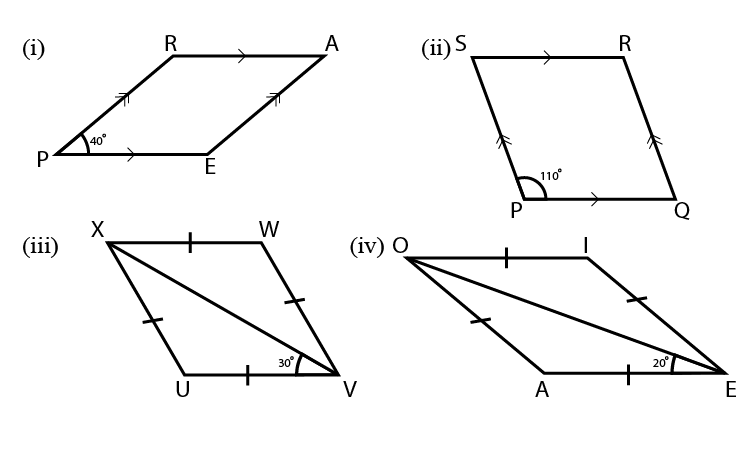
Solution:
(i) Quadrilateral PEAR
Here in PEAR, we can see that PR ∥ EA, and PE ∥ RA
Therefore, PEAR is a parallelogram.
Opposite angles of a parallelogram are equal, so ∠P = ∠A = 40°
Adjacent angles of a parallelogram add up to 180°, so, ∠P + ∠R = 180°
40° + ∠R = 180°
∠R = 180° – 40°
∠R = 140°.
Opposite angles of a parallelogram are equal, so ∠R = ∠E = 140°
(ii) Quadrilateral PQRS
Here, PQ ∥ SR, and PS ∥ QR
So, PQRS is a parallelogram.
We know that the opposite angles of a parallelogram are equal,
∠P = ∠R = 110°
We also know that the sum of the adjacent angles of a parallelogram is 180°, so
∠P + ∠S = 180°
110° + ∠S = 180°
∠S = 180° – 110°
∠S = 70°.
Opposite angles of a parallelogram are equal, so here,
∠S = ∠Q = 70°
(iii) Rhombus XWUV
Here, XWUV is a rhombus because all its sides are equal.
In △VUX, UV = UX, then the angles opposite them are equal.
∴ ∠UXV = ∠UVX = 30°
We know that the diagonals of a rhombus bisect its angles,
∠UXV = ∠WXV = 30°
The diagonals of a rhombus bisect its angles, so
Also, ∠UVX = ∠WVX = 30°
∠E = 2 × ∠UVX = 2 × 30° = 60°
The Opposite angles of a rhombus are equal, so here
∠V = ∠X = 60°
The sum of adjacent angles of a rhombus is 180°, so we can write,
∠V + ∠U = 180°
60° + ∠U = 180°
∠U = 180° – 60°
∠U = 120°
Opposite angles of a rhombus are equal, here
∠U = ∠W = 120°
(iv) Rhombus AEIO
Here, all sides are equal, so AEIO is a rhombus (all sides equal).
In △EAO, AE = AO, then the angles opposite them are equal.
∴ ∠AOE = ∠AEO = 20°
The diagonals of a rhombus bisect its angles. We can write
∠AEO = ∠IEO = 20°
The diagonals of a rhombus bisect its angles, so here
Also, ∠AOE = ∠IOE = 20°
∠E = 2 × ∠AEO = 2 × 20° = 40°
We already know that Opposite angles of a rhombus are equal, we can write,
∠E = ∠O = 40°
Also, the sum of adjacent angles of a rhombus is 180°, so here
∠E + ∠A = 180°
40° + ∠A = 180°
∠A = 180° – 40°
∠A = 140°
Opposite angles of a rhombus are equal, which can be written as
∠A = ∠I = 140°
2. Using the diagonal properties, construct a parallelogram whose diagonals are of lengths 7 cm and 5 cm, and intersect at an angle of 140°.
Solution:
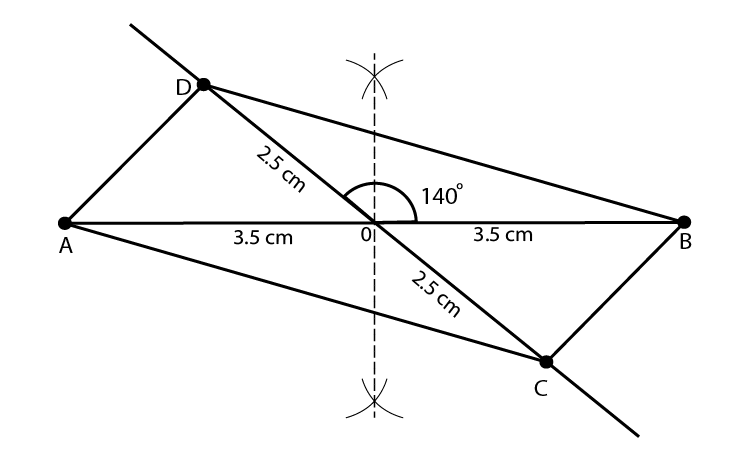
Complete Steps of Construction of a Parallelogram :
(i) Draw the longer diagonal
- Draw AC = 7 cm.
- Mark its midpoint O
(ii) Draw the intersecting angle
- At point O, draw a line making an angle of 140° with diagonal AC.
- This line will represent the other diagonal BD.
(iii) Mark half of the shorter diagonal
- Since the diagonals bisect each other, OB = OD = ½ × 5 cm = 2.5 cm.
- Using a compass, mark points B and D along the 140° line on either side of O.
(iv) Complete the parallelogram
- Join D to A and C, and B to A and C.
- Quadrilateral ABCD is the required parallelogram.
3. Using the diagonal properties, construct a rhombus whose diagonals are of lengths 4 cm and 5 cm.
Solution:
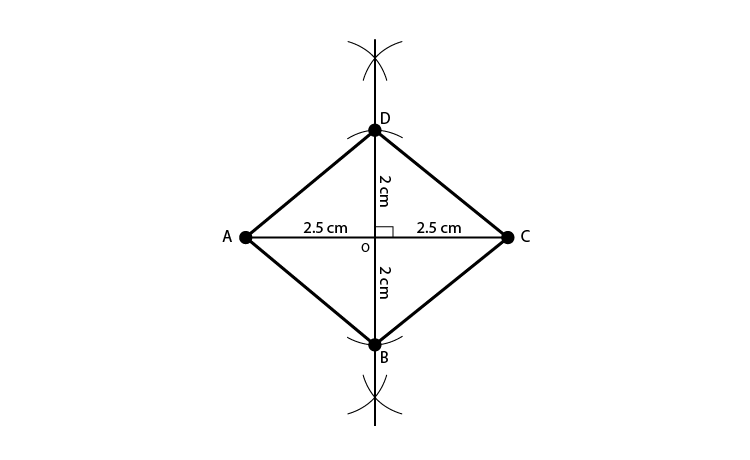
Complete Steps of Construction:
(i) Draw the longer diagonal
- Draw AC = 5 cm.
(ii) Draw the perpendicular bisector
- Draw the perpendicular bisector of AC.
- Let it intersect AC at O, the midpoint of AC.
(iii) Mark the endpoints of the shorter diagonal
- The shorter diagonal is 4 cm, so half of it is 2 cm.
- With O as centre and radius 2 cm, mark points B (below AC) and D (above AC) on the perpendicular bisector.
(iv) Join the vertices
- Join A–D, D–C, C–B, and B–A.
Quadrilateral ABCD is the required rhombus.
Figure it Out (Page 107)
1. Find all the sides and the angles of the quadrilateral obtained by joining two equilateral triangles with sides 4 cm.
Solution:
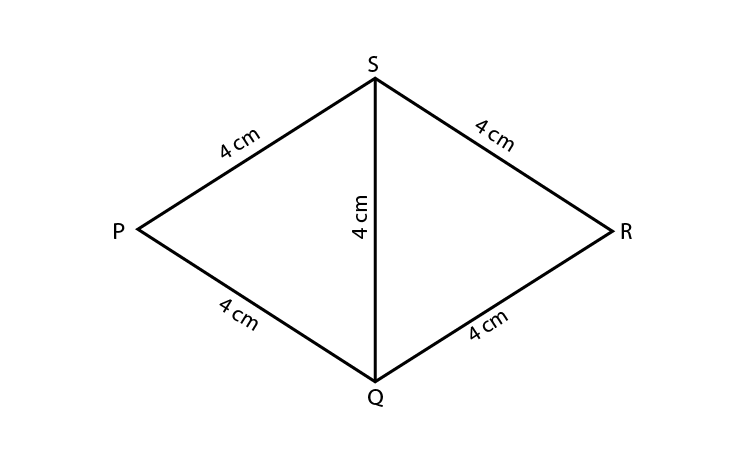
Step 1: Determine the sides
In an equilateral triangle, all sides are equal.
Therefore, when two triangles are joined, the quadrilateral formed has all sides equal
∴ Sides of the quadrilateral, PQ = QR = RS = SP = 4 cm.
Step 2: Determine the angles
Each angle of an equilateral triangle is 60°.
When two triangles are joined along a common side, the angles at the joined vertices add up.
- ∠P = ∠R = 60°, here angles at the non-shared vertices
- ∠S = ∠PSQ + ∠RSQ = 60° + 60° = 120°.
- ∠Q = ∠PQR + ∠RQS = 60° + 60° = 120°.
So here,
Sides: PQ = QR = RS = SP = 4 cm
Angles: ∠P = ∠R = 60°, ∠Q = ∠S = 120°
2. Construct a kite whose diagonals are of lengths 6 cm and 8 cm.
Solution:
We are given the lengths of the diagonals of a kite.
Recall that in a kite, one diagonal bisects the other at right angles. We use this property to construct the figure.
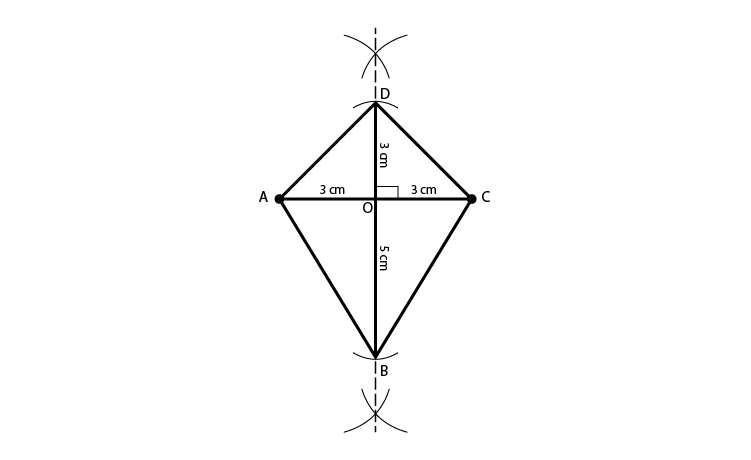
Step 1: Draw one diagonal
Draw a line segment AC = 6 cm.
This will act as one diagonal of the kite.
Step 2: Locate the midpoint
Construct the perpendicular bisector of AC.
Let it meet AC at point O.
So, O is the midpoint of AC.
Step 3: Draw the second diagonal
The other diagonal is 8 cm, so its half-lengths are 3 cm and 5 cm on either side of O.
With O as centre and radius 3 cm, draw an arc on the perpendicular bisector above AC and mark the point D.
With O as centre and radius 5 cm, draw another arc on the perpendicular bisector below AC and mark the point B.
Step 4: Join the vertices
Join the points in order:
A–B
B–C
C–D
D–A
ABCD is the required kite.
3. Find the remaining angles in the following trapeziums-
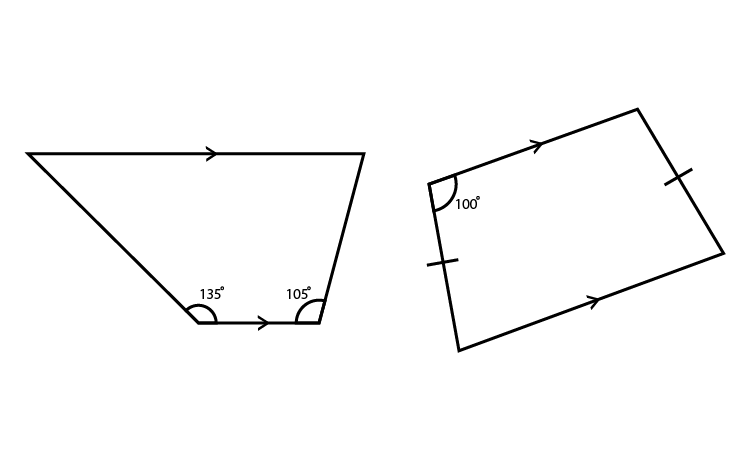
Solution:
(i) Trapezium ABCD
In this trapezium, AB ∥ DC.
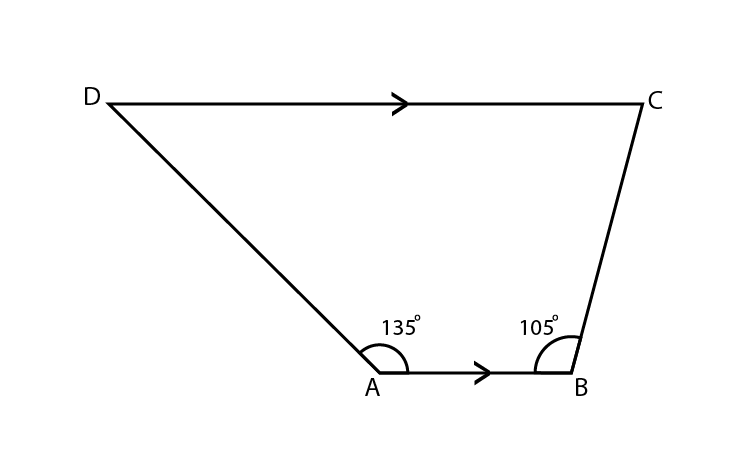
Step 1: Find ∠D
Line AD acts as a transversal to the parallel sides AB and DC.
Angles on the same side of a transversal between two parallel lines add up to 180°.
So,
∠A + ∠D = 180°
135° + ∠D = 180°
∠D = 180° – 135°
∠D = 45°
Also, since AB ∥ DC, and BC are a tranversal, then
∠B + ∠C = 180°
105° + ∠C = 180°
∠C = 180° – 105°
∠C = 75°
(ii) Trapezium PQRS
Here, PQ ∥ SR.
Step 1: Find ∠P
Line PS acts as a transversal. Angles on the same side of a transversal between parallel lines sum to 180°.
So,
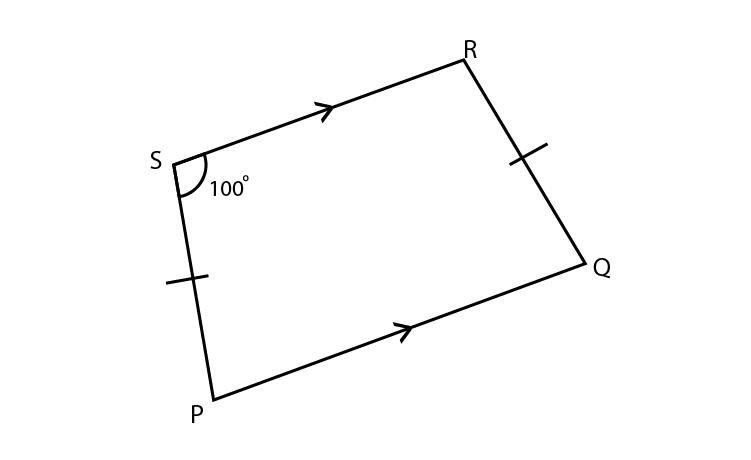
∠P + ∠S = 180° …………. (Sum of angles on the same side of the transversal)
∠P + 100° = 180°
∠P = 180° – 100° = 80°.
Step 2: Find ∠R
In this trapezium, the non-parallel sides are equal, so the angles opposite them are equal.
∠S = ∠R = 100°
Step 3: Find ∠Q
Line QR is a transversal to PQ ∥ SR.
Angles on the same side of the transversal add up to 180°.
∠Q + ∠R = 180° …………… (Sum of angles on the same side of the transversal)
∠Q + 100° = 180°
∠Q = 180° – 100° = 80°.
4. Draw a Venn diagram showing the set of parallelograms, kites, rhombuses, rectangles, and squares. Then, answer the following questions-
(i) What is the quadrilateral that is both a kite and a parallelogram?
(ii) Can there be a quadrilateral that is both a kite and a rectangle?
(iii) Is every kite a rhombus? If not, what is the correct relationship between these two types of quadrilaterals?
Solution:
(i) What is the quadrilateral that is both a kite and a parallelogram?
A rhombus is both a kite and a parallelogram.
The reason behind this is,
- A kite has two pairs of equal adjacent sides.
- A parallelogram has opposite sides equal and parallel.
- A rhombus satisfies both conditions: all four sides are equal, making it a kite, and its opposite sides are parallel, making it a parallelogram.
(ii) Can there be a quadrilateral that is both a kite and a rectangle?
Yes, a square is both a kite and a rectangle.
Reason:
- A rectangle has opposite sides equal and all angles equal to 90°.
- A kite has two pairs of equal adjacent sides.
- A square has all sides equal and all angles 90°, so it satisfies the properties of both a kite and a rectangle.
(iii) Is every kite a rhombus? If not, what is the correct relationship?
No, every kite is not a rhombus.
Because,
- Every rhombus is a kite, because it has two pairs of equal adjacent sides.
- But not every kite is a rhombus, because a kite does not necessarily have all four sides equal or opposite sides parallel.
(ii) A square is a quadrilateral that is both a kite and a rectangle.
(iii) No, every kite is not a rhombus.
Correct relationship: Every rhombus is a kite, but not every kite is a rhombus.
5. If PAIR and RODS are two rectangles, find ∠IOD.
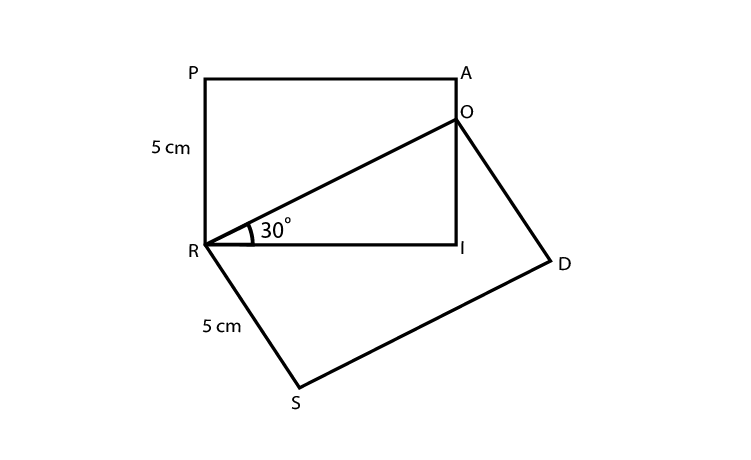
Solution:
Since PAIR and RODS are rectangles, all their interior angles are right angles.
Step 1: Identify right angles
In rectangle PAIR, angle at I is a right angle.
∠RIO = 90° ……… (Corner angle of a rectangle)
Step 2: Use the triangle angle sum property
Consider ∆RIO.
By the sum of angles of a triangle,
∠IRO + ∠IOR + ∠RIO = 180°
Substitute the given values:
30° + ∠IOR + 90° = 180°
120° + ∠IOR = 180°
∠IOR = 180° – 120° = 60°.
Step 3: Find ∠IOD
Since RODS is also a rectangle, the angle at O is a right angle:
Angle ∠IOD is a part of this right angle:
∴ ∠IOD = 90° – ∠IOR = 90° – 60° = 30°.
6. Construct a square with a diagonal of 6 cm without using a protractor.
Solution:
To construct a square when the diagonal is given, we use the fact that:
- The diagonals of a square are equal, bisect each other, and intersect at right angles.
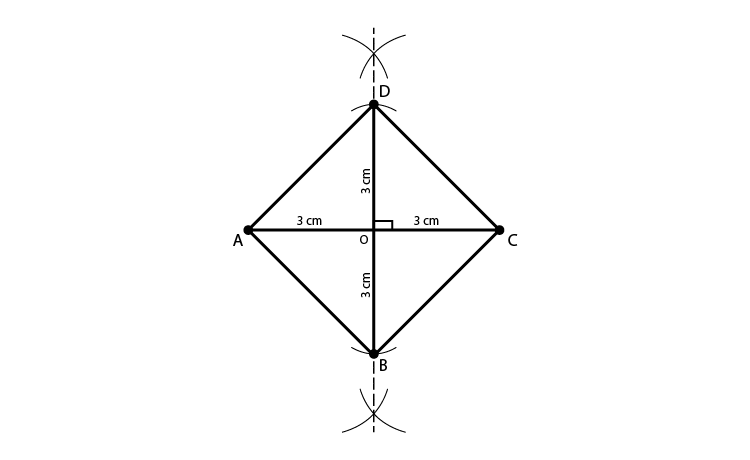
Step 1: Draw the diagonal
Draw a line segment AC = 6 cm.
Mark the midpoint O using a compass.
Step 2: Draw the perpendicular bisector
With O as centre and a radius more than half of AC, draw arcs above and below the line segment AC from points A and C.
Let the arcs intersect at two points.
Step 3: Draw a perpendicular line
Join the points of intersection of the arcs.
This line is the perpendicular bisector of AC and passes through O.
Step 4: Locate the other two vertices
With O as centre and radius = 3 cm (half of the diagonal), mark points B and D on the perpendicular line on opposite sides of O.
Step 5: Join the vertices
Join the points in order:
Connect A–B–C–D–A.
Hence, ABCD is the required square with a diagonal of 6 cm.
7. CASE is a square. The points U, V, W, and X are the midpoints of the sides of the square. What type of quadrilateral is UVWX? Find this by using geometric reasoning, as well as by construction and measurement. Find other ways of constructing a square within a square such that the vertices of the inner square lie on the sides of the outer square, as shown in Figure (b)
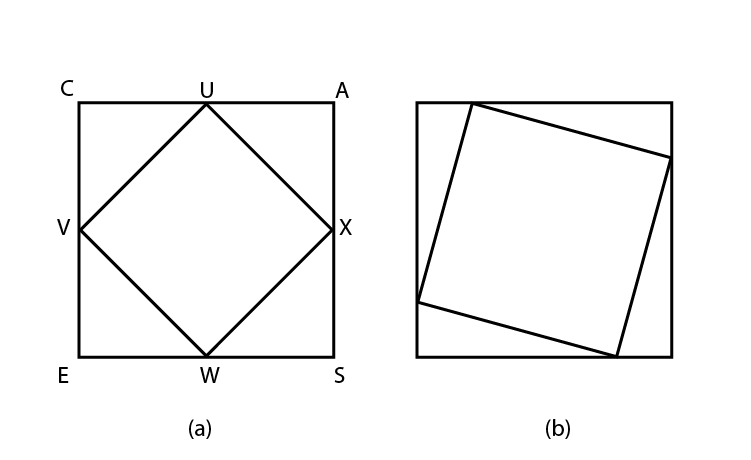
Solution:
(a) Nature of quadrilateral UVWX
Here, CASE is a square. And U, V, W, X are the midpoints of the sides of the square CASE.
Step 1: Equality of sides of UVWX
Consider triangles ∆VCU and ∆UAX.
Here, we have:
- VC=UAVC = UAVC=UA (midpoints of equal sides of a square)
- CU=AXCU = AXCU=AX (sides of the same square)
- (angles of a square)
∴ By the SAS congruence rule, ∆VCU ≅ ∆UAX.
∴ VU = UX.
Similarly, by considering other pairs of triangles, we can show
VU = XW and VU = WV.
Hence, all sides of the quadrilateral UVWX are equal.
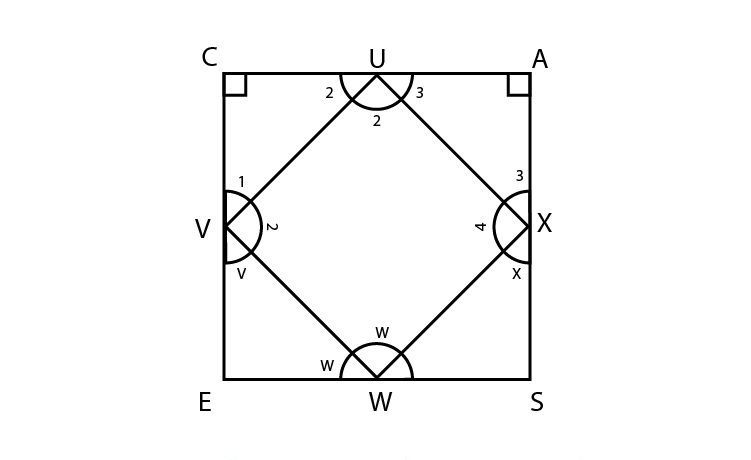
Step 2: Measurement of angles
In ∆VCU, VC = CU
⇒ ∠1 = ∠2
Using the angle sum of a triangle, we get
∠1 + ∠C + ∠2 = 180°
⇒ ∠1 + 90° + ∠1 = 180°
⇒ 2∠1 = 90° ⇒ ∠1 = 45°
Therefore, each acute angle formed at the midpoints is 45°.
Similarly, ∠3 = ∠4 = 45°.
Now, ∠2 + ∠VUX + ∠3 = 180°
⇒ 45° + ∠VUX + 45° = 180°
⇒ ∠VUX = 180° – 90°
⇒ ∠VUX = 90°
In the same way, ∠VXW = 90°, ∠XWV = 90°, and ∠WVU = 90°.
From this, it can be concluded that Quadrilateral UVWX has all sides equal and all interior angles are equal to 90°.
Therefore, UVWX is a square.
(b) Other ways of constructing a square inside a square
Let ABCD be a square. Take points P, Q, R, and S such that
AS = BP = CQ = DR.
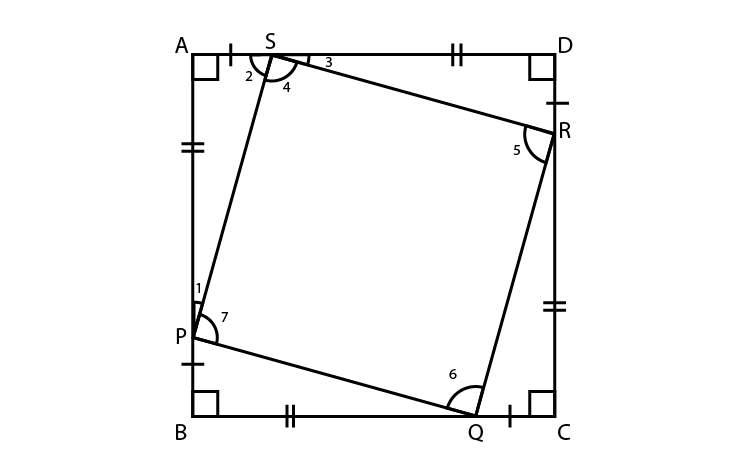
Step 1: Equality of sides
Since all the sides of the squares are equal, we have
DS = AP = BQ = CR.
In ΔPAS and ΔSDR,
PA = SD,
∠PAS = ∠SDR = 90°, and
AS = DR.
∴ By the SAS congruence criterion,
ΔPAS ≅ ΔSDR.
Hence, PS = SR. Similarly, PS = RQ and PS = QP,
So all sides of the quadrilateral PQRS are equal.
Step 2: Angles of PQRS
In ΔPAS, ∠1 + ∠2 + 90° = 180°
⇒ ∠1 + ∠2 = 90°
Using triangle relations and linear pairs, we get
⇒ ∠3 + ∠2 = 90° (since ∠1 = ∠3).
Also, ∠2 + ∠4 + ∠3 = 180°
⇒ 90° + ∠4 = 180°
⇒ ∠4 = 90°.
Similarly,
∠5 = 90°, ∠6 = 90°, and ∠7 = 90°.
From this, it can be concluded that quadrilateral PQRS has all sides equal, and all interior angles are equal to 90°
8. If a quadrilateral has four equal sides and one angle of 90°, will it be a square? Find the answer using geometric reasoning as well as by construction and measurement.
Solution:
(a) Geometric Reasoning:
A quadrilateral with four equal sides is called a rhombus.
Now, suppose a rhombus has one interior angle of 90°.
In a rhombus, opposite angles are equal.
Hence, if one angle is 90°, the opposite angle is also 90°.
The sum of adjacent angles in a rhombus (or parallelogram) is 180°.
Therefore, each angle adjacent to the 90° angle must also be:
Thus, all four angles are 90°.
Since the quadrilateral has all four sides equal, and all four angles equal to 90°
A rhombus is a quadrilateral with four equal sides.
(b) Construction and Measurement:
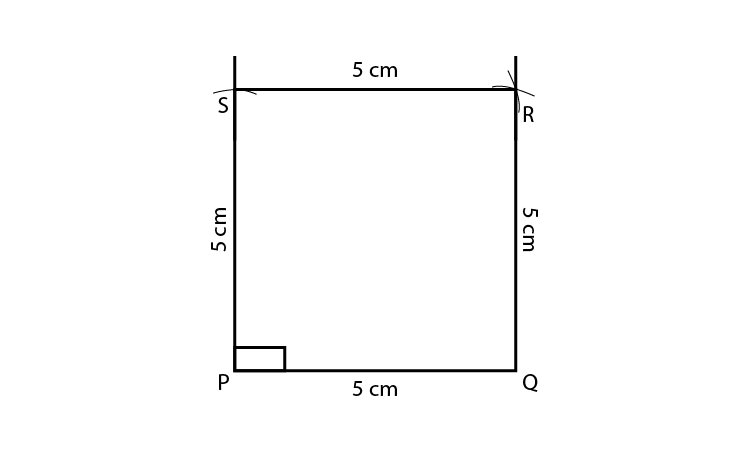
Complete Steps of Construction:
- Draw a line segment PQ = 5 cm.
- At point P, construct a perpendicular to the line segment PQ.
- On this perpendicular, mark a point S such that PS = 5 cm.
- With S as centre and radius 5 cm, draw an arc to the right of PS.
- With Q as centre and radius 5 cm, draw an arc above PQ to intersect the previous arc at R.
- Join Q–R, R–S, and S–P.
The quadrilateral PQRS is formed.
(c) Verification by measurement
All sides: PQ = QR = RS = SP = 5 cm
All angles: ∠P =∠Q =∠R =∠S = 90°.
So here, the constructed quadrilateral has four equal sides and four right angles
9. What type of quadrilateral is one in which the opposite sides are equal? Justify your answer.
Hint: Draw a diagonal and check for congruent triangles.
Solution:
A quadrilateral in which both pairs of opposite sides are equal is a parallelogram.
Geometric reasoning using a diagonal,
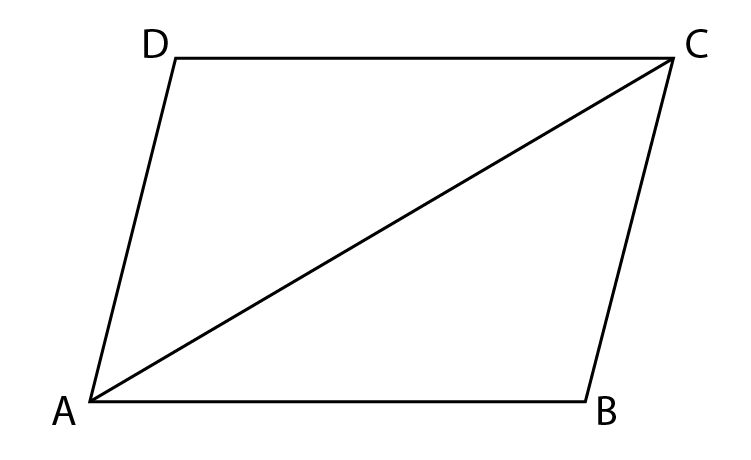
Let ABCD be a quadrilateral such that AB = CD and BC = DA.
Draw diagonal AC.
Step 1: Consider the two triangles formed
In △ABC and △CDA,
AB = CD (given)
BC = DA (given)
AC = AC (common side)
Step 2: Apply the congruence rule
By congruence, △ABC ≅ △CDA.
Step 3: Use corresponding parts of congruent triangles
From congruence, corresponding angles are equal:
∠BAC =∠DCA and ∠ACB =∠CAD.
But these are alternate interior angles.
Step 4: Conclusion
∴ AB ∥ DC, and AD ∥ BC.
Hence, both pairs of opposite sides are parallel. Hence, ABCD is a parallelogram.
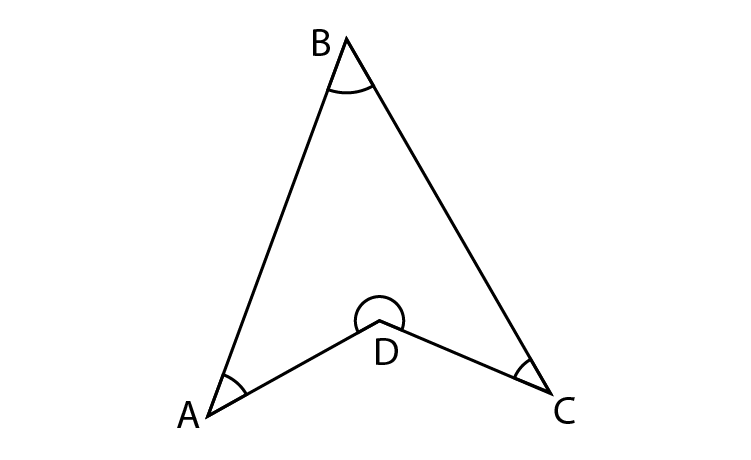
10. Will the sum of the angles in a quadrilateral such as the following one also be 360°? Find the answer using geometric reasoning as well as by constructing this figure and measuring.
Solution:
Yes, the sum of the angles in a quadrilateral will always be 360°.
(a) Construction and Measurement
- Mark four non-collinear points and name them A, B, C, and D.
- Join the points in order to form a quadrilateral ABCD.
- Measure each interior angle using a protractor.
- Add the measures of all four angles.
You will observe that the sum of the four interior angles is 360°
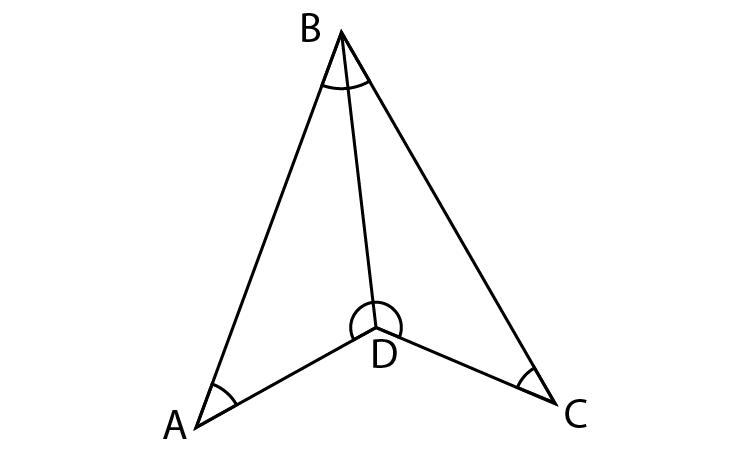
(b) Geometric Reasoning:
Draw diagonal BD, which divides the quadrilateral into two triangles:
- ∆BAD
- ∆BCD
Now, in △BAD,
By applying the triangle angle sum property
∠DBA + ∠BAD + ∠ADB = 180° ……….(1)
In △BCD,
∠BCD + ∠CDB + ∠DBC = 180° ……….(2)……. (Sum of angles of a triangle)
Adding (1) and (2), we get
∠DBA + ∠BAD + ∠ADB + ∠BCD + ∠CDB + ∠DBC = 180° + 180°
After rearranging the terms, we get
(∠DBA + ∠DBC) + (∠ADB + ∠CDB) + ∠BAD + ∠BCD = 360°
∠ABC + ∠ADC + ∠BAD + ∠BCD = 360°
Thus, the sum of the angles of the given quadrilateral is 360°.
This is true for all types of quadrilaterals, whether regular or irregular.
11. State whether the following statements are true or false. Justify your answers.
(i) A quadrilateral whose diagonals are equal and bisect each other must be a square.
Solution:
Answer: False.
Explanation: If the diagonals of a quadrilateral are equal and bisect each other, the quadrilateral is a rectangle. A square is a special rectangle in which all sides are equal, which is not given here.
Hence, the R every such quadrilateral is not necessarily a square.
(ii) A quadrilateral having three right angles must be a rectangle.
Solution:
Answer: True.
Explanation: The sum of the interior angles of a quadrilateral is 360°.
If three angles are 90° each, their sum is 270°.
So, the fourth angle is:
Thus, all four angles are right angles, and the quadrilateral is a rectangle.
(iii) A quadrilateral whose diagonals bisect each other must be a parallelogram.
Solution:
Answer: True.
Explanation: If the diagonals of a quadrilateral bisect each other, the triangles formed are congruent. This gives both pairs of opposite sides parallel. Hence, the quadrilateral is a parallelogram.
(iv) A quadrilateral whose diagonals are perpendicular to each other must be a rhombus.
Solution:
Answer: False.
Explanation: Diagonals being perpendicular is not a property unique to a rhombus.
Other quadrilaterals, like kites and squares, also have perpendicular diagonals.
Therefore, the quadrilateral need not be a rhombus.
(v) A quadrilateral in which the opposite angles are equal must be a parallelogram.
Solution:
Answer: True.
Explanation: If both pairs of opposite angles are equal, then each pair of adjacent angles is supplementary. This implies both pairs of opposite sides are parallel.
Hence, the quadrilateral is a parallelogram.
(vi) A quadrilateral in which all the angles are equal is a rectangle.
Solution:
Answer: True
Explanation: The sum of the interior angles of a quadrilateral is 360°. If all four angles are equal, then each angle is:
360°/4 = 90°.
A quadrilateral with four right angles is a rectangle.
(vii) Isosceles trapeziums are parallelograms.
Solution:
Answer: False.
Explanation: An isosceles trapezium has exactly one pair of parallel sides and the non-parallel sides are equal, while a parallelogram must have two pairs of parallel sides. So an isosceles trapezium is not a parallelogram.
Through this chapter on Quadrilaterals, students learn how different four-sided figures are formed and how their properties help in identifying and comparing them. The step-by-step solutions, diagrams, and reasoning methods help strengthen logical thinking and improve problem-solving skills. These NCERT Solutions for Class 8 Maths Ganita Prakash Chapter 4 make learning geometry simple, structured, and enjoyable, helping students build a strong foundation for advanced mathematical concepts.
Frequently Asked Questions (FAQs)
Q1. What is a quadrilateral?
A quadrilateral is a closed plane figure formed by four line segments, having four sides, four vertices, and four angles.
Q2. What is a quadrilateral with 4 sides?
Any polygon that has four sides is called a quadrilateral. Examples include square, rectangle, parallelogram, rhombus, trapezium, and kite.
Q3. What are the basic properties of quadrilaterals?
The properties of quadrilateralsinclude: A quadrilateral has four sides, four angles, and four vertices, and the sum of its interior angles is 360°.
Q4. What is a parallelogram?
A parallelogram is a four-sided figure with opposite sides parallel, opposite angles equal, and diagonals that bisect each other.
Q5. Is every rhombus a kite?
Yes, every rhombus is a kite because it has two pairs of equal adjacent sides, but every kite is not a rhombus.
Q6. What has two pairs of parallel sides?
A parallelogram has two pairs of parallel sides; examples include a rectangle, a rhombus, and a square.
Frequently Asked Questions on NCERT Solutions Class 8 Maths Chapter 4 Quadrilaterals
1. What is a quadrilateral?
A quadrilateral is a closed plane figure formed by four line segments, having four sides, four vertices, and four angles.
2. What is a quadrilateral with 4 sides?
Any polygon that has four sides is called a quadrilateral. Examples include square, rectangle, parallelogram, rhombus, trapezium, and kite.
3. What are the basic properties of quadrilaterals?
The properties of quadrilateralsinclude: A quadrilateral has four sides, four angles, and four vertices, and the sum of its interior angles is 360°.
4. What is a parallelogram?
A parallelogram is a four-sided figure with opposite sides parallel, opposite angles equal, and diagonals that bisect each other.
5. Is every rhombus a kite?
Yes, every rhombus is a kite because it has two pairs of equal adjacent sides, but every kite is not a rhombus.
6. What has two pairs of parallel sides?
A parallelogram has two pairs of parallel sides; examples include a rectangle, a rhombus, and a square.
Admissions Open for 2026-27
What type of concept pages would you prefer?
CBSE Schools In Popular Cities
- CBSE Schools in Bangalore
- CBSE Schools in Mumbai
- CBSE Schools in Pune
- CBSE Schools in Hyderabad
- CBSE Schools in Chennai
- CBSE Schools in Gurgaon
- CBSE Schools in Kolkata
- CBSE Schools in Indore
- CBSE Schools in Sonipat
- CBSE Schools in Delhi
- CBSE Schools in Rohtak
- CBSE Schools in Bhopal
- CBSE Schools in Aurangabad
- CBSE Schools in Jabalpur
- CBSE Schools in Jaipur
- CBSE Schools in Jodhpur
- CBSE Schools in Nagpur
- CBSE Schools in Ahmednagar
- CBSE School In Tumkur











Orchids The International School is one of India's leading chains of CBSE and ICSE schools, with 110+ schools across the country.