

NCERT Solutions Class 8 Maths Chapter 5 Number Play
Refer to NCERT Solutions Class 8 Maths Chapter 5 Number Play to build a clear and engaging understanding of numbers through activities that involve patterns, reasoning, and logical thinking. This chapter encourages students to think beyond routine methods and understand the ideas behind numerical operations. Solving the practice questions regularly helps improve exam readiness and problem-solving confidence. The solutions are presented in a structured and easy-to-follow format for better comprehension.
This chapter explains how numbers interact through simple rules and observations, helping students analyse situations and reach correct conclusions. Learners develop the ability to recognise patterns, apply logical steps, and explain their reasoning clearly. These skills are essential for tackling more advanced mathematical concepts in higher classes.
Topics Covered:
- Exploring numerical patterns
- Fun activities and number-based puzzles
- Logical reasoning with numbers
- Step-by-step number tricks
- Understanding relationships between numbers
By using NCERT Solutions Class 8 Maths Chapter 5 Number Play, students can practise all textbook problems with clarity and guidance. Each answer is explained in a straightforward manner, supporting better understanding, improved accuracy, and increased confidence in mathematics.
Find Complete NCERT Solutions Class 8 Maths Chapter 5 Number Play
5.1 Is This a Multiple Of?
Sum of Consecutive Numbers
NCERT In-Text Questions (Pages 112-115)
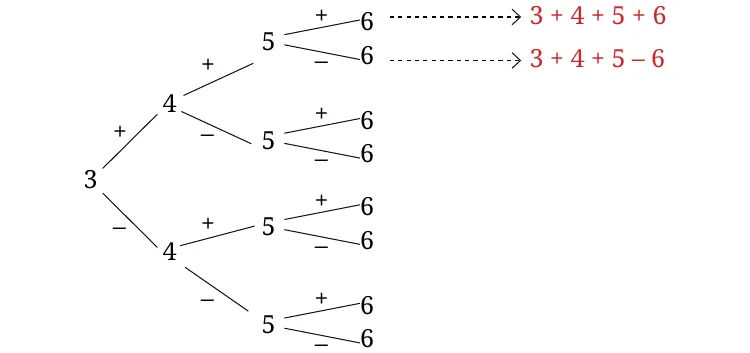
2. Take any 4 consecutive numbers. For example, 3, 4, 5, and 6. Place ‘+’ and ‘-’ signs in between the numbers. How many different possibilities exist? Write all of them.
Solution:
We have the numbers:
3,4,5,6
There are three gaps where we can put either a ‘+’ or a ‘-’ sign:
- between 3 and 4
- between 4 and 5
- between 5 and 6
Since each gap has 2 choices (plus or minus), the total number of expressions is:
2 × 2 × 2 = 8
This means 8 different expressions are possible.
To ensure we list all possibilities, it is helpful to think systematically:
- Start by choosing the sign between the first two numbers (3 and 4). It can be + or -.
- For each choice, decide the sign between the next two numbers (4 and 5). Again, + or -.
- Finally, choose the sign between the last two numbers (5 and 6).
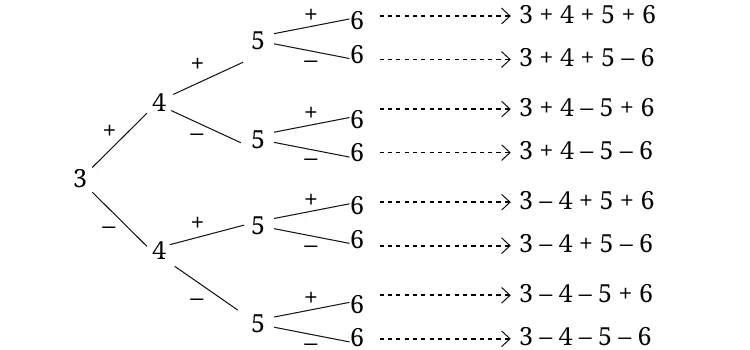
Following this method, we get all 8 expressions:
- 3 + 4 + 5 + 6
- 3 + 4 + 5 - 6
- 3 + 4 - 5 + 6
- 3 + 4 - 5 - 6
- 3 - 4 + 5 + 6
- 3 - 4 + 5 - 6
- 3 - 4 - 5 + 6
- 3 - 4 - 5 - 6
So, the key idea is:
- With n numbers, there are n-1 gaps, each with 2 choices.
- So the total number of expressions = 2(n-1).
- A systematic listing prevents missing any combination.
3. Evaluate each expression and write the result next to it. Do you notice anything interesting?
Solution:
Observation:
All the results obtained are even numbers.
Explanation:
This happens because:
- The numbers 3, 4, 5, and 6 are consecutive integers.
- When we add or subtract consecutive numbers in any combination, the sum always ends up being even.
- This is due to the way even and odd numbers interact:
- Odd ± Odd = Even
- Even ± Even = Even
- Odd ± Even = Odd
- In this case, the combination of all operations always results in an even number, which shows a consistent pattern in arithmetic with consecutive numbers.
By observing and calculating carefully, we can see that no matter how we arrange plus or minus signs among these consecutive numbers, the final result will always be an even number. This is a simple yet interesting property of numbers.
|
Expression |
Calculation |
Result |
|---|---|---|
|
1. 3 + 4 + 5 + 6 |
3 + 4 = 7 → 7 + 5 = 12 → 12 + 6 = 18 |
18 |
|
2. 3 + 4 + 5 – 6 |
3 + 4 = 7 → 7 + 5 = 12 → 12 – 6 = 6 |
6 |
|
3. 3 + 4 – 5 + 6 |
3 + 4 = 7 → 7 – 5 = 2 → 2 + 6 = 8 |
8 |
|
4. 3 + 4 – 5 – 6 |
3 + 4 = 7 → 7 – 5 = 2 → 2 – 6 = -4 |
-4 |
|
5. 3 – 4 + 5 + 6 |
3 – 4 = -1 → -1 + 5 = 4 → 4 + 6 = 10 |
10 |
|
6. 3 – 4 + 5 – 6 |
3 – 4 = -1 → -1 + 5 = 4 → 4 – 6 = -2 |
-2 |
|
7. 3 – 4 – 5 + 6 |
3 – 4 = -1 → -1 – 5 = -6 → -6 + 6 = 0 |
0 |
|
8. 3 – 4 – 5 – 6 |
3 – 4 = -1 → -1 – 5 = -6 → -6 – 6 = -12 |
-12 |
4. Now, take four other consecutive numbers. Place the ‘+’ and ‘-’ signs as you have done before. Find out the results of each expression. What do you observe?
Solution:
Consider any four consecutive numbers. Such numbers always follow a fixed pattern of odd and even numbers. That is, among four consecutive numbers, two are even and two are odd.
Let us now place plus (+) and minus (−) signs between these numbers in all possible ways. Doing this means we are only adding or subtracting the given numbers; their order and values remain unchanged.
When we combine the numbers, the following facts are important:
- Adding or subtracting two even numbers always gives an even result.
- Similarly, adding or subtracting two odd numbers also results in an even number.
As a result, in every expression formed, the two even numbers together produce an even value, and the two odd numbers together also produce an even value.
Finally, when these two even results are added to or subtracted from each other, the answer remains even.
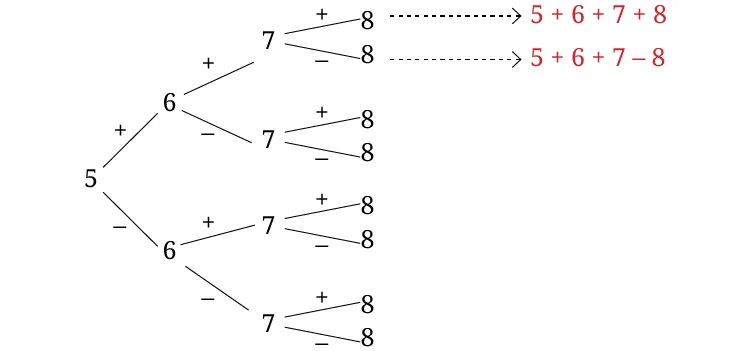
This reasoning explains why, in the given example using 5, 6, 7, and 8, all the obtained results, such as 26, 10, 12, −4, 14, −2, 0, and −16 are even numbers.
Thus, regardless of the starting number, all possible combinations of four consecutive numbers using plus and minus signs always yield even results. The observed pattern occurs because of the fixed odd–even nature of consecutive numbers and the properties of addition and subtraction.
5. Repeat this for one more set of 4 consecutive numbers. Share your findings.

Solution:
Let us take four consecutive numbers such as 12, 13, 14, and 15.
When we place ‘+’ or ‘–’ signs between these numbers in all possible ways, we get different results. However, one thing remains the same, every result is an even number.
This happens because in any group of four consecutive numbers, there are always two even numbers and two odd numbers. Changing a plus sign to a minus sign only changes whether a number is added or subtracted; it does not change the nature of the number (even or odd).
For example:
(i) 12 + 13 + 14 + 15 = 54
(ii) 12 + 13 + 14 − 15 = 24
(iii) 12 + 13 − 14 + 15 = 26
(iv) 12 + 13 − 14 − 15 = −4
(v) 12 − 13 + 14 + 15 = 28
(vi) 12 − 13 + 14 − 15 = −2
(vii) 12 − 13 − 14 + 15 = 0
(viii) 12 − 13 − 14 − 15 = −30
When the two even numbers are combined, the result is always even. Similarly, when the two odd numbers are combined, the result is also even. Finally, combining these two even results again gives an even number.
So, even though the signs change and the final values look different, the even–odd balance of the numbers stays the same, which is why all the results turn out to be even.
6. Replace any negative sign in the expression a + b – c – d with a positive sign and find the difference between the two numbers.
Solution:
Consider the given expression:
a + b − c − d
Let us replace one of the negative terms with a positive term.
Replacing −c by +c, the new expression becomes:
a + b + c − d
Step 1: Find the difference between the two expressions
Difference = (a + b − c − d) − (a + b + c − d)
Now simplify:
= a + b - c - d - a - b - c + d = −2c
Step 2: Interpret the result
The difference obtained is −2c.
Since 2c is always divisible by 2, the difference is an even number, regardless of the value of c.
When a negative sign in the expression a + b − c − d is replaced by a positive sign, the value of the expression changes by an even number.
Therefore, the difference between the two expressions is even. Hence, both expressions are either even or odd.
Breaking Even | NCERT In-Text Questions (Pages 115-116)
1. We know how to identify even numbers. Without computing them, find out which of the following arithmetic expressions are even.

Solution:
We know how to identify even numbers. Without performing full calculations, determine which of the following arithmetic expressions are even or odd.
Important Rules to Remember:
- Even numbers: divisible by 2 (e.g., 2, 4, 6…).
- Odd numbers: not divisible by 2 (e.g., 1, 3, 5…).
Basic operations with even and odd numbers:
|
Operation |
Result |
Explanation |
|---|---|---|
|
Even + Even |
Even |
Adding two numbers divisible by 2 gives a number divisible by 2. |
|
Odd + Odd |
Even |
Adding two numbers not divisible by 2 always gives an even number. |
|
Even + Odd |
Odd |
Adding one divisible by 2 and one not divisible by 2 gives an odd number. |
|
Even – Even |
Even |
Subtracting two even numbers keeps it divisible by 2. |
|
Odd – Odd |
Even |
Subtracting two odd numbers gives an even number. |
|
Even – Odd |
Odd |
Subtracting an odd number from an even number gives an odd number. |
|
Even × Any number |
Even |
Multiplying any number with an even number makes the product even. |
|
Odd × Odd |
Odd |
Only multiplying two odd numbers gives an odd product. |
Step-by-Step Solution:
1. 43 + 37
-
- 43 is odd, 37 is odd.
- Rule: Odd + Odd = Even
- Reasoning: When two numbers that leave a remainder of 1 when divided by 2 are added, the sum is divisible by 2.
- Answer: Even
2. 672 – 348
-
- 672 is even, and 348 is even.
- Rule: Even – Even = Even
- Reasoning: Subtracting one multiple of 2 from another multiple of 2 still leaves a multiple of 2.
- Answer: Even
3. 4 × 347 ×
-
- 4 is even; 347 and 3 are odd.
- Rule: Even × Any = Even
- Reasoning: Multiplying by an even number always results in a number divisible by 2, regardless of the other numbers.
- Answer: Even
4. 708 – 477
-
- 708 is even, 477 is odd.
- Rule: Even – Odd = Odd0
- Reasoning: Removing an odd amount from an even number leaves a number that is not divisible by 2.
- Answer: Odd
5. 809 + 214
-
- 809 is odd, 214 is even.
- Rule: Odd + Even = Odd
- Reasoning: Adding a number divisible by 2 to one that is not divisible by 2 leaves a number not divisible by 2.
- Answer: Odd
6. 119 × 303
-
- Both numbers are odd.
- Rule: Odd × Odd = Odd
- Reasoning: Multiplying numbers that are not divisible by 2 cannot create a number divisible by 2.
- Answer: Odd
7. 543 – 479
-
- Both numbers are odd.
- Rule: Odd – Odd = Even
- Reasoning: Removing one odd number from another odd number always leaves a multiple of 2.
- Answer: Even
8. 5133
-
- Single number check: 5133 ends with 3, so it’s odd.
- Answer: Odd
2. Using our understanding of how parity behaves under different operations, identify which of the following algebraic expressions give an even number for any integer values for the letter-numbers.

Solution:
To decide whether an algebraic expression is always even, we rely on the idea of parity, that is, whether numbers are even or odd. An expression is called always even only if for every possible integer value of its variables, the result remains even and never becomes odd.
A key observation helps us throughout this problem:
Any term that contains a factor of 2 is even, and adding or subtracting even numbers keeps the result even.
Keeping this in mind, we analyse each expression one by one.
(a) 2a + 2b
Both terms, 2a and 2b, clearly contain the factor 2. Hence, each term is even regardless of the values of a and b.
Since the sum of two even numbers is always even, the expression 2a + 2b must also be even for all integers.
Therefore, 2a + 2b is always even.
(b) 3g + 5h
Unlike the previous expression, neither term here contains a factor of 2. The numbers 3 and 5 are odd, so the parity of 3g depends entirely on g, and the parity of 5h depends on h.
If both g and h are odd or both are even, the sum turns out to be even. However, if one is odd and the other is even, the sum becomes odd. Since the result changes depending on the values chosen, the expression does not remain even in all cases.
Thus, 3g + 5h is not always even.
(c) 4m + 2n
Here, both terms contain a factor of 2. The term 4m4m4m is even, and 2n is also even for all integers. When two even numbers are added, the result is always even.
Hence, 4m + 2n is always even.
(d) 2u − 4v
Just as in the previous case, both 2u and 4v are even. Subtracting one even number from another does not change parity; the result remains even.
Therefore, 2u − 4v is always even.
(e) 13k − 5k
Before analysing parity, it helps to simplify the expression:
13k − 5k = 8k
The simplified form 8k clearly contains a factor of 2, making it even for all integer values of k.
So, 13k − 5k is always even.
(f) 6m − 3n
The term 6m is always even because it contains a factor of 2. However, 3n may be even or odd depending on whether nnn is even or odd.
If 3n is odd, then subtracting it from an even number produces an odd result. Since this can happen for certain integer values, the expression does not consistently remain even.
Thus, 6m − 3n is not always even.
(g) x² + 2
The square of an integer has the same parity as the integer itself: even numbers square to even, and odd numbers square to odd. Adding 2 (an even number) does not change parity.
As a result, when x is even, the expression is even, but when x is odd, the expression becomes odd. Because both outcomes are possible, the expression is not guaranteed to be even.
Hence, x² + 2 is not always even.
(h) b2 + 1
Again, the parity of b2 depends on whether b is even or odd. Adding 1 flips the parity: even becomes odd, and odd becomes even.
Since the result changes with different values of b, the expression does not remain even in all cases.
Therefore, b2 + 1 is not always even.
(i) 4k × 3j
Rewriting the product gives:
4k × 3j = 12kj
The coefficient 12 is even, and any product containing an even factor is always even, regardless of the remaining variables.
Thus, 4k × 3j is always even.
Expressions that always remain even:
2a + 2b, 4m + 2n, 2u − 4v, 13k − 5k, 4k × 3j
Expressions that do not remain even for all integers:
3g + 5h, 6m − 3n, x2 + 2, b2 + 1
3. Similarly, determine and explain which of the other expressions always give even numbers. Write a couple of examples and non-examples, as appropriate, for each expression.
Solution:
We are required to find which of the given algebraic expressions always result in an even number, regardless of the values of the variables. To do this, we use the basic property that any number divisible by 2 is even.
Expression 1: 2u − 4v
The term 2u is always even because it is obtained by multiplying an integer u by 2. Similarly, 4v is also always even since it is a multiple of 2 for any integer v.
Now, the difference of two even numbers is always even. Therefore,
2u − 4v will always be even.
This can be further understood by factorising the expression:
2u − 4v = 2(u − 2v)
Here, 2 is a common factor of the entire expression. Since the expression is a multiple of 2, it must be even for all integer values of uuu and v.
Examples:
- If u = 4 and v = 1
2u − 4v = 8 − 4 = 4 (even)
- If u = 3 and v = 5
2u − 4v = 6 − 20 = −14 (even)
The expression 2u − 4v always gives an even number.
Expression 2: b² + 3
The value of b2 depends on whether bbb is even or odd:
- If b is even, then b² is even.
- If b is odd, then b² is odd.
Now, we add 3, which is an odd number:
- Even + odd = odd
- Odd + odd = even
Since the result changes depending on the value of b, the expression does not always produce an even number.
Example (even result):
- If b = 7
b + 3 = 49 + 3 = 52 (even)
Non-example (odd result):
- If b = 6:
b² + 3 = 36 + 3 = 39 (odd)
And the final answer is:
- The expression 2u − 4v always results in an even number.
- The expression b2 + 3 does not always result in an even number, as it can be either even or odd.
4. Write a few algebraic expressions that always give an even number.
Solution:
A number is called even if it is divisible by 2. Therefore, any algebraic expression that has 2 or a multiple of 2 as a factor will always give an even number, regardless of the values of the variables.
Some such algebraic expressions are:
- 2x + 2y
Each term is divisible by 2, so their sum is always even.
- 6x − 4m
Both 6 and 4 are even numbers. The difference of two even numbers is always even.
- 8pq
Since 8 is an even number, the product will always be even for all values of p and q.
Hence, algebraic expressions containing only even coefficients always result in even numbers.
Pairs to Make Fours | NCERT In-Text Questions (Pages 116-117)
1. When will two even numbers add up to give a multiple of 4?
Solution:
Every even number, when divided by 4, leaves either no remainder or a remainder of 2.
So, any even number must be of one of these two types:
- Type 1: Even numbers divisible by 4 → remainder 0 (examples: 4, 8, 12, 16)
- Type 2: Even numbers not divisible by 4 → remainder 2 (examples: 2, 6, 10, 14)
Now, let us see what happens when we add these numbers:
Adding two even numbers
Case 1: Both leave a remainder of 0 when divided by 4
That means both are multiples of 4.
- Remainder: 0 + 0 = 0
- So, the sum is divisible by 4.
Example: 8 + 12 = 20 → divisible by 4
Case 2: Both leave a remainder of 2 when divided by 4
That means both are even but not multiples of 4.
- Remainder: 2 + 2 = 4
Since 4 is divisible by 4, the sum is also divisible by 4.
Example: 6 + 10 = 16 → divisible by 4
Case 3: One leaves a remainder of 0, and the other leaves a remainder of 2.
That means one is a multiple of 4 and the other is not.
- Remainder: 0+2=2
- The sum is not divisible by 4.
Example: 8 + 6 = 14 → not divisible by 4
Two even numbers will add up to a multiple of 4 only when they are of the same type:
- Both divisible by 4, or
- Both not divisible by 4
If they are of different types, their sum will not be a multiple of 4.
2. What happens when we add a multiple of 4 to an even number that is not a multiple of 4? Is it similar to the case of the parity of the sum of an even and an odd number?
Solution:
When we add a multiple of 4 to an even number that is not a multiple of 4, the result is still an even number, but not a multiple of
4.
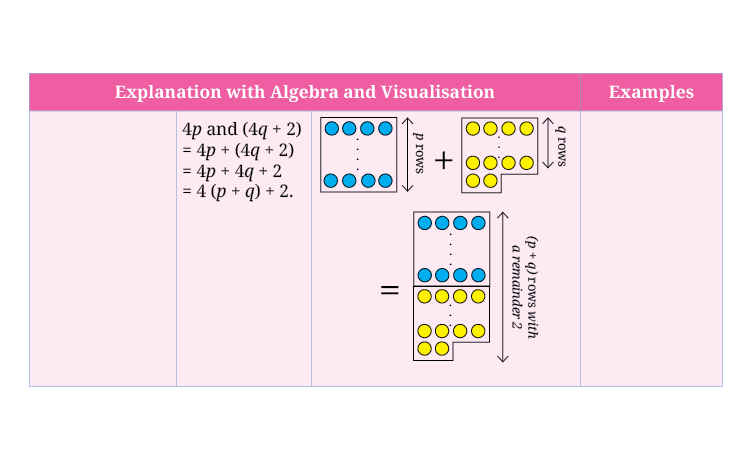
Like: 4y(multiple of 4) + (4x + 2) = 4y + 4x + 2, is not a multiple of 4. Yes, it is similar to the case of parity of the sum of an even and an odd number.
3. Look at the following expressions and the visualisation. Write the corresponding explanation and examples.
Solution:
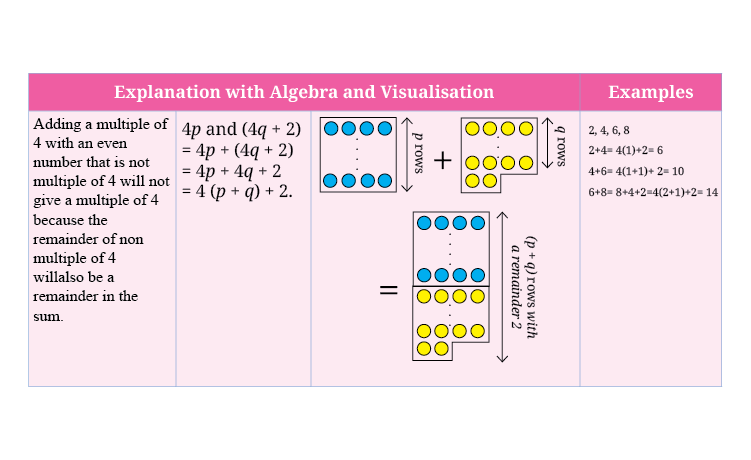
Always, Sometimes, or Never | NCERT In-Text Questions (Pages 118-121)
1. If 8 exactly divides two numbers separately, it must exactly divide their sum.
When a number exactly divides another number, the given number is a multiple of the divisor.
Assume that the two given numbers are both divisible by 8. Then they can be written as:
- First number = 8a
- Second number = 8b
where a and b are integers.
Verification for Addition
Now, consider the sum of the two numbers:
8a + 8b = 8(a+b)
Since the sum is expressed as 8 multiplied by an integer, it is also divisible by 8. Therefore, if 8 divides two numbers, it will always divide their sum.
Verification for Subtraction
Next, consider the difference of the two numbers:
8a − 8b = 8(a − b)
The difference is again a multiple of 8.
Hence, 8 also exactly divides the difference of the two numbers.
Examples
- 16 − 8 = 8
- 120 − 80 = 40
- 56 − 16 = 40
In each case, both numbers are divisible by 8, and their difference is also divisible by 8.
If 8 exactly divides two numbers, it always exactly divides both their sum and their difference.
2. If a number is divisible by both 9 and 4, it must be divisible by 36.
Solution:
To verify the truth of the given statement, we analyse the divisibility conditions mathematically.
First, find the least common multiple (LCM) of 6 and 4, since any number divisible by both must be a multiple of their LCM.
- Prime factorisation of 6 = 2×3
- Prime factorisation of 4 = 22
LCM (6,4) = 22 × 3 = 12
This shows that every number divisible by both 6 and 4 is necessarily divisible by 12. However, divisibility by 12 alone is not sufficient to ensure divisibility by 24, because:
24 = 23 × 3
To be divisible by 24, a number must contain three factors of 2 and one factor of 3 in its prime factorisation.
A number divisible by 6 and 4 only guarantees two factors of 2 and one factor of 3, which corresponds to divisibility by 12, not necessarily 24.
Let us examine this through examples:
Example 1:
Consider the number 36.
-
- 36 is divisible by 6 (36 ÷ 6 = 6)
- 36 is divisible by 4 (36 ÷ 4 = 9)
- 36 is not divisible by 24 (36 ÷ 24 = 1.5)
Hence, 36 satisfies divisibility by 6 and 4 but fails divisibility by 24.
Example 2:
Consider the number 48.
-
- 48 is divisible by 6 (48 ÷ 6 = 8)
- 48 is divisible by 4 (48 ÷ 4 = 12)
- 48 is divisible by 24 (48 ÷ 24 = 2)
Hence, 48 satisfies all three conditions.
Since some numbers divisible by both 6 and 4 are not divisible by 24, while some others are, the given statement cannot be classified as always true or always false.
Therefore, the statement is sometimes true.
3. If a number is divisible by both 6 and 4, it must be divisible by 24.
Solution:
LCM(6, 4) = 12 Consider the number 36 multiple of 12, which is divisible by both 6 and 4 but not by 24. Consider another number, 48, which is divisible by both 6 and 4, and it is also divisible by 24. So, the statement is ‘sometimes true’.

What Remains? | NCERT In-Text Questions (Pages 121-122)
1. Find a number that has a remainder of 3 when divided by 5. Write more such numbers.
Solution:
When a number is divided by 5, it can leave a remainder of 0, 1, 2, 3, or 4. Here, we are looking for numbers that leave a remainder of 3.
Let the number be n. According to the division algorithm:
n = 5 × k + r
where k is any whole number (0, 1, 2, …) and r is the remainder (0 ≤ r < 5).
Since the remainder is r = 3, we can write:
n =5k + 3
Now, by substituting different values of k, we can find numbers that satisfy the condition:
- If k = 0, then n = 5 × 0 + 3 = 3
- If k = 1, then n = 5 × 1 + 3 = 8
- If k = 2, then n = 5 × 2 + 3 = 13
- If k = 3, then n = 5 × 3 + 3 = 18
- If k = 4, then n = 5 × 4 + 3 = 23
… and so on.
Therefore, the numbers that leave a remainder of 3 when divided by 5 are:
3, 8, 13, 18, 23, 28, 33, 38, 43,…
Any number of the form 5k + 3, where k is a whole number, will satisfy the given condition.
2. Are there other expressions that generate numbers that are 3 more than a multiple of 5?
Solution:
Yes, there are infinitely many expressions that produce numbers which are 3 more than a multiple of 5. A number that is 3 more than a multiple of 5 can be written in the form:
5n + 3
where n is any whole number (0, 1, 2, 3, …).
This is because any multiple of 5 can be written as 5n, and adding 3 to it gives a number 3 more than a multiple of 5.
Examples of such expressions include:
1. 10x+3
Here, 10x is always a multiple of 5 (since 10x = 5⋅2x), and adding 3 ensures the result is 3 more than a multiple of 5.
2. 5 (2x + 1) − 2
Simplifying this: 5(2x + 1) −2 = 10x + 5 − 2 = 10x + 3
Again, this is in the form 5n+3.
3. 25x + 3
Since 25 is a multiple of 5, 25x is always divisible by 5, and adding 3 gives a number 3 more than a multiple of 5.
So, the idea is, any expression that can be simplified to the form 5⋅(whole number) + 3 will generate numbers that are 3 more than a multiple of 5.
There are infinitely many such expressions because you can replace nnn with any whole number or create more complex expressions that reduce to the form 5n+3.
Figure it Out (Pages 122-123)
1. The sum of four consecutive numbers is 34. What are these numbers?
Solution:
We are asked to find four consecutive numbers whose sum is 34. Consecutive numbers are numbers that follow each other in order, like 3, 4, 5, 6.
To solve this, we can represent the smallest of these four numbers as a variable, say x.
Then the next three numbers, being consecutive, will naturally be x + 1, x + 2, and x + 3.
When we add these numbers together, the sum becomes x + (x + 1) + (x + 2) + (x + 3).
By combining like terms, we see that the sum simplifies to 4x + 6, where 4x represents the total contribution of the four numbers themselves, and 6 is the total of the consecutive increases (1 + 2 + 3).
Since the problem states that the sum is 34, we set up the equation 4x + 6 = 34
Subtracting 6 from both sides gives 4x = 28, and dividing both sides by 4 shows that x = 7.
This tells us that the first number is 7. Naturally, the next three consecutive numbers are one more, two more, and three more than 7, which are 8, 9, and 10. Therefore, the four consecutive numbers that add up to 34 are 7, 8, 9, and 10.
To confirm, we can quickly check the sum: 7 + 8 = 15, 15 + 9 = 24, and 24 + 10 = 34, which matches perfectly with the given sum. Hence, the solution is correct.
This method shows how using a variable to represent consecutive numbers makes it easy to solve such problems systematically, and it also gives insight into the relationship between the numbers and their sum.
2. Suppose p is the greatest of five consecutive numbers. Describe the other four numbers in terms of p.
Solution:
1. Understanding consecutive numbers:
Consecutive numbers are numbers that follow each other in order, each differing by exactly 1. For example, 4, 5, 6, 7, 8.
Here, we know the largest number is p. To find the remaining numbers, we simply move backward step by step because each number before p is smaller by 1.
2. Finding the other numbers:
- The number just before p is p−1.
- One step further back is p−2.
- Continuing backward gives p−3 and p−4.
3. So the numbers gradually decrease as we move away from ‘p’.
4. Visualising the sequence:
Arranging the five numbers in increasing order:
P − 4, p − 3, p − 2, p − 1, p
Or in decreasing order:
P > p − 1 > p − 2 > p − 3 > p − 4
Therefore, if p is the greatest of five consecutive numbers, the other four numbers can be expressed as:
p −1, p − 2, p − 3, p − 4
Key Idea:
- Think of the numbers as steps on a ladder. p’ is at the top. Moving down each step gives the next smaller number.
- This approach works the same way if the smallest number is known; just move up step by step.
3. For each statement below, determine whether it is always true, sometimes true, or never true. Explain your answer. Mention examples and non-examples as appropriate. Justify your claim using algebra.
(i) The sum of two even numbers is a multiple of 3.
(ii) If a number is not divisible by 18, then it is also not divisible by 9.
(iii) If two numbers are not divisible by 6, then their sum is not divisible by 6.
(iv) The sum of a multiple of 6 and a multiple of 9 is a multiple of 3.
(v) The sum of a multiple of 6 and a multiple of 3 is a multiple of 9.
Solution:
(i) The sum of two even numbers is a multiple of 3
Any even number can be written as 2a, where ‘a’ is an integer. So, the sum of two even numbers is:
2a + 2b = 2(a+b)
This sum is always even, but it is not necessarily divisible by 3, because a + ba + ba + b may or may not be a multiple of 3.
- Example (sum divisible by 3): 2 + 4 = 6
- Example (sum not divisible by 3): 2 + 8 = 10
Therefore, the statement is sometimes true, depending on the numbers.
(ii) If a number is not divisible by 18, then it is also not divisible by 9
A number divisible by 9 may or may not be divisible by 18. For example:
- 9 is divisible by 9 but not by 18.
- 12 is divisible by neither 9 nor 18.
Algebraically, numbers divisible by 9 can be written as 9k, and numbers divisible by 18 are 18m = 9⋅2m. A number can be 9k where k is odd, making it divisible by 9 but not by 18.
The statement is sometimes true, not always.
(iii) If two numbers are not divisible by 6, then their sum is not divisible by 6
Let two numbers be written as 6k₁ + r₁ and 6k₂ + r₂, where r₁, r₂ = 1, 2, 3, 4, or 5 (remainders when divided by 6).
Their sum is:
(6k1 + r1) + (6k2 + r2) = 6(k11 + k2) + (r1 + r2)
If r1 + r2 = 6, then the sum becomes divisible by 6.
- Example (sum divisible by 6): 4 + 8 = 12
- Example (sum not divisible by 6): 2 + 5 = 7
The statement is sometimes true. The sum may or may not be divisible by 6 depending on the numbers.
(iv) The sum of a multiple of 6 and a multiple of 9 is a multiple of 3
Let the numbers be 6m and 9n. Then:
6m + 9n = 3(2m + 3n)
This is always divisible by 3, because 2m+3n is an integer.
- Example: 6 + 9 = 15, divisible by 3
- Example: 12 + 18 = 30, divisible by 3
Therefore, the statement is always true.
(v) The sum of a multiple of 6 and a multiple of 3 is a multiple of 9
Let the numbers be 6i and 3j. Their sum is:
6i + 3j = 3(2i + j)
This sum is always divisible by 3, but not necessarily by 9, because 2i+j may or may not be a multiple of 3.
- Example (sum divisible by 9): 6 + 3 = 9
- Example (sum not divisible by 9): 6 + 6 = 12
The statement is sometimes true, depending on the numbers.
4. Find a few numbers that leave a remainder of 2 when divided by 3 and a remainder of 2 when divided by 4. Write an algebraic expression to describe all such numbers.
Solution:
We can solve the problem using the following approach.
Step 1: Express numbers algebraically
When a number leaves a remainder after division, we can write it as:
1. For division by 3, remainder 2:
Number = 3a + 2
Where a = 0, 1, 2, 3,…
Example numbers: 2, 5, 8, 11, 14, 17,…
2. For division by 4, remainder 2
Number = 4b + 2
Where b = 0, 1, 2, 3,…
Example numbers: 2, 6, 10, 14, 18, 22, 26,…
Step 2: Find numbers that satisfy both conditions
We need numbers that are in both sequences.
- Sequence for remainder 2 when divided by 3: 2, 5 ,8, 11, 14, 17, 20, …
- Sequence for remainder 2 when divided by 4: 2, 6, 10, 14, 18, 22, 26,…
Common numbers: 2, 14, 26, 38, 50,…
Step 3: Identify the pattern
Look at the differences between consecutive common numbers:
14 − 2 = 12, 26 − 14 = 12, 38 − 26 = 12,…
- The numbers increase by 12 each time.
- Why 12? Because 12 is the LCM (least common multiple) of 3 and 4.
This makes sense because we are looking for numbers that satisfy both divisibility patterns, so the cycle repeats every LCM of the divisors.
Step 4: Write the general formula
The numbers can now be expressed as:
Number = 12c + 2
Where c = 0, 1, 2, 3, ...
- Here, 12 is the LCM of 3 and 4.
- 2 is the remainder we want.
- ccc counts how many steps of 12 we take.
Step 5: Generate examples
- C = 0: 12 ⋅ 0 + 2 = 2
- C = 1: 12 ⋅ 1 + 2 = 14
- C = 2: 12 ⋅ 2 + 2 = 26
- C = 3: 12 ⋅ 3 + 2 = 38
Sequence:
2, 14, 26, 38, 50,…
Step 6: Verification
Check one number (e.g., 26):
- Divide by 3: 26 ÷ 3 = 8, remainder 2
- Divide by 4: 26 ÷ 4 = 6, remainder 2
It works perfectly.
Step 7: Intuitive understanding
- Any number leaving remainder 2 with 3 or 4 can be written as “divisor × something + 2.”
- To satisfy both, the “something” must repeat every LCM of divisors.
- That’s why the formula is 12c + 2
Tip: Think of it as “a clock” of 12 steps, where the remainder 2 aligns every 12 steps.
All numbers are of the form 12c + 2, c = 0,1,2,3,…
5. “I hold some pebbles, not too many; when I group them in 3’s, one stays with me. Try pairing them up — it simply won’t do. A stubborn odd pebble remains in my view. Group them by 5, yet one’s still around, but grouping by seven, perfection is found. More than one hundred would be far too bold. Can you tell me the number of pebbles I hold?”
Solution:
The person has a certain number of pebbles, fewer than 100, and several clues help us find the exact count.
When the pebbles are grouped in threes, one pebble remains, which means the total is one more than a multiple of three. Pairing the pebbles is impossible, so the number must be odd.
Grouping them in fives also leaves one pebble, indicating it is one more than a multiple of five. When the pebbles are grouped in sevens, there is no remainder, showing the number is divisible by seven.
To find a number that meets all these conditions, we consider the multiples of seven below 100, which are 7, 14, 21, and so on up to 98.
Among these, 91 is the only number that is odd and leaves a remainder of one when divided by both three and five.
Therefore, the person holds a total of 91 pebbles.
6. Tathagat has written several numbers that leave a remainder of 2 when divided by 6. He claims, “If you add any three such numbers, the sum will always be a multiple of 6.” Is Tathagat’s claim true?
Solution:
First, let us understand what it means when a number leaves a remainder of 2 on division by 6.
When a number is divided by 6 and the remainder is 2, it means the number is 2 more than a multiple of 6. So, every such number can be written in the form:
6k + 2
where k is a whole number.
Step 1: Represent the three numbers
Let the three numbers written by Tathagat be:
6a + 2, 6b + 2, 6c + 2
Here, a, b, and c are whole numbers.
Step 2: Add the three numbers
Now, add them:
(6a + 2) + (6b + 2) + (6c + 2)
Group the multiples of 6 and the remainders separately:
= (6a + 6b + 6c) + (2 + 2 + 2)
= 6(a + b + c) + 6
Step 3: Factor out 6
= 6(a + b + c + 1)
This shows that the sum is exactly divisible by 6, because it can be written as 6 multiplied by a whole number.
Checking with examples:
- Numbers: 2, 8, 14
Each leaves a remainder of 2 when divided by 6
Sum = 2 + 8 + 14 = 24, which is divisible by 6
- Numbers: 20, 26, 32
Sum = 20 + 26 + 32 = 78, and 78 ÷ 6 = 13
No matter which three numbers are chosen that leave a remainder of 2 when divided by 6, their sum will always be a multiple of 6.
Hence, Tathagat’s claim is true.
7. When divided by 7, the number 661 leaves a remainder of 3, and 4779 leaves a remainder of 5. Without calculating, can you say what remainders the following expressions will leave when divided by 7? Show the solution both algebraically and visually.
(i) 4779 + 661
(ii) 4779 – 661
Solution:
When a number is divided by 7, the remainder tells us how many units are left over after making complete groups of 7.
We are given:
- 661 leaves a remainder of 3 when divided by 7
- 4779 leaves a remainder of 5 when divided by 7
This means:
661 = (7 × 94) + 3
779 = (7 × 682) + 5
So, both numbers are written as:
Multiple of 7 + remainder
We will now use this idea to find the remainders without doing long division.
(i) Finding the remainder of 4779 + 661 when divided by 7
Step 1: Write both numbers in remainder form
4779 = 7 × 682 + 54779
Step 2: Add the two expressions
4779 + 661 = (7 × 682 + 5) + (7 × 94 + 3)
Step 3: Group similar terms
= 7 (682 + 94) + (5 + 3) = 7 (682 + 94) + (5 + 3)
Step 4: Observe the remainder
- 7×776 is completely divisible by 7
- Only 8 affects the remainder
Since:
8 = 7 + 1
Remainder = 1
(ii) Finding the remainder of 4779−661 when divided by 7
Step 1: Use the same remainder forms
4779 = 7 × 682 + 5
661 = 7 × 94 + 3
Step 2: Subtract the expressions
(7 × 682 + 5) − (7 × 94 + 3)
Step 3: Rearrange the terms
= 7(682 − 94) + (5 − 3)
= 7 × 588 + 2
Step 4: Observe the remainder
- 7×588 is divisible by 7
- 2 is left over
Remainder = 2
Visualization Method
To understand this visually, imagine that one box can hold exactly 7 marbles. When 4779 is divided by 7, it leaves 5 loose marbles, and when 661 is divided by 7, it leaves 3 loose marbles.
For addition, these loose marbles are combined. Thus, the total number of loose marbles becomes 5 + 3 = 8. From these 8 marbles, 7 marbles can be placed into one complete box, and 1 marble is left outside.
Therefore, the remainder when 4779 + 661 is divided by 7 is 1.
For subtraction, we again focus only on the loose marbles. We start with the 5 loose marbles left from 4779 and remove the 3 loose marbles left from 661.
After removing them, 2 marbles remain. Since no complete group of 7 can be formed, the remainder when 4779 − 661 is divided by 7 is 2.
So, finally we can say that,
- The remainder of 4779 + 661 when divided by 7 is 1.
- The remainder of 4779 − 661 when divided by 7 is 2.
8. Find a number that leaves a remainder of 2 when divided by 3, a remainder of 3 when divided by 4, and a remainder of 4 when divided by 5. What is the smallest such number? Can you give a simple explanation of why it is the smallest?
Solution:
Let the required number be N.
When a number is divided by a divisor, it can be written as:
Number = (Divisor × Quotient) + Remainder
So, using the given conditions:
- Since N leaves a remainder of 2 when divided by 3,
N = 3a + 2N
- Since N leaves a remainder of 3 when divided by 4,
N = 4b + 3
- Since N leaves a remainder of 4 when divided by 5,
N = 5c + 4
Observe the remainders carefully:
- 2 = 3 − 1
- 3 = 4 − 1
- 4 = 5 − 1
In each case, the remainder is one less than the divisor. This tells us that the number falls short of a multiple of each divisor by exactly 1.
So, if we add 1 to the number:
- the remainder becomes 0 in all three cases,
- meaning N + 1 is exactly divisible by 3, 4, and 5.
Using LCM to Find the Smallest Value
Since N + 1 must be divisible by 3, 4, and 5 at the same time, it must be a common multiple of these numbers.
To get the smallest such number, we find the Least Common Multiple (LCM):
LCM(3,4,5) = 60
Thus,
N + 1 = 60
N = 60 − 1 = 59
Why 59 Is the Smallest Possible Number
- Any number smaller than 59 would make N + 1 less than 60.
- Such a value cannot be divisible by 3, 4, and 5 together.
- Since 60 is the smallest common multiple, subtracting 1 gives the smallest possible N.
5.2 Checking Divisibility Quickly | NCERT In-Text Questions (Page 123)
1. Similarly, explain using algebra why the divisibility shortcuts for 5, 2, 4, and 8 work. Let us now examine shortcuts to check divisibility by some other
numbers and explain why they work!
Solution:
Let a four-digit number dcba be written in the decimal (Indian) numeral system as
dcba = 1000d + 100c + 10b + a
Using this expression, we explain why the divisibility shortcuts work.
Since 1000 = 5 × 200, 100 = 5 × 20, and 10 = 5 × 2, the terms 1000d, 100c, and 10b are all divisible by 5.
Therefore, the divisibility of the given number by 5 depends only on the units digit aaa. Hence, the number is divisible by 5 if and only if the last digit is 0 or 5.
Similarly, 1000 = 2 × 500, 100 = 2 × 50, and 10 = 2 × 5.
Thus, 1000d, 100c, and 10b are divisible by 2. As a result, the entire number will be divisible by 2 only when the units digit 'a’ is even. Hence, a number is divisible by 2 if its last digit is even.
Now, since 1000 = 4 × 250, the terms 1000d and 100c are divisible by 4.
Therefore, the divisibility of the number by 4 depends on the remaining part, 10b+a, which is the number formed by the last two digits. Hence, the given number is divisible by 4 if the number formed by its last two digits is divisible by 4.
Further, 1000 = 8 × 125, so 1000d is divisible by 8. Thus, the divisibility of the whole number by 8 depends on 100c + 10b + a, which is the number formed by the last three digits.
Hence, a number is divisible by 8 if the number formed by its last three digits is divisible by 8.
A Shortcut for Divisibility by 9 | NCERT In-Text Questions (Pages 123-126)
1. Is 10 divisible by 9? If not, what is the remainder?
Solution:
10 is not divisible by 9 because when we divide 10 by 9, one full group of 9 can be taken away and 1 is left behind.
This can be written as 10 = 9 × 1 + 1, where 1 is the remainder. To understand this better, note that 10 = 9 + 1.
Every time we take another 10, we are actually adding one more 9 and one extra 1.
Therefore, a multiple of 10 can be written as
10n = (9 + 1) n = 9n + n
The part 9n is completely divisible by 9, but the extra ‘n’ cannot be divided by 9 and becomes the remainder.
Hence, when 20, 30, or 40 are divided by 9, the remainders obtained are 2, 3, and 4 respectively.
Thus, 10 is not divisible by 9, the remainder is 1, and in general, the remainder obtained on dividing a multiple of 10 by 9 is equal to the number of tens in that number.
2. Look at each of the following statements. Which are correct and why?
(i) If a number is divisible by 9, then the sum of its digits is divisible by 9.
(ii) If the sum of the digits of a number is divisible by 9, then the number is divisible by 9.
(iii) If a number is not divisible by 9, then the sum of its digits is not divisible by 9.
(iv) If the sum of the digits of a number is not divisible by 9, then the number is not divisible by 9.
Solution:
To answer these statements, we use the divisibility rule of 9:
A number is divisible by 9 if and only if the sum of its digits is divisible by 9.
(i) If a number is divisible by 9, then the sum of its digits is divisible by 9.
Correct.
Reason:
According to the divisibility rule of 9, whenever a number is divisible by 9, the sum of its digits must also be divisible by 9.
Example:
Take the number 234.
234 ÷ 9 = 26 (divisible by 9)
Sum of digits = 2 + 3 + 4 = 9, which is divisible by 9.
Hence, the statement is true.
(ii) If the sum of the digits of a number is divisible by 9, then the number is divisible by 9.
Correct.
Reason:
The divisibility rule of 9 works both ways. If the sum of the digits of a number is divisible by 9, then the number itself must be divisible by 9.
Example:
Take the number 450.
Sum of digits = 4 + 5 + 0 = 9, which is divisible by 9.
Therefore, 450 is divisible by 9.
Thus, the statement is true.
(iii) If a number is not divisible by 9, then the sum of its digits is not divisible by 9.
Correct.
Reason:
A number can be divisible by 9 only if the sum of its digits is divisible by 9.
So, if a number is not divisible by 9, it means the sum of its digits cannot be divisible by 9.
Example:
Take the number 123.
123 ÷ 9 is not a whole number (not divisible by 9).
Sum of digits = 1 + 2 + 3 = 6, which is not divisible by 9.
Hence, the statement is true.
(iv) If the sum of the digits of a number is not divisible by 9, then the number is not divisible by 9.
Correct.
Reason:
This is the contrapositive of the divisibility rule of 9. If the sum of the digits is not divisible by 9, then the number itself cannot be divisible by 9.
Example:
Take the number 347.
The sum of digits is 3 + 4 + 7 = 14, which is not divisible by 9.
Therefore, 347 is not divisible by 9.
Thus, the statement is true.
All four statements (i), (ii), (iii), and (iv), are correct, as they directly follow from the divisibility rule of 9.
Figure it Out (Page 126)
1. Find, without dividing, whether the following numbers are divisible by 9.
(i) 123
(ii) 405
(iii) 8888
(iv) 93547
(v) 358095
Solution:
When a number is written in the decimal system, it is made up of digits placed at different positions (ones, tens, hundreds, thousands, etc.). Each position represents a power of 10.
The important idea is this:
- When 10 is divided by 9, the remainder is 1.
- The same is true for 100, 1000, and all higher powers of 10.
Because of this, each digit contributes its value directly to the remainder when dividing by 9.
So, instead of dividing the entire number, we can add all its digits. If this digit sum is divisible by 9, the original number is also divisible by 9.
This method works for small and very large numbers and saves time in calculations.
(i) 123
The digits of the number are 1, 2, and 3.
Adding these digits gives:
1 + 2 + 3 = 6
The number 6 is less than 9 and cannot be divided evenly by 9.
Therefore, 123 is not divisible by 9.
(ii) 405
The digits of the number are 4, 0, and 5.
Adding these digits gives:
4+ 0 + 5 = 9
Since 9 is exactly divisible by 9, the original number must also be divisible by 9.
Therefore, 405 is divisible by 9.
(iii) 8888
The digits of the number are 8, 8, 8, and 8.
Adding these digits gives:
8 + 8 + 8 + 8 = 32
The number 32 is not divisible by 9.
This means the original number does not satisfy the divisibility rule for 9.
Therefore, 8888 is not divisible by 9.
(iv) 93547
The digits of the number are 9, 3, 5, 4, and 7.
Adding these digits gives:
9 + 3 + 5 + 4 + 7 = 28
The number 28 cannot be divided evenly by 9.
Hence, the given number does not meet the condition for divisibility by 9.
Therefore, 93547 is not divisible by 9.
(v) 358095
The digits of the number are 3, 5, 8, 0, 9, and 5.
Adding these digits gives:
3 + 5 + 8 + 0 + 9 + 5 = 30
Although 30 is greater than 9, it is not a multiple of 9.
So, the number does not satisfy the divisibility rule.
Therefore, 358095 is not divisible by 9.
2. Find the smallest multiple of 9 with no odd digits.
Solution:
To find the smallest multiple of 9 containing only even digits, we use the fact that a number is divisible by 9 if the sum of its digits is a multiple of 9.
Since we can only use the digits 0, 2, 4, 6, and 8, we look for a combination of these digits whose sum is 9, 18, 27, etc.
One- and two-digit numbers are too small; any sum made from these digits is either less than 9 or cannot reach a multiple of 9, so they do not work.
Considering three-digit numbers, the sum of digits must be 18 to satisfy the divisibility rule. Among all combinations of even digits that add up to 18, 2 + 8 + 8 gives the smallest number when arranged in ascending order.
Thus, 288 is the smallest multiple of 9 that contains only even digits.
3. Find the multiple of 9 that is closest to the number 6000.
Solution:
To find the multiple of 9 nearest to 6000, we look for numbers divisible by 9 that are just below and just above 6000.
a. Express 6000 in a convenient way:
6000 = 6 × 1000
b. Break 1000 into a number near a multiple of 9:
1000 = 999 + 1 ⟹ 6000 = 6 × (999 + 1) = 6 × 999 + 6 = 5994 + 6
Here, 5994 is clearly a multiple of 9 (since 999 is divisible by 9, and multiplying it by 6 keeps it divisible by 9).
c. Find the next multiple of 9:
The next multiple of 9 after 5994 is 5994 + 9 = 6003.
d. Compare distances to 6000:
- Distance from 5994 to 6000: 6000 − 5994 = 6
- Distance from 6003 to 6000: 6003 − 6000 = 3
Since 3 is smaller than 6, 6003 is closer to 6000 than 5994.
Answer: 6003
4. How many multiples of 9 are there between the numbers 4300 and 4400?
Solution:
To find how many multiples of 9 lie between 4300 and 4400, we first identify the smallest multiple of 9 greater than 4300 and the largest multiple of 9 less than 4400.
Dividing 4300 by 9 gives a quotient of 477 with a remainder of 7, which means 9 × 477 = 4293 is the largest multiple below 4300.
Therefore, the first multiple above 4300 is 4293 + 9 = 4302
Similarly, dividing 4400 by 9 gives a quotient of 488 with a remainder of 8, so the largest multiple of 9 less than 4400 is 9 × 488 = 4392.
The multiples of 9 between 4302 and 4392 form an arithmetic sequence with a common difference of 9.
The total number of multiples in this sequence is calculated by (4392 − 4302)/9 + 1 = 11
Hence, there are 11 multiples of 9 between 4300 and 4400.
A Shortcut for Divisibility by 3 | NCERT In-Text Questions (Page 126)
1. The shortcut to find the divisibility by 3 is similar to the method for 9. A number is divisible by 3 if the sum of its digits is divisible by 3. Explore the remainders when powers of 10 are divided by 3. Explain why this method works.
Solution:
Rule:
A number is divisible by 3 if the sum of its digits is divisible by 3. Let’s understand why this rule works, step by step.
Step 1: Powers of 10 and their remainders
Consider the powers of 10: 1,10,100,1000,….When each is divided by 3, we notice the remainder is always 1:
- 100=1 → remainder 1
- 101=10 → remainder 1
- 102 = 100 → remainder 1
- 103 = 1000 → remainder 1
Observation: Every power of 10 leaves a remainder of 1 when divided by 3.
This means that the contribution of each digit to the remainder of the whole number is effectively the digit itself, because multiplying by powers of 10 does not change the remainder modulo 3.
Step 2: Expressing a number using its digits
Take a 4-digit number bcdebcdebcde. Using place value, it can be written as:
Bcde = 1000b + 100c + 10d + e
From Step 1, we know each power of 10 can be written as a multiple of 3 plus 1:
1000 = 3k1+1,
100 = 3k2+1,
10 = 3k3+1,
1 = 3k4+1
Substituting these into the number gives:
Bcde = (3k1+1)b + (3k2+1)c + (3k3+1)d + (3k4+1)e
Here, we see the number is split into two parts: multiples of 3 and a sum of digits.
Step 3: Simplifying
Expanding the terms, we get:
Bcde = 3(k1b + k2c + k3d + k4e) + (b + c + d + e)
- The first part, 3(k1b + k2c + k3d + k4e) is clearly divisible by 3.
- Therefore, the divisibility of the number by 3 depends only on the sum of the digits, b + c + d + e
Step 4: Key Insight
A number is divisible by 3 ⟺ the sum of its digits is divisible by 3.
This works because each digit, when multiplied by a power of 10, contributes the same remainder as the digit itself.
Step 5: Examples
1. Check if 237 is divisible by 3:
2 + 3 + 7 = 12
Since 12 is divisible by 3, ⇒ 237 is divisible by 3.
2. Check if 425 is divisible by 3:
4 + 2 + 5 = 11
Since 11 is not divisible by 3 ⇒ 425 is not divisible by 3.
Step 6: Intuition in simple words
- Each digit is multiplied by a power of 10.
- Since every power of 10 leaves a remainder of 1 when divided by 3, each digit contributes exactly its own value to the remainder.
- Therefore, the sum of digits determines divisibility by 3, which is why this shortcut works perfectly.
A Shortcut for Divisibility by 11 | NCERT In-Text Questions (Pages 126-129)
1. Using these observations, can you tell whether the number 462 is divisible by 11?
Solution:
First, we break down 462 into its place values:
462 = 400 + 60 + 2
Next, we express each part in terms of multiples of 11 plus a remainder:
- 400 = 11 × 36 + 4 → 400 is 4 more than a multiple of 11.
- 60 = 11 × 5 + 5 → 60 is 5 more than a multiple of 11.
- 2 = 11 × 0 + 2 → 2 is 2 more than a multiple of 11.
Now, according to the divisibility rule of 11, we combine these remainders by applying alternating signs (subtracting the second, adding the third, and so on):
4 − 5 + 2 = 1
The final result is 1, which is not divisible by 11.
∴462 is not divisible by 11.
By breaking the number into parts and carefully applying the alternating-sign method, we can clearly check divisibility and understand why the rule works, rather than just memorising it.
2. If this difference is 11 or a multiple of 11, what does that say about the remainder obtained when the number is divisible by 11?
Solution:
To understand this, let’s break it down step by step:
Divisibility Rule for 11: A number is divisible by 11 if the difference between the sum of its digits in odd positions and the sum of its digits in even positions is either 0 or a multiple of 11.
For example, for a number
N = d1, d2, d3 d4,…dn,
Calculate:
(d1 + d3 + d5 +......) - (d2 + d4 + d6 +....)
If this difference is 0, 11, 22, 33, etc. (i.e., a multiple of 11), then N is divisible by 11.
Implication for the Remainder: When a number is divisible by 11, it means there is no remainder left after division by 11. In mathematical terms:
Nmod 11=0
So, if the difference of sums of alternate digits is 11 or any multiple of 11, the remainder when the number is divided by 11 is 0, confirming that the number is exactly divisible by 11.
Example:
Take N = 352
- Sum of digits in odd positions: 3 + 2 = 5
- Sum of digits in even positions: 5
- Difference: 5 − 5 = 0 → a multiple of 11
Hence, 352 is divisible by 11, and the remainder is 0.
3. Using this shortcut, find out whether the following numbers are divisible by 11. Further, find the remainder if the number is not divisible by 11.
(i) 158
(ii) 841
(iii) 481
(iv) 5529
(v) 90904
(vi) 857076
Look at the following procedure.
|
Steps to follow |
Example for the number 328105 |
|---|---|
|
1. Place alternating '+' and '-' signs before every digit starting from the unit's digit. 2. Evaluate the expression. 3. The result denotes the remainder obtained when the number is divided by 11 |
- 3 + 2 - 8 + 1 + 0 + 5 - 3 + 2 - 8 + 1 + 0 + 5 = - 3 328105 is 3 less than or 8 more than a multiple of 11 |
Solution:
A number is divisible by 11 if the difference between the sum of its digits in odd positions and the sum of its digits in even positions is a multiple of 11 (including 0).
Step-by-Step Procedure
- Identify positions of digits: Start counting from the unit (rightmost) digit.
- Odd positions: 1st, 3rd, 5th… (from right)
- Even positions: 2nd, 4th, 6th… (from right)
- Add digits separately:
- Sum of digits at odd positions
- Sum of digits at even positions
- Find the difference:
- Difference = (Sum of odd-position digits) − (Sum of even-position digits)
- Interpret the difference:
- If the difference = 0 or divisible by 11 → Number is divisible by 11.
- If not divisible by 11 → Remainder = Absolute value of difference (or 11 − |difference| if difference is negative).
Now use these shortcuts for the given numbers:
(i) 158
- Digits: 1, 5, 8
- Odd positions (from right): 8 + 1 = 9
- Even positions: 5
- Difference: 9 − 5 = 4
- Interpretation: Not divisible by 11.
- Remainder: 4
(ii) 841
- Digits: 8, 4, 1
- Odd positions (from right): 1 + 8 = 9
- Even positions: 4
- Difference: 9 − 4 = 5
- Interpretation: Not divisible by 11.
- Remainder: 5
(iii) 481
- Digits: 4, 8, 1
- Odd positions: 1 + 4 = 5
- Even positions: 8
- Difference: 5 − 8 = -3
- Interpretation: Negative difference → Number is 3 less than a multiple of 11 (or 8 more than a previous multiple of 11).
- Remainder: 8
Tip for exams: If the difference is negative, just subtract its absolute value from 11 to get the remainder.
(iv) 5529
- Digits: 5, 5, 2, 9
- Odd positions: 9 + 5 = 14
- Even positions: 2 + 5 = 7
- Difference: 14 − 7 = 7
- Interpretation: Not divisible by 11
- Remainder: 7
(v) 90904
- Digits: 9, 0, 9, 0, 4
- Odd positions: 4 + 9 + 9 = 22
- Even positions: 0 + 0 = 0
- Difference: 22 − 0 = 22
- Interpretation: 22 is divisible by 11 → Number is divisible by 11
- Remainder: 0
(vi) 857076
- Digits: 8, 5, 7, 0, 7, 6
- Odd positions: 6 + 0 + 5 = 11
- Even positions: 7 + 7 + 8 = 22
- Difference: 11 − 22 = -11
- Interpretation: -11 is divisible by 11 → Number is divisible by 11
- Remainder: 0
Quick Tips to Remember:
- Always start counting digits from the unit’s place.
- Odd-even sums → difference → check divisibility by 11.
- Negative difference → remainder = 11 − |difference|.
- If difference = 0 or divisible by 11 → remainder = 0.
4. Is this method similar to or different from the method we saw just before?
Solution:
The first method (place value groups) relies on the place value of digits such as units, tens, hundreds, and so on.
In this method, we group the digits according to their place value, perform the operation within each group, and then subtract the sums of these groups. The focus here is on the value represented by each digit in the number.
The second method (alternate signs) takes a different approach. Here, we focus on the position of the digits, starting from the unit digit, and apply alternating addition and subtraction.
This means that starting from the rightmost digit, we add, then subtract, then add, and so on, moving leftwards across the digits.
Although the procedures appear different, both methods are mathematically equivalent.
That is, they will give the same final result, but the way we approach the calculation is different: one emphasises place values, and the other emphasises digit positions with alternating signs.
We can say that the methods are different in procedure but equivalent in result.
5. Fill in the following table. Find a quick way to do this?
Divisibility Table
| Number | Divisible by | ||||||||
|---|---|---|---|---|---|---|---|---|---|
| 2 | 3 | 4 | 5 | 6 | 8 | 9 | 10 | 11 | |
| 128 | Yes | No | No | No | No | Yes | No | No | No |
| 990 | |||||||||
| 1586 | |||||||||
| 275 | |||||||||
| 6686 | |||||||||
| 639210 | |||||||||
| 429714 | |||||||||
| 2856 | |||||||||
| 3060 | |||||||||
| 406839 | |||||||||
Solution:
Divisibility Table
| Number | Divisible by | ||||||||
|---|---|---|---|---|---|---|---|---|---|
| 2 | 3 | 4 | 5 | 6 | 8 | 9 | 10 | 11 | |
| 128 | Yes | No | Yes | No | No | Yes | No | No | No |
| 990 | Yes | Yes | No | Yes | Yes | No | Yes | Yes | Yes |
| 1586 | Yes | No | No | No | No | No | No | No | No |
| 275 | No | No | No | Yes | No | No | No | No | Yes |
| 6686 | Yes | No | No | No | No | No | No | No | No |
| 639210 | Yes | Yes | No | Yes | Yes | No | No | Yes | Yes |
| 429714 | Yes | Yes | No | No | Yes | No | Yes | No | No |
| 2856 | Yes | Yes | Yes | No | Yes | Yes | No | No | No |
| 3060 | Yes | Yes | Yes | Yes | Yes | No | Yes | Yes | No |
| 406839 | No | Yes | No | No | No | No | No | No | No |
More on Divisibility Shortcuts Divisibility Shortcuts for Other Numbers | NCERT In-Text Questions (Pages 129-130)
1. How can we find out if a number is divisible by 6?
Solution:
A number is divisible by 6 if it is divisible by both 2 and 3, because the prime factors of 6 are 2 and 3.
6 = 2 × 3
To check divisibility by 2, see if the number is even (its last digit is 0, 2, 4, 6, or 8).
To check divisibility by 3, add up all the digits of the number; if the sum is divisible by 3, then the number is divisible by 3.
For example, consider the number 54. Its last digit is 4, so it is divisible by 2. The sum of its digits is 5 + 4 = 9, which is divisible by 3. Since both conditions are satisfied, 54 is divisible by 6.
So, we can say that a number is divisible by 6 if it is even and the sum of its digits is divisible by 3.
2. Will checking its divisibility by its factors 2 and 3 work? Use the shortcuts for 2 and 3 on these numbers and divide each number by 6 to verify — 38, 225, 186, 64.
Solution:
We know that a number is divisible by 6 if it is divisible by both 2 and 3. To check this, we can use the shortcuts for divisibility:
- Divisibility by 2: A number is divisible by 2 if its last digit is 0, 2, 4, 6, or 8.
- Divisibility by 3: A number is divisible by 3 if the sum of its digits is divisible by 3.
Let’s apply this method to the numbers 38, 225, 186, and 64.
|
Number |
Divisible by 2? |
Divisible by 3? |
Divisible by 6? |
|---|---|---|---|
|
38 |
Yes (last digit 8 is even) |
No (3 + 8 = 11, not divisible by 3) |
No |
|
225 |
No (last digit 5 is odd) |
Yes (2 + 2 + 5 = 9, divisible by 3) |
No |
|
186 |
Yes (last digit 6 is even) |
Yes (1 + 8 + 6 = 15, divisible by 3) |
Yes |
|
64 |
Yes (last digit 4 is even) |
No (6 + 4 = 10, not divisible by 3) |
No |
3. How about checking divisibility by 24? Will checking the divisibility by its factors, 4 and 6, work? Why or why not?
Solution:
Before we begin, it is important to understand the prime factors of 24, because divisibility depends on whether all these prime factors are present in the number.
Step 1: Prime factorisation of 24
First, express 24 in terms of its prime factors:
24 = 2 x 2 x 2 x 3 = 23 x 3
This shows that for a number to be divisible by 24, it must include three factors of 2 and one factor of 3.
Step 2: Checking divisibility by 4 and 6
- 4 = 22
- 6 = 2 x 3
If a number is divisible by both 4 and 6:
- Divisible by 4 → number has at least 22
- Divisible by 6 → number has at least 2×3
Combining these factors:
22 x 23 = 23 x 3 = 24
So, in this case, checking divisibility by 4 and 6 does work for 24.
Step 3: Why this method may be unreliable in general
Using two arbitrary factors of a number does not always guarantee divisibility by the original number. For example, consider 4 and 8:
- 4 = 22, 8 = 23
- Divisible by 4 and 8 → number has at least 23
- But the factor 3 is missing, so divisibility by 4 and 8 does not ensure divisibility by 24.
Step 4: A more reliable method is to check divisibility by 3 and 8
- 8 = 23
- 3 = 3
If a number is divisible by both 8 and 3:
8 × 3 = 23 × 3 = 24
This method works reliably because it includes all the prime factors of 24.
Step 5: Conclusion
- Divisibility by 4 and 6 works in this particular case, but it is not a generally safe method.
- The most reliable approach is to check divisibility by numbers that cover all prime factors of 24, which are 8 and 3.
Digital Roots
1. Write the digital roots of any 12 consecutive numbers. What do you observe?
Solution:
The digital root of a number is obtained by adding all its digits repeatedly until a single-digit number is obtained.
Let us take the 12 consecutive numbers from 101 to 112 and find their digital roots.
- 101 → 1 + 0 + 1 = 2
- 102 → 1 + 0 + 2 = 3
- 103 → 1 + 0 + 3 = 4
- 104 → 1 + 0 + 4 = 5
- 105 → 1 + 0 + 5 = 6
- 106 → 1 + 0 + 6 = 7
- 107 → 1 + 0 + 7 = 8
- 108 → 1 + 0 + 8 = 9
- 109 → 1 + 0 + 9 = 10 → 1 + 0 = 1
- 110 → 1 + 1 + 0 = 2
- 111 → 1 + 1 + 1 = 3
- 112 → 1 + 1 + 2 = 4
So, the digital roots obtained are:
2, 3, 4, 5, 6, 7, 8, 9, 1, 2, 3, 4
We observe that the digital roots follow a repeating pattern from 1 to 9. After reaching 9, the next digital root becomes 1 again, and the cycle continues.
This happens because a number can have only nine possible non-zero digital roots (1 to 9). Therefore, the digital roots of consecutive numbers repeat in a cycle of 9.
2. Now, find the digital roots of some consecutive multiples of (i) 3, (ii) 4, and (iii) 6.
Solution:
Digital Root:
The digital root of a number is obtained by adding its digits repeatedly until a single-digit number is obtained. Using this method, we now examine the digital roots of consecutive multiples of 3, 4, and 6.
(i) Consecutive multiples of 3
The consecutive multiples of 3 are:
3, 6, 9, 12, 15, 18, 21, …
To find their digital roots, we add the digits of each number:
- 3 → digital root = 3
- 6 → digital root = 6
- 9 → digital root = 9
- 12 → 1 + 2 = 3
- 15 → 1 + 5 = 6
- 18 → 1 + 8 = 9
- 21 → 2 + 1 = 3
From these results, we observe that the digital roots repeat in the sequence 3, 6, 9.
(ii) Consecutive multiples of 4
The consecutive multiples of 4 are:
4, 8, 12, 16, 20, 24, …
Applying the same method:
- 4 → digital root = 4
- 8 → digital root = 8
- 12 → 1 + 2 = 3
- 16 → 1 + 6 = 7
- 20 → 2 + 0 = 2
- 24 → 2 + 4 = 6
In this case, the digital roots do not repeat in a regular pattern. This shows that multiples of 4 do not have a fixed digital-root sequence.
(iii) Consecutive multiples of 6
The consecutive multiples of 6 are:
6, 12, 18, 24, 30, 36, …
Finding their digital roots:
- 6 → digital root = 6
- 12 → 1 + 2 = 3
- 18 → 1 + 8 = 9
- 24 → 2 + 4 = 6
- 30 → 3 + 0 = 3
- 36 → 3 + 6 = 9
Here, the digital roots repeat in the sequence 6, 3, 9.
By examining the digital roots of consecutive multiples, we conclude that:
- Multiples of 3 show a repeating digital-root pattern of 3, 6, 9.
- Multiples of 4 do not show any regular pattern.
- Multiples of 6 show a repeating digital-root pattern of 6, 3, 9.
3. What are the digital roots of numbers that are 1 more than a multiple of 6? What do you notice?
Solution:
Numbers that are 1 more than a multiple of 6 can be written in the form 6n + 1, where n is a natural number.
Let us calculate the digital roots of some of these numbers:
- 37 → 3 + 7 = 10 → 1 + 0 = 1
- 43 → 4 + 3 = 7
- 49 → 4 + 9 = 13 → 1 + 3 = 4
- 55 → 5 + 5 = 10 → 1 + 0 = 1
- 61 → 6 + 1 = 7
- 67 → 6 + 7 = 13 → 1 + 3 = 4
From these calculations, the digital roots obtained are:
1, 7, 4, 1, 7, 4,…
We notice a repeating pattern in the digital roots. They follow the sequence 1 → 7 → 4 → 1 → 7 → 4 … and continue in this cycle indefinitely.
Hence, the digital roots of numbers that are 1 more than a multiple of 6 are always 1, 7, or 4, occurring in a fixed repeating order.
This predictable pattern allows us to determine the digital root of such numbers quickly without performing repeated addition.
4. I’m made of digits, each tiniest and odd, No shared ground with root #1 — how odd! My digits count, their sum, my root — All point to one bold number’s pursuit — The largest odd single-digit I proudly claim. What’s my number? What’s my name?
Solution:
To solve this riddle, we can carefully analyse each clue and reason through the conditions step by step.
1. Analysing the digits
The clue "each tiny and odd" indicates that all digits are odd, and "tiny" suggests the smallest odd digit, which is 1. Therefore, the number is composed entirely of 1s.
2. Understanding the digital root
The line "no shared ground with root number one" tells us that the digital root of the number is not 1.
The digital root is obtained by repeatedly summing the digits until a single-digit number remains.
3. Connecting the number of digits, sum, and root
The statement "digit count, the sum of my digits, and my root all point to the same number" implies that these three values are equal.
The final line, "I carry the largest odd single-digit," identifies this number as 9, the largest odd single-digit.
4. Determining the number of digits
Let the number have n digits, all ones.
- The sum of the digits is n.
- The digital root of a number made entirely of ones is equal to the remainder of n divided by 9, with a remainder of 0 corresponding to a digital root of 9.
To satisfy the requirement that the digital root is 9, n must be a multiple of 9.
5. Constructing the number
The smallest number meeting all the conditions is 111,111,111, which has nine digits of 1.
- All digits are odd
- Number of digits = 9
- Sum of digits = 9
- Digital root = 9
This number satisfies all the conditions in the riddle. A descriptive name for this number is "The Ninefold One," reflecting its nine digits, all ones, and digital root of 9.
Figure It Out (Page 131)
1. The digital root of an 8-digit number is 5. What will be the digital root of 10 more than that number?
Solution:
Let the given 8-digit number be N.
It is given that the digital root of N is 5.
When 10 is added to a number, the tens digit increases by 1, while the unit digit remains the same. As a result, the sum of digits of the number increases by 1.
Therefore, the new number is N + 10.
Since the digital root depends on the sum of digits, an increase of 1 in the digit sum will increase the digital root by 1.
Digital root of (N + 10) = 5 + 1 = 6
Final Answer: 6
Key Point to Remember
Adding 10 to a number increases its digital root by 1, provided there is no carry-over affecting multiple digits.
2. Write any number. Generate a sequence of numbers by repeatedly adding 11. What would be the digital roots of this sequence of numbers? Share your observations.
Solution:
Take any number, for example 100. By repeatedly adding 11, we obtain the sequence 100, 111, 122, 133, 144, 155, 166, 177, 188, 199, and so on.
Now, let us find the digital root of each number by adding its digits until a single digit is obtained.
|
Number |
Sum of digits |
Digital Root |
|---|---|---|
|
100 |
1 + 0 + 0 = 1 |
1 |
|
111 |
1 + 1 + 1 = 3 |
3 |
|
122 |
1 + 2 + 2 = 5 |
5 |
|
133 |
1 + 3 + 3 = 7 |
7 |
|
144 |
1 + 4 + 4 = 9 |
9 |
|
155 |
1 + 5 + 5 = 11 → 1 + 1 |
2 |
|
166 |
1 + 6 + 6 = 13 → 1 + 3 |
4 |
|
177 |
1 + 7 + 7 = 15 → 1 + 5 |
6 |
|
188 |
1 + 8 + 8 = 17 → 1 + 7 |
8 |
|
199 |
1 + 9 + 9 = 19 → 1 + 9 |
1 |
The digital root of 100 is 1, of 111 is 3, of 122 is 5, of 133 is 7, of 144 is 9, of 155 is 2, of 166 is 4, of 177 is 6, of 188 is 8, and of 199 again becomes 1.
Thus, the digital roots obtained are 1, 3, 5, 7, 9, 2, 4, 6, 8, and the pattern repeats. We observe that each time 11 is added, the digital root increases by 2, and after reaching 9, it continues cyclically from 1.
Therefore, the digital roots form a repeating cycle of 9 numbers, and this pattern will be the same irrespective of the starting number.
3. What will be the digital root of the number 9a + 36b + 13?
Solution:
The digital root of a number is obtained by repeatedly adding its digits until a single-digit number is left.
An important property to remember is:
- Any multiple of 9 has a digital root of 9 (except 0).
Now, let us find the digital root of each term:
- 9a is a multiple of 9, so its digital root is 9.
- 36b = 9 × 4b, which is also a multiple of 9, so its digital root is 9.
- For the number 13,
1 + 3 = 4, so its digital root is 4.
Next, add the digital roots of all the terms:
9 + 9 + 4 = 22
Now, find the digital root of 22:
2 + 2 = 4
∴ Digital root of (9a + 36b + 13) = 4
4. Make conjectures by examining if there are any patterns or relations between (i) the parity of a number and its digital root. (ii) the digital root of a number and the remainder obtained when the number is divided by 3 or 9.
Solution:
To understand the relationship between parity, digital roots, and remainders, we examine a sequence of numbers and carefully observe the patterns that appear.
Let us consider the numbers:
8, 16, 24, 32, 40, …
(i) Relationship between the parity of a number and its digital root
First, we find the digital root of each number and note whether the number and its digital root are even or odd.
- For 8, the digital root is 8. The number is even and its digital root is also even.
- For 16, the digital root is 1 + 6 = 7. The number is even, but the digital root is odd.
- For 24, the digital root is 2 + 4 = 6. Both the number and the digital root are even.
- For 32, the digital root is 3 + 2 = 5. The number is even, but the digital root is odd.
- For 40, the digital root is 4 + 0 = 4. Both the number and the digital root are even.
Explanation
From these examples, we notice that although all the given numbers are even, their digital roots are sometimes even and sometimes odd. This shows that the parity of a number does not decide the parity of its digital root.
Conjecture
There is no fixed relationship between the parity of a number and the parity of its digital root. An even number can have either an even or an odd digital root.
(ii) Relationship between digital root and remainder on division by 3 or 9
Division by 3
Now, we divide each number by 3 and observe the remainder.
- 8 ÷ 3 gives a remainder of 2, and its digital root, 8 ÷ 3, also gives a remainder of 2.
- 24 ÷ 3 gives a remainder of 0, and its digital root 6 ÷ 3 also gives 0.
- 32 ÷ 3 gives a remainder of 2, and its digital root, 5 ÷ 3, also gives 2.
- 40 ÷ 3 gives a remainder of 1, and its digital root, 4 ÷ 3, also gives 1.
Explanation
In each case, the remainder obtained by dividing the number by 3 is the same as the remainder obtained by dividing its digital root by 3.
Division by 9
Next, we divide the numbers by 9.
- 8 ÷ 9 gives a remainder of 8, which is equal to its digital root.
- 24 ÷ 9 gives a remainder of 6, which matches its digital root.
- 32 ÷ 9 gives a remainder of 5, the same as its digital root.
- 40 ÷ 9 gives a remainder of 4, equal to its digital root.
Explanation
When a number is divided by 9, the remainder obtained is equal to its digital root. (If the digital root is 9, the remainder is 0.)
Final Conjectures
- Parity and Digital Root: The parity of a number does not determine the parity of its digital root.
- Digital Root and Division by 3 or 9
- The digital root of a number gives the same remainder when the number is divided by 3 or 9.
- Therefore, digital roots help us quickly check divisibility by 3 and 9.
5.3 Digits in Disguise | NCERT In-Text Questions (Pages 131-132)
1. Solve the cryptarithms given below.
(i) A1 + 1BB0
(ii) AB + 376A
(iii) ONON + ONPO
(iv) QRQR + QRPRR
Solution:
(i) A1 + 1BB0
In the cryptarithm A1 + 1BB0, analysing the digits shows that choosing A = 7 and B = 9 satisfies the addition. This ensures that all columns align correctly, producing a valid sum.
Solution:
A = 7, B = 9
Verification:
71 + 1990 = 2061
The result confirms that these values correctly solve the cryptarithm.
(ii) AB + 376A
For the cryptarithm AB + 376A, selecting A = 2 and B = 5 satisfies both the units and tens positions. These values maintain consistency across the sum and correctly complete the addition.
Solution:
A = 2, B = 5
Verification:
25 + 3762 = 3787
Thus, the cryptarithm is resolved accurately.
(iii) ONON + ONPO
In ONON + ONPO, examining the repeated digit pattern indicates that O = 1, N = 7, and P = 5. With these values, each digit column adds up correctly, ensuring a valid total.
Solution:
O = 1, N = 7, P = 5, O = 1
Verification:
1717 + 1751 = 3468
The addition confirms the correctness of the chosen digits.
(iv) QRQR + QRPRR
The cryptarithm QRQR + QRPRR involves larger numbers with repeated digits. Choosing Q = 8, R = 5, and P = 2 satisfies all the columns and carries, producing an accurate sum.
Q = 8, R = 5, P = 2, Q = 8
Verification:
8585 + 85255 = 93840
This verifies that the values are correct.
2. Try this now: GH × H = 9K. Pick the solution to this question from the options given below:
11 × 9 = 99, 12 × 8 = 96, 46 × 2 = 92, 24 × 4 = 96, 47 × 2 = 94, 31 × 3 = 93, 16 × 6 = 96.
Solution:
We are asked to solve the equation GH × H = 9K, where GH is a two-digit number, H is a single-digit number, and 9K represents a two-digit number in the 90s. This means the product must be between 90 and 99.
Looking at the options, several multiplications give results in the 90s:
- 11 × 9 = 99
- 12 × 8 = 96
- 46 × 2 = 92
- 24 × 4 = 96
- 47 × 2 = 94
- 31 × 3 = 93
- 16 × 6 = 96
Next, we consider the pattern GH × H, which suggests that the ones digit of the two-digit number GH should correspond logically with the multiplier H.
For example, in 24 × 4, the ones digit of 24 is 4, which matches the multiplier 4. Similarly, in 16 × 6, the ones digit 6 matches the multiplier 6.
While both 24 × 4 and 16 × 6 satisfy the basic pattern, 24 × 4 is typically considered the correct solution because it follows the intended structure of such problems, where the multiplication clearly reflects the relationship between the digits of the two-digit number and the single-digit multiplier.
In this case, multiplying 24 by 4 gives 96, which fits perfectly into the 9K format (tens digit 9, ones digit 6).
Therefore, the correct solution is:
24 × 4 = 96
This problem is essentially about recognising patterns in numbers rather than just performing multiplication. The key is to ensure the product is in the 90s and that the digits of GH align logically with the multiplier H.
3. What can you say about ‘Y’? What digits are possible/not possible?
Solution:
We are given the multiplication:
BYE × 6RAY
and a partial evaluation shows:
BYE = 105
We need to determine the digit Y and check which values are possible.
Step 1: Analyse the number BYE
The number BYE is given as 105. By comparing the letters with digits:
B = 1, Y = 0, E = 5
Here, we immediately see that Y = 0
Step 2: Examine the second number, 6RAY.
The second number in the multiplication is 6RAY. From the problem, the other digits are:
R = 6, A = 3
Substituting the known values, 6RAY becomes
6RAY = 6 6 3 Y
Step 3: Determine Y in 6RAY
Since Y is already determined as 0 in BYE, and each letter represents the same digit everywhere it appears, the last digit of 6RAY must also be 0.
This ensures consistency in the multiplication.
6RAY = 6630
Step 4: Identify possible and impossible digits for Y
From the above reasoning:
- Y = 0 is the only value that works.
- Any other digit (1–9) would contradict the value of Y in BYE or disrupt the multiplication.
Step 5: Conclusion
By carefully analysing both numbers:
BYE = 105 and 6RAY = 6630
we conclude:
Y = 0
- Possible digit: 0
- Impossible digits: 1, 2, 3, 4, 5, 6, 7, 8, 9
This reasoning ensures full consistency in the cryptarithmetic multiplication problem.
4. Solve the following:
(i) UT × 3 = PUT
(ii) AB × 5 = BC
(iii) L2N × 2 = 2NP
(iv) XY × 4 = ZX
(v) PP × QQ = PRP
(vi) JK × 6 = KKK
Solution:
It is important to note that each letter represents a unique digit, and the same letter always stands for the same digit.
(i) UT × 3 = PUT
Let UT be a two-digit number. Multiplying it by 3 gives a three-digit number PUT.
To get a three-digit number, UT must be at least 34.
Trying UT = 50:
50 × 3 = 150
This matches the pattern PUT.
Hence: U = 5, T = 0, P = 1
(ii) AB × 5 = BC
AB is a two-digit number, and the product BC is also two digits.
Try AB = 19:
19 × 5 = 95
This fits the form BC.
Hence: A = 1, B = 9, C = 5
(iii) L2N × 2 = 2NP
L2N is a three-digit number whose middle digit is 2.
Try L2N = 124:
124 × 2 = 248
This matches 2NP.
Hence: L = 1, N = 4, P = 8
(iv) XY × 4 = ZX
XY is a two-digit number, and the product ZX is also a two-digit number.
Try XY = 23:
23 × 4 = 92
This matches ZX.
Hence: X = 2, Y = 3, Z = 9
(v) PP × QQ = PRP
PP and QQ are repeated-digit numbers.
Try PP = 44 and QQ = 11:
44 × 11 = 484
This matches PRP.
Hence: P = 4, Q = 1, R = 8
(vi) JK × 6 = KKK
The product has all digits the same.
Try JK = 74:
74 × 6 = 444
This matches KKK.
Hence: J = 7, K = 4
Figure it Out (Pages 132-134)
1. If 31z5 is a multiple of 9, where z is a digit, what is the value of z? Explain why there are two answers to this problem.
Solution:
A number is divisible by 9 if the sum of its digits is divisible by 9. This rule helps us determine the value of the unknown digit z.
In the number 31z5, the digits are 3, 1, z, and 5. The sum of these digits is:
3 + 1 + z + 5 = 9 + z
For 31z5 to be a multiple of 9, the sum 9+z must also be divisible by 9.
Since z represents a digit, its possible values are from 0 to 9. The sum 9+z will be divisible by 9 only when it equals a multiple of 9, such as 9 or 18. This happens in two cases:
- When z = 0, the sum becomes 9, which is divisible by 9.
- When z = 9, the sum becomes 18, which is also divisible by 9.
Thus, the value of z can be either 0 or 9.
This problem has two answers because the sum of the known digits (3 + 1 + 5 = 9) is already divisible by 9. Adding 0 keeps the sum unchanged, while adding 9 adds another multiple of 9. In both situations, the divisibility condition remains satisfied.
Therefore, the number 31z5 is divisible by 9 for both values of z.
Final Answer:
z = 0 or z = 9
2. “I take a number that leaves a remainder of 8 when divided by 12.1 take another number, which is 4 short of a multiple of 12. Their sum will always be a multiple of 8”, claims Snehal. Examine his claim and justify your conclusion.
Solution:
To examine Snehal’s claim, we first understand the meaning of each condition.
A number that leaves a remainder of 8 when divided by 12 can be written in the form 12k+8, where k is a whole number.
A number that is 4 short of a multiple of 12 means it is 4 less than a number divisible by 12. Such a number can be written as 12m−4, where m is a whole number.
Now, let us find the sum of these two numbers:
(12k+8)+(12m−4)=12(k+m)+4
The expression 12(k+m) is always divisible by 4 and by 8, but when we add 4 to it, the result becomes 4 more than a multiple of 12. Such a number is not necessarily divisible by 8.
To further verify this, we take an example:
- Let the first number be 20, which leaves a remainder of 8 when divided by 12.
- Let the second number be 32, which is 4 less than 36 (a multiple of 12).
Their sum is:
20+32=52
Since 52÷8=6.5, 52 is not divisible by 8.
Snehal’s claim is incorrect. The sum of a number that leaves a remainder of 8 when divided by 12 and a number that is 4 short of a multiple of 12 is not always a multiple of 8. A counter-example proves that the claim does not hold true in all cases.
3. When is the sum of two multiples of 3, a multiple of 6, and when is it not? Explain the different possible cases, and generalise the pattern.
Solution:
To decide whether the sum of two multiples of 3 is a multiple of 6, we must first recall what it means to be divisible by 6. A number is divisible by 6 only when it is divisible by both 2 and 3.
Now, every multiple of 3 is already divisible by 3. Therefore, when we add two multiples of 3, their sum will always be divisible by 3. This part never changes.
So the real question becomes: Is the sum even or odd?
Only an even sum will be divisible by 2 and hence by 6.
Multiples of 3 can be separated into two clear groups:
- Odd multiples of 3: 3, 9, 15, 21, …
- Even multiples of 3: 6, 12, 18, 24, …
Now we examine all possible combinations:
When two odd multiples of 3 are added, the sum of two odd numbers is always even. Since the sum is already divisible by 3 and is now even, it becomes divisible by both 2 and 3.
Example:
- 3 + 9 = 12
- 9 + 15 = 24
These sums are multiples of 6.
When two even multiples of 3 are added, the sum of two even numbers is also even. Again, the sum remains divisible by 3 and is even, so it is a multiple of 6.
Example:
6+12=18
12+18=30
However, when one odd and one even multiple of 3 are added, the sum of an odd and an even number is always odd. An odd number cannot be divisible by 2, even though it is divisible by 3. Therefore, the sum is not a multiple of 6.
Example:
- 3+6=9
- 9+12=21
Generalisation:
The sum of two multiples of 3 is a multiple of 6 only when both numbers have the same parity (both odd or both even).
If one multiple of 3 is odd and the other is even, their sum will never be a multiple of 6.
Since divisibility by 3 is guaranteed, divisibility by 6 depends entirely on whether the sum is even.
4. Sreelatha says, “I have a number that is divisible by 9. If I reverse its digits, it will still be divisible by 9.”
(i) Examine if her conjecture is true for any multiple of 9.
(ii) Are any other digit shuffles possible such that the number formed is still a multiple of 9?
Solution:
A number is divisible by 9 if the sum of its digits is divisible by 9. This rule depends only on the digits of the number, not on their order.
To examine Sreelatha’s statement, consider a number divisible by 9, such as 72. The sum of its digits is
7 + 2 = 9
which is divisible by 9. Hence, 72 is a multiple of 9.
Now reverse the digits to form 27. The sum of the digits of 27 is
2 + 7 = 9
which is again divisible by 9. Therefore, the reversed number is also divisible by 9.
This observation is not limited to this example. Reversing the digits of any number does not change the sum of its digits, and since divisibility by 9 depends only on this sum, the reversed number will also be divisible by 9.
Hence, Sreelatha’s conjecture is true for all multiples of 9.
For the second part, not only reversal but any rearrangement (shuffle) of the digits of a number divisible by 9 will also result in a number divisible by 9.
This is because rearranging digits changes their order but does not change their sum. As long as the sum of the digits remains a multiple of 9, the newly formed number will also be divisible by 9.
Final Answers:
(i) Yes, Sreelatha’s conjecture is true for every multiple of 9.
(ii) Yes, any rearrangement of the digits will also form a number divisible by 9.
5. If 48a23b is a multiple of 18, list all possible pairs of values for a and b.
Solution:
A number is divisible by 18 if it is divisible by both 2 and 9. Hence, the number 48a23b must satisfy both these conditions.
First, consider divisibility by 2. A number is divisible by 2 if its last digit is even. Since the last digit of 48a23b is b, b must be one of the even digits:
b = 0, 2, 4, 6, 8
Next, consider divisibility by 9. A number is divisible by 9 if the sum of its digits is divisible by 9.
The sum of the digits of 48a23b is:
4 + 8 + a + 2 + 3 + b = 17 + a + b
For the number to be divisible by 9, 17 + a + b must be a multiple of 9.
Now, we test each allowed value of b and find the corresponding value of aaa that makes 17 + a + b divisible by 9:
- If b = 0, then 17 + a = 18 ⇒ a = 1
- If b = 2, then 19 + a = 27 ⇒ a = 8
- If b = 4, then 21 + a = 27 ⇒ a = 6
- If b = 6, then 23 + a = 27 ⇒ a = 4
- If b = 8, then 25 + a = 27 ⇒ a = 2
Each of these pairs satisfies both conditions: divisibility by 2 and divisibility by 9.
Therefore, the possible pairs of values of a and b are:
(1,0), (8,2), (6,4), (4,6), (2,8)
6. If 3p7q8 is divisible by 44, list all possible pairs of values for p and q.
Solution:
The number 44 can be written as 4×114. Therefore, a number divisible by 44 must be divisible by both 4 and 11. We apply these two rules to the number 3p7q8.
For divisibility by 4, only the last two digits matter. The last two digits here are q8. A number ending in 8 will be divisible by 4 only when the tens digit is even. Hence, the possible values of q are:
Q = 0, 2, 4, 6, 8
Next, we apply the divisibility rule for 11. According to this rule, the difference between the sum of digits in odd places and the sum of digits in even places must be 0 or a multiple of 11.
For the number 3p7q8:
- Digits in odd positions: 3, 7, 8 → sum = 18
- Digits in even positions: p, q → sum = p + q
The difference is:
18 − (p + q)
For divisibility by 11, this difference must be 0 or 11. Hence,
P + q = 18 or p + q = 7
Now we combine this condition with the possible values of q:
- If q=0, then p=7 → number =37708
- If q=2, then p=5 → number =35728
- If q=4, then p=3 → number =33748
- If q=6, then p=1 → number =31768
- If q=8, no valid digit p is possible
Each of these numbers is divisible by both 4 and 11, and therefore divisible by 44.
Hence, the possible pairs of values are:
(p,q)=(7,0),(5,2),(3,4),(1,6)
7. Find three consecutive numbers such that the first number is a multiple of 2, the second number is a multiple of 3, and the third number is a multiple of 4. Are there more such numbers? How often do they occur?
Solution:
Let the three consecutive numbers be written as
x, x+1, x+2
According to the given conditions:
- The first number x must be divisible by 2,
- The second number x+1 must be divisible by 3,
- The third number x+2 must be divisible by 4.
To satisfy all three divisibility conditions together, we consider the least common multiple (LCM) of 2, 3, and 4.
LCM(2,3,4) = 12
This means that the same pattern of divisibility will repeat after every 12 numbers.
Checking the smallest such set:
14, 15, 16
- 14 is divisible by 2
- 15 is divisible by 3
- 16 is divisible by 4
Adding 12 to each number gives another valid set:
26, 27, 28
which again satisfies all the given conditions. This process can be continued indefinitely.
Hence, there are infinitely many such groups of three consecutive numbers, and they occur at intervals of 12.
In general, the first number of each group can be expressed as:
12n + 2
where n = 0,1,2,3,…
- For n = 0: 12 (0) + 2 = 2 → 2,3,4
- For n = 1: 12 (1) + 2 = 14 → 14, 15, 16
- For n = 2: 12 (2) + 2 = 26 → 26, 27, 28
There are infinitely many such consecutive numbers, and they occur regularly every 12 numbers.
8. Write five multiples of 36 between 45,000 and 47,000. Share your approach with the class.
Solution:
To find multiples of 36 in a given range, it is helpful to recall that
36=4×9
So, any number that is divisible by both 4 and 9 will also be divisible by 36.
Let us begin by checking whether 45,000 is divisible by 36, as it lies within the required range.
- Divisibility by 4: A number is divisible by 4 if its last two digits are divisible by 4. The last two digits of 45,000 are 00, which is divisible by 4.
- Divisibility by 9: A number is divisible by 9 if the sum of its digits is divisible by 9.
4+5+0+0+0=9
Since 9 is divisible by 9, 45,000 satisfies this condition.
As 45,000 is divisible by both 4 and 9, it is divisible by 36. Therefore, 45,000 is a multiple of 36 and serves as a convenient starting point.
To find the next multiples of 36, we simply keep adding 36 repeatedly:
- 45,000+36=45,036
- 45,000+2×36=45,072
- 45,000+3×36=45,108
- 45,000+4×36=45,144
- 45,000+5×36=45,180
All these numbers lie between 45,000 and 47,000.
Hence, the five multiples of 36 are:
45,036, 45,072, 45,108, 45,144, 45,180
9. The middle number in the sequence of 5 consecutive even numbers is 5p. Express the other four numbers in sequence in terms of p.
Solution:
Consecutive even numbers differ from each other by 2. Since there are 5 numbers in the sequence, the middle number has two even numbers before it and two even numbers after it, each separated by 2.
Given that the middle number is 5p, the two even numbers before it are obtained by subtracting 2 and 4, and the two even numbers after it are obtained by adding 2 and 4.
Therefore, the complete sequence of five consecutive even numbers is:
5p − 4, 5p − 2, 5p, 5p + 2, 5p + 4
Hence, the other four numbers in the sequence, excluding the middle number 5p, are:
5p − 4, 5p − 2, 5p + 2, 5p + 4
10. Write a 6-digit number that is divisible by 15, such that when the digits are reversed, it is divisible by 6.
Solution:
For a number to be divisible by 15, it must satisfy the divisibility rules of both 3 and 5. This means the number should end in 0 or 5 (divisibility by 5), and the sum of its digits should be divisible by 3.
Now, the reversed number must be divisible by 6. A number is divisible by 6 only if it is divisible by both 2 and 3. Therefore, the reversed number must be even (to satisfy divisibility by 2), and again, the sum of its digits must be divisible by 3.
Consider the 6-digit number 630255.
- It ends in 5, so it is divisible by 5.
- The sum of its digits is
6 + 3 + 0 + 2 + 5 + 5 = 21
Hence, 630255 is divisible by 15.
Now reverse the digits of the number:
630255 → 552036
Check whether the reversed number is divisible by 6:
- It ends in 6, an even digit, so it is divisible by 2.
- The sum of its digits is
5 + 5 + 2 + 0 + 3 + 6 = 21, which is divisible by 3.
Thus, 552036 is divisible by 6.
The number 630255 satisfies both the given conditions: it is divisible by 15, and its reverse is divisible by 6.
Working with Number Play allows students to view mathematics as a subject of exploration rather than memorisation. This chapter encourages learners to experiment with numbers, identify hidden patterns, and understand the logic behind numerical tricks, which sharpens their thinking skills.
The NCERT Solutions Class 8 Maths Chapter 5 Number Play support clear conceptual understanding and help students answer reasoning-based questions effectively in exams. Beyond the classroom, the ideas from this chapter improve mental maths, decision-making, and logical analysis. Developing comfort with Number Play creates a strong base for tackling more complex mathematical concepts in the future.
Frequently Asked Questions on NCERT Solutions Class 8 Maths Chapter 5 Number Play
1. What is meant by “Number Play” in this chapter?
Number Play refers to exploring interesting patterns and properties of numbers through activities such as puzzles, games, tricks, and logical reasoning. This chapter helps students observe how numbers behave, rather than just performing calculations, making mathematics more engaging and meaningful.
2. Why is pattern recognition important in Number Play?
Recognising patterns helps students predict results, simplify calculations, and solve problems faster. Many questions in this chapter are based on identifying number patterns, which improves logical thinking and problem-solving skills useful in higher mathematics.
3. How do number tricks work in this chapter?
Number tricks usually follow fixed mathematical rules, even though they may look magical at first. When students carefully follow each step, the final result often becomes predictable. These tricks help students understand operations like addition, subtraction, multiplication, and division in a fun way.
4. What types of questions are commonly asked from Number Play in exams?
Exam questions usually include identifying number patterns, completing sequences, explaining number tricks, and reasoning-based problems. Students may also be asked to justify why a particular trick always works or to describe the pattern in their own words.
5. How does this chapter improve logical reasoning?
Instead of direct formulas, Number Play encourages students to think step by step, observe relationships, and explain their reasoning. This strengthens logical thinking and builds confidence in tackling unfamiliar problems.
6. Are calculations very lengthy in this chapter?
No, most questions involve simple calculations. The focus is more on understanding ideas, recognising patterns, and explaining reasoning clearly rather than doing long or complex computations.
7. How should students prepare effectively for Number Play?
Students should practice all examples and activities given in the NCERT textbook, understand each step of the number tricks, and try creating similar patterns on their own. Writing clear explanations is important, as many questions test understanding rather than just the final answer.
8. Why is Number Play included in the Class 8 syllabus?
Number Play makes mathematics enjoyable and less intimidating. It helps students develop curiosity, logical thinking, and a deeper understanding of numbers, which forms a strong foundation for advanced mathematical concepts in higher classes.
Admissions Open for 2026-27
What type of concept pages would you prefer?
CBSE Schools In Popular Cities
- CBSE Schools in Bangalore
- CBSE Schools in Mumbai
- CBSE Schools in Pune
- CBSE Schools in Hyderabad
- CBSE Schools in Chennai
- CBSE Schools in Gurgaon
- CBSE Schools in Kolkata
- CBSE Schools in Indore
- CBSE Schools in Sonipat
- CBSE Schools in Delhi
- CBSE Schools in Rohtak
- CBSE Schools in Bhopal
- CBSE Schools in Aurangabad
- CBSE Schools in Jabalpur
- CBSE Schools in Jaipur
- CBSE Schools in Jodhpur
- CBSE Schools in Nagpur
- CBSE Schools in Ahmednagar
- CBSE School In Tumkur











Orchids The International School is one of India's leading chains of CBSE and ICSE schools, with 110+ schools across the country.