

Ethiopia volcano eruption: What the Hayli Gubbi burst after 12,000 years reveals about India’s hidden geological risks
By Orchids Editorial Team |
Date 28-11-2025
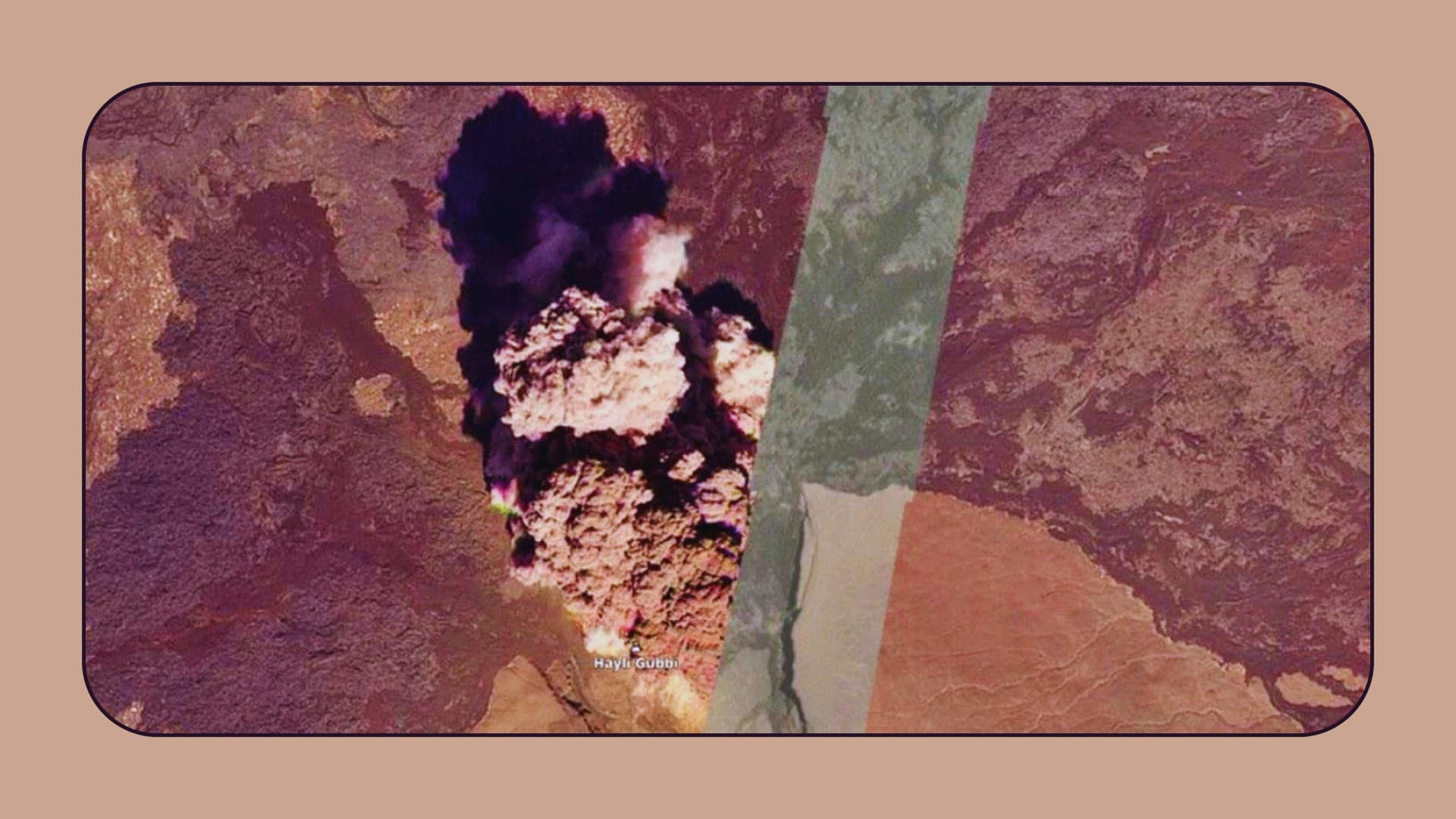
Satellite view of the Hayli Gubbi eruption in Ethiopia, releasing massive ash clouds after 12,000 years of dormancy.
Admissions Open for 2026-27
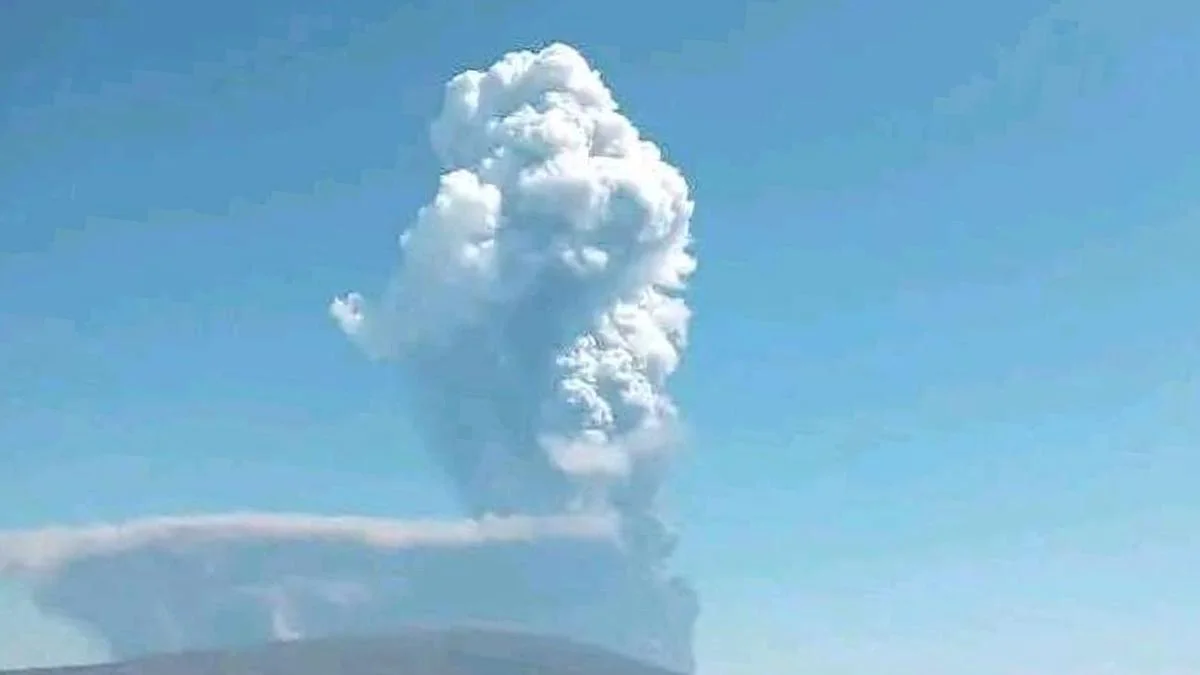
Over the past few days, the sudden explosion of Ethiopia’s long dormant Hayli Gubbi volcano - which erupted for the first time in 12,000 years - has been making headlines. The burst was so massive that ash plumes shot up nearly 45,000 feet high, sending thick smoke clouds from East Africa to as far as the Middle East and South Asia. This has majorly disrupted air travel in several regions and caused panic among people. What’s catching more attention in India is how the plume of volcanic ash and sulphur swept across the Red Sea through Oman and Yemen to reach Delhi, where the Air Quality Index (AQI) is already above danger levels.
The history behind Hayli Gubbi and what message the volcanic eruption sends to the world…
Known as a shield volcano, Hayli Gubbi is located at the southern end of the Erta-Ale range, a line of volcanoes in the Afar region of eastern Ethiopia. This region is known for its seismically active and tectonic plates’ movement potential for rare but significant eruptions. Did you know the last eruption of Hayli Gubbi was recorded during the Holocene era, which arguably began some 11,700 years ago after the last Ice Age?
Cut to 2025, smoke from the volcano was reportedly first observed in July. Then on November 23, the long dormant volcano erupted spewing ash loaded with fine particles, sulphur dioxide and volcanic gases across international airspace.
According to the Smithsonian Institution’s Global Volcanism Program, Ethiopia has 50 known volcanoes, several of which have been dormant for thousands of years. The scale and abruptness of the eruption underline a key message: volcanoes can stay quiet for millennia and still hold the potential for impetuous, high-impact activity. Even distant eruptions can affect global aviation, weather patterns and air quality, reminding countries to understand their own geological histories and monitoring systems.

Insights and learnings - the India angle
Geologists and other experts are working round the clock to keep a tab on the spreading of the ash plumes, gas emissions and lava flow, in order to provide real-time insights into the eruption of Hayli Gubbi, as well as use the readings for further research. While the eruption doesn’t signal immediate danger, it does highlight why understanding our own volcanic and tectonic framework is essential. For a country like India, which is often considered largely non-volcanic, this eruption carries a far more complex story. The nation’s geology is shaped by forces that are far older and more dynamic than they seem. From quiet volcanic remnants strewn throughout the mainland to active subduction zones, the image is anything but dull when combined with the active seismic belts of India.
India’s volcanic landscape: active, dormant and extinct
Our country’s volcanic landscape is more dynamic than it appears. The presence of active, dormant and extinct volcanoes (not to forget the strong seismic zones) underscore the fact that India’s geology is still evolving beneath the surface. Here’s a quick recce:
-
Barren Island (India’s only active volcano): Located in the Andaman Sea on the Andaman-Burma subduction zone, this volcano erupts intermittently and so is closely monitored.
-
Narcondam (a dormant volcano): Again situated in the Andaman region, Narcondam is currently inactive. However, it is geologically significant due to ongoing tectonic pressure beneath the islands.
-
Baratang Mud Volcanoes: Not true volcanoes, but mud vents that indicate underground pressure and tectonic activity similar to the forces behind major eruptions elsewhere.
-
Extinct Mainland Volcanoes: Dhosi Hill (Haryana/Rajasthan), Tosham (Haryana), and Dhinodhar (Kutch) are remnants of ancient eruptions, located near active seismic belts like the Delhi-Aravalli lineament and the Kutch seismic zone.
-
The Deccan Traps (India’s ancient supervolcanic legacy): One of the world’s largest volcanic formations, the Deccan Traps are shaped by massive eruptions millions of years ago that transformed the landscape and ecosystems of western and central India.
Also read: Believe it or not, the Periodic Table has more drama than a reality show. Here’s proof!
Why we should pay attention
Although geographically distant, the eruption of Hayli Gubbi holds lessons for India, mainly because:
-
It demonstrates how volcanic eruptions that are thousands of kilometers away can affect air quality, air travel and cross‑border environmental conditions.
-
It underscores the value of monitoring ‘quiet’ or little-known volcanic zones. India’s own volcanic regions may seem dormant or extinct, but they lie on tectonic plates that are still shifting. Subtle signals, minor eruptions or unexpected reactivations can carry outsized consequences.
-
For students and educators, it’s a reminder that geography - including earth science, tectonics and volcanic history - is an important subject to create awareness about our planet, atmosphere and climatic conditions.
Ethiopia’s volcanic eruption may be a distant event, but it offers a timely reminder: the earth’s systems are interconnected and India’s geology is part of that larger pulse. Recognising our own volcanic map - active, dormant and ancient volcanoes - is a way of understanding the land where we live and the forces that continue to shape it.


Admissions Open for 2026-27
Recent Blogs






CBSE Schools In Popular Cities
- CBSE Schools in Bangalore
- CBSE Schools in Mumbai
- CBSE Schools in Pune
- CBSE Schools in Hyderabad
- CBSE Schools in Chennai
- CBSE Schools in Gurgaon
- CBSE Schools in Kolkata
- CBSE Schools in Indore
- CBSE Schools in Sonipat
- CBSE Schools in Delhi
- CBSE Schools in Rohtak
- CBSE Schools in Bhopal
- CBSE Schools in Aurangabad
- CBSE Schools in Jabalpur
- CBSE Schools in Jaipur
- CBSE Schools in Jodhpur
- CBSE Schools in Nagpur
- CBSE Schools in Ahmednagar
- CBSE School In Tumkur

Call Us to know more about Orchids











Orchids The International School is one of India's leading chains of CBSE and ICSE schools, with 110+ schools across the country.