

Seven million years in the making: The story of human evolution
By Orchids Editorial Team |
Date 08-08-2024
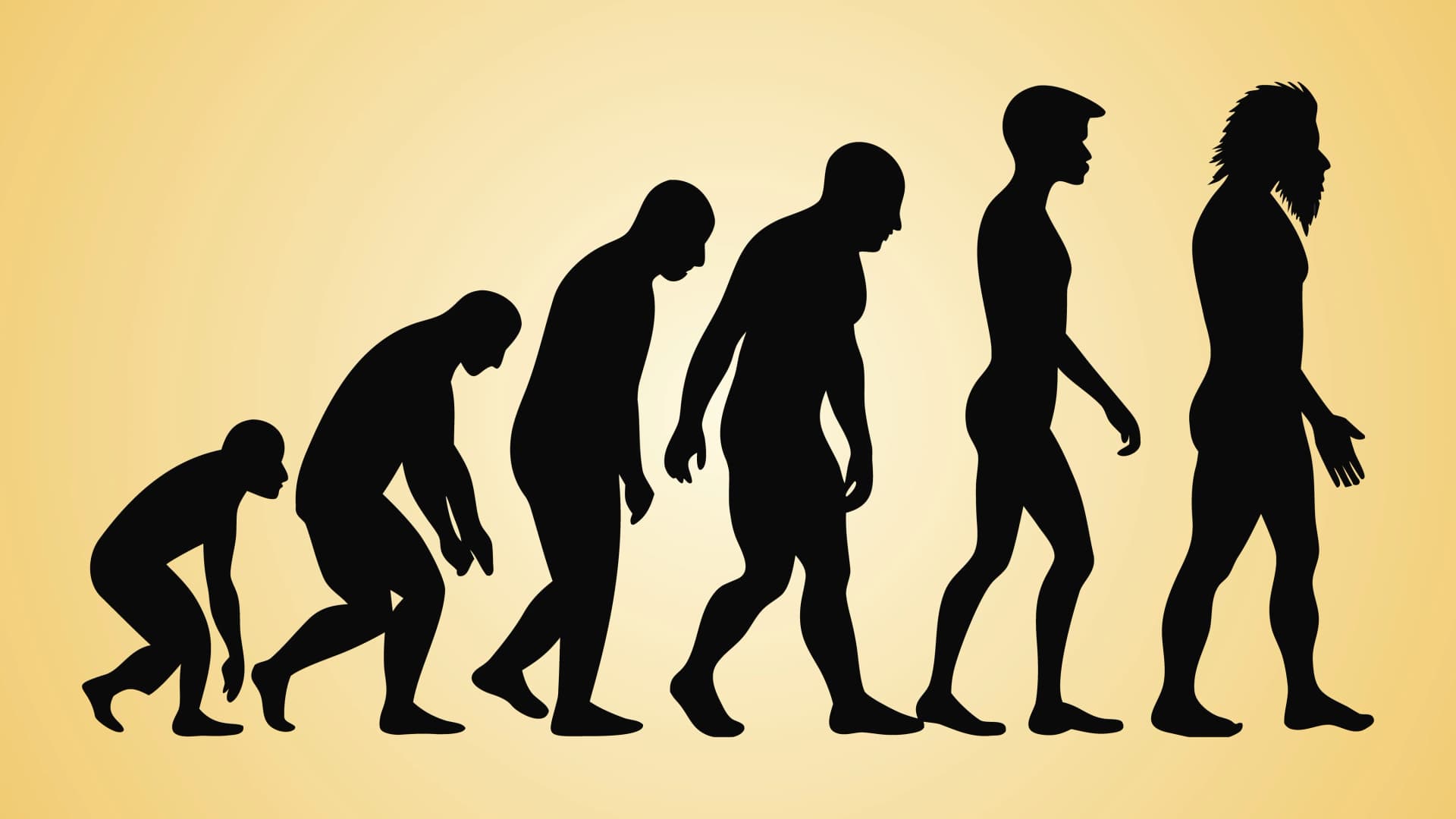
Taking a closer look at how the story of human evolution unfolded, stage by stage.
Admissions Open for 2026-27
About 10 million years ago, somewhere in the forests of a warmer, wider Earth, a population of primates split into two paths. One path eventually led to chimpanzees. The other, after millions of years of change, adaptation and survival against considerable odds, led to us.
That split is one of the most consequential moments in the history of life on this planet, and yet it happened without drama, without announcement, in the quiet, incremental way that evolution always works. No single creature woke up one morning and became human. The transformation happened across hundreds of thousands of generations, each one slightly different from the last, each one shaped by the pressures of a world that never stopped changing. This is the story of those changes. Seven stages, millions of years and one extraordinary destination.
But first: a question worth answering
Before we trace the journey, there is a question that comes up almost every time human evolution is discussed. If humans evolved from primates, why are there still apes?
The answer is worth understanding clearly, because it reveals something important about how evolution actually works. Humans did not evolve from chimpanzees or gorillas. We share a common ancestor with them, a now-extinct primate that lived roughly 10 million years ago. From that common ancestor, two separate evolutionary lines branched out. One led to the great apes as we know them today. The other led, eventually, to us.
Chimpanzees did not fail to evolve into humans. They evolved into chimpanzees, which is an entirely different and equally successful outcome. Evolution does not have a destination. It has direction, shaped entirely by what helps a species survive in its particular environment at a particular moment in time. With that in mind, here is how our particular direction took shape.
The seven stages of human evolution
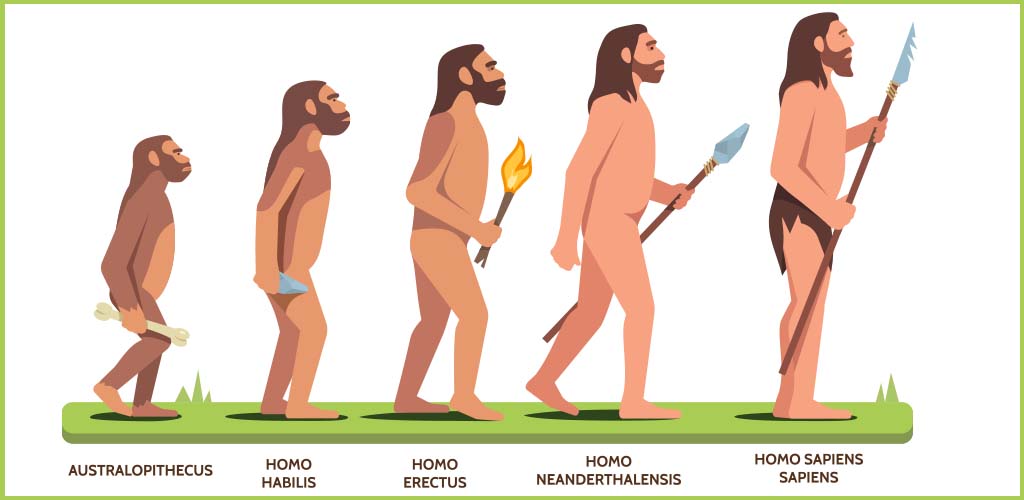
Each stage in our evolutionary journey represents more than a biological shift. It marks a new way of surviving, thinking and engaging with the world. Some stages stretched across millions of years; others introduced changes so significant that the species that came out the other side bore little resemblance to the one that went. Here is how it happened, from the earliest forest-dwelling primates to the species that would go on to paint cave walls, build cities and ask questions about its own origins.
Stage 1: Dryopithecus (the forest dweller)
Approximately 15 to 8 million years ago
The story begins in the forests. Dryopithecus, whose name translates loosely as ‘oak wood ape’, is considered one of the earliest common ancestors shared by both humans and modern apes. These creatures lived across what is now China, Europe, African and India, spending most of their lives in dense tropical forest canopies that have long since disappeared. They moved through the trees, likely fed on fruits and vegetation, and left behind fossils that scientists have spent decades piecing together into a portrait of what early primate life looked like.
Dryopithecus was not yet human in any recognisable sense. But it was the starting point, the first chapter of a story that would take millions of years to reach its conclusion.
Stage 2: Ramapithecus (the first steps toward us)

Approximately 14 to 7 million years ago
The first clue that something was shifting came from the teeth. When remains of Ramapithecus were first discovered in the Shivalik range of Punjab, and later in Africa and Saudi Arabia, researchers noticed something significant. The tooth enamel was thicker than in earlier primates. The canine teeth were shorter. The jaw was more robust, built for grinding rather than tearing. These changes matter more than they might seem. Thickened enamel and reduced canines suggest a shift in diet, from the soft fruits of the forest to the tougher, more varied foods of open grasslands. Ramapithecus, it appears, had begun moving out of the trees and into a more exposed, more demanding environment.
There is also evidence pointing toward an increasingly upright posture and the early use of hands for gathering food and self-defence. The body was beginning to rearrange itself for a different kind of life.
Stage 3: Australopithecus (standing up)
Approximately 4 to 2 million years ago
Few moments in human evolution carry as much weight as the shift to walking upright on two legs, and Australopithecus is where that shift becomes unmistakable. The first fossil of Australopithecus was discovered in South Africa in 1924, and it changed our understanding of human prehistory significantly. These creatures stood roughly four feet tall, weighed between 60 and 80 pounds, and lived on the ground rather than in the trees. They used stone tools as rudimentary weapons and showed a posture that, while not identical to ours, was recognisably upright. Walking on two legs freed the hands. Freed hands could carry things, shape things and eventually build things. It is difficult to overstate how much that single shift set in motion.
The name Australopithecus means ‘southern ape’, but in truth, this genus sits right at the boundary between ape and something else entirely. Something on its way to becoming human.
Stage 4: Homo Habilis (the first toolmaker)
Approximately 2.4 to 1.4 million years ago
The name says it plainly: Homo Habilis means ‘handy man’ in Latin. This genus represents the first members of the Homo family, our direct ancestral line and they earned their name through one defining characteristic. They made tools. Deliberately shaped stone tools, designed to cut, scrape and process food in ways that no primate had managed before.
Compared to Australopithecus, Homo Habilis had a larger braincase and a smaller, less protruding face. These changes were not cosmetic. A larger brain meant greater capacity for problem-solving, communication and planning. The face was becoming less ape-like, more human. Homo Habilis still spent time in trees and was not yet fully adapted to ground life. But the direction was clear. The brain was growing. The hands were learning. The gap between this genus and what would follow was closing.
Stage 5: Homo Erectus (fire, community and the world beyond)
Approximately 1.9 million to 110,000 years ago
Home Erectus is where the story becomes recognisably ours. The first fossil of this genus was discovered in Java in 1891 and caused considerable scientific debate at the time, referred to initially as the ‘missing link’ between apes and humans. Later discoveries in China, including the famous Peking Man specimen, added remarkable detail to our understanding of this genus.
Homo Erectus lived in communities. They hunted collectively, which required coordination, communication and shared strategy. They used tools made from quartz, bone and wood, more sophisticated and varied than anything that had come before. And crucially, there is evidence that they used fire. Fire changed everything. It meant warmth in colder climates, safety from predators and cooked food, which is more calorie-dense and easier to digest than raw food, potentially contributing to the continued growth of the brain. Homo Erectus also lived in caves, evidence of a creature that was not just surviving in its environment but actively adapting it to suit its needs. This genus persisted for an extraordinarily long time, far longer than modern humans have existed so far, and spread across a vast geographical range. They were, by any measure, remarkably successful.
Stage 6: Homo Sapiens Neanderthalensis (the cousins we almost forget)
Approximately 400,000 to 40,000 years ago
By the time Homo Erectus gave rise to Homo Sapiens, the evolutionary line had split again, producing two distinct subspecies that would coexist, and occasionally interbreed, for thousands of years. Homo Sapiens Neanderthalensis, or Neanderthals, are perhaps the most misunderstood figures in human prehistory. The popular image of a hunched, dim-witted brute is not supported by evidence. Neanderthals had cranial capacities between 1.200 and 1.600 cc, comparable to and in some cases larger than modern humans. They buried their dead. They made tools. They were capable of hunting very large animals, including mammoths. They were not a failed prototype of humanity. They were a separate and sophisticated species that lived successfully across Europe and parts of Asia for hundreds of thousands of years, before gradually disappearing around 40,000 years ago, likely due to a combination of climate change, competition and absorption into the expanding population of Homo Sapiens Sapiens.
Modern genetic research has shown that most people today carry a small percentage of Neanderthal DNA, a quiet reminder that the boundary between these two subspecies was not always as firm as the fossil record alone might suggest.
Stage 7: Homo Sapiens Sapiens (us)
Approximately 300,000 years ago to present
The final stage is the one we inhabit. The remains of Homo Sapiens Sapiens were first discovered in Europe and named Cro-Magnon, after the site where they were found. The differences from earlier hominins are significant: a rounded skull, a reduced jaw, the appearance of a modern chin and a cranial capacity of approximately 1,350 cc. The face, for the first time, looks like one we would recognise. But perhaps the most remarkable development of this stage is not anatomical. It is cultural.
Art appeared for the first time during this period. Cave paintings, carved figures, decorative objects made from shells and bone. These are not just aesthetic curiosities. They are evidence of symbolic thinking, the capacity to represent the world in abstract form, to tell stories, to imagine things that do not yet exist. No earlier species had done this. Language almost certainly followed, or perhaps developed alongside it. And with language came the ability to transmit knowledge across generations, to accumulate learning rather than starting fresh with each new life. That capacity, more than any physical adaptation, is what gave Homo Sapiens Sapiens the ability to inhabit every environment on Earth and to build, over thousands of years, the world we live in today.
Also read: Earthrise to Earthset: How our view of the planet has changed with time
What evolution actually teaches us
Charles Darwin, in his landmark work on natural selection, described evolution as a process driven not by intention but by circumstance. Organisms that were better suited to their environment survived long enough to reproduce. Their offspring inherited those advantages. Over generations, those advantages accumulated into something new. Four principles sit at the heart of this process. Natural selection, through which traits that aid survival are passed on. The struggle for existence, in which resources are limited and competition is constant. Survival of the fittest, meaning not the strongest, but the best adapted to a given set of conditions. And variation, the small differences between individuals that give selection something to work with.
What the seven stages of human evolution illustrate, more than anything else, is just how responsive life is to the world around it. Every stage of our journey was shaped by environmental pressure: forests that thinned, climates that cooled, landscapes that opened up and demanded new ways of moving, eating and surviving. We did not evolve because of a plan. We evolved because we adapted. That is, in its way, one of the most remarkable stories ever told.
At Orchids The International School, science is taught not as a set of facts to be memorised but as a way of thinking about the world, exactly the kind of curiosity-driven, evidence-based learning that subjects like evolution deserve. Because understanding where we came from is one of the most meaningful ways to understand who we are.
The questions evolution still cannot fully answer
For all that science has uncovered about our origins, the story of human evolution is far from complete. And that is, arguably, part of what makes it so compelling.
-
Why did our brains grow so rapidly relative to other species? The caloric demands of a large brain are significant, and yet natural selection favoured its growth consistently across multiple stages of our evolution. The full picture of ‘why’ remains an active area of scientific inquiry.
-
What exactly happened to the Neanderthals? Climate, competition and interbreeding all feature in current theories, but no single explanation has settled the question entirely. Every new fossil find or genetic study tends to add nuance rather than finality.
-
How did languages emerge? We know it changed everything. We do not know precisely when it began, what form it first took, or whether other hominin species had forms of language we have not yet found evidence for.
These open questions are not a weakness in science. They are an invitation. Every generation of researchers brings new tools, new methods and new perspectives to questions that have been with us for over a century. The answers, when they arrive, tend to raise further questions. That is how science works, and it is one of the reasons a subject like evolution never really grows old.
Curious about how we make science come alive in the classroom? Reach out to our admissions team to learn more about the learning environment at Orchids The International School.


Admissions Open for 2026-27
Recent Blogs






CBSE Schools In Popular Cities
- CBSE Schools in Bangalore
- CBSE Schools in Mumbai
- CBSE Schools in Pune
- CBSE Schools in Hyderabad
- CBSE Schools in Chennai
- CBSE Schools in Gurgaon
- CBSE Schools in Kolkata
- CBSE Schools in Indore
- CBSE Schools in Sonipat
- CBSE Schools in Delhi
- CBSE Schools in Rohtak
- CBSE Schools in Bhopal
- CBSE Schools in Aurangabad
- CBSE Schools in Jabalpur
- CBSE Schools in Jaipur
- CBSE Schools in Jodhpur
- CBSE Schools in Nagpur
- CBSE Schools in Ahmednagar
- CBSE School In Tumkur

Call Us to know more about Orchids











Orchids The International School is one of India's leading chains of CBSE and ICSE schools, with 110+ schools across the country.