

Fiddlehead Ferns in India: Origin, Foraging, Nutritional Properties and Culinary Use
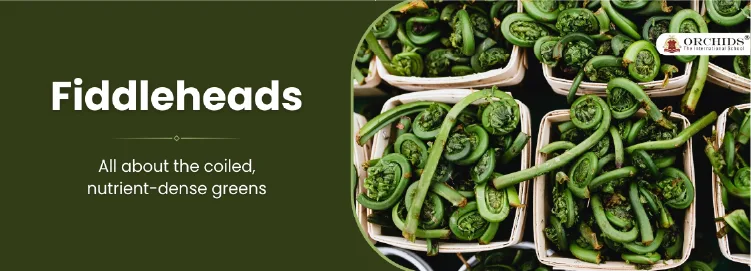
Deep in the misty forests of Northeast India and along the shaded hillsides of the Western Ghats, a curious spring delicacy emerges each year before most people think to look for it. Tightly coiled, bright green, and resembling the scroll of a violin, fiddlehead ferns are among nature’s most visually distinctive wild foods, and one of India's most underappreciated forest harvests.
Table of Contents:
- Origin and Distribution of Fiddlehead Ferns in India
- Foraging Fiddlehead Ferns
- Nutritional Properties of Fiddlehead Ferns
- Culinary Use of Fiddlehead Ferns
- Frequently Asked Questions about Fiddlehead Ferns

Origin and Distribution of Fiddlehead Ferns in India
Fiddlehead ferns are the young, unfurled fronds of various fern species, harvested in early spring before they open into full leaves. The term “fiddlehead” refers to their characteristic coiled shape, which mimics the carved scroll at the head of a fiddle or violin. In India, several species produce edible fiddleheads, most notably Diplazium esculentum (widely called vegetable fern or lingura), Dryopteris species, and members of the Osmunda family.
Diplazium esculentum is the most commercially significant edible fern in India. It thrives across the northeastern states, Assam, Meghalaya, Nagaland, Manipur, Mizoram, Sikkim, and Arunachal Pradesh, as well as in parts of Uttarakhand and Himachal Pradesh in the Himalayas. It favours moist, shaded environments: riverbanks, forest clearings, the edges of paddy fields, and the slopes of ravines where humidity remains high.
In Assam, the plant is known locally as dhekia xaak; in Sikkim and Nepal, as ningro; and across much of the Northeast, fiddleheads are a beloved seasonal green that have been foraged and eaten for centuries. Their appearance marks the arrival of the pre-monsoon season, and for many forest-dwelling communities, they signal the first fresh greens after winter.
Foraging Fiddlehead Ferns
Foraging for fiddleheads requires timing and discernment. The harvest window is narrow; fronds must be collected when they are still tightly coiled and no more than a few centimetres tall. Once they begin to unfurl, they become fibrous, bitter, and lose culinary appeal. In India's Northeast, foragers typically venture into forested areas or cultivated wetland edges in late winter through early spring, roughly February to April, depending on altitude and local climate.
When harvesting, foragers snap or cut the young coils close to the base, leaving the parent plant intact to continue growing. Responsible foraging means taking only a portion of the fronds from any single plant, ensuring it can regenerate. Misidentification is a concern; not all ferns are edible, and some contain toxic compounds. Diplazium esculentum is the primary safe species for consumption in India; foragers should learn to identify it with certainty before harvesting.
In many parts of Northeast India, fiddleheads are also cultivated semi-commercially along paddy field borders and shaded gardens, blurring the line between wild foraging and small-scale farming.
Nutritional Properties of Fiddlehead Ferns
Despite their humble appearance, fiddlehead ferns are nutritionally impressive. They are a good source of dietary fibre, vitamins A and C, and several B vitamins, including riboflavin and niacin. Their mineral content is notable; fiddleheads provide iron, potassium, phosphorus, manganese, and copper in meaningful quantities.
They are low in calories and contain significant antioxidant compounds, including omega-3 fatty acids in trace amounts, which is unusual for a leafy vegetable. Studies on Diplazium esculentum have found it contains flavonoids and phenolic compounds that contribute to anti-inflammatory and free radical-scavenging activity. Traditional medicine in Northeast India has long used fiddlehead ferns as a remedy for digestive complaints and as a general tonic.
One important note: raw fiddleheads contain an enzyme called thiaminase, which can degrade vitamin B1 (thiamine) in the body, along with other potentially harmful compounds. For this reason, they should always be cooked before consumption, blanched, boiled, or stir-fried, never eaten raw.
Culinary Use of Fiddlehead Ferns
In Indian kitchens, fiddlehead ferns are treated as a prized seasonal vegetable. In Assam, dhekia xaak is most classically prepared as a simple stir-fry with mustard oil, garlic, dried red chillies, and salt, a dish that lets the fern's slightly earthy, green flavour speak for itself. It is also cooked with prawns, snakehead fish (goroi maas), or dried fish (shidol) for a deeply savoury preparation beloved across the Brahmaputra valley.
In Sikkim and Darjeeling, ningro is stir-fried with fermented cheese (chhurpi) or paired with pork and fermented bamboo shoots. In Manipur, fiddleheads find their way into eromba, the traditional fermented fish and vegetable stew. Across the Northeast, they are also pickled or dried for use in the off-season.
Beyond India’s borders but echoing the subcontinent's reverence for forest greens, fiddleheads appear in Nepali cuisine alongside sesame and garlic, in Bangladeshi cooking with mustard paste, and throughout Southeast Asian cuisines where Diplazium esculentum is similarly cherished.
Their flavour, often described as a cross between asparagus, spinach, and green beans, with a pleasant nuttiness, makes them versatile and appealing even to those encountering them for the first time.
Frequently Asked Questions about Fiddlehead Ferns
1. Are fiddlehead ferns safe to eat raw?
No. Raw fiddlehead ferns contain thiaminase (an enzyme that breaks down vitamin B1) and other potentially harmful compounds. They must always be thoroughly cooked, blanched in boiling water for several minutes, then stir-fried, sautéed, or added to curries. Cooking deactivates these compounds and makes the ferns completely safe and nutritious.
2. Where in India can fiddlehead ferns be found and foraged?
Fiddlehead ferns, particularly Diplazium esculentum, are most abundant in the northeastern states of India, Assam, Meghalaya, Manipur, Nagaland, Mizoram, Arunachal Pradesh, and Sikkim. They are also found in hilly, forested areas of Uttarakhand and Himachal Pradesh. They grow best near water sources, in shaded forest edges, and along paddy field borders at low to mid elevations.
3. How do I identify edible fiddlehead ferns versus non-edible ones?
The most reliable edible species in India is Diplazium esculentum, which has smooth, bright green coils without any papery brown covering (unlike the ostrich fern of North America, which has a distinctive brown papery sheath). The fronds grow in clusters from a central base in moist, shaded areas. If you are uncertain about identification, forage with an experienced local guide or purchase from trusted market vendors in the Northeast, where vendors handle this species routinely.
Understanding the world starts with the environment around us. To see how Orchids The International School brings EVS to life, reach out to our admissions team.


Admissions Open for 2026-27
What type of concept pages would you prefer?
CBSE Schools In Popular Cities
- CBSE Schools in Bangalore
- CBSE Schools in Mumbai
- CBSE Schools in Pune
- CBSE Schools in Hyderabad
- CBSE Schools in Chennai
- CBSE Schools in Gurgaon
- CBSE Schools in Kolkata
- CBSE Schools in Indore
- CBSE Schools in Sonipat
- CBSE Schools in Delhi
- CBSE Schools in Rohtak
- CBSE Schools in Bhopal
- CBSE Schools in Aurangabad
- CBSE Schools in Jabalpur
- CBSE Schools in Jaipur
- CBSE Schools in Jodhpur
- CBSE Schools in Nagpur
- CBSE Schools in Ahmednagar
- CBSE School In Tumkur











Orchids The International School is one of India's leading chains of CBSE and ICSE schools, with 130+ schools across the country.