

Sustainable Agriculture: Definition, Core Principles, Methods, Practices and Benefits
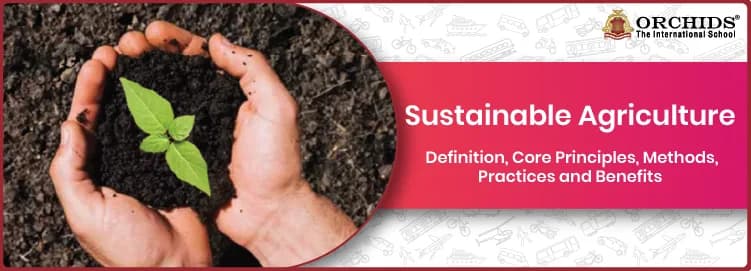
Agriculture has an enormous impact on our environment. From land that sustains our crops to the water that nourishes it, there are a variety of resources involved in agriculture. In recent times harsh agriculture practices have resulted in nearly 90% of worldwide forest loss. There is a need to adopt sustainable agricultural practices to reduce the damage caused to our environment and ecosystems. In this article, we will learn about sustainable agriculture, its benefits and its various aspects that help promote stability in the environment.
Table of Contents
- What is Sustainable Agriculture
- Need for Sustainable Agriculture
- Principles and Practices of Sustainable Agriculture
- Benefits of Sustainable Agriculture
- Frequently Asked Questions about Sustainable Agriculture

What is Sustainable Agriculture
Sustainable agriculture reduces the environmental harm of farming and helps in expanding the use of natural resources over non-renewable resources. It supports the conservation of soil and water as well as preservation of biodiversity. It ensures the wellbeing of farmers and rural communities.
How is sustainable agriculture different from conventional agriculture:
|
Feature |
Conventional Farming |
Sustainable Agriculture |
|
Soil management |
Heavy tillage, chemical fertilisers |
Minimal tillage, organic matter, composting |
|
Pest control |
Chemical pesticides |
Integrated pest management, biological controls |
|
Water use |
Often inefficient, flood irrigation |
Drip irrigation, rainwater harvesting, water recycling |
|
Biodiversity |
Monocultures (single crops) |
Crop diversity, agroforestry, companion planting |
|
Energy |
High fossil fuel dependence |
Reduced energy use, renewable energy |
|
Long-term impact |
Soil degradation, water depletion |
Soil regeneration, water conservation |
|
Farmer welfare |
Often exploitative supply chains |
Fair prices, community ownership, local markets |
Need for Sustainable Agriculture
For thousands of years, we have relied on farming for our survival. It has shaped landscapes and defined cultures. But, modern industrial agriculture has done some serious damage to the natural systems that farming ultimately depends on. Such as overuse of chemical fertilizers, soil and water crises. For example, it takes around 1,000 years to form just one centimetre of topsoil but modern farming is destroying it way faster than it can regenerate. The heavy use of synthetic pesticides and fertilisers has serious consequences such as pesticide residue in food, water and soil that have an adverse impact on plants, animals and human health. Farming activities also add 23% of global greenhouse gas emissions through deforestation, release of methane from livestock and nitrous oxide from fertilizers.
Principles and Practices of Sustainable Agriculture
Agriculture is the foundation of human civilization and farming has been a means of feeding humanity for over thousands of years. Sustainable agriculture principles focus on soil health, water conservation, biodiversity preservation, energy efficiency and working with nature while using minimal amounts of chemicals. Different farming systems, climates and cultures can follow these principles for sustainable agriculture. Here are some methods that help in applying these principles:
- Organic farming: It refers to the farming that uses organic fertilizers and pesticides to replace synthetic fertilisers, pesticides or genetically modified organisms (GMOs)
- Crop Rotation: Growing various types of crops in the same field in consecutive seasons, in place of the same crop every year helps prevent the depletion of natural nutrients of soil.
- Agroforestry: Growing different trees and shrubs intentionally into crop and livestock farming systems helps in improving soil fertility and prevents soil erosion.
- Composting and Vermicomposting: Converting organic waste such as kitchen waste, crop residue and animal manure into compost helps to improve the organic nutrients, structure and water retention of soil.
- Rainwater Harvesting: Storing rainwater for agricultural and managing entire watersheds to reduce runoff and improve groundwater recharge:
- Integrated Pest Management (IPM): It is a holistic approach to minimize the use of chemical pesticide by introducing natural pest predators.
Benefits of Sustainable Agriculture
From soil regeneration to water conservation there are many environmental and economical benefits of sustainable farming:
- Use of organic matter in farming helps rebuild soil health over time.
- Efficient irrigation practices and water harvesting reduce the use of freshwater for farming helping in conservation of water resources.
- Less use of chemical fertilizers helps avoid contamination of the surface water and groundwater.
- Growing different crops and using less pesticide helps in preserving the natural habitat of many birds, insects and soil organisms.
- Healthy soils and agroforestry helps in reducing the emission of greenhouse gas in the environment that improves our health and well-being.
- Minimal dependency on synthetic fertilisers or pesticides decreases farming cost and helps farmers in saving money.
Frequently Asked Questions about Sustainable Agriculture
1. What are the core principles of sustainable agriculture?
The core principles of sustainable farming are restoring soil health, water conservation, biodiversity preservation, energy efficiency and integrated pest management.
2. Can sustainable agriculture feed a growing global population?
Yes, if implemented efficiently, sustainable agriculture practices enhance long-term productivity by preserving soil and water efficiency while reducing post-harvest waste and resource degradation.
3. What are the main challenges in adopting sustainable agriculture methods?
There are a few challenges that farmers often face such as high initial costs when transitioning to new technologies, a lack of local awareness or specialized training and policy/market barriers that sometimes favor traditional, high-input farming.
Understanding the world starts with the environment around us. To see how Orchids The International School brings EVS to life, reach out to our admissions team.


Admissions Open for 2026-27
What type of concept pages would you prefer?
CBSE Schools In Popular Cities
- CBSE Schools in Bangalore
- CBSE Schools in Mumbai
- CBSE Schools in Pune
- CBSE Schools in Hyderabad
- CBSE Schools in Chennai
- CBSE Schools in Gurgaon
- CBSE Schools in Kolkata
- CBSE Schools in Indore
- CBSE Schools in Sonipat
- CBSE Schools in Delhi
- CBSE Schools in Rohtak
- CBSE Schools in Bhopal
- CBSE Schools in Aurangabad
- CBSE Schools in Jabalpur
- CBSE Schools in Jaipur
- CBSE Schools in Jodhpur
- CBSE Schools in Nagpur
- CBSE Schools in Ahmednagar
- CBSE School In Tumkur











Orchids The International School is one of India's leading chains of CBSE and ICSE schools, with 130+ schools across the country.