

Class 10 Maths Chapter 8 Introduction to Trigonometry Notes with Free PDF Download
Class 10 Maths Chapter 8 Introduction to Trigonometry Notes Free PDF Download is prepared based on the latest CBSE and NCERT syllabus. These notes will help in school exams, board exams and quick revision. it helps students to understand the chapter clearly, revise faster and prepare for exams with confidence.
Trigonometry deals with the relationship between the sides and angles of a right-angled triangle. In Class 10, you study trigonometry specifically for acute angles angles between 0° and 90°.
Chapter 8 covers four main topics:
-
Trigonometric ratios of acute angles
-
Trigonometric ratios of specific angles (0°, 30°, 45°, 60°, 90°)
-
Trigonometric ratios of complementary angles
-
Trigonometric identities
Table of Contents
- Right Angled Triangle Parts and Terms
- Trigonometric Ratios of Acute Angles
- Trigonometric Ratios of Specific Angles
- Trigonometric Ratios of Complementary Angles
- Trigonometric Identities for Class 10
- Solved Examples on Chapter 8 Introduction to Trigonometry
- Practice Questions on Chapter 8 Introduction to Trigonometry
- Frequently Asked Questions on Class 10 Maths Chapter 8 Introduction to Trigonometry

Right Angled Triangle Parts and Terms
A right-angled triangle has one angle equal to 90° (called the right angle).
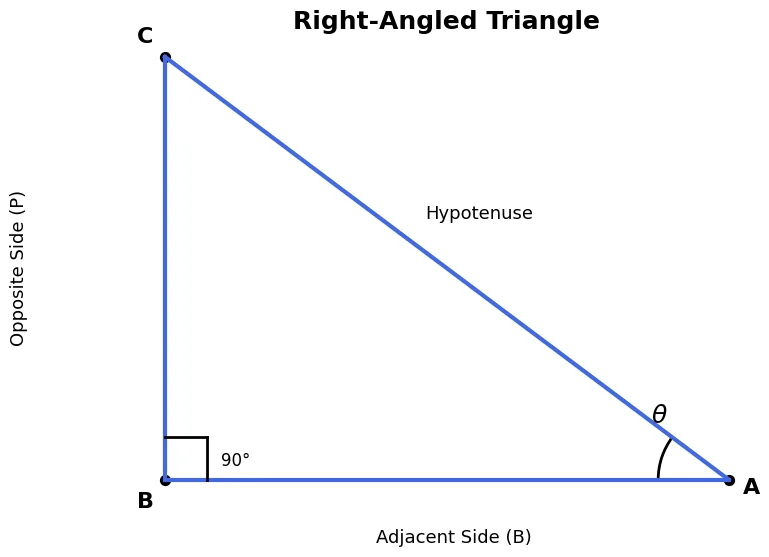
∠B = 90°, ∠A = θ (reference angle)
∠C = remaining angle
Three sides explained:
Hypotenuse (H): The side opposite to the right angle. Always the longest side. In the diagram, AC is the hypotenuse.
Opposite side (P): The side directly opposite to the reference angle θ. In the diagram, BC is opposite to angle A.
Adjacent side (B): The side next to the reference angle (other than hypotenuse). In the diagram, AB is adjacent to angle A.
Important: The names of sides change when your reference angle changes. The hypotenuse always stays the same, but opposite and adjacent shift based on which angle you're working with.
Know more about related topics:
- Class 10 Maths Notes Chapter 9 Some Applications Of Trigonometry
- Class 10 Maths Mcqs Chapter 8 Introduction To Trigonometry
- Class 10 Maths Chapter 8 Introduction To Trigonometry Worksheets
- Important Questions Class 10 Maths Introduction To Trigonometry
- Class 10 Maths Case Study Chapter 8 Introduction To Trigonometry
Trigonometric Ratios of Acute Angles
For a right-angled triangle with reference angle θ, the six trigonometric ratios are:
The six ratios are:
1. Sine (sin θ): sin θ = Opposite/Hypotenuse = P/H = BC/AC
2. Cosine (cos θ): cos θ = Adjacent/Hypotenuse = B/H = AB/AC
3. Tangent (tan θ): tan θ = Opposite/Adjacent = P/B = BC/AB
4. Cosecant (cosec θ): cosec θ = Hypotenuse/Opposite = H/P = AC/BC
(Reciprocal of sin θ)
5. Secant (sec θ): sec θ = Hypotenuse/Adjacent = H/B = AC/AB
(Reciprocal of cos θ)
6. Cotangent (cot θ): cot θ = Adjacent/Opposite = B/P = AB/BC
(Reciprocal of tan θ)
SOH CAH TOA:
SOH → Sin = Opposite/Hypotenuse
CAH → Cos = Adjacent/Hypotenuse
TOA → Tan = Opposite/Adjacent
Reciprocal relationships:
sin θ × cosec θ = 1
cos θ × sec θ = 1
tan θ × cot θ = 1
Quotient relationships:
tan θ = sin θ / cos θ
cot θ = cos θ / sin θ
Formula Table:
Trigonometric Ratios of Specific Angles
These are the standard angle values you must memorize for your board exam.
Standard Values Table:
ND = Not Defined
sin values:
sin 0° = √0/2 = 0
sin 30° = √1/2 = 1/2
sin 45° = √2/2 = 1/√2
sin 60° = √3/2
sin 90° = √4/2 = 1
Pattern: Numerators go √0, √1, √2, √3, √4
Denominator is always 2
For cos simply reverse the sin pattern:
cos 0° = 1 = sin 90°
cos 30° = √3/2 = sin 60°
cos 45° = 1/√2 = sin 45°
cos 60° = 1/2 = sin 30°
cos 90° = 0 = sin 0°
How 45° values are derived:
Using an isosceles right triangle with equal sides = 1:
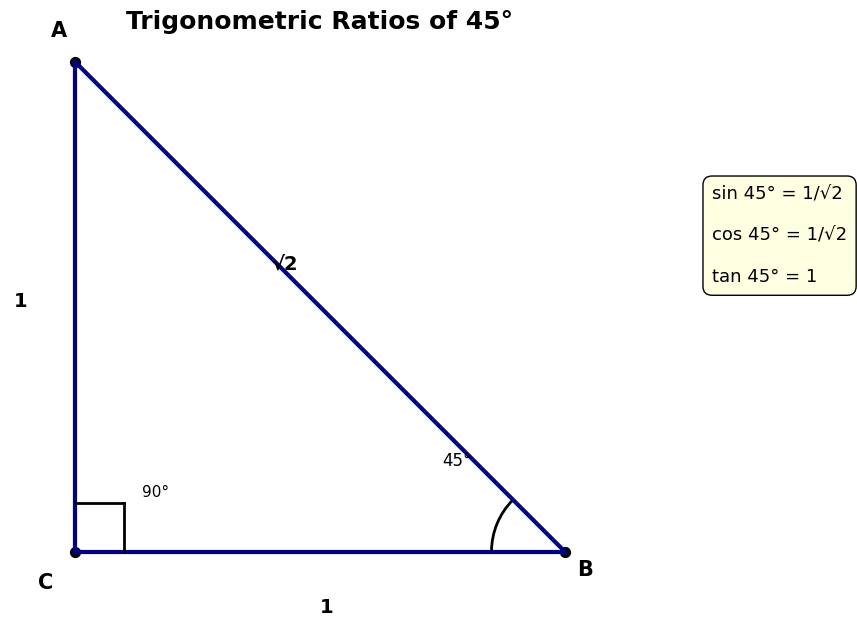
sin 45° = 1/√2, cos 45° = 1/√2, tan 45° = 1
How 30° and 60° values are derived:
Using half of an equilateral triangle with side = 2:
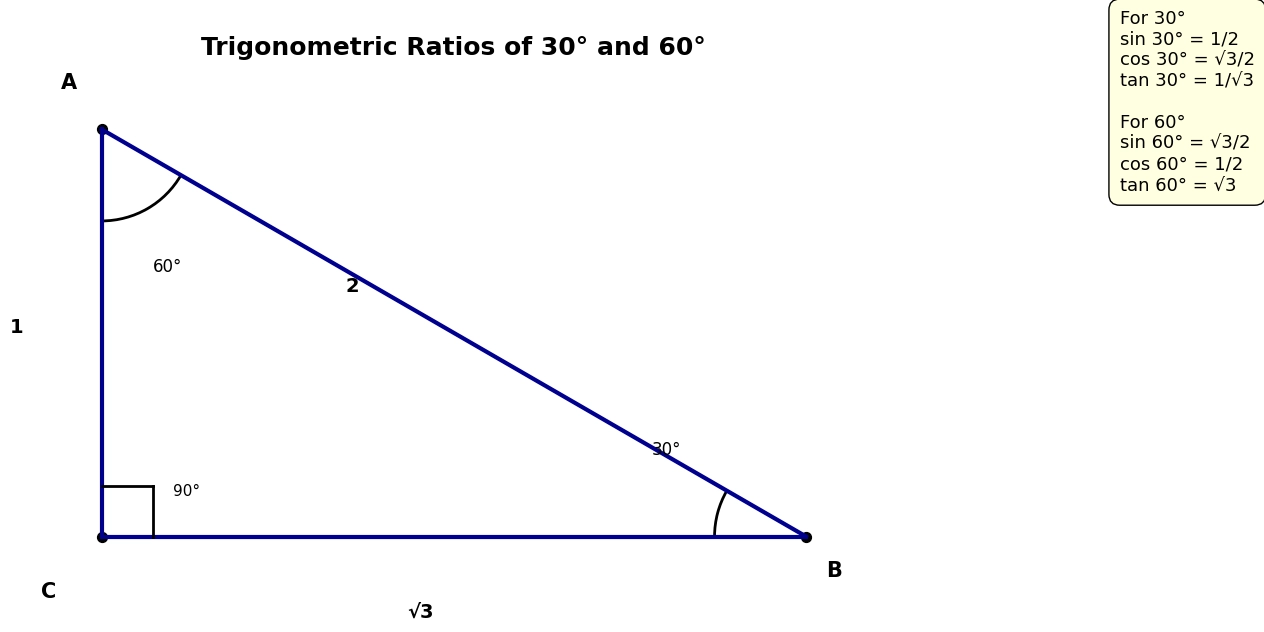
For 30°: sin 30° = 1/2, cos 30° = √3/2, tan 30° = 1/√3
For 60°: sin 60° = √3/2, cos 60° = 1/2, tan 60° = √3
Trigonometric Ratios of Complementary Angles
Two angles are complementary when they add up to 90°.
In a right-angled triangle, the two acute angles are always complementary. This creates a beautiful relationship between trigonometric ratios.
The Six Complementary Relationships:
sin(90° - θ) = cos θ
cos(90° - θ) = sin θ
tan(90° - θ) = cot θ
cot(90° - θ) = tan θ
sec(90° - θ) = cosec θ
cosec(90° - θ) = sec θ
The prefix "co" literally means complement.
sin ↔ cosine (co-sine)
tan ↔ cotangent (co-tangent)
sec ↔ cosecant (co-secant)
Proof of sin(90° - θ) = cos θ:
In right △ABC with ∠B = 90°, ∠A = θ:
Then ∠C = 90° - θ
For angle A (= θ):
sin θ = BC/AC
For angle C (= 90° - θ):
sin(90° - θ) = AB/AC (opposite to C is AB)
= B/H
= cos θ
Practical example:
sin 67° = sin(90° - 23°) = cos 23°
tan 40° = tan(90° - 50°) = cot 50°
sec 15° = sec(90° - 75°) = cosec 75°
Trigonometric Identities for Class 10
A trigonometric identity is an equation involving trigonometric ratios that holds true for all values of the angle.
Identity 1:
sin²θ + cos²θ = 1
Proof using Pythagoras:
In right △ABC: AC² = AB² + BC²
Dividing both sides by AC²:
AB²/AC² + BC²/AC² = 1
cos²θ + sin²θ = 1
Derived forms:
sin²θ = 1 - cos²θ
cos²θ = 1 - sin²θ
Identity 2:
1 + tan²θ = sec²θ
Proof:
Dividing AC² = AB² + BC² by AB²:
(AC/AB)² = 1 + (BC/AB)²
sec²θ = 1 + tan²θ
Derived forms:
sec²θ - tan²θ = 1
tan²θ = sec²θ - 1
Identity 3:
1 + cot²θ = cosec²θ
Proof:
Dividing AC² = AB² + BC² by BC²:
(AC/BC)² = (AB/BC)² + 1
cosec²θ = cot²θ + 1
Derived forms:
cosec²θ - cot²θ = 1
cot²θ = cosec²θ - 1
Solved Examples On Chapter 8 Introduction to Trigonometry
Example 1: Finding All Six Ratios
Question: In △ABC, right-angled at B, AB = 5 cm and BC = 12 cm. Find all six trigonometric ratios for angle A.
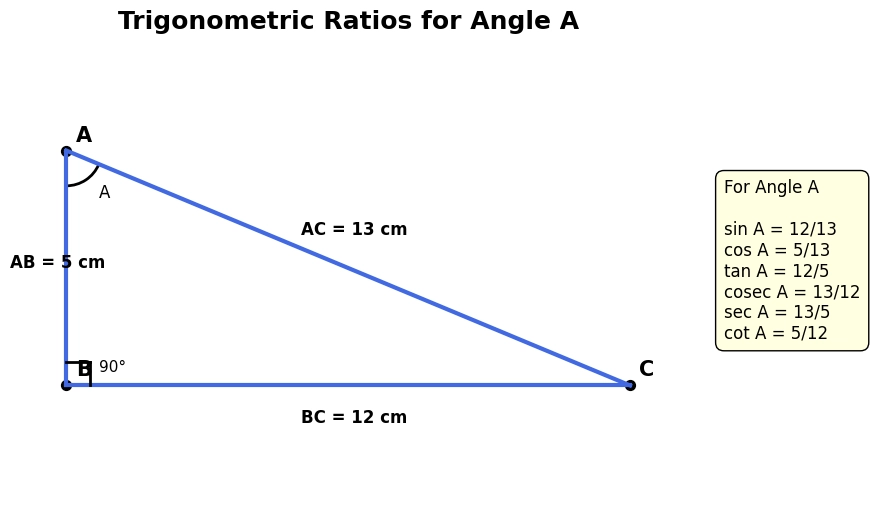
Solution:
Step 1: Find hypotenuse
AC² = AB² + BC² = 25 + 144 = 169
AC = 13 cm
Step 2: Identify sides for angle A
Opposite = BC = 12
Adjacent = AB = 5
Hypotenuse = AC = 13
Step 3: Write ratios
sin A = 12/13 cosec A = 13/12
cos A = 5/13 sec A = 13/5
tan A = 12/5 cot A = 5/12
Example 2: Standard Angle Calculation
Question: Evaluate: 2tan²45° + cos²30° - sin²60°
Solution:
tan 45° = 1, cos 30° = √3/2, sin 60° = √3/2
= 2(1)² + (√3/2)² - (√3/2)²
= 2 + 3/4 - 3/4
= 2
Answer: 2
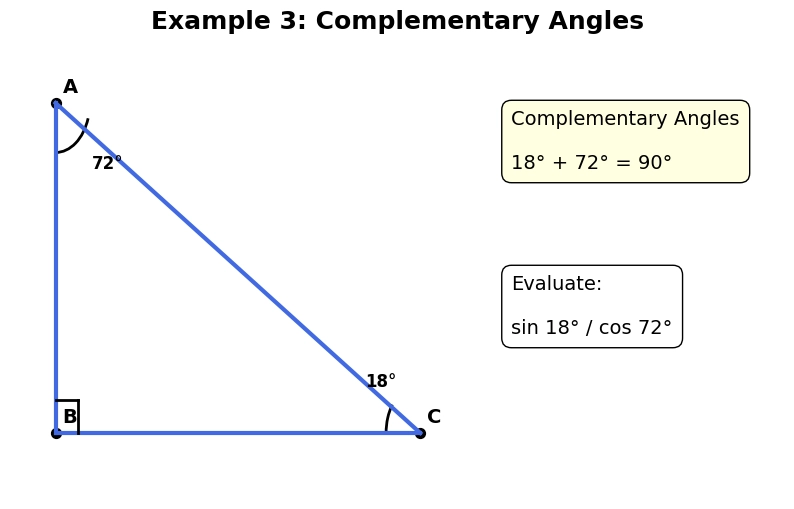
Example 3: Complementary Angles
Question: Evaluate: sin 18°/cos 72°
Solution:
cos 72° = cos(90° - 18°) = sin 18°
sin 18°/cos 72° = sin 18°/sin 18° = 1
Answer: 1
Example 4: Identity Proof
Question: Prove that (sin θ + cosec θ)² + (cos θ + sec θ)² = 7 + tan²θ + cot²θ
Solution:
LHS = sin²θ + 2sinθ cosecθ + cosec²θ
+ cos²θ + 2cosθ secθ + sec²θ
Since sinθ × cosecθ = 1 and cosθ × secθ = 1:
= (sin²θ + cos²θ) + 2 + 2 + cosec²θ + sec²θ
= 1 + 4 + (1 + cot²θ) + (1 + tan²θ)
= 1 + 4 + 1 + cot²θ + 1 + tan²θ
= 7 + tan²θ + cot²θ = RHS
Key Formulas
Six Ratios:
sin θ = P/H cos θ = B/H tan θ = P/B
cosec θ = H/P sec θ = H/B cot θ = B/P
Three Identities:
sin²θ + cos²θ = 1
1 + tan²θ = sec²θ
1 + cot²θ = cosec²θ
Complementary Pairs:
sin(90° - θ) = cos θ
tan(90° - θ) = cot θ
sec(90° - θ) = cosec θ
Practice Questions on Chapter 8 Introduction to Trigonometry
Section 1: Trigonometric Ratios
Q1: In △PQR, right-angled at Q, PQ = 3 cm, QR = 4 cm. Find sin P, cos P, tan P.
Q2: If cos A = 7/25, find sin A and tan A.
Q3: If sin θ = a/b, find cos θ in terms of a and b.
Q4: Find the value of sin 45° + cos 45°.
Q5: If tan θ = 5/12, find sec θ.
Section 2: Standard Angles
Q6: Evaluate: sin²30° + cos²30°
Q7: Find the value of: tan 45° × sec 60° - cosec 30°
Q8: If A = 30°, verify that sin 2A = 2 sin A cos A.
Q9: Evaluate: (cos 0° + sin 30° + sin 45°)(sin 90° - cos 45° + cos 60°)
Q10: Find: 4/3 tan²30° + sin²60° - 3cos²60° + 3/4 tan²60°
Section 3: Complementary Angles
Q11: Express sin 67° + cos 75° in terms of angles between 0° and 45°.
Q12: Prove: sin 35° cos 55° + cos 35° sin 55° = 1
Q13: Evaluate: (tan 26°)/(cot 64°)
Q14: If sin 3A = cos(A - 26°) where 3A is acute, find A.
Q15: Show that tan 48° tan 23° tan 42° tan 67° = 1.
Section 4: Identities
Q16: Prove: (1 + tan²θ)/(1 + cot²θ) = tan²θ
Q17: Prove: (cos A - sin A + 1)/(cos A + sin A - 1) = cosec A + cot A
Q18: If cosec θ - cot θ = 1/3, find cosec θ + cot θ.
Q19: Prove: √(1 + sin θ)/(1 - sin θ) = sec θ + tan θ
Q20: If tan θ + 1/tan θ = 2, find the value of tan²θ + 1/tan²θ.
Download Below Chapter 8 Introduction to Trigonometry Revision Notes PDF
Download PDF - Class 10 Maths Chapter 8 Introduction to Trigonometry Notes
Related Topics:
Frequently Asked Questions on Class 10 Maths Chapter 8 Introduction to Trigonometry
1. What is trigonometry in Class 10 Maths?
Trigonometry is the branch of mathematics that studies the relationship between the angles and sides of a right-angled triangle.
2. What are the six trigonometric ratios?
The six trigonometric ratios are:
- Sine (sin θ)
- Cosine (cos θ)
- Tangent (tan θ)
- Cosecant (cosec θ)
- Secant (sec θ)
- Cotangent (cot θ)
3. Which exercises are important for board exams?
All NCERT exercises are important, but special focus should be given to:
- Trigonometric ratios
- Standard angle values
- Complementary angles
- Trigonometric identities
- Board-level application questions
4. Is Chapter 8 Introduction to Trigonometry easy?
Yes. Most students find this chapter manageable once they understand the basic ratios and memorize the standard trigonometric values.
5. How can I remember trigonometric values?
Students can remember the standard values of 0°, 30°, 45°, 60°, and 90° using trigonometric tables, repeated practice, and mnemonic techniques.
6. What are complementary angles in trigonometry?
Two angles are complementary if their sum is:
For complementary angles:
- sin (90° − θ) = cos θ
- cos (90° − θ) = sin θ
- tan (90° − θ) = cot θ
7. What is the formula of sin θ?
Numbers make sense when they're taught right. To see how Orchids The International School turns Maths from intimidating to intuitive, reach out to our admissions team.


Admissions Open for 2026-27
What type of concept pages would you prefer?
CBSE Schools In Popular Cities
- CBSE Schools in Bangalore
- CBSE Schools in Mumbai
- CBSE Schools in Pune
- CBSE Schools in Hyderabad
- CBSE Schools in Chennai
- CBSE Schools in Gurgaon
- CBSE Schools in Kolkata
- CBSE Schools in Indore
- CBSE Schools in Sonipat
- CBSE Schools in Delhi
- CBSE Schools in Rohtak
- CBSE Schools in Bhopal
- CBSE Schools in Aurangabad
- CBSE Schools in Jabalpur
- CBSE Schools in Jaipur
- CBSE Schools in Jodhpur
- CBSE Schools in Nagpur
- CBSE Schools in Ahmednagar
- CBSE School In Tumkur










Orchids The International School is one of India's leading chains of CBSE and ICSE schools, with 130+ schools across the country.